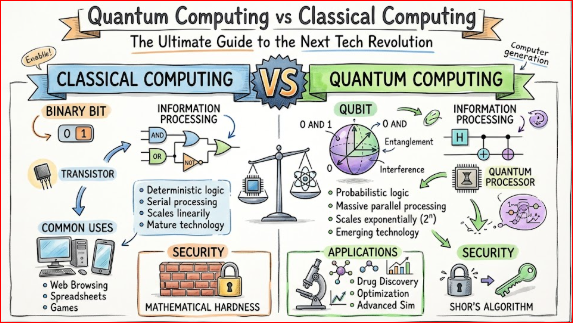
Quantum computing promises to fundamentally redefine how we process information, offering a radically different approach to computation that leverages the bizarre principles of physics at an atomic scale. To appreciate this shift, we must first look at classical computing. Classical computers are the devices we use daily, including smartphones, laptops, and the servers powering the global internet. They operate using clear, predictable rules to execute tasks. However, understanding the core differences between quantum computing vs classical computing is no longer just an academic exercise. It is essential for understanding the future of technology, cybersecurity, business optimization, and scientific innovation. As we explore this technological shift, platforms like QuantumUting serve as vital educational hubs, helping students, developers, and tech enthusiasts navigate the rapidly evolving quantum landscape. By bridging the gap between theoretical physics and practical computer science, we can better appreciate how both systems will shape our world.
Summary Box: Core Insights at a Glance
- Classical Computing: Relies on binary bits (0 or 1) and processes information sequentially using silicon-based transistors. It is ideal for daily tasks, web browsing, enterprise software, and general data processing.
- Quantum Computing: Utilizes quantum bits, or qubits, which can exist as 0, 1, or both simultaneously through superposition. It excels at complex, multi-variable simulations, optimization problems, and advanced cryptography.
- The Core Difference: Classical computers solve problems by exploring paths one by one. Quantum computers evaluate vast landscapes of possibilities all at once, offering exponential speedups for specific mathematical challenges.
- The Future: Quantum systems will not replace classical computers. Instead, the future belongs to a hybrid computing architecture where both systems work together to tackle different types of problems.
Understanding Classical Computing
To understand the quantum revolution, we must first look closely at the mechanics of classical computing. At its core, a classical computer is a sophisticated counting machine. No matter how sleek a modern smartphone or how powerful a cloud server appears, every operation it performs boils down to simple arithmetic conducted at blinding speeds.
Definition of Classical Computing
Classical computing refers to the traditional computation model that has powered the digital age since the mid-20th century. It relies on standard physical architectures, primarily silicon microchips containing billions of miniature electronic switches called transistors. These systems operate based on classical physics, where electrical currents are manipulated to represent and process data deterministically.
How Classical Computers Process Information
Classical computers process information through a series of logical operations. When you type a document, edit a photo, or stream a video, the computer translates those actions into electrical signals. These signals travel through logic gates (such as AND, OR, NOT, and NAND gates) embedded within the central processing unit (CPU).
The CPU acts as the brain of the system, orchestrating the flow of electrical currents through these gates. The state of a transistor determines how information moves. If a transistor allows current to pass, it represents one state; if it blocks the current, it represents another. By combining billions of these micro-switches, classical computers execute complex algorithms in a step-by-step, linear fashion.
The Binary System (0s and 1s)
The fundamental language of classical computing is the binary system. Every piece of information is broken down into basic units called bits (binary digits). A classical bit can exist in one of two distinct, mutually exclusive states:
- 0 (off, representing low or no voltage)
- 1 (on, representing high voltage)
Every letter, number, color, and audio frequency is encoded as a string of these 0s and 1s. For example, the letter “A” might be represented by the binary code 01000001. Because a bit can only ever be a 0 or a 1 at any given moment, the processing capacity of a classical system grows linearly with the number of bits available. If you have eight bits (one byte), you can represent any single value between 0 and 255, but the system can only hold one specific value at a time.
Strengths of Classical Systems
While quantum computing captures major headlines, classical systems possess unique strengths that make them irreplaceable:
- High Reliability and Low Error Rates: Modern silicon transistors are incredibly stable. They can perform trillions of operations without experiencing a single computational error, a characteristic known as low fault vulnerability.
- Exceptional Clock Speeds: Consumer-grade classical processors operate at gigahertz (GHz) speeds, meaning they execute billions of cycles per second.
- Cost-Effectiveness: Decades of manufacturing optimization have made classical hardware incredibly inexpensive to mass-produce.
- Ambient Environment Compatibility: Classical computers operate efficiently at room temperature and require minimal specialized infrastructure.
Common Applications
Classical computers excel at tasks requiring deterministic, step-by-step logic and massive, sequential data storage. Key applications include:
- Running operating systems and user interfaces.
- Managing relational databases and text processing.
- Rendering standard 2D and 3D graphics.
- Powering internet infrastructure, web servers, and communication protocols.
- Executing daily personal and corporate productivity software.
Understanding Quantum Computing
If classical computing is defined by predictability and rigid boundaries, quantum computing is defined by probability and fluid possibilities. It represents a fundamental departure from the binary logic we have relied on for decades.
Definition of Quantum Computing
Quantum computing is an advanced computational paradigm that uses the principles of quantum mechanics to process information in entirely new ways. Instead of relying on traditional silicon transistors and binary algebra, quantum computers use subatomic particles to perform complex mathematical calculations that would be virtually impossible for classical architectures to solve efficiently.
The Quantum Mechanics Foundation
To understand quantum computers, we must set aside our everyday observations of the physical world. In the subatomic realm, particles do not behave like macroscopic objects. Instead of existing in definitive, unchanging states, entities like electrons and photons exhibit behaviors governed by probability amplitudes. Quantum computing leverages these natural subatomic behaviors, transforming the laws of quantum physics into computational resources.
Qubits Explained
The fundamental building block of a quantum computer is the quantum bit, or qubit. Unlike a classical bit, which is restricted to being either a 0 or a 1, a qubit can represent a 0, a 1, or any fractional combination of both simultaneously.
Qubits can be constructed using various physical systems, such as trapped ions, superconducting circuits, or photons. Because a qubit can hold multiple states at once, a quantum computer can store and process vast amounts of data using fewer physical units than a classical system would require for the same workload.
Superposition
The ability of a qubit to exist in multiple states at the same time is known as superposition. Think of a classical bit as a coin resting on a table; it can either show heads (1) or tails (0). A qubit, by contrast, is like a coin spinning on its edge. While it spins, it exists in a fluid combination of both heads and tails simultaneously. It only locks into a definite state of 0 or 1 when the calculation concludes and the system is measured.
This property means that while a 3-bit classical system can hold exactly one of eight possible combinations ($2^3 = 8$) at a time, a 3-qubit quantum system can hold all eight combinations simultaneously. As you add more qubits, the processing capacity grows exponentially ($2^n$), allowing the system to explore an immense number of possibilities at the same time.
Entanglement
Entanglement is a unique quantum phenomenon where two or more qubits become deeply interconnected. When qubits are entangled, the physical state of one instantly dictates the state of another, regardless of how far apart they are. Albert Einstein famously referred to this counterintuitive property as “spooky action at a distance.”
In quantum computing, entanglement serves as a powerful force multiplier. By entangling multiple qubits, a quantum computer can share information across its entire processor instantly. Change the state of one qubit, and the entire interconnected system adjusts immediately. This allows quantum systems to process highly complex variables in parallel, rather than evaluating them one by one.
Quantum Interference
While superposition and entanglement open up vast computational possibilities, quantum computers must still surface the single correct answer at the end of a calculation. This is achieved through quantum interference.
Borrowing from the physics of waves, quantum interference can be either constructive or destructive. Quantum algorithms are carefully designed to create constructive interference, which amplifies the signal of the correct answer, while using destructive interference to cancel out the signals of incorrect answers. When the final measurement occurs, the wrong paths fade away, leaving the correct solution clearly visible.
Evolution of Computing Technologies
The transition from classical to quantum architectures is the next logical step in a long journey of technological evolution. Understanding where we started helps clarify why this new frontier is so critical.
Early Computing Systems
Before the digital age, computing relied on mechanical and electromechanical devices. Tools like the abacus gave way to Charles Babbage’s Analytical Engine concept in the 19th century. By the 1940s, early electronic computers like the ENIAC used vacuum tubes to control electrical signals. These machines were massive, consumed enormous amounts of electricity, and broke down frequently.
Growth of Classical Computing
The invention of the silicon transistor in 1947 changed everything. Transistors replaced fragile vacuum tubes, making computers smaller, faster, and far more reliable. In 1965, Intel co-founder Gordon Moore observed that the number of transistors on a microchip was doubling roughly every two years—a trend known as Moore’s Law. This exponential growth drove the rapid evolution from room-sized mainframes to desktop PCs, laptops, and smartphones.
Emergence of Quantum Computing
By the early 1980s, visionary physicists like Richard Feynman and Paul Benioff realized that classical computers faced an ultimate physical limit. Feynman pointed out that nature operates on quantum mechanical principles, meaning classical systems could never perfectly simulate quantum physics. He proposed a radical alternative: build computers using quantum properties to simulate nature directly.
In the 1990s, mathematicians like Peter Shor and Lov Grover developed pioneering quantum algorithms. Shor’s algorithm proved that a quantum computer could factor large numbers rapidly, threatening modern encryption, while Grover’s algorithm demonstrated a faster way to search unsorted databases. These breakthroughs shifted quantum computing from a theoretical concept to an intense global research priority.
Why Traditional Systems Face Limitations
Today, classical computing is hitting a hard physical wall. We have shrunk silicon transistors down to the width of just a few atoms. At this miniscule scale, we encounter a phenomenon called quantum tunneling, where electrons leak across barrier walls unexpectedly, disrupting binary signals.
Furthermore, many critical real-world problems suffer from the “combinatorial explosion” problem. For instance, finding the optimal route for a global delivery network with hundreds of stops involves more possible combinations than there are atoms in the observable universe. A classical computer must evaluate these options one by one, making the task practically impossible. We need an entirely different computational framework to move forward.
Comprehensive Comparison Table
To see how these two paradigms contrast across key metrics, review this comprehensive breakdown of features:
| Feature | Classical Computing | Quantum Computing |
| Data Unit | Binary Bit (0 or 1) | Quantum Bit / Qubit (0, 1, or superposition) |
| Processing Method | Sequential, linear logic using Boolean algebra | Parallel processing via superposition and entanglement |
| Speed | Blindingly fast for daily arithmetic and linear algorithms | Exponentially faster for specific complex mathematical problems |
| Scalability | Scale linearly; adding bits increases storage one-by-one | Scales exponentially ($2^n$ options explored simultaneously) |
| Problem Solving Capability | Excellent for general-purpose tasks and structured data processing | Superior for optimization, molecular simulation, and factoring |
| Hardware Requirements | Standard silicon microchips operating at ambient temperatures | Superconducting arrays or trapped ions requiring extreme cooling |
| Error Handling | Highly stable; requires simple, minimal error correction | Highly fragile; requires complex quantum error correction (QEC) |
| Energy Efficiency | High efficiency for standard tasks; high power for supercomputers | Low power for the core chip, but high energy needed for cooling |
| Security Applications | Relies on mathematical hardness (RSA, AES encryption) | Breaks classical encryption; enables unbreakable quantum keys |
| Current Maturity Level | Fully mature, commercialized, and ubiquitous worldwide | Emergent; currently in the noisy, intermediate-scale era |
Key Differences Between Quantum and Classical Computing
To truly master the quantum computing basics, we need to look closer at the specific operational differences that separate these two paradigms.
Data Representation
The fundamental way data is held in memory differs completely between the two systems. A classical computer uses a fixed system. If you look at a bank of classical memory, each slot contains a definitive charge status: either high (1) or low (0).
A quantum computer represents data using the probability amplitudes of subatomic states. To visualize this, imagine an arrow inside a sphere. In a classical system, the arrow can only point straight up (0) or straight down (1). In a quantum system, the arrow can point to any spot on the surface of the sphere. This gives quantum systems a vastly more expressive language for holding and manipulating information.
Processing Power
Because data representation scales differently, the processing power of these machines diverges rapidly as problems grow larger. Consider a maze. If you send a classical computer into a maze to find an exit, it will try the first path. If it hits a dead end, it backs up and tries the second path. It repeats this process sequentially until it finds the way out.
[Image comparing sequential maze solving vs parallel maze exploration]
A quantum computer enters the maze and splits into multiple paths simultaneously due to superposition. It explores every path through the maze at the same time, finding the correct exit in a single operational cycle.
Parallelism
Classical computers can achieve a form of parallelism by linking multiple processor cores together, which is how modern supercomputers operate. However, this is still a collection of separate processors handling individual chunks of data sequentially.
Quantum parallelism is fundamentally different. It is built into the physics of the system itself. A single quantum processor can hold a massive number of possibilities in memory simultaneously, manipulating all of them with every single gate operation. This is an intrinsic, structural parallelism that no number of connected classical computers can match.
Algorithms
Computers are only as smart as the instructions we give them. Classical computers run algorithms based on Boolean logic (AND, OR, NOT operations) designed to find definitive, exact answers through step-by-step calculations.
Quantum computers run specialized quantum algorithms designed to manipulate probabilities. Examples include Shor’s algorithm for prime factorization and Grover’s algorithm for searching unsorted spaces. These algorithms do not simply run faster; they drastically reduce the total number of steps required to find a solution, shifting the math from exponential time to polynomial time.
Security Implications
Most of modern digital security—including online banking, secure messaging, and enterprise databases—relies on public-key cryptography systems like RSA. These encryption methods work because factoring the product of two massive prime numbers is incredibly difficult for classical computers, requiring thousands of years of trial-and-error.
Because a quantum computer running Shor’s algorithm can factor these huge numbers in minutes, it poses a direct challenge to traditional cybersecurity. This shift is driving the global tech community to develop post-quantum cryptography (PQC) standards designed to resist quantum attacks.
Hardware Architecture
The physical look of these machines reveals stark differences. Classical processors are flat, durable silicon microchips that fit into phones and laptops, operating smoothly at room temperature.
Classical Hardware:  [Silicon Die] -> [Motherboard] -> [Air/Liquid Cooling] -> Standard Case
Quantum Hardware:    [Dilution Refrigerator (0.015K)] -> [Superconducting Chip] -> Shielding
A quantum computer looks more like a high-tech chandelier. The bulk of the machine is a dilution refrigerator designed to shield the delicate qubits from external noise. The actual quantum chip sits at the very bottom, cooled to a frosty 0.015 Kelvin—a temperature colder than deep interstellar space.
Performance Limitations
Classical computers are limited by physical space and heat dissipation. As transistors shrink to atomic scales, electrical leakage limits how much faster they can run.
Quantum computers are limited by environmental fragility, a challenge known as quantum decoherence. Qubits are highly sensitive to their surroundings. Microscopic temperature shifts, electromagnetic signals, or even slight physical vibrations can cause qubits to fall out of their quantum state, ruining the calculation. Developing reliable quantum error correction to protect these fragile states remains a primary goal for the industry.
How Quantum Computers Process Information
To understand how quantum computers transform theory into reality, let’s trace the journey of an active quantum calculation.
Qubits vs Bits
As we established, bits are binary, while qubits exist in a fluid superposition. When a quantum calculation begins, the first step is initialized by preparing the qubits into a clean, baseline state. This is often achieved using precision lasers or microwave pulses to align the subatomic particles.
Quantum Gates
Once the qubits are prepared, they are manipulated using quantum gates. In a classical computer, logic gates change a bit from a 0 to a 1 or vice versa. Quantum gates perform precise physical rotations on the state vector of the qubit.
For instance, a Hadamard gate takes a qubit that is sitting at a definitive 0 and rotates it into a perfect 50/50 superposition of both 0 and 1. Other gates, like the Controlled-NOT (CNOT) gate, allow qubits to interact, creating the entangled states required for parallel processing.
Quantum Circuits
A sequence of these quantum gates forms a quantum circuit. Unlike classical circuits made of hardwired copper traces on a motherboard, a quantum circuit is a sequence of time-based operations.
Engineers write software code that tells the control hardware exactly when to shoot microwave pulses at specific qubits. The information flows through this programmed sequence, shifting probabilities with every gate step.
The Measurement Process
Throughout the calculation, the qubits remain isolated in their superposed, entangled states. If you look inside early, you collapse the system prematurely, destroying the parallel processing.
When the circuit operations are complete, the system is measured. This measurement forces the spinning qubits to stop, collapsing them into a definitive string of classical 0s and 1s. Thanks to quantum interference, the system is engineered so that the single configuration you observe corresponds to the correct answer to your problem.
Computational Advantages
This process gives quantum computers an incredible advantage for specific workloads. Instead of checking every possible answer one by one, the machine guides a wave of overlapping possibilities toward a single correct outcome. This allows users to solve complex problems in minutes that would stall a standard computer indefinitely.
Real-World Applications of Classical Computing
Despite the rise of quantum tech, classical computers remain the backbone of our digital infrastructure. Their strengths are perfectly aligned with the needs of daily life and global business.
Web Applications
Every website you visit, from online storefronts to social media platforms, runs entirely on classical architecture. Web development relies on predictable, deterministic logic to render pages, handle user inputs, and route data across the internet quickly and reliably.
Enterprise Software
Modern businesses run on software platforms like Enterprise Resource Planning (ERP) tools, Customer Relationship Management (CRM) databases, and project management applications. These systems require structured data management, consistent record-keeping, and strict logic—tasks where classical processors excel.
Databases
Relational and non-relational databases form the foundation of corporate memory. Storing financial records, user profiles, inventory logs, and historical archives requires highly stable, permanent storage media. Classical systems excel at writing, indexing, and retrieving this structured data with perfect accuracy.
Mobile Applications
The apps on our smartphones require processors that consume minimal power and run reliably at room temperature. From navigation systems to media players, mobile applications depend on highly optimized, small-scale classical chipsets.
Cloud Computing
Cloud computing links millions of classical server blades into massive global networks. This infrastructure allows companies to scale their web traffic, store petabytes of user data, and distribute computational workloads smoothly across the globe.
Real-World Applications of Quantum Computing
Quantum computers are not built to run web browsers or spreadsheet software. Instead, they are designed for specialized, high-stakes applications that push the boundaries of science and industry.
Cryptography
As noted, quantum computing will disrupt modern security by breaking traditional public-key encryption. However, it also offers a solution: quantum cryptography. Using Quantum Key Distribution (QKD), companies can create encryption keys protected by the laws of physics. If an eavesdropper tries to intercept a quantum key, the act of observing it instantly alters its state, alerting both parties to the intrusion.
Drug Discovery
Developing a new medication currently takes over a decade and billions of dollars in laboratory trial-and-error. Scientists must simulate how complex molecules interact with human proteins.
Because molecules are quantum systems, classical computers struggle to simulate them accurately. Quantum computers can model these molecular behaviors directly, allowing pharmaceutical companies to discover effective compounds and develop target treatments rapidly.
Financial Modeling
The financial world is a massive web of shifting variables, risk factors, and market signals. Quantum computers excel at running complex portfolio risk assessments and Monte Carlo simulations. By evaluating thousands of volatile market scenarios simultaneously, financial institutions can optimize their investment strategies and manage risk with unprecedented accuracy.
Logistics Optimization
Shipping goods across international borders involves balancing complex variables, including fluctuating fuel costs, changing weather patterns, and port congestion. Quantum systems can evaluate these massive, moving parts all at once. This allows logistics companies to optimize delivery routes, reduce carbon footprints, and save billions in operational costs.
Artificial Intelligence
Modern Artificial Intelligence (AI) and Machine Learning (ML) models require massive computational power to analyze huge datasets. Quantum computing basics can be integrated into AI architectures to create Quantum Machine Learning (QML). These advanced algorithms can process complex data patterns far faster, accelerating the training of deep learning models and enabling more intuitive AI systems.
Materials Science
Beyond pharmaceuticals, simulating molecular structures allows us to design entirely new materials. Quantum computing can help engineers develop high-capacity batteries, lighter and stronger manufacturing composites, and more efficient solar cells, accelerating our transition toward sustainable technologies.
Benefits of Quantum Computing
The shift toward quantum systems offers several profound advantages that will transform technological problem-solving.
Complex Problem Solving
Quantum computers can tackle complex mathematical challenges that would cause classical systems to lock up. Problems involving thousands of variables and infinite combinations—such as mapping genetic variations or global climate models—fall within the unique capabilities of quantum processors.
Massive Parallelism
Thanks to superposition and entanglement, a quantum computer does not have to work through problems sequentially. It explores an entire landscape of options simultaneously, providing an architectural shortcut that delivers answers to specific challenges far faster than traditional methods.
Advanced Simulations
To simulate nature accurately, you need a computer that operates like nature. Quantum systems provide an ideal platform for simulating physics and chemistry at the molecular level, opening the door to breakthroughs in clean energy, materials engineering, and biology.
Optimization Capabilities
Whether it is streamlining global supply chains, managing power grids, or fine-tuning financial portfolios, our world runs on optimization. Quantum systems can find the most efficient paths through complex variables, helping industries cut waste, maximize performance, and reduce operational costs.
Challenges of Quantum Computing
Despite its immense promise, the road to building practical quantum computers is filled with major engineering hurdles.
Hardware Limitations
Building a stable quantum chip is an incredibly difficult task. Controlling individual subatomic particles requires high-precision manufacturing, ultra-stable laser arrays, and advanced microwave engineering. Even minor physical flaws on a chip can ruin a calculation.
Quantum Decoherence
Qubits are highly fragile. Any interaction with the outside world—whether from temperature changes, magnetic interference, or slight physical vibrations—can cause them to lose their quantum state. This problem, known as quantum decoherence, limits how long a quantum computer can hold information and run calculations before returning errors.
Error Correction Complexity
Because qubits are so fragile, quantum computers require extensive error correction. In a classical system, error correction is simple and requires minimal overhead.
In a quantum system, protecting a single working “logical qubit” requires linking hundreds or thousands of physical qubits together to constantly monitor for errors. This adds massive complexity to both hardware design and software control.
High Costs
Operating a quantum research lab requires a massive financial investment. Dilution refrigerators, high-frequency control systems, and custom superconducting chips cost millions of dollars to build and maintain, keeping the technology out of reach for most standard businesses.
Limited Availability
Today, true quantum computers are rare. They are largely concentrated inside the research facilities of major technology companies, national laboratories, and top academic institutions. While cloud access to these systems is growing, widespread, everyday access remains a work in progress.
Will Quantum Computing Replace Classical Computing?
A common misconception is that quantum computers will eventually replace classical computers, rendering our laptops and smartphones obsolete. This is not the case.
A Complementary Relationship
Quantum and classical computers are designed for completely different tasks. A quantum computer offers no advantage for everyday activities like word processing, streaming video, or browsing the web. In fact, due to their lower clock speeds and the need for complex error correction, a quantum computer would likely run standard consumer applications slower than a traditional smartphone.
Instead, these technologies share a complementary relationship. Classical computers will continue to handle user interfaces, data storage, and everyday logic, while offloading highly complex mathematical challenges to quantum co-processors.
Hybrid Computing Models
The near-term future of advanced technology relies on a hybrid computing model. In this setup, high-performance classical supercomputers work closely with quantum processors.
[User Input]
     │
     ▼
[Classical Supercomputer] ──(Identifies Complex Math)──► [Quantum Processor]
     ▲                                                          │
     │                                                          ▼
     └───────────────────(Returns Results)──────────────────────┘
The classical system manages the overall flow of an application and pre-processes data. When it encounters an optimization or molecular simulation step, it passes that specific task to a quantum processor, collects the result, and continues its work.
Future Enterprise Architecture
For businesses, adopting quantum technology will not mean clearing out existing IT infrastructure. Instead, companies will access quantum processors through cloud computing platforms. This approach allows enterprises to integrate quantum capabilities directly into their existing classical workflows, using the strengths of both architectures to solve difficult business challenges.
Future of Computing
Looking ahead, the computing landscape will be defined by continuous innovation across both paradigms.
Quantum Advancements
Over the next decade, quantum hardware developers will focus on moving past the current era of noisy, intermediate-scale systems. The goal is to build fault-tolerant quantum computers that feature millions of physical qubits and robust error correction, enabling long, highly stable calculations.
Hybrid Systems
As hybrid computing models mature, software tools will become more intuitive. Developers will be able to write applications that automatically distribute tasks between classical and quantum processors, making it easier for businesses to leverage quantum power without needing a degree in theoretical physics.
Industry Adoption
As quantum access through the cloud grows easier, early adopters in fields like chemistry, banking, and logistics will integrate quantum workflows into their core businesses. Companies that learn to leverage these tools early will gain a significant competitive advantage in optimization and research.
Research Developments
Global research is expanding beyond hardware into quantum software, programming languages, and networking infrastructure. Projects focused on building a “quantum internet”—which uses entangled photons to send completely secure data between distant quantum hubs—are moving from theory to active field testing.
Long-Term Possibilities
In the long run, quantum computing will help us address some of our biggest global challenges. From discovering clean energy alternatives and capturing carbon to creating new medical treatments and optimizing global resource networks, the combination of classical stability and quantum power will open doors to discovery we have only begun to imagine.
Key Takeaways
- Fundamental Shift: Classical computing relies on definitive binary bits (0 and 1), while quantum computing uses qubits capable of superposition and entanglement to explore multiple states at once.
- Specialized Focus: Quantum computers are not general-purpose upgrades; they are highly specialized machines designed for specific mathematical problems like optimization, simulation, and cryptography.
- Coexistence, Not Replacement: Quantum systems will work alongside classical infrastructure rather than replacing it, creating a powerful hybrid computing ecosystem.
- Real Challenges: Major hurdles like quantum decoherence and the need for complex error correction must be solved before we achieve full commercialization.
- Strategic Impact: The ongoing development of quantum technologies will reshape global security, pharmaceutical research, and business optimization over the coming decade.
FAQ Section
1.What is the main difference between quantum computing and classical computing?
The main difference lies in how they represent and process data. Classical computing uses binary bits that must be either a 0 or a 1, processing calculations linearly. Quantum computing uses qubits that can exist as 0, 1, or both simultaneously through a property called superposition, allowing the system to evaluate vast combinations of data at the same time.
2.What is a qubit?
A qubit, or quantum bit, is the basic unit of information in a quantum computer. Unlike a classical bit made of silicon, a qubit is a subatomic particle (like an electron or photon) controlled by precision lasers or microwaves, enabling it to leverage quantum properties like superposition and entanglement.
3.Can quantum computers replace traditional computers?
No, quantum computers will not replace classical computers. They are highly specialized machines designed for complex mathematical simulations and optimization tasks. For daily activities like writing documents, browsing the web, or gaming, classical computers remain more efficient and practical.
4.Why is quantum computing faster for some problems?
Quantum computing is faster because its unique properties enable parallel problem-solving. Through superposition and entanglement, a quantum computer can evaluate every potential solution to a complex problem at the same time, rather than testing options one by one like a classical system.
5.What industries benefit most from quantum computing?
Industries that handle highly complex data and optimization challenges stand to benefit most. Key sectors include pharmaceuticals (for accelerated drug discovery), finance (for risk analysis and portfolio optimization), logistics (for supply chain routing), and materials science (for creating advanced composites and energy solutions).
6.Is quantum computing available commercially?
True quantum computing is in its early stages and is not yet available as a standard consumer product. However, it is available commercially through cloud services, allowing businesses and researchers to run algorithms on real quantum hardware managed by major tech firms.
7.What are quantum gates?
Quantum gates are the foundational building blocks of quantum circuits, similar to logic gates in classical computers. Instead of toggling binary switches, quantum gates perform physical manipulations (like microwave pulses) to rotate a qubit’s probability state, creating superposition and entanglement.
8.What are the biggest challenges in quantum computing?
The biggest challenges are environmental sensitivity and error management. Qubits are prone to quantum decoherence, meaning they easily lose their operational state due to slight temperature changes or physical vibrations. Building stable hardware and developing quantum error correction remain primary focus areas.
9.How does quantum computing impact cybersecurity?
Quantum computers have the theoretical ability to run algorithms that can break modern public-key encryption methods (like RSA). This potential disruption is driving a global shift toward developing post-quantum cryptography standards designed to withstand quantum-level attacks.
10.How can beginners start learning quantum computing?
Beginners can start by learning foundational concepts in linear algebra and basic computer science, followed by exploring open-source quantum programming tools. Engaging with specialized tech platforms and educational communities helps make learning quantum computing basics structured and approachable.
Conclusion
The transition from classical to quantum computing represents a major milestone in human ingenuity. For generations, classical computing has driven our digital world, turning simple binary code into a global framework for connection, commerce, and communication. These systems will remain central to our daily lives, running our software, storing our data, and managing our global networks with exceptional reliability.
However, as we tackle increasingly complex global challenges, the limits of silicon processors have become clear. Quantum computing offers a completely new way forward. By utilizing the unique rules of quantum mechanics, quantum systems provide a new toolkit for solving calculations that once seemed impossible.
