Introduction
In our everyday world, looking at something doesn’t change what it is. If you look at a car parked on the street, your eyes simply register its position and color. The car doesn’t suddenly teleport to a different lane or switch from blue to red just because you blinked. Measurement in the classical world is a passive act. It is a process of gathering information about an already established reality. To explore these groundbreaking concepts deeper, platforms like QuantumUting offer foundational educational resources designed to make the quantum realm accessible to everyone. By mastering how we extract information from qubits, you unlock the core mechanics behind quantum algorithms, cryptography, and the future of computation.
Featured Snippet
What Is Measurement in Quantum Systems?
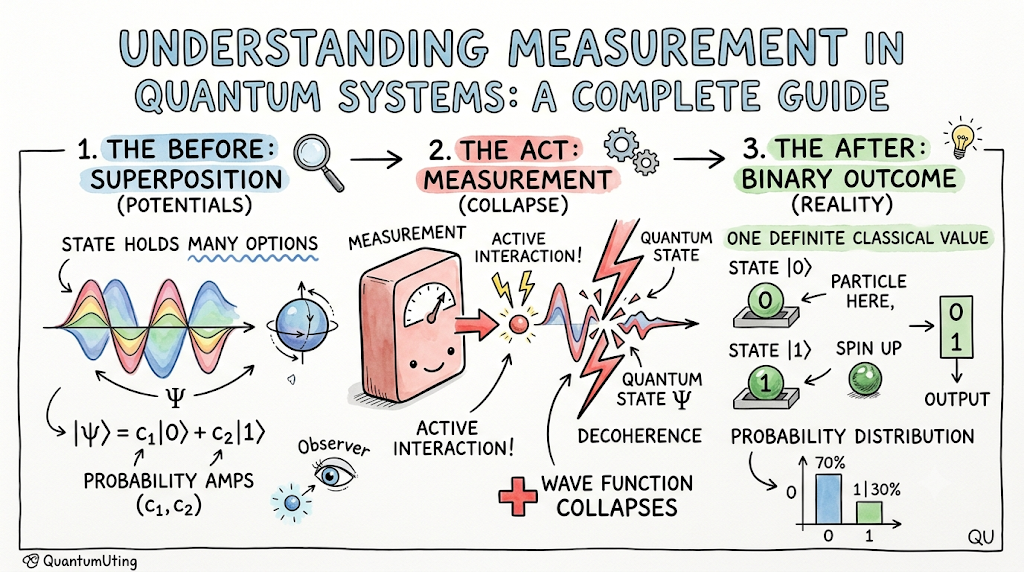
Measurement in quantum systems is the process of observing a quantum state, forcing it to choose one definite classical outcome from a pool of multiple possibilities. Before measurement, a system exists in a probabilistic blend of states called superposition; the act of measurement collapses this fragile state into a single, permanent reality.
Foundations of Quantum Systems
What Is a Quantum System?
A quantum system is any physical environment governed by the rules of quantum mechanics rather than classical physics. Usually, this involves incredibly small entities like single photons, electrons, or isolated atoms. However, it can also include engineered macro-structures like superconducting circuits acting as artificial atoms. Unlike classical objects, these systems cannot be described with definitive attributes like an exact position and a precise speed simultaneously. Instead, they are defined by a cloud of potential characteristics.
Classical Physics vs Quantum Physics
Classical physics is entirely deterministic. If you know the starting weight, angle, and force applied to a rolling bowling ball, you can predict exactly which pins it will hit every single time. It operates on certainty. Quantum physics, conversely, operates entirely on probability. You can prepare an electron in the exact same way a million times, yet when you measure its position, you will get a distribution of different results. Classical physics describes a world of solid targets; quantum physics describes a world of shifting waves.
Understanding Quantum States
The condition or configuration of a quantum system at any given moment is known as its quantum state. In classical computing, a bit can be in one of two states: 0 or 1. In a quantum system, the state is a mathematical combination of all possible outcomes. This state contains all the physical information about the system, packaged as an abstract set of coordinates. Think of it like a point on a sphere. While a classical bit can only live at the North Pole (0) or the South Pole (1), a quantum state can reside anywhere on the surface of that sphere.
Probability in Quantum Mechanics
Probability in the quantum world is not a result of human ignorance or sloppy tools. In classical weather forecasting, saying there is a 60% chance of rain means our atmospheric models lack the perfect data to be certain. If we knew the position of every atom in the sky, we could predict the rain with 100% accuracy. In quantum mechanics, the probability is fundamental to nature itself. Even with a perfect, omniscient understanding of a quantum system, the outcome of a measurement remains truly random until it happens.
Foundations Review
In Simple Terms
A quantum system is like a magical spinning die. While it is spinning on the table, it doesn’t show a 1, a 2, or a 6. It exists as a blend of all six numbers at the same time. Only when you slam your hand down to stop it does it pick a single number to show you.
Real-World Analogy
Think of a fan blade. When the fan is turned off, you can point to a specific blade and say exactly where it is (classical state). When you turn the fan on high speed, the blades blur together. You can no longer say a blade is at “3 o’clock”—it is simultaneously filling the entire circle until you jam a pen in to stop it (quantum state collapsing upon interaction).
Common Misconception
Many people believe that quantum systems are just too small for our current microscopes to see clearly, and that if we just build better tools, the randomness will go away. In reality, the randomness is a hardwired feature of the universe, not a limitation of our technology.
Key Takeaways
- Quantum systems are governed by fundamental probabilities, not certainties.
- A quantum state holds all the potential information about a system before it is looked at.
- The randomness of quantum mechanics is an intrinsic property of nature itself.
What Is Quantum Measurement?
Definition of Quantum Measurement
Quantum measurement is the interaction between a quantum system and an external, macroscopic device designed to extract information. It is the bridge where the strange, delicate rules of quantum physics collide with the rigid, concrete rules of our classical world. It is not a passive recording of an existing property; it is an active intervention that forces a fluid system to finalize its identity.
Why Measurement Matters
Without measurement, quantum mechanics would be an untestable, purely mathematical philosophy. Measurement is how we read the outputs of a quantum computer. It transforms fragile quantum information, which can easily vanish into thin air, into durable classical data (1s and 0s) that we can store on a hard drive, send over the internet, or read on a computer screen.
+------------------------+      Measurement      +------------------------+
|  Fragile Quantum State  | -------------------> | Concrete Classical Data |
|   (Superposition / ~)  |   (Active Bridge)    |     (0 or 1 Digit)     |
+------------------------+                        +------------------------+
The Relationship Between Observation and Outcomes
In the classical world, observing a bird through binoculars does nothing to the bird. In the quantum world, the word “observation” is synonymous with “interaction.” To observe a quantum particle, you must bounce something off it—like a photon of light or an electrical pulse. Because the particle is so incredibly small, this interaction acts like a physical sledgehammer, completely disrupting the original state and dictating the final outcome.
Measurement as Information Extraction
You can view quantum measurement as a forced interrogation of a particle. Before you ask the question (“Where are you?” or “What is your spin?”), the particle holds a vast spectrum of answers simultaneously. The act of measuring forces the particle to pick one clear, unambiguous answer from its internal menu, sacrificing all its other potentials in the process.
Measurement Insights
In Simple Terms
Imagine someone holding a secret behind their back. Instead of just looking at it, quantum measurement is like forcing them to shout out a single word from a long poem they were memorizing. The moment they say that word, the rest of the poem vanishes from the room.
Real-World Analogy
Consider a musical chord played on a piano containing three notes. If you listen normally, you hear the harmonious blend of all three notes at once. Quantum measurement is like pressing a single filter button that instantly mutes two of the notes, leaving you with just one piercing sound.
Common Misconception
People often think “measurement” requires a human being with a clipboard looking into a lab instrument. In physics, any piece of dust, stray gas molecule, or magnetic field that bumps into a quantum particle counts as a “measurement” or observation because it forces an interaction.
Key Takeaways
- Measurement converts delicate quantum states into solid, permanent classical bits.
- Observation requires physical interaction, which alters the system being looked at.
- The system goes from holding multiple possibilities to displaying a single choice.
Classical Measurement vs Quantum Measurement
To truly appreciate why quantum measurement confuses our intuition, it helps to line it up directly against the type of measurement we experience every single day. The table below outlines how these two styles of interacting with reality stack up against each other.
Direct Comparison Table
| Aspect | Classical Measurement | Quantum Measurement |
| Predictability | High; same inputs yield identical results. | Probabilistic; identical states yield varied results. |
| State Behavior | Unchanged; the object remains exactly as it was. | Altered; the system drops all options for one. |
| Observation Effects | None; passive observation leaves objects alone. | Destructive; the act of looking alters the state. |
| Probability | Apparent; due to missing external data. | Fundamental; woven directly into physical law. |
| Information Extraction | Continuous; can track changes smoothly over time. | Discontinuous; reveals an instantaneous snap snapshot. |
| Repeatability | Infinite; can measure the same item repeatedly. | Single-shot; measuring again just confirms the collapse. |
Understanding the Differences
In classical measurement, everything is continuous. You can watch a thermometer slowly rise from 70°F to 72°F, tracking every tiny fraction of a degree along the way. In quantum measurement, the process is sudden and discontinuous. The system snaps instantly from its fluid quantum behavior into a fixed classical value.
Furthermore, once a quantum measurement occurs, you cannot undo it to see what the system was doing a millisecond prior. The history of its alternative choices is wiped clean, leaving you with a single point of data.
Comparison Review
In Simple Terms
Classical measurement is like taking a video of a walking dog—you see everything smoothly develop without bothering the dog. Quantum measurement is like setting off a massive flashbulb in a dark room; you get one frozen picture, but the bright light scared the dog into running in a brand-new direction.
Real-World Analogy
Think of a digital scale. If you place an apple on it, it weighs 150 grams. You can take it off, put it back on, and let ten friends look at it—it stays 150 grams. Now imagine a quantum apple: the first person weighs it and it says 150 grams. The second person weighs it immediately after, and it says 150 grams. But if you reset the experiment from scratch, the next quantum apple might register as 200 grams, despite being prepared identically.
Common Misconception
It is easy to assume that quantum measurement is just a lower-quality version of classical measurement with extra static or noise. It isn’t a matter of noise; it is a completely separate set of physical laws where the act of collecting data redefines the object itself.
Key Takeaways
- Classical measurements can be done passively; quantum ones cannot.
- Quantum results are truly random across identical trials, unlike classical outcomes.
- Measuring a quantum object resets its behavior, preventing you from seeing its past states.
Understanding Quantum States
Superposition
Superposition is the ability of a quantum system to exist in multiple states at the same time. This is often described as a particle being in two places at once, but that is a slight mischaracterization. It is more accurate to say the particle exists in a wave-like state where all potential positions are equally valid parts of its current reality. It only sheds this multi-choice existence when an outside force interacts with it.
Probability Amplitudes
In classical math, probabilities are simple percentages that add up to 100% (like a 50% chance of heads and a 50% chance of tails). Quantum mechanics uses something more complex called probability amplitudes. These are complex numbers (numbers involving the square root of negative one) assigned to each possible outcome.
To find the actual real-world percentage chance of an outcome occurring, physicists take the absolute square of these amplitudes ($|c|^2$). Because these amplitudes can be negative or complex, they can cancel each other out or reinforce one another, much like overlapping ripples in a pond.
Quantum State Representation
Physicists write quantum states using a special notation called Dirac notation or bra-ket notation. A state is represented inside a partial bracket called a “ket,” which looks like this: $|\psi\rangle$. A standard qubit state in superposition is written as a neat equation:
$$\left|\psi\right\rangle = \alpha\left|0\right\rangle + \beta\left|1\right\rangle$$
In this equation, $\alpha$ (alpha) and $\beta$ (beta) are the probability amplitudes. The squares of these numbers, $|\alpha|^2$ and $|\beta|^2$, tell you the exact percentage chance the qubit has of collapsing into either the $|0\rangle$ state or the $|1\rangle$ state when you run a measurement.
Basis States
Basis states are the default reference coordinates chosen for a measurement. In quantum computing, these are typically the standard computational basis states: $|0\rangle$ and $|1\rangle$. Think of them as the true North and South poles on a globe. You can choose to measure along this North-South axis, or you can rotate your measurement instruments to look at an East-West axis instead. The choice of your basis completely changes what your measurement outcomes will look like.
State Physics Review
In Simple Terms
Superposition is like a mixed color, such as green. Green isn’t secretly hiding blue and yellow in separate pockets; it is genuinely green. However, if you pass it through a special filter that only allows pure primary colors to pass, it will suddenly snap into being either completely blue or completely yellow with a certain probability.
Real-World Analogy
Imagine a spinning wheel with blue and yellow stripes. While it spins rapidly, your eyes see a solid green wheel. This green wheel is the superposition state. Stopping the wheel abruptly with your hand forces it to rest on either a blue stripe or a yellow stripe—revealing a single base color.
Common Misconception
People frequently write that a qubit in superposition is “both 0 and 1 at the same time.” This makes it sound like a chaotic glitch. It is actually in a highly precise, single, well-defined quantum state that merely contains the potential for both outcomes once measured.
Key Takeaways
- Superposition means holding a landscape of potentials, not just being broken or glitched.
- Probability amplitudes use complex math to dictate final physical percentages.
- Changing your measurement basis alters how a quantum state reveals its information.
Wave Function and Measurement
What Is a Wave Function?
The wave function is the mathematical description of a quantum system’s behavior over time. Usually written using the Greek letter Psi ($\Psi$), it tracks how the probabilities of a particle’s properties ripple, expand, and move through space. It treats the particle not as a hard pellet, but as a spread-out wave of likelihoods.
Probabilistic Nature of Quantum Systems
Because the wave function is fundamentally a wave of probabilities, it means that at any moment before measurement, a particle does not possess a definitive location. It is literally smeared across a region of space. The crests of the wave indicate areas where the particle is highly likely to show up, while the troughs represent zones where it will almost certainly never appear.
Wave Function (Psi)
  _      _      _
 / \    / \    / \    <-- Peaks = High Probability Zones
/   \__/   \__/   \   <-- Troughs = Low Probability Zones
Wave Function Collapse
The most famous, dramatic event in quantum mechanics is wave function collapse. The instant a measurement device interacts with a spread-out wave function, the entire wave vanishes everywhere in space except at one specific point.
The fluid wave instantaneously sharpens into a single spike. The particle goes from being a distributed cloud of possibilities to a single, locked-in point in reality.
                  [ Before Measurement ]
     ~ ~ ~ ~ ~ Spread-out Wave of Probabilities ~ ~ ~ ~ ~
                             │
                             ▼
                     [ MEASUREMENT ACT ]
                             │
                             ▼
                   [ After Measurement ]
  ───────────────────────────█───────────────────────────
                    Sharp, Single Location
Why Collapse Is Important
Without wave function collapse, our macroscopic universe could not function. If quantum states never collapsed upon interacting with their surroundings, large objects like tables, chairs, planets, and people would also smear out into waves of probability. Collapse is the protective mechanism that keeps our day-to-day world solid, predictable, and stable.
Collapse Review
In Simple Terms
Imagine an ink drop falling into a glass of water, slowly clouding the entire glass with blue mist. Wave function collapse is like snapping your fingers and causing all that dispersed blue ink to instantly snap back together into a single, solid droplet at the bottom of the glass.
Real-World Analogy
Think of an auction. Before the gavel falls, anyone in the room might buy the painting; the ownership is spread out across a room of potential buyers. The second the auctioneer hits the block with the gavel (measurement), the ownership instantly collapses onto a single seat.
Common Misconception
Many people think wave function collapse takes time, like ice melting into water. In standard quantum theory, it is modeled as an instantaneous, digital snap. One moment the system is a wave; the next exact instant, it is a single coordinate.
Key Takeaways
- The wave function tracks the movement of probabilities, not solid matter.
- Collapse turns a wide wave of likelihoods into an absolute certainty.
- Collapse prevents our macroscopic world from dissolving into a fuzzy blur.
Measurement of Qubits
What Is a Qubit?
A qubit, or quantum bit, is the foundational building block of a quantum computer. While a classical transistor can only hold a voltage corresponding to a 0 or a 1, a qubit utilizes quantum properties (like the spin of an electron or the polarization of a photon) to process data using superposition, entanglement, and interference.
Measuring a Single Qubit
When you measure a single qubit that has been placed in a superposition state, you apply an external physical force—such as a microwave pulse or a laser—to read its value. This force compels the qubit to fall out of its delicate balance. No matter how complex its internal quantum state was before the measurement, your reading device will only ever show one of two answers: 0 or 1.
Measurement Outcomes
The outcomes of qubit measurements are completely binary in our classical readouts. You cannot read a value of “0.5” or “halfway between.” The quantum system handles complex, multi-dimensional calculations while hidden inside its calculation chamber, but the moment you open the door to read the answer, it translates its final state into standard binary code.
Binary Results and Probabilities
The probability of getting a 0 or a 1 depends entirely on how the quantum algorithm shaped the qubit’s wave function right before the measurement. If an algorithm is designed correctly, it uses constructive interference to boost the probability amplitude of the correct answer close to 100%, while dampening the incorrect answers down near 0%.
Multiple-Qubit Measurements
When a quantum computer reads an array of multiple qubits, it reads them together as a register. If you have a system of 3 qubits, they can hold 8 numbers ($2^3$) simultaneously in superposition.
However, when you measure that 3-qubit register, you don’t get 8 answers. You get exactly one 3-bit binary string (such as 101). The measurement collapses the entire multi-qubit system simultaneously into a single combined answer.
Qubit Review
In Simple Terms
A qubit is like a light switch with a dimmer dial. While the closet door is closed, the light can be set to any brightness level or rhythm. But the switch is wired so that when you open the door, it violently snaps either completely up (ON) or completely down (OFF).
Real-World Analogy
Think of a standard ballot box. You can write an incredibly detailed, nuanced essay on your political beliefs on the ballot paper. But the scanning machine at the polling station only counts a simple checkmark next to Candidate A or Candidate B. The rich essay is stripped away for a simple tally.
Common Misconception
A common mistake is thinking that because a quantum computer uses qubits, it outputs “quantum data.” Quantum computers take classical inputs, process them using quantum states, and output standard, ordinary classical data that any regular laptop can understand.
Key Takeaways
- Qubits drop their complex states to provide simple 0 or 1 readouts.
- Quantum algorithms work by altering the mathematical odds of the final binary outcomes.
- Measuring a group of qubits drops all parallel paths to reveal one binary string.
The Role of Superposition in Measurement
Understanding Multiple Possibilities
Superposition allows a quantum system to explore vast landscapes of data simultaneously. If a classical computer needs to find the way out of a maze, it must try one path, hit a dead end, back up, and try the next path sequentially. A quantum system introduces a wave of states that flows through every single path of the maze at the exact same time.
Probability Before Measurement
Before the measurement apparatus is introduced, all those parallel paths inside the maze are active. They can interact with each other, share data, and cross paths. The system maintains a fluid, interconnected network of probabilities where no single choice has been designated as the final historical reality.
Definite Outcomes After Measurement
The second a measurement gate is applied at the end of the maze, the magic stops. The system instantly selects one concrete path based on the probabilities established during the journey. All the other paths that were actively being traveled a microsecond ago vanish instantly from reality, leaving behind a single trajectory.
[ Maze Entry ] ───►  Wave Enters All Paths Simultaneously (Superposition)
                             │
                             ├───► Path A (Vanishes)
                             ├───► Path B (Vanishes)
                             ├───► Path C ───► [ MEASUREMENT ] ───► DEFINITE OUTCOME
                             └───► Path D (Vanishes)
Why Superposition Matters
Superposition is what gives quantum computing its massive computational potential, but it is entirely useless without measurement. The art of quantum programming lies in manipulating the system so that the absolute highest probability peak aligns perfectly with the correct answer to your problem, ensuring that when you force the system to choose, it chooses wisely.
Superposition Review
In Simple Terms
Superposition is like a drop of water that splits into a mist to explore an entire house through every open window at once. Measurement is like a magical vacuum that instantly sucks the entire mist back into a single drop of water inside one specific room.
Real-World Analogy
Think of choosing a career path when you are 5 years old. In your mind, you are an astronaut, a firefighter, a doctor, and an artist all at once. As you grow up and sign your very first employment contract (measurement), all those other childhood potentials evaporate, and you become one specific professional.
Common Misconception
Many learners believe that superposition lasts forever inside a quantum computer. In reality, superposition is incredibly fragile. The slightest warmth, vibration, or poor shielding will cause an accidental measurement, destroying the superposition prematurely.
Key Takeaways
- Superposition allows parallel exploration of data streams before observation.
- Measurement acts as a definitive filter that terminates parallel computing paths.
- Quantum computing success depends on aligning high probabilities with correct answers.
Quantum Entanglement and Measurement
What Is Entanglement?
Quantum entanglement is a phenomenon where two or more particles become deeply linked, causing their physical properties to share an identical identity, no matter how far apart they are separated in space. Albert Einstein famously doubted this concept, referring to it as “spooky action at a distance” because it seemed to violate the classical rule that information cannot travel faster than light.
Measuring Entangled Systems
The true wonder of entanglement reveals itself during measurement. Imagine you have two entangled qubits, Qubit A and Qubit B, prepared in a state where they must always have opposite spins. You keep Qubit A in your lab on Earth and ship Qubit B to an astronaut on Mars. Before any measurement happens, both qubits are in a fuzzy superposition, holding no definite spin direction.
Correlated Outcomes
The instant you measure Qubit A on Earth and see it collapse into a spin-up state ($|1\rangle$), you instantly know the state of Qubit B on Mars. Without anyone touching it, Qubit B immediately collapses into a spin-down state ($|0\rangle$).
The measurement on Earth did not just collapse the local wave function; it collapsed the shared, unified wave function spanning across the solar system.
       [ Unified Entangled Wave Function ]
  Earth Lab (Qubit A) ─────────────── Mars Station (Qubit B)
          │                                  │
   [ MEASURED: |1> ]                         │
          │                                  ▼
          └────────────────────────► [ INSTANT COLLAPSE: |0> ]
Why Entanglement Is Important
This correlated measurement behavior is the engine behind quantum teleportation, advanced cryptographic networks, and ultra-secure communication channels. It allows quantum computers to link qubits together, exponentially scaling up the amount of operational data they can process simultaneously.
Entanglement Review
In Simple Terms
Imagine a magical pair of shoes divided into two identical plain boxes. You take one box to New York and send the other to Tokyo. The moment you open your box in New York and find a left shoe, the box in Tokyo instantly becomes a right shoe, even though no one has looked inside it yet.
Real-World Analogy
Consider a pair of two-sided coins painted so that one side is always red and the other is always blue. If they are entangled, spinning them both on separate tables means they are a purple blur. The exact millisecond you slap your hand down on Coin A and see Red, Coin B on the other side of the room drops its blur and shows Blue.
Common Misconception
A frequent misconception is that entanglement allows you to send faster-than-light text messages to Mars. It doesn’t. Because the outcome of your local measurement on Earth is completely random, you cannot control what the astronaut on Mars sees; you only discover the correlation once you compare notes later using classical radio waves.
Key Takeaways
- Entangled particles share a single, unified wave function across space.
- Measuring one entangled particle instantly determines the state of its partner.
- Entanglement correlation does not allow for faster-than-light data transmission.
Common Interpretations of Quantum Measurement
Because the mathematics of quantum mechanics works perfectly but challenges our fundamental view of reality, physicists have spent decades debating what actually happens during a measurement. Here are the leading school-of-thought interpretations presented neutrally.
Copenhagen Interpretation
Developed by Niels Bohr and Werner Heisenberg in the 1920s, this is the traditional, mainstream view. It states that quantum systems simply do not possess physical properties before measurement. The act of measurement causes a literal, physical wave function collapse. You shouldn’t ask what the particle was doing before you looked; you should only focus on the mathematical results of your instruments.
Many-Worlds Interpretation
Proposed by Hugh Everett in 1957, this interpretation eliminates wave function collapse entirely. It suggests that when a measurement has multiple potential outcomes, the universe splits into parallel realities. If you measure a qubit and get a 0, a parallel version of you branches off in a separate universe and records a 1. Every quantum measurement simply splits the multiverse into endless alternative paths.
Objective Collapse Theories
These models suggest that wave function collapse happens naturally and spontaneously without requiring external observation or human intervention. Larger, heavier systems collapse much faster than tiny subatomic ones. According to this view, the universe collapses its own states continuously simply due to the accumulation of mass and gravity.
Modern Scientific Perspectives
Today, many quantum computing engineers take a pragmatic approach often nicknamed “Shut up and calculate.” Because the math yields flawless engineering results for building hardware, the philosophical question of whether the universe is splitting or physically collapsing takes a backseat to optimizing qubit coherence times and building fault-tolerant architectures.
Interpretations Review
In Simple Terms
Imagine choosing a flavor of ice cream. The Copenhagen view says the flavors don’t exist until you point your finger. The Many-Worlds view says you choose vanilla in this world, but a clone of you chooses chocolate in an alternate universe. Objective collapse says the ice cream machine naturally doles out vanilla on its own schedule.
Real-World Analogy
Think of a fork in a hiking trail. Copenhagen says the path you didn’t take instantly vanishes from the Earth. Many-Worlds says the trail splits into two separate planets, and a version of you walks down each path simultaneously.
Common Misconception
Many people think these interpretations are competing scientific theories that can be easily tested in a high school lab. Currently, they all use the exact same mathematical equations, making them philosophical explanations of the same data rather than distinct, provable theories.
Key Takeaways
- The Copenhagen model relies on literal, sharp wave function collapse.
- The Many-Worlds model proposes that every measurement splits reality into branches.
- Modern engineers focus on utilizing the mathematical rules rather than settling the philosophical debate.
Quantum Measurement in Quantum Computing
Reading Computation Results
In a quantum computer, you don’t look at the qubits while they are working. If you did, you would ruin the calculation. Instead, you let the qubits interact through quantum gates inside a shielded environment. Only at the very final step of the algorithm do you apply a measurement command to read the final results out as standard data.
Quantum Circuit Measurements
On a quantum circuit diagram, measurements are represented by a specific box symbol containing a meter needle. This gate marks the transition point where a quantum wire carrying a fragile qubit state ($|\psi\rangle$) turns into a double-lined classical wire carrying a solid bit ($0$ or $1$).
Quantum Wire (Fragile) ──── [ 🎛️ Measurement Gate ] ════ Classical Wire (Solid)
Measurement Gates
Measurement gates are actual physical hardware components. In a superconducting quantum processor, this involves sending a specific microwave pulse down a readout line positioned right next to the qubit. The way the microwave pulse bounces back tells the computer’s classical control processors whether the qubit was resting in its ground state (0) or excited state (1).
Extracting Information from Quantum Algorithms
Because quantum measurement is probabilistic, running an algorithm once is rarely enough. Engineers use a process called sampling. They run the exact same quantum circuit hundreds or thousands of times (known as “shots”). This builds up a classical histogram showing which binary answers pop up most frequently, allowing them to verify the true mathematical output of the computation.
Computing Review
In Simple Terms
Running a quantum algorithm is like setting up an elaborate chain of falling dominoes in the dark. You can’t turn on the lights while they are falling, or you will knock them over. Measuring is like turning on the lights at the very end to see the final layout of the collapsed pieces.
Real-World Analogy
Think of a professional kitchen baking a cake. While the oven door is closed, the ingredients blend, rise, and transform in secret. Opening the oven door repeatedly ruins the baking process. You only open the door at the absolute end of the timer to see if you have a finished cake.
Common Misconception
Learners often assume that if a quantum computer has 50 qubits, it can give you 50 independent quantum answers at once. In reality, those 50 qubits collapse down into one single string of 50 classical zeros and ones per run.
Key Takeaways
- Measurements are intentionally delayed until the final step of a quantum circuit.
- Readout pulses extract information by checking how energy fields bounce off qubits.
- Quantum circuits are run thousands of times to compile accurate statistical results.
Measurement Challenges in Quantum Systems
Noise
Quantum hardware is incredibly sensitive. Any external disturbance—whether it is a tiny temperature change, a stray radio wave, or acoustic vibration from a footstep in the hallway—is classified as environmental noise. This noise acts as an accidental, unintended measurement that destroys your quantum information before your program finishes running.
Decoherence
Decoherence is the process where a quantum system loses its quantum properties and dissolves back into a standard classical state due to interacting with its environment. It is the primary enemy of quantum computer scientists. Currently, qubits can only maintain their delicate superposition states for tiny fractions of a second before decoherence takes over.
Measurement Errors
Even when an algorithm runs perfectly, the actual tool reading the qubit can make a mistake. This is called readout assignment error. For instance, a qubit might be sitting correctly in the $|1\rangle$ state, but due to thermal fluctuations in the control cables, the reading instrument misidentifies it and records a $0$ on the control screen instead.
Hardware Limitations
Building devices that can interact strongly enough with a qubit to read it instantly, while remaining completely invisible and non-disruptive during the calculation phase, is a massive engineering paradox. It requires building highly specialized materials operating at temperatures colder than deep space.
Precision Challenges
As quantum processors scale up from 50 qubits to thousands of qubits, measuring one specific qubit without accidentally disturbing its neighbors (an issue known as crosstalk) becomes an extraordinary challenge. It requires sub-nanosecond timing precision and immaculate magnetic shielding.
Challenges Review
In Simple Terms
Managing a quantum computer is like trying to build a house of cards outdoors during a windy storm. The slightest draft of wind acts like a hand knocking the cards flat onto the table before you are finished building.
Real-World Analogy
Imagine trying to read the time on a watch made completely out of morning dew. The second you press your finger against the watch face to feel the hands, the heat from your skin melts the water away, destroying the very clock you were trying to read.
Common Misconception
Many people think the biggest challenge in quantum computing is just adding more qubits to the chip. In truth, the harder challenge is preventing those qubits from accidentally measuring each other through material defects and environmental interference.
Key Takeaways
- Environmental noise acts as an unwanted measurement that triggers decoherence.
- Readout assignment errors occur when instruments misidentify a qubit’s final state.
- Scaling quantum chips requires isolating qubits perfectly to prevent crosstalk.
Quantum Error Correction and Measurement
Why Error Correction Is Needed
Because individual physical qubits are prone to decoherence and measurement errors, a practical quantum computer cannot rely on raw hardware alone. Classical computers use simple backup copies to fix errors, but quantum systems are bound by the No-Cloning Theorem, which proves it is mathematically impossible to make a perfect independent copy of an unknown quantum state.
Syndrome Measurements
To bypass the cloning restriction, scientists use a technique called Quantum Error Correction (QEC). They map the information of one single “logical qubit” across a large network of multiple “physical qubits.”
They use specialized, non-destructive measurements called syndrome measurements on auxiliary qubits (called ancilla qubits). These measurements are carefully designed to extract information about where an error occurred without revealing or collapsing the actual data stored inside the logical qubit.
       [ Logical Qubit Information ]
                     │
        Mapped across multiple units
                     ▼
  [ Physical Qubit 1 ] [ Physical Qubit 2 ] [ Physical Qubit 3 ]
                             │
            Tested via Non-Destructive Scans
                             ▼
                [ Syndrome Measurement ]
                             │
     Tells you where the error is WITHOUT collapsing data!
Fault-Tolerant Quantum Computing
Fault-tolerant quantum computing is the ultimate goal of the industry. It describes a system where error correction loops run continuously in the background, measuring and fixing physical errors faster than the environment can create them. This ensures that the overall computational space remains stable indefinitely.
Future Improvements
As error correction protocols mature, the industry is transitioning from measuring noisy, raw physical qubits to interacting exclusively with clean, stable logical qubits. This shift will allow quantum algorithms to run for hours or days, opening the door to revolutionary molecular simulations and complex codebreaking.
Error Correction Review
In Simple Terms
Imagine writing a secret letter in invisible ink. Instead of looking directly at the text to see if it is fading, you use a special magnifying glass that only checks for smudge marks on the edges of the paper, letting you protect the secret text while fixing the paper.
Real-World Analogy
Think of a modern luxury car with an active lane-assist system. The car doesn’t turn off the engine or stop the trip to check if you are safe; its cameras make continuous, subtle adjustments to the steering wheel in milliseconds to keep you centered on the highway.
Common Misconception
Learners often think that “error correction” means making the hardware 100% perfect so errors never happen. In reality, physics dictates that errors will happen; error correction is about building a smart system that manages and neutralizes errors dynamically.
Key Takeaways
- The No-Cloning Theorem prevents making simple duplicate backups of quantum states.
- Syndrome measurements spot hardware errors without destroying calculation states.
- Fault-tolerant computing uses continuous background loops to stabilize data.
Real-World Applications of Quantum Measurement
While quantum measurement sounds like an abstract lab problem, it is actively driving the development of several disruptive real-world technologies.
Quantum Computing
- Purpose: Processing highly complex computational problems like molecular mapping, logistics optimization, and financial modeling.
- Measurement Role: Acts as the essential extraction valve at the end of circuits to convert quantum states into readable digital data.
- Impact: Speeds up data processing timelines from thousands of years down to mere minutes for specific computational workloads.
Quantum Cryptography
- Purpose: Creating unhackable communication networks using Quantum Key Distribution (QKD).
- Measurement Role: Exploits the rule that observation alters a state. If an eavesdropper tries to intercept a quantum security key, their measurement instantly leaves traces by altering the data.
- Impact: Alerts the sender and receiver of an intrusion immediately, making silent data theft physically impossible.
Quantum Sensing
- Purpose: Detecting incredibly small changes in magnetic fields, gravity, and temperature with extreme precision.
- Measurement Role: Uses individual atomic systems that alter their quantum measurements at the slightest nudge from an outside physical force.
- Impact: Enables the creation of radiation-free medical imaging, subterranean mineral mapping, and GPS-free navigation systems.
Quantum Communication
- Purpose: Transmitting highly sensitive data across global distances using entangled photon networks.
- Measurement Role: Coordinates simultaneous state collapses across far-reaching nodes to secure information routing.
- Impact: Forms the foundational backbone for a future global quantum internet.
Scientific Research
- Purpose: Probing the core foundational laws of astrophysics, materials science, and thermodynamics.
- Measurement Role: Allows researchers to capture snapshots of molecular transitions at subatomic scales.
- Impact: Accelerates the discovery of clean-energy materials, advanced superconductors, and next-generation pharmaceutical compounds.
Common Misconceptions About Quantum Measurement
Quantum mechanics is often sensationalized, leading to several deep-seated myths that confuse newcomers. Let’s correct those directly.
Observation Does Not Mean Human Awareness
Pop-culture articles often claim that a human being must consciously look at an experiment to make it real. This is false. An “observer” in physics is any macroscopic object—an atom of gas, a wire, or a piece of glass. Nature doesn’t care if a human is in the room; it only cares if a physical interaction occurred.
Measurement Is Not Magic
Quantum measurement can feel like sorcery because it is instantaneous and non-local. However, it follows rigorous, strict mathematical frameworks and probability distributions. It cannot be used to manifest thoughts, bend spoons, or violate the fundamental conservation laws of energy.
Collapse Is Not Necessarily Consciousness
The idea that the human mind collapses the wave function is a fringe philosophical interpretation, not accepted physics. The wave function collapses because a tiny subatomic particle collided with a massive, warm macroscopic instrument, forcing it into a classical state via decoherence.
Probability Does Not Mean Random Chaos
Just because a quantum measurement outcome is probabilistic doesn’t mean it is completely unpredictable chaos. We know the exact mathematical odds of the outcomes with perfect precision. It is structured, organized randomness that follows beautiful, predictable statistical curves over time.
Benefits of Understanding Quantum Measurement
Taking the time to digest how quantum measurement works yields massive intellectual dividends for anyone exploring modern technology.
                  [ Master Quantum Measurement ]
                                │
        ┌───────────────────────┼───────────────────────┐
        ▼                       ▼                       ▼
[ Coding Accuracy ]    [ Algorithmic Insight ]  [ Advanced Readiness ]
 Write clean code        Understand how gates     Easily pivot into QKD,
 without breaking         shift probabilities       Sensing, and Error
 fragile superpositions    before final reads       Correction tracks
- Better Understanding of Quantum Computing: You stop viewing quantum processors as magic black boxes and start viewing them as advanced machines that manipulate probability waves.
- Improved Understanding of Quantum Algorithms: You will finally understand why algorithms like Grover’s Search or Shor’s Algorithm use specific gates—their goal is simply to shift measurement odds in your favor.
- Foundation for Advanced Quantum Topics: Once you grasp measurement, concepts like error correction, quantum keys, and teleportation become intuitive extensions rather than impossible puzzles.
- Greater Scientific Literacy: You gain immunity to “quantum mysticism” marketing and can accurately analyze real tech news regarding hardware breakthroughs.
Challenges Beginners Face
Learning this field is famously challenging because it requires unlearning how you interact with the day-to-day world.
- Thinking Classically About Quantum Systems: Beginners constantly try to visualize a qubit as a tiny ball that is physically moving between two pockets. You must train your mind to think of it as a fluid wave of possibilities instead.
- Misunderstanding Probability: Many people struggle with the concept of true randomness, assuming there must be a hidden trick or clock inside the particle dictating its choices.
- Confusing Observation with Consciousness: Sifting through pop-science videos to separate the mystical interpretations from real, peer-reviewed engineering data takes real effort.
- Overcomplicating the Mathematics: Newcomers often dive straight into complex linear algebra and differential equations before building a solid, intuitive conceptual model of what the system is trying to do.
Best Practices for Learning Quantum Concepts
If you want to master this field efficiently without burning out, follow this proven learning path:
- Build Strong Foundations: Focus on understanding a single qubit thoroughly before moving on to multi-qubit systems, entanglement, or complex circuits.
- Learn Through Visualizations: Use tools like the Bloch Sphere—a visual model that represents quantum states as lines moving on a 3D globe—to see how gates rotate states before a measurement.
- Use Quantum Simulators: Write simple, free quantum programs on platforms like IBM Quantum Learning or Google Quantum AI’s Cirq. Running a circuit and seeing a histogram of results makes the concept real.
- Focus on Concepts Before Mathematics: Learn what wave functions and measurements do conceptually first. Once the mechanics make sense, the underlying linear algebra feels like a helpful language rather than a wall of math.
- Practice with Real Examples: Walk through basic quantum gates (like the Hadamard gate) step-by-step to see exactly how they create and destroy superposition states.
Future of Quantum Measurement
The field of quantum measurement is rapidly evolving, moving out of experimental physics labs and into scaled commercial production.
Advanced Quantum Hardware
Next-generation quantum chips are integrating control electronics directly onto the cooling units. This allows measurement signals to be processed locally using cryogenic microchips, drastically reducing readout delays and boosting accuracy.
Improved Error Correction
The coming years will see the debut of hardware architectures with built-in, real-time autonomous error tracking. These systems will detect and isolate breaking qubits instantly, ensuring uninterrupted runtimes for complex enterprise algorithms.
Better Quantum Sensors
Quantum measurement research is producing sensors capable of measuring gravitational shifts down to the millimeter scale. These will allow construction crews to see underground pipes without digging and let deep-sea submarines navigate accurately without any satellite connections.
Scalable Quantum Computers
As readout speeds increase and crosstalk errors decrease, quantum computers will safely scale from hundreds of physical qubits to millions. This milestone will mark the transition into the era of true commercial quantum supremacy.
Real-World Learning Examples
To make these concepts concrete, let’s walk through three distinct scenarios you would encounter when running a real quantum application.
Example 1: Measuring a Single Qubit
- Scenario: You use a quantum computer to prepare a single qubit in a perfect 50/50 superposition state using a Hadamard gate. The state is written mathematically as:$$\left|\psi\right\rangle = \frac{1}{\sqrt{2}}\left|0\right\rangle + \frac{1}{\sqrt{2}}\left|1\right\rangle$$
- Concept: The qubit contains equal probability amplitudes for both options. Its wave function is perfectly balanced between the $|0\rangle$ and $|1\rangle$ options.
- Outcome: You hit the qubit with a readout pulse. The state instantly collapses. The monitor outputs a standard digital
1. - Lesson Learned: Even though the state was perfectly balanced, the single measurement only gave a single binary value. To prove the 50/50 balance, you must reset the qubit and run this circuit many times to see a balanced distribution of outcomes.
Example 2: Measuring an Entangled Pair
- Scenario: You create a Bell State using two qubits, linking them together so they share an identical identity but must collapse into opposite values. You keep Qubit A and send Qubit B down a fiber-optic cable to a separate building.
- Concept: The two qubits no longer have independent individual identities; they exist as a single, combined wave function distributed across two locations.
- Outcome: You measure Qubit A and receive a
0. The second this happens, an engineer in the other building measures Qubit B and instantly receives a1. - Lesson Learned: Measuring one part of an entangled system instantly dictates the collapse behavior of the rest of the system, confirming the non-local connection of quantum mechanics.
Example 3: Measurement in a Quantum Algorithm
- Scenario: You run a database search using Grover’s Algorithm. The algorithm passes the qubits through an iterative sequence of gates designed to amplify the correct answer.
- Concept: The quantum gates act like constructive waves, boosting the probability amplitude of the correct answer string (e.g.,
1010) while flattening the amplitudes of all other wrong answers. - Outcome: When the final measurement gate fires, the entire register collapses, and the computer prints out
1010with 99.9% statistical consistency across multiple shots. - Lesson Learned: Quantum computing doesn’t eliminate randomness; it shapes the landscape of randomness so that the correct answer becomes the statistically inevitable outcome when measured.
FAQ Section
- What is quantum measurement?
Quantum measurement is the physical interaction between a quantum system and an external classical device that extracts information, causing a fluid quantum state to collapse into a single, definite classical outcome.
2. What happens when a qubit is measured?
When a qubit is measured, its multi-possibility superposition state instantly terminates, forcing it to snap into a standard classical value of either a 0 or a 1.
3. What is wave function collapse?
Wave function collapse is the sudden transition of a quantum system from a spread-out wave of multiple mathematical probabilities into a sharp, single localized reality upon interaction with an observer.
4. Why does observation matter in quantum mechanics?
Observation matters because at the quantum scale, you cannot look at something without physically interacting with it. This inevitable interaction acts as a disruptive force that alters the system’s original state.
5. How is quantum measurement different from classical measurement?
Classical measurement is passive and records a state without altering it. Quantum measurement is active and alters the system, changing its fundamental properties during the act of data collection.
6. What is superposition?
Superposition is the ability of a quantum system to exist in a mathematical blend of multiple potential configurations simultaneously until an external measurement forces it to pick one.
7. What is entanglement?
Entanglement is a deep quantum link between particles where their physical states are shared, meaning a measurement on one particle instantly determines the state of its distant partner.
8. Why are quantum outcomes probabilistic?
Quantum outcomes are probabilistic because indeterminacy is a core feature of subatomic physics, meaning nature does not establish a final value until an interaction forces a choice.
9. How does measurement affect quantum computing?
Measurement reads out the final answer of a quantum computation, converting delicate quantum states into standard classical bits that traditional software architectures can read.
10. Can measurement introduce errors?
Yes, hardware limits and thermal interference can cause readout assignment errors, where an instrument misidentifies a qubit’s true collapsed state and writes down the wrong binary digit.
11. Does observation require a human conscious mind?
No. In quantum physics, any physical interaction with an environmental object—like a collision with a stray molecule or an instrument sensor—counts as an observation that triggers collapse.
12. What is a basis state?
A basis state is the chosen coordinate framework or perspective along which you choose to measure a quantum system, which directly alters how the final outcomes manifest.
13. Can you undo a quantum measurement?
No. Once a measurement collapses a wave function, the history of its alternative possibilities is permanently erased, locking the system into its new classical identity.
14. What is a syndrome measurement?
A syndrome measurement is a specialized, non-destructive quantum error correction scan that looks for hardware errors without looking at or collapsing the actual data inside the qubit.
15. How many times do you run a quantum circuit?
Because quantum measurements are probabilistic, circuits are run hundreds or thousands of times (shots) to compile a reliable statistical histogram of the outputs.
Final Summary
Measurement in quantum systems is the foundational bridge connecting the strange, fluid mechanics of the subatomic realm to the structured, digital reality of our everyday world. While classical observation is passive, quantum measurement is transformative—disrupting superpositions, collapsing wave functions from waves of potential into single spikes of certainty, and validating the non-local connections of entangled states.
In quantum computing, this process is what allows us to translate parallel quantum pathways into clean binary data strings. While managing the engineering hurdles of noise, decoherence, and readout errors remains an ongoing battle, mastering these measurement mechanisms unlocks unprecedented capabilities in secure communication, deep-space sensing, and hyper-scalable computation.
