Introduction
For decades, silicon-based classical computers have driven global technological progress. These machines process everything from simple text documents to complex global banking networks. Yet, as we push into frontiers like deep molecular simulation, multi-variable logistical optimization, and advanced cryptography, classical systems are hitting a definitive physical wall. To explore deep training tracks, industry whitepapers, and guided learning pathways in this rapidly evolving space, you can discover educational materials at QuantumUting, a premier hub dedicated to breaking down complex quantum concepts for developers and students alike. By shifting from the predictable mechanics of macroscopic physics to the probabilistic nature of the subatomic world, we open up a computational architecture capable of processing information at unprecedented scales.
Featured Snippet: How Do Quantum Computers Process Information?
Quantum computers process information by utilizing quantum mechanics instead of classical physics. They use quantum bits, or qubits, which can exist in multiple states simultaneously through superposition. By linking qubits via entanglement and manipulating their probabilities using quantum gates, a quantum computer evaluates vast configurations of data simultaneously, collapsing into a definitive answer upon final measurement.
Understanding Quantum Computing Basics
What Is Quantum Computing?
Quantum computing is the study and development of computational systems that leverage the unique, counterintuitive properties of quantum mechanics to process information. Traditional computers run on classical thermodynamics and electromagnetism. Quantum computers operate in a regime governed by probability amplitudes, wave-function interference, and multi-state systems. This allows them to execute specialized algorithms far more efficiently than any classical machine.
Classical vs. Quantum Computing
To understand how quantum systems process information, we must first look at how they differ structurally from the machines we use every day.
| Feature | Classical Computing | Quantum Computing |
| Basic Data Unit | Bit ($0$ or $1$) | Qubit ($0$, $1$, or both simultaneously) |
| Physical Mechanism | Transistors controls electrical current voltage | Trapped ions, superconducting loops, or photons |
| Processing Model | Deterministic Boolean logic gates (AND, OR, NOT) | Probabilistic quantum gates operating on state vectors |
| Computational Space | Scales linearly ($N$ bits = $N$ tracking states) | Scales exponentially ($N$ qubits = $2^N$ simultaneous states) |
| Operational Output | Exact binary results | Probabilistic distribution collapsed to a classical state |
Why Quantum Computing Matters
In Simple Terms
Classical computers are like a librarian trying to find a specific sentence in a book by reading every single page one by one. A quantum computer is like reading all the pages of the book at the exact same time to pinpoint the sentence instantly.
Real-World Example
In pharmaceutical drug discovery, finding a molecule to block a disease pathway requires mapping thousands of atomic bonds. A classical supercomputer checks every molecular structure individually, taking years. A quantum computer models these molecular bonds simultaneously, identifying viable drug candidates in minutes.
Why It Matters
As global challenges grow more complex, our computational tools must evolve. Quantum computing represents a massive leap forward, allowing us to simulate nature exactly as it is—at the quantum scale.
Key Takeaways
- Quantum computing relies on subatomic physics rather than macro-scale electronics.
- The processing capacity scales exponentially with the addition of each new quantum bit.
- They solve highly specific, ultra-complex problems that classical supercomputers cannot resolve.
- Quantum systems act as accelerators alongside classical enterprise servers.
The Building Block of Quantum Information: Qubits
What Is a Qubit?
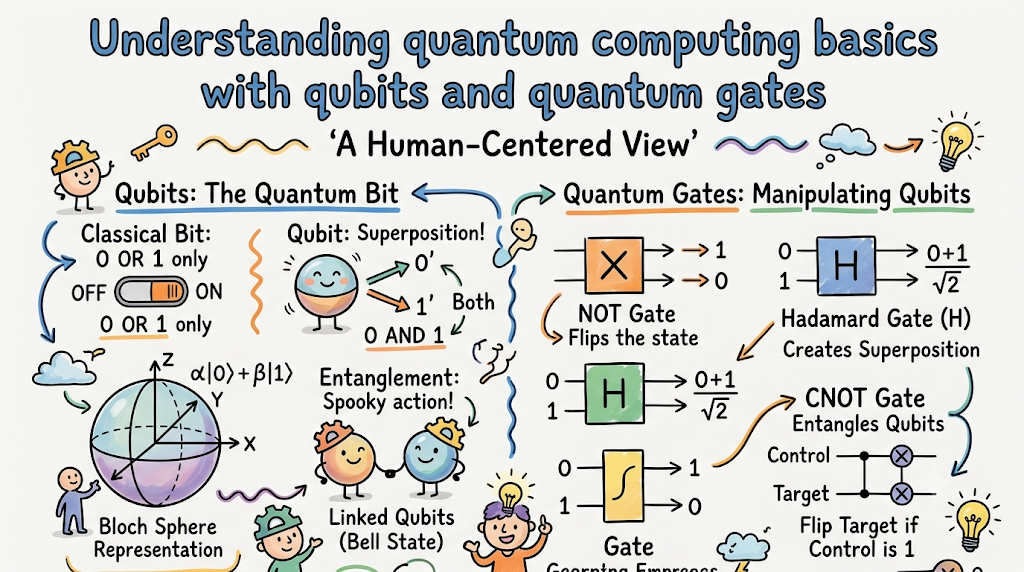
A quantum bit, or qubit, is the fundamental unit of quantum information processing. While a classical bit is restricted to a macroscopic physical state—such as a high voltage representing a $1$ or a low voltage representing a $0$—a qubit is built from a microscopic quantum system. This can be the spin of an electron, the polarization of a photon, or the energetic state of a tiny superconducting circuit.
Qubit vs. Classical Bit
Because a classical bit is binary, it is always a certain value: either $0$ or $1$. A qubit can also be measured as a $0$ or a $1$, but before that measurement occurs, its mathematical state can be a linear combination of both.
Classical Bit:  [0]  OR  [1]  (Static Switch)

Quantum Qubit:  [|0⟩ and |1⟩ simultaneously]  (Fluid Wavefront)
Superposition Explained
Superposition is the ability of a quantum system to exist in multiple states at the same time. Mathematically, we represent the state of a qubit, denoted as $|\psi\rangle$, using Dirac bra-ket notation:
$$\psi = \alpha|0\rangle + \beta|1\rangle$$
In this equation, $\alpha$ and $\beta$ are complex numbers representing the probability amplitudes of the system. When the qubit is measured, it collapses into either the $|0\rangle$ state or the $|1\rangle$ state. The probability of collapsing into $|0\rangle$ is $|\alpha|^2$, and the probability of collapsing into $|1\rangle$ is $|\beta|^2$, such that:
$$|\alpha|^2 + |\beta|^2 = 1$$
Bloch Sphere Concept
To visualize this concept, quantum physicists use a mathematical construct called the Bloch Sphere.
         |0⟩ (North Pole)
           /\
          /  \
         |    | ---> Qubit Vector State (Any point on the surface)
          \  /
           \/
         |1⟩ (South Pole)
Think of a classical bit as a light switch that can only point to the exact North Pole ($0$) or the exact South Pole ($1$) of a globe. A qubit, however, can be represented as a vector pointing to any coordinate on the surface of that sphere. The latitudes and longitudes represent various superpositions, holding a complex mix of both potential outcomes until it is forced back to a pole upon observation.
In Simple Terms
Imagine a coin lying flat on a desk; it must show either heads or tails. This is a classical bit. Now imagine spinning that coin on its edge. While it is spinning, it is a blur of both heads and tails simultaneously. It only stops and becomes a definitive “heads” or “tails” when you slap your hand down to stop it.
Real-World Example
In global shipping logistics, a fleet must navigate thousands of shifting route combinations affected by weather, fuel costs, and customs delays. A qubit-driven framework maps these infinite combinations across its spherical state space, evaluating all routes at once rather than testing them path by path.
Why It Matters
Without the multi-state capabilities of the qubit, a quantum computer would just be a slower, more expensive classical computer. Superposition allows us to load, hold, and manipulate massive datasets across a compact footprint of physical hardware.
Key Takeaways
- Qubits utilize subatomic properties to represent states beyond basic binary.
- Superposition allows a mathematical blend of $0$ and $1$ governed by probability amplitudes.
- The Bloch Sphere visually maps a qubit’s processing states as locations on a sphere.
- Measuring a qubit collapses its fluid superposition into a standard classical data value.
Quantum Superposition in Information Processing
How Superposition Works
In a classical processor, if you have two bits, they can form one of four possible configurations at any single moment: 00, 01, 10, or 11. To analyze all four options, a classical computer must execute four separate operations or split its processing power across four physical circuits.
In a quantum processor, when you place two qubits into a state of superposition, they represent all four combinations simultaneously. The computational workspace expands according to the formula $2^N$, where $N$ is the number of qubits.
Parallel Computation Concept
This exponential scaling behavior quickly leads to staggering numbers:
- 10 Qubits can represent $2^{10}$ = $1,024$ states simultaneously.
- 20 Qubits can represent $2^{20}$ = $1,048,576$ states simultaneously.
- 300 Qubits can hold more simultaneous states than there are atoms in the observable universe.
This is not standard parallel computing, where multiple processors run separate lines of code at the same time. Instead, it is a single quantum circuit processing an entire mathematical landscape at once.
Classical Multi-Core Parallelism:
Core 1: [00] ---> Processed
Core 2: [01] ---> Processed
Core 3: [10] ---> Processed
Core 4: [11] ---> Processed

Quantum Superposition Parallelism:
Single Circuit: [00 + 01 + 10 + 11] ---> Processed in One Unified Step
Real-World Analogy (The Maze Solver)
Think of a traditional computer trying to find its way out of a vast hedge maze. It walks down the first path, hits a dead end, backs up, and tries the second path. It repeats this process until it finds the exit.
A quantum computer solves the maze by flooding it like water. It flows down every single pathway at the exact same moment, finding the correct exit instantly because it explores every possible route simultaneously.
Why It Increases Power
By holding millions of possibilities in a suspended state, the quantum processor eliminates the need to run time-consuming computational loops. It shifts the challenge from running trillions of calculations to managing the shape of a single, highly complex quantum wave.
In Simple Terms
Superposition gives a quantum computer an expanding memory canvas, allowing it to hold a massive number of options open all at once instead of looking at them one by one.
Real-World Example
Financial institutions use Monte Carlo simulations to forecast portfolio risks based on millions of shifting market factors. Superposition allows risk engines to process all economic variations simultaneously, delivering real-time risk profiles during volatile market events.
Why It Matters
This capability unlocks solutions for problems that would otherwise require classical computers the size of planets. It transforms impossible, centuries-long calculations into tasks that take just a few minutes.
Key Takeaways
- Computational capacity scales exponentially at a rate of $2^N$ states.
- Superposition acts as a high-dimensional workspace, avoiding sequential processing loops.
- This mechanism allows the system to evaluate an entire problem space all at once.
- It scales efficiently, enabling compact quantum systems to handle incredibly dense datasets.
Quantum Entanglement and Its Role
What Is Entanglement?
Quantum entanglement is a unique phenomenon where two or more qubits become deeply interconnected. When qubits are entangled, the physical state of one qubit cannot be described independently of the state of the others, no matter how far apart they are.
How Qubits Interact
In a classical computer, every bit operates independently. Changing bit #4 from a 0 to a 1 has no direct physical effect on bit #5 unless a software command routes data between them.
In a quantum system, entangling qubits ties their mathematical identities together. If you modify the state of one entangled qubit, you instantly alter the probability distribution of its entangled partner. This link allows qubits to share information across the system instantly, creating a highly coordinated processing network.
Classical Bits (Isolated):
[Bit 1: 0]   [Bit 2: 1]   [Bit 3: 0] ---> No intrinsic link

Entangled Qubits (Unified System):
( [Qubit 1] <=========> [Qubit 2] <=========> [Qubit 3] ) ---> Act as a single unit
“Spooky Action” Explained Simply
Albert Einstein famously doubted this concept, calling it “spooky action at a distance.” He disliked the idea that measuring one particle could instantly fix the state of another far away. Yet, decades of physics experiments have proven that entanglement is real. In quantum computing, we use this phenomenon as a high-speed data bus to link qubits together.
Role in Quantum Processing
Entanglement allows a quantum computer to orchestrate complex relationships across its entire registry of qubits. This interconnectedness allows quantum algorithms to create shortcuts through data spaces, finding patterns and correlations that a classical computer would take ages to uncover.
In Simple Terms
Imagine you have a pair of magical dice. You give one to a friend who travels to Tokyo, while you stay in London. When you roll your die and land on a 6, your friend’s die in Tokyo instantly lands on a 6 at that exact same moment, even though no one threw it. They are perfectly synchronized.
Real-World Example
In supply chain management, changing a delivery deadline in Europe instantly impacts manufacturing schedules in Asia and shipping routes across the Atlantic. Entangled qubit arrays mirror these interconnected global dependencies, instantly adjusting the entire system without needing to recalculate each piece individually.
Why It Matters
Entanglement is the mechanism that allows a quantum computer to scale its processing power. It ensures that all qubits work together as a single system, amplifying the benefits of superposition.
Key Takeaways
- Entanglement creates an inseparable link between qubits, forming a single operational system.
- It enables instant correlation across the entire processor layout.
- It allows quantum algorithms to process complex, multi-variable systems with ease.
- Without entanglement, qubits would just be isolated, independent multi-state systems.
Quantum Gates and Circuits
What Are Quantum Gates?
Classical computers use physical transistors to build logic gates like AND, OR, NOT, and NAND. These gates take incoming electrical currents, alter them based on Boolean logic rules, and output a new current representing a 0 or 1.
Quantum computers use quantum gates. Instead of switching electrical currents, a quantum gate applies a precise external energy pulse—such as a microwave burst or a laser strike—to shift a qubit’s probability amplitude. Quantum gates are mathematically represented as matrices, and they must be reversible, meaning you can always deduce the precise inputs from the outputs.
Common Gates
      Hadamard (H)                  Pauli-X                    CNOT
     ---[__H__]---               ---[__X__]---            ------*------
                                                                |
  Puts qubit into a           Flips state between         ------⊕------
  fluid superposition.        |0⟩ and |1⟩ (Quantum NOT).  Flips target qubit if
                                                          control qubit is |1⟩.
- Hadamard (H) Gate: This gate takes a definitive state ($|0\rangle$ or $|1\rangle$) and rotates it into a perfect 50/50 superposition. It is the gate that activates the quantum workspace.
- Pauli Gates (X, Y, Z): These gates act as directional rotations around the axes of the Bloch Sphere. The Pauli-X gate, for instance, acts as a quantum
NOTgate, flipping a $|0\rangle$ state directly to a $|1\rangle$ state. - Controlled-NOT (CNOT) Gate: A crucial two-qubit gate that uses a “control” qubit to decide whether to flip a “target” qubit. This gate is essential for generating entanglement across the circuit.
How Quantum Circuits Process Data
A quantum circuit is a sequential diagram showing exactly which quantum gates are applied to specific qubits over time. Data flows from left to right. Instead of moving through physical copper traces, the qubits stay in place within their cryogenic traps, and external lasers or microwave pulses strike them in a choreographed sequence.
Step-by-Step Example Circuit
Let’s look at a simple circuit designed to create a Bell State—a pair of perfectly entangled qubits.
Qubit 0: ---[ H ]-------*------- (Control)
                        |
Qubit 1: ---------------⊕------- (Target)
- Initialization: Qubit 0 and Qubit 1 are stabilized at their lowest energy state, representing a clean $|00\rangle$.
- Superposition: Qubit 0 passes through a Hadamard (H) Gate, splitting it into an equal superposition of $|0\rangle$ and $|1\rangle$. Qubit 1 remains untouched.
- Entanglement: Both qubits pass through a CNOT Gate. Qubit 0 acts as the control, and Qubit 1 is the target. Because Qubit 0 is in a superposition of both states, the CNOT gate entangles them.
- Result: The system enters a unified state:
$$\frac{1}{\sqrt{2}}(|00\rangle + |11\rangle)$$
If you measure Qubit 0 and find a $1$, Qubit 1 instantly becomes a $1$ as well, confirming they are entangled.
In Simple Terms
A quantum circuit is like a detailed sheet of musical notation. The qubits are the strings of an instrument, and the quantum gates are the precise finger placements and strums of the musician, shaping the sound waves into a beautiful harmony.
Real-World Example
Automotive engineers use quantum circuits to design lightweight, high-strength structural alloys. Each gate sequence refines the simulation of atomic forces, helping engineers find the exact molecular blend needed to maximize crash safety.
Why It Matters
Quantum circuits give us a precise framework to program and control quantum hardware. They transform abstract quantum physics concepts into structured software instructions that can run on real machines.
Key Takeaways
- Quantum gates use external energy pulses to alter a qubit’s probability vector.
- These gates are reversible, preserving quantum information throughout the calculation.
- The Hadamard gate creates superposition, while the CNOT gate generates entanglement.
- Quantum circuits map these operations over time to execute complex algorithms.
How Quantum Computers Process Information Step-by-Step
Understanding how a quantum computer processes information means looking at it as a structured workflow, moving from a standard classical input to a final classical output.
+------------------+     +------------------+     +------------------+
| 1. Initialize    | --> | 2. Apply Gates   | --> | 3. Superposition |
|    Reset Qubits  |     |    Laser/Microwave|    |    & Entanglement|
+------------------+     +------------------+     +------------------+
                                                                   |
+------------------+     +------------------+                      |
| 5. Measurement   | <-- | 4. Interference  | <--------------------+
|    State Collapse|     |    Amplify Answer|
+------------------+     +------------------+
Step 1: Initialize Qubits
The process begins by cooling the quantum processor down to near absolute zero or isolating it in a high-vacuum chamber. This step clears out ambient thermal noise and resets all qubits to their lowest baseline energy state, typically represented as $|0\rangle$.
Step 2: Apply Quantum Gates
The control computer triggers a programmed sequence of instructions. It directs microwave emitters, lasers, or radiofrequency pulses toward specific qubits in the array, kicking off the calculation.
Step 3: Create Superposition and Entanglement
Hadamard gates push the qubits into a state of superposition, opening up an exponential computational workspace. Next, multi-qubit gates like the CNOT link the qubits together, entangling them so they can share information across the entire system.
Step 4: Perform Interference
This is where the magic happens. The algorithm uses constructive interference to boost the probability amplitudes of the correct answers, making them stronger. At the same time, it uses destructive interference to cancel out the wrong answers, making them fade away. Think of it like noise-cancelling headphones filtering out unwanted background sound.
Step 5: Measurement of Output
Finally, the system is measured. This observation forces the fluid quantum state to collapse. The complex probabilities drop away, and the machine outputs a standard classical string of 0s and 1s that a regular computer can easily read, store, and display.
In Simple Terms
Think of a quantum calculation like a talent show. First, all contestants gather on stage (Initialization). Next, they perform their acts together in a complex dance (Gates and Superposition). The crowd cheers for the best acts and ignores the bad ones (Interference). Finally, the judges pick one clear winner to stand under the spotlight (Measurement).
Real-World Example
Grid operators manage regional electricity networks by constantly balancing power plants, solar farms, and consumer demand. A quantum workflow evaluates millions of distribution options simultaneously, using interference to highlight the most efficient configuration just before final measurement.
Why It Matters
This structured workflow shows that quantum computing isn’t about random guesswork. It is a highly precise engineering process that systematically shapes probabilities to find the correct answer to complex problems.
Key Takeaways
- The workflow begins by stabilizing and resetting all qubits to a clean baseline state.
- Algorithms use interference to actively amplify correct answers and cancel out incorrect ones.
- Measurement forces the fluid quantum system to collapse into a standard binary result.
- The final output is a clean classical string, making it easy to integrate with existing IT systems.
Quantum Measurement and Collapse of State
What Happens During Measurement?
Before you measure a quantum system, it exists in a fluid landscape of possibilities. When a measurement occurs, the delicate interaction with the macroscopic environment forces the system to choose a definitive state. In physics, this is known as the collapse of the wave function.
Pre-Measurement State:  0.707|0⟩ + 0.707|1⟩  (Fluid Superposition)
                                 |
                        [ PHYSICAL MEASUREMENT ]
                                 |
Post-Measurement State:        |1⟩            (100% Solid Reality)
Probabilistic Output Concept
Unlike classical systems, running a quantum circuit once does not give you an absolute answer. Instead, it yields a single sample from a probability distribution. If a qubit is in a 50/50 superposition, measuring it once will give you either a 0 or a 1. To find the true underlying probability distribution, you must run the circuit multiple times—a process called running shots.
Why Results Are Not Deterministic
Because quantum mechanics is inherently probabilistic, quantum algorithms are designed around statistical confidence. If an algorithm is well-designed, it will use interference to ensure that the correct answer has a 99% probability of appearing. If you run the circuit 1,000 times, the correct answer will clearly stand out as the dominant peak in your data.
In Simple Terms
Imagine a wave rolling through the ocean. You cannot say exactly which single point on the beach the wave occupies—it spans across the entire shoreline. But the moment you drop a physical barrier into the sand, the wave strikes it at a precise, localized spot. The wave’s broad potential collapses into a single, concrete event.
Real-World Example
An AI system trying to recognize handwriting might narrow down an obscured letter to an 85% chance of being an “A” and a 15% chance of being an “R”. Quantum processors handle these natural probabilities directly inside their hardware, matching the messy, non-deterministic nature of real-world data far better than rigid classical bits.
Why It Matters
Understanding state collapse helps engineers design better quantum software. It reminds us that programming a quantum computer is about shaping a landscape of probabilities rather than tracing a single, fixed path.
Key Takeaways
- Interaction with classical tools causes the wave function to collapse completely.
- Quantum systems are naturally probabilistic rather than deterministic.
- Circuits are executed multiple times to verify the statistical accuracy of the output.
- Advanced algorithms focus on maximizing the probability of the correct answer.
Quantum Algorithms in Action
Quantum hardware needs specialized software to unlock its true power. Quantum algorithms use unique step-by-step gate sequences to solve complex problems much faster than classical alternatives.
+------------------------------------------------------------------------+
|                      QUANTUM ALGORITHM MATRIX                          |
+------------------------------------+-----------------------------------+
| Shor's Algorithm                   | Grover's Algorithm                |
| -> Targets RSA Cryptography        | -> Targets Database Search        |
| -> Factors Primes Exponentially    | -> Offers Quadratic Speedup       |
+------------------------------------+-----------------------------------+
Shor’s Algorithm (Factoring Example)
Most modern digital security relies on RSA encryption. RSA works because it is incredibly easy to multiply two large prime numbers together, but exceptionally difficult for a classical computer to reverse that process and find the prime factors of a massive number. A 2048-bit encryption key would take a classical supercomputer billions of years to crack.
In 1994, Peter Shor revealed an algorithm that uses quantum superposition and periodic wave analysis to find prime factors in just minutes. This capability means a powerful enough quantum computer could easily bypass modern encryption standards, making post-quantum cryptography a top priority for cybersecurity teams worldwide.
Grover’s Algorithm (Search Optimization)
Imagine looking for a specific name in an unsorted phone book with $N$ entries. A classical computer has to check every single entry one by one, requiring an average of $N/2$ steps, and up to $N$ steps in the worst-case scenario.
Grover’s Algorithm uses quantum interference to search that unsorted database in roughly $\sqrt{N}$ steps. For a database with 100 million entries, a classical computer would need up to 100 million steps, while Grover’s algorithm finds the answer in just 10,000 steps. This quadratic speedup significantly accelerates search optimization, pattern matching, and complex AI data processing.
Quantum Simulation Algorithms
According to physicist Richard Feynman, nature isn’t classical—it is quantum mechanical. Therefore, if you want to simulate how molecules interact, you need a quantum computer. Quantum simulation algorithms natively map the electron orbitals of molecules directly onto arrays of qubits, opening up incredible new possibilities for material science and biochemistry.
In Simple Terms
If a classical computer searching a database is like a security guard checking every passport in a long line at the airport, Grover’s algorithm is like a security guard using a magical scanner that screens the entire line at once, immediately highlighting the one passport that needs inspection.
Real-World Example
Modern fertilizer production relies on the Haber-Bosch process, which consumes roughly 1-2% of the world’s total energy due to the extreme heat and pressure it requires. Bacteria, however, split nitrogen effortlessly at room temperature using a special enzyme called nitrogenase. Quantum simulation algorithms could map this enzyme’s behavior, allowing us to replicate it industrially and save billions of dollars in energy costs.
Why It Matters
These algorithms prove that quantum computing offers a true computational advantage. They take problems that are completely intractable for classical machines and turn them into practical, everyday calculations.
Key Takeaways
- Shor’s algorithm can factor massive prime numbers exponentially faster than classical systems.
- Grover’s algorithm provides a quadratic speedup for searching unsorted databases.
- Quantum simulation models molecules naturally by mapping electron states directly to qubits.
- These algorithms highlight the urgent need to transition to quantum-resistant cybersecurity models.
Quantum Information Processing vs. Classical Processing
To see where each system shines, let’s look at a direct comparison of their processing mechanics.
| Aspect | Classical Processing | Quantum Processing |
| Data Throughput Speed | Extremely fast clock cycles (Gigahertz scale) | Slower clock cycles (Megahertz scale) |
| Data Representation | Independent binary bits ($0$ or $1$) | Entangled, multi-state qubit systems |
| Processing Model | High-speed sequential or multi-core execution | Universal wave interference and probability mapping |
| Accuracy Model | Exact, deterministic calculations | Probabilistic distribution with statistical verification |
| Error Vulnerability | High resistance; rare bit flips | High vulnerability; susceptible to environmental noise |
Real-World Applications
Quantum information processing is ready to transform several major global industries.
+-------------------------------------------------------------------------+
|                        INDUSTRY IMPACT SECTORS                          |
+-------------------+--------------------+--------------------------------+
| Security          | Health & Medicine  | Logistics & Finance            |
| Post-Quantum RSA  | Molecular Modeling | Portfolio Risk & Supply Chain  |
+-------------------+--------------------+--------------------------------+
Cryptography and Security
- Problem: Modern digital infrastructure relies on encryption methods that can be easily cracked by Shor’s algorithm.
- Quantum Advantage: Quantum systems can quickly break RSA keys, but they also enable Quantum Key Distribution (QKD)—a perfectly secure encryption method where any attempt to eavesdrop instantly collapses the quantum state, alerting the network operators.
- Impact: A complete shift toward quantum-resistant cybersecurity architectures across banking, defense, and government networks.
Drug Discovery
- Problem: Creating new medicines requires years of trial-and-error laboratory testing to see how molecules bind together.
- Quantum Advantage: Quantum computers simulate molecular structures perfectly at the atomic level, verifying effectiveness before any physical lab tests even begin.
- Impact: Slashing the time it takes to develop life-saving drugs from decades down to months.
Financial Modeling
- Problem: Evaluating risk in global financial markets requires analyzing millions of shifting variables simultaneously.
- Quantum Advantage: Qubit networks evaluate vast portfolios of assets simultaneously, discovering hidden correlations and optimizing risk management in real time.
- Impact: More stable investment funds, optimized pricing models, and faster fraud detection across global banking networks.
AI and Machine Learning Acceleration
- Problem: Training massive deep learning models requires enormous amounts of compute power and massive classical server farms.
- Quantum Advantage: Quantum neural networks use superposition to optimize the internal weights of AI models far more efficiently than classical processors.
- Impact: Faster AI training times, better pattern recognition, and the creation of highly efficient, low-power autonomous intelligence engines.
Material Science Simulation
- Problem: Designing better batteries, more efficient solar panels, and stronger alloys requires a deep, precise understanding of subatomic interactions.
- Quantum Advantage: Quantum computers simulate these atomic structures directly, pointing researchers toward ideal material formulations without endless physical testing.
- Impact: High-capacity solid-state batteries, highly efficient solar arrays, and lightweight, ultra-strong materials for aerospace engineering.
Challenges in Quantum Information Processing
While the potential of quantum computing is incredible, building these machines is one of the toughest engineering challenges in human history.
       Thermal Flux               Acoustic Vibrations         Magnetic Interference
            |                             |                             |
            v                             v                             v
+-------------------------------------------------------------------------------+
|                        DELICATE QUANTUM CORE RESIDENCY                         |
|                                                                               |
|   [ Qubit State ] --------> ( ENVIRONMENTAL INTERFERENCE ) --------> [ NOISE ] |
|                                                                               |
+-------------------------------------------------------------------------------+
                                          |
                                          v
                                 [ DECOHERENCE EVENT ]
Quantum Decoherence
Qubits are incredibly sensitive to their surroundings. Any minor external disturbance—like a slight temperature shift, a tiny vibration, or stray electromagnetic waves—can cause the qubits to lose their quantum properties. This breakdown is called decoherence, and it instantly ruins the ongoing calculation by turning the qubits back into ordinary, noisy classical bits.
Hardware Limitations
To prevent decoherence, most quantum computers must operate in specialized dilution refrigerators cooled to roughly 0.015 Kelvin ($-273.13^\circ\text{C}$). This makes the environment colder than deep space, requiring a complex footprint of support hardware just to keep a small chip stable.
Error Rates
Classical processors are incredibly reliable, experiencing less than one bit-flip error every $10^{17}$ operations. Modern quantum computers are much noisier, with error rates hovering around one error for every $10^3$ operations. Overcoming this requires Quantum Error Correction (QEC), an approach that bundles thousands of unstable physical qubits together into a single, reliable “logical qubit.”
Scalability Issues
Connecting thousands of physical qubits while keeping them perfectly stabilized and error-corrected is a massive engineering hurdle. As you add more qubits to the processor, managing the wiring, microwave control lines, and cooling capacity becomes exponentially more difficult.
High Cost of Quantum Systems
Because they require specialized cryogenic cooling, custom lasers, and rare materials, building and maintaining a quantum computer costs millions of dollars. For now, this limits ownership to major tech enterprises, top research universities, and elite government labs.
Current Quantum Hardware Models
Different companies use different physical methods to build and isolate qubits. Here are the leading architectural models today:
Superconducting Qubits
This approach builds qubits out of tiny superconducting circuits that handle electricity without resistance at ultra-low temperatures. These loops feature a microscopic gap known as a Josephson Junction, which lets engineers control the quantum states using precise microwave pulses.
- Key Players: IBM, Google, Rigetti.
Trapped Ions
This design uses individual atoms—like Ytterbium or Calcium—suspended in a high-vacuum chamber by electromagnetic fields. Engineers strip away an electron to turn the atoms into ions, then use highly precise lasers to manipulate their internal energy states and entangle them.
- Key Players: IonQ, Quantinuum.
Photonic Systems
This model uses individual particles of light—photons—as qubits, routing them through specialized pathways on silicon chips. Because photons rarely interact with their environment, these systems can operate at room temperature, completely avoiding the need for expensive dilution refrigerators.
- Key Players: PsiQuantum, Xanadu.
Topological Quantum Computing
This highly advanced approach structures quantum information by braiding paths across specialized materials, protecting the data physically from external noise. While it is incredibly difficult to build, it features built-in protection against decoherence, making it an ideal long-term solution.
- Key Players: Microsoft.
Future of Quantum Information Processing
Looking ahead, quantum information processing is moving beyond isolated lab experiments and entering mainstream enterprise technology.
+-------------------------------------------------------------------------+
|                       QUANTUM COMPUTING TIMELINE                        |
+--------------------+--------------------+-------------------------------+
| Short-Term         | Medium-Term        | Long-Term                     |
| Cloud Access &     | Logical Qubits &   | Global Quantum Internet &     |
| Hybrid Algorithms  | Scaled Hardware    | Full Fault-Tolerant Engines   |
+--------------------+--------------------+-------------------------------+
Quantum Cloud Computing
Most businesses won’t buy a physical quantum computer. Instead, the future lies in Quantum Cloud Platforms. Companies can log into classical cloud portals to route complex optimization problems directly to remote quantum processors, paying only for the compute time they use.
Hybrid Quantum-Classical Systems
The near future belongs to hybrid computing architectures. Instead of trying to run an entire application on a quantum processor, developer frameworks use Variational Quantum Eigensolvers (VQE). A classical computer handles the bulk of the application logic, while spinning out specific, ultra-complex sub-tasks to a quantum co-processor.
Quantum AI Models
As quantum hardware grows more stable, we will see the rise of true Quantum Artificial Intelligence. These systems will run advanced machine learning algorithms capable of processing complex datasets instantly, accelerating progress toward true Artificial General Intelligence (AGI).
Enterprise Quantum Adoption
Major industries like aerospace, logistics, global banking, and energy production are already setting up internal quantum teams. These organizations are writing custom algorithms today, ensuring they are ready to capitalize on the technology the moment hardware reaches full commercial scale.
Post-Classical Computing Era
We are witnessing the dawn of a post-classical era. As quantum computing, neuromorphic chips, and traditional silicon supercomputers converge, our ability to process information will reach unprecedented heights, helping us solve some of humanity’s greatest scientific challenges.
Common Misconceptions
As interest in quantum computing grows, it is important to clear up a few common myths and rumors.
Quantum Computers Are Not Faster for Everything
A quantum computer won’t speed up your everyday tasks. It won’t load web pages faster, make video games run smoother, or speed up file downloads. For basic tasks, quantum computers are actually slower than classical machines due to their complex error-checking needs and slower clock speeds. They excel specifically at complex mathematical and combinatorial problems.
They Don’t Replace Classical Computers
Quantum computers are not a direct replacement for your smartphone or laptop. Instead, think of them as specialized accelerators—similar to how your computer uses a dedicated Graphics Processing Unit (GPU) alongside the main CPU to handle heavy 3D rendering tasks.
+-----------------------------------------------------------------------+
|                    THE MODERN HYBRID DATA CENTER                      |
+-----------------------------------+-----------------------------------+
| Classical CPU / GPU Core          | Quantum Processing Unit (QPU)     |
| -> Runs Operating Systems         | -> Runs Molecular Simulations     |
| -> Manages Databases & UI         | -> Solves Combinatorial Problems  |
| -> Handles Every Day Logic        | -> Accelerates Specialized AI     |
+-----------------------------------+-----------------------------------+
Not All Problems Benefit from Quantum Computing
Quantum systems only offer an advantage for specific classes of problems that can take advantage of interference patterns, such as factoring, unstructured searching, and molecular simulation. For simple calculations, a classical computer remains the fastest, most efficient tool for the job.
FAQ Section
1. How do quantum computers process information?
Quantum computers process information by using the principles of quantum mechanics rather than classical electronics. They manipulate quantum bits (qubits) using specialized gates to create states of superposition and entanglement. This allows the system to evaluate countless variations of data simultaneously, using wave interference to highlight the correct answer before final measurement.
2. What is a qubit?
A qubit, or quantum bit, is the basic unit of information in a quantum computer. Unlike a classical bit that can only represent a $0$ or a $1$, a qubit can exist in a superposition of both states at the same time. This multi-state flexibility allows quantum processors to handle highly complex datasets far more efficiently.
3. What is superposition in quantum computing?
Superposition is the ability of a qubit to exist in multiple mathematical states simultaneously. While a qubit is in superposition, its value is governed by complex probability amplitudes. This allows the computer to process vast combinations of data at once, rather than checking each option one after another.
4. How is quantum computing different from classical computing?
Classical computing processes data sequentially using binary bits ($0$ or $1$) and traditional silicon transistors. Quantum computing uses qubits to hold multiple states at once, scaling its processing power exponentially ($2^N$). This makes quantum computers uniquely suited for complex optimization and simulation tasks that overwhelm classical systems.
5. What are quantum gates?
Quantum gates are the foundational building blocks of quantum software circuits. Unlike classical logic gates that manipulate electrical currents, quantum gates use precise external energy pulses (like lasers or microwaves) to alter a qubit’s probability amplitude, changing its vector position on the Bloch Sphere.
6. Are quantum computers available today?
Yes, physical quantum computers exist today, but they are highly specialized research machines rather than consumer products. Major technology firms and research labs make these processors available to developers and enterprises via cloud services, allowing users to run quantum algorithms remotely.
7. What is quantum entanglement?
Quantum entanglement is a unique phenomenon where two or more qubits become deeply interconnected. When qubits are entangled, changing the physical state of one instantly updates the probability distribution of its partner, regardless of distance. This allows the processor to share data across qubits instantly for highly coordinated calculations.
8. What problems do quantum computers solve best?
Quantum computers excel at high-dimensional, multi-variable challenges. Key use cases include factoring large numbers for cybersecurity, optimizing global supply chains, simulating molecular bonds for drug discovery, accelerating machine learning models, and designing advanced materials.
9. Is quantum computing difficult to learn?
While the underlying physics and linear algebra can be challenging, learning to program quantum systems is becoming much more accessible. Modern open-source software frameworks allow developers to write quantum code using familiar languages like Python, without needing a PhD in quantum mechanics.
10. What is the future of quantum computing?
The future points toward fault-tolerant, error-corrected quantum systems accessed primarily via cloud platforms. We will see the rise of hybrid data centers where classical CPUs and quantum processors work side-by-side, unlocking massive breakthroughs across artificial intelligence, medicine, and clean energy production.
Final Summary
Quantum computing represents an entirely new way to process information, moving past the binary limitations of classical systems. By harnessing the strange properties of subatomic physics—using qubits that communicate through superposition and entanglement—these machines create an exponential computational workspace. Controlled by precise quantum gates inside structured circuits, they use wave interference to solve complex challenges that would overwhelm traditional supercomputers.
While major hurdles like decoherence and high error rates remain, the development of error-corrected logical qubits and hybrid cloud architectures is moving this technology forward rapidly. From discovering life-saving medicines to optimizing global supply chains, quantum information processing is poised to transform our technological landscape.
