The global tech landscape is buzzing with anticipation over the quantum revolution. For decades, breakthroughs in computing relied on shrinking silicon transistors on traditional microchips. However, as these components approach the boundaries of atomic physics, a paradigm shift is underway. Quantum computing offers a completely new way to process information, promising to solve computational problems that would take classical supercomputers millennia to complete.
To truly understand this computational shift, we must look beyond the abstract mathematics of quantum algorithms and focus on physical reality: the hardware. Quantum hardware forms the fundamental physical infrastructure that makes quantum computing possible. Without advanced quantum processors, sophisticated cryogenic engineering, and precise control electronics, quantum software remains purely theoretical. Explore the world of cutting-edge computation, quantum mechanics, and advanced systems engineering at QuantumUting, your educational hub for everything quantum.
Featured Snippet
What Is Quantum Hardware?
Quantum hardware refers to the physical components, control electronics, cryogenic infrastructure, and architectural systems required to isolate, manipulate, and measure quantum bits (qubits). Unlike classical hardware based on silicon transistors, quantum hardware leverages physical systems—such as superconducting circuits, trapped ions, or photons—to execute quantum logic operations.
Understanding Quantum Computing Basics
What Is Quantum Computing?
Quantum computing is an entirely new computing paradigm that processes information using the laws of quantum mechanics. While traditional computers rely on classical physics to manipulate data, quantum computers utilize quantum phenomena to perform complex calculations at speeds unimaginable with standard silicon chips.
Classical Computing vs. Quantum Computing
To understand the hardware, we must contrast how these two paradigms operate. Classical computing processes tasks sequentially or through parallel multi-core architectures. Quantum computing, by contrast, evaluates a vast space of possibilities simultaneously by manipulating quantum states.
Classical Computing: [0] OR [1] (Sequential Processing)
Quantum Computing:   [0] AND [1] (Simultaneous Processing via Superposition)
Bits vs. Qubits
The foundational element of a classical computer is the bit, which exists strictly as a 0 or a 1—analogous to a standard light switch that is either off or on.
A quantum bit, or qubit, serves as the fundamental unit of quantum information. Thanks to quantum mechanics, a qubit can exist in a state of 0, 1, or any fractional combination of both at the same time.
Why Quantum Hardware Matters
Software algorithms require physical mediums to run. In quantum computing, the software is intimately tied to the underlying physical hardware. Small fluctuations in temperature, electromagnetic interference, or material impurities can destroy quantum data. Advancing quantum hardware is therefore the primary bottleneck to achieving widespread, practical quantum computing.
What Is Quantum Hardware?
Definition of Quantum Hardware
Quantum hardware encompasses the entire collection of physical devices, structural environments, and control mechanisms that enable quantum information processing. This includes the quantum processor unit (QPU), control electronics, signal delivery lines, and isolation infrastructure.
Purpose of Quantum Hardware
The primary purpose of quantum hardware is to maintain delicate quantum states long enough to execute computational instructions (quantum gates) and accurately read out the final results.
Relationship Between Hardware and Quantum Software
In classical computing, software developers rarely need to worry about the physics of the transistor. In quantum computing, the software must be specifically tailored to the constraints, error rates, and connectivity of the physical hardware architecture.
Evolution of Quantum Hardware Development
Quantum hardware has evolved from isolated university physics experiments in the late 1990s into highly complex, integrated systems engineered by global tech firms and specialized startups. We are moving from the NISQ (Noisy Intermediate-Scale Quantum) era toward fault-tolerant, error-corrected quantum machines.
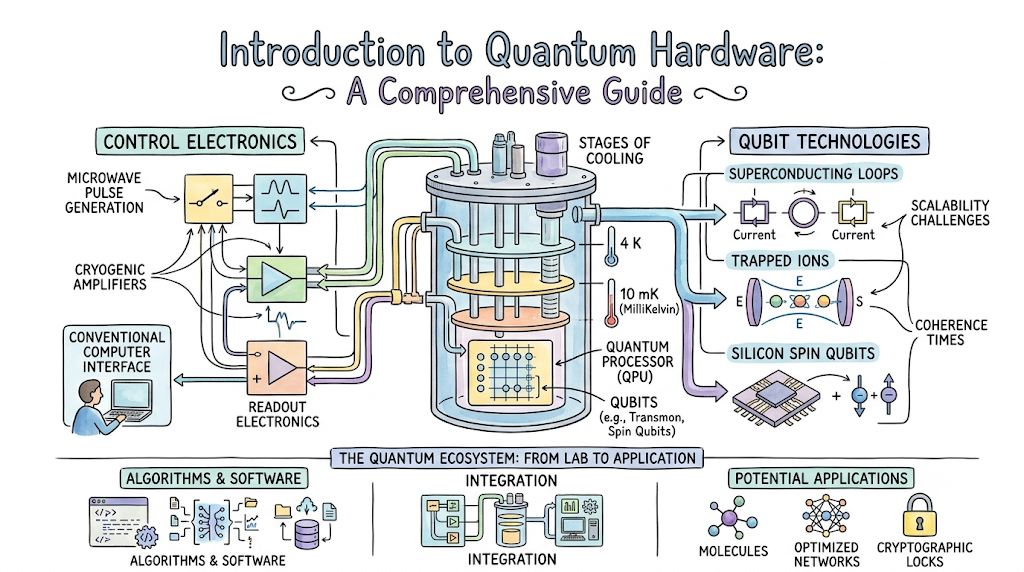
Major Components of Quantum Hardware
A functional quantum computer is an intricate system of interconnected subsystems.
1. Quantum Processor (QPU)
The Quantum Processing Unit is the core chip where qubits reside and interact. It is the quantum equivalent of the classical Central Processing Unit (CPU).
2. Qubits
The physical entities—such as artificial atoms, ions, or particles of light—that store and process quantum information within the QPU.
3. Control Electronics
High-precision instruments that generate, transmit, and route the precise microwave, radiofrequency, or laser pulses required to manipulate the qubits’ states.
4. Cryogenic Systems
Advanced cooling units, primarily dilution refrigerators, that lower the operating environment of certain QPUs to near absolute zero ($0\text{ K}$ or $-273.15^{\circ}\text{C}$).
5. Quantum Interconnects
The channels and wave guides that transport quantum information between different sections of a processor or between separate quantum chips.
6. Readout Systems
Amplifiers and detectors that measure the final state of the qubits at the end of a computation, translating quantum states back into classical 0s and 1s.
7. Classical Computing Components
Co-processors and servers that manage system orchestrations, error tracking, and user interfaces, acting as the bridge between the quantum machine and end users.
Understanding Qubits
What Is a Qubit?
A qubit is any two-level quantum mechanical system used to store information. Its physical manifestation depends entirely on the chosen hardware approach.
Superposition
Superposition allows a qubit to exist in a linear combination of both basic states ($|0\rangle$ and $|1\rangle$) simultaneously. Mathematically, it is represented as:
$$\psi = \alpha|0\rangle + \beta|1\rangle$$
where $\alpha$ and $\beta$ are probability amplitudes.
Entanglement
A unique quantum phenomenon where two or more qubits become deeply interconnected. The state of one qubit instantaneously dictates the state of another, no matter how far apart they are. This allows quantum hardware to share information across components instantaneously during a calculation.
Quantum Measurement
The act of looking at a qubit. Measurement forces a qubit out of its fluid superposition state, causing it to collapse into a definite classical state of either 0 or 1.
Decoherence
The loss of a qubit’s quantum state due to environmental interference. Decoherence turns a quantum superposition back into a standard classical state, destroying the ongoing calculation.
Fidelity
A metric indicating how accurately a quantum hardware component performs an operation compared to an ideal, error-free system. High gate fidelity is vital for reliable computing.
Types of Quantum Hardware Technologies
There is currently no single standard for quantum hardware. Instead, several competing physical modalities are being actively developed.
Superconducting Qubits
- Overview: Utilizes tiny electronic circuits made of superconducting materials that exhibit zero electrical resistance at ultra-low temperatures.
- How It Works: Uses a Josephson junction inside a microcircuit to create an artificial atom. Information is manipulated using microwave pulses.
- Advantages: Fast operation speeds; manufactured using established silicon fabrication techniques.
- Limitations: Short coherence times; requires extreme cryogenic cooling; high susceptibility to material defects.
- Real-World Applications: Optimization problems, early-stage chemical simulations.
- Current Industry Adoption: Heavily championed by IBM, Google, and Rigetti.
Trapped Ion Systems
- Overview: Uses individual, electrically charged atoms (ions) suspended in a vacuum space.
- How It Works: Ions are trapped using electromagnetic fields and manipulated using highly stable laser beams or radiofrequency signals.
- Advantages: Exceptionally long coherence times; identical, naturally occurring qubits; high connectivity between qubits.
- Limitations: Slower gate speeds; complex laser control infrastructure that is difficult to scale on a single chip.
- Real-World Applications: Quantum communication, complex molecular modeling.
- Current Industry Adoption: Led by IonQ and Quantinuum.
Photonic Quantum Computing
- Overview: Uses individual particles of light (photons) as the vehicle for qubits.
- How It Works: Photons route through optical chips containing mirrors, beam splitters, and phase shifters to alter light states.
- Advantages: Can operate at room temperature; naturally immune to electromagnetic interference; ideal for quantum networking.
- Limitations: High photon loss rates; difficult to make photons interact with each other to perform two-qubit logic gates.
- Real-World Applications: Network-distributed quantum computing, secure communications.
- Current Industry Adoption: Driven by PsiQuantum and Xanadu.
Neutral Atom Quantum Computing
- Overview: Utilizes uncharged atoms held in place inside a vacuum chamber using focused beams of light.
- How It Works: Optical tweezers (lasers) arrange arrays of atoms, which are then excited into high-energy “Rydberg states” to interact.
- Advantages: High scalability; ability to arrange thousands of atoms in 2D and 3D configurations.
- Limitations: Sensitive to background gas collisions; requires highly complex laser trapping arrays.
- Real-World Applications: Large-scale quantum simulations of materials.
- Current Industry Adoption: Advanced by companies like Pasqal and QuEra.
Quantum Dots (Silicon Spin Qubits)
- Overview: Traps individual electrons inside miniature semiconductor structures.
- How It Works: Uses tiny electrostatic gates on silicon wafers to capture electrons, using the electron’s spin direction as the qubit.
- Advantages: Incredibly small footprint; highly compatible with existing commercial semiconductor factories.
- Limitations: High susceptibility to nanoscale material variations; requires precise microwave control.
- Real-World Applications: Compact commercial quantum processors.
- Current Industry Adoption: Heavily researched by Intel and specialized academic spin-offs.
Topological Qubits
- Overview: A theoretical approach that creates qubits by braiding non-Abelian anyons (quasiparticles).
- How It Works: Information is stored non-locally in the structural geometry of the system rather than a single physical point.
- Advantages: Built-in hardware protection against decoherence and operational errors.
- Limitations: Extremely difficult to physically engineer and verify the existence of the required quasiparticles.
- Real-World Applications: Highly stable, long-term fault-tolerant quantum computing systems.
- Current Industry Adoption: Primarily researched by Microsoft.
Comparison Table of Quantum Hardware Technologies
| Technology | Speed | Scalability | Error Rate | Complexity | Commercial Maturity |
| Superconducting | Fast (~nanoseconds) | Medium-High | Medium | High (Cryogenic) | High (Cloud-accessible) |
| Trapped Ion | Slow (~microseconds) | Medium | Very Low | High (Optics/Lasers) | High (Cloud-accessible) |
| Photonic | Very Fast (Speed of light) | High | Medium-High | Medium | Medium |
| Neutral Atom | Medium | Very High | Low-Medium | High (Laser Arrays) | Medium-High |
| Quantum Dots | Fast | Very High | Medium | High (Nanofabrication) | Early-Medium |
| Topological | N/A (Theoretical) | High | Extremely Low | Ultra-High | Experimental |
Quantum Hardware Architecture
To operate effectively, a quantum computer requires a layered architecture that bridges the gap between digital software code and physical quantum states.
+-----------------------------------------------------------+
|               Layer 5: Application / Software             |
+-----------------------------------------------------------+
                             |
+-----------------------------------------------------------+
|               Layer 4: Quantum Logic Gates                |
+-----------------------------------------------------------+
                             |
+-----------------------------------------------------------+
|       Layer 3: Control Systems & Signal Generation        |
+-----------------------------------------------------------+
                             |
+-----------------------------------------------------------+
|          Layer 2: Cryogenic / Isolation Shielding          |
+-----------------------------------------------------------+
                             |
+-----------------------------------------------------------+
|               Layer 1: Physical Qubit (QPU)               |
+-----------------------------------------------------------+
Hardware Layers
- Physical Layer: The base layer housing the physical qubits themselves (e.g., the chip surface or the vacuum cell).
- Abstraction/Shielding Layer: The environmental isolation infrastructure, such as vacuum chambers and magnetic shielding plates, protecting the qubits.
- Control Layer: The hardware that translates digital instructions into analog waves (pulses) to manipulate the physical layer.
- Logic Layer: The software-to-hardware compilation system that organizes pulses into logical quantum gates.
Quantum Control Systems
The control system acts as the conductor of the quantum orchestra. It takes digital files containing quantum circuit designs and converts them into precise analog waves with perfect timing.
Signal Generation
Signals must be generated cleanly. For superconducting systems, this involves arbitrary waveform generators (AWGs) creating microwave tones. For atomic systems, it involves radiofrequency synthesizers managing laser modulators.
Error Detection Systems
Dedicated hardware monitors look for real-time anomalies. These systems help identify when environmental interference has disrupted a qubit, enabling modern error detection protocols.
Hardware Integration
Connecting room-temperature classical computers to ultra-cold quantum processors requires specialized wiring. Thousands of coaxial cables must travel down the cooling chamber without introducing heat, presenting a significant engineering challenge.
Cryogenics and Quantum Systems
Why Quantum Computers Need Extreme Cooling
Heat is atomic motion. In superconducting and silicon quantum processors, thermal energy causes atoms to vibrate, which disrupts the fragile state of qubits. Cooling the hardware slows down this atomic motion, minimizing environmental interference.
Dilution Refrigerators
A dilution refrigerator is a specialized cooling system that uses a mixture of two helium isotopes ($^3\text{He}$ and $^4\text{He}$) to achieve ultra-low temperatures without moving parts that cause physical vibration.
Temperature Requirements
Superconducting quantum computers operate at roughly $10\text{ millikelvin}$ ($0.01\text{ K}$). This is colder than the background temperature of deep space, which sits at roughly $2.7\text{ K}$.
Engineering Challenges
Managing thermal dissipation is a major hurdle. Every control wire running from the room-temperature outside world into the refrigerator leaks a tiny amount of heat. As engineers add more qubits, adding more wires risks warming up the refrigerator.
Quantum Error Correction and Hardware Reliability
Sources of Errors
Quantum hardware is highly susceptible to faults. Main sources include:
- Thermal Fluctuations: Residual heat causing accidental qubit state transitions.
- Electromagnetic Cross-talk: Signal leaks from an adjacent control line inadvertently altering a nearby qubit.
- Material Defects: Microscopic imperfections on the chip surface absorbing quantum energy.
Noise
Noise refers to any unwanted environmental disturbance that corrupts quantum information. Minimizing physical noise is a primary focus for modern hardware engineers.
Decoherence
As noted earlier, decoherence is the process where a system slips out of its quantum state due to interacting with its surroundings.
Error Correction Concepts
Because physical qubits are prone to errors, scientists use Quantum Error Correction (QEC). QEC distributes a single unit of reliable quantum information across multiple physical qubits, creating a single, highly stable logical qubit.
[Physical Qubit 1] + [Physical Qubit 2] + [Physical Qubit 3] ---> Combined into One [Logical Qubit]
Fault-Tolerant Quantum Computing
Fault-tolerant quantum computing is the ultimate goal for the industry. It describes a system where hardware can detect and fix errors faster than they occur, enabling long, complex computations without data corruption.
How Quantum Hardware Executes Computation
The journey from a line of software code to a physical measurement follows a strict sequence:
- State Preparation: Qubits are initialized into a known baseline state (typically the ground state, represented as $|0\rangle$).
- Pulse Calibration: The classical control computer retrieves the required algorithm and translates the logical gates into specific physical pulses (microwave or laser).
- Signal Delivery: These pulses travel down through the shielding layers to hit the precise location of the targeted qubits on the processor.
- Quantum Gate Execution: The pulse alters the energy state or phase of the qubits, putting them into superpositions or entangling them with neighboring qubits.
- Computation Execution: A sequence of these pulses runs through the system, manipulating the quantum state across the processor.
- Measurement Process: At the end of the circuit, a final readout pulse passes through the chip. The hardware captures the resulting signal, amplifies it, and converts it into a standard digital 0 or 1.
Quantum Hardware vs. Classical Hardware
| Feature | Classical Hardware | Quantum Hardware |
| Processing Units | Transistors arranged on silicon microchips. | Qubits engineered via superconductors, ions, or photons. |
| Information Storage | Binary states (strictly 0 or 1). | Superposition states (combining 0 and 1 simultaneously). |
| Error Handling | Exceptionally low error rates; handled seamlessly via hardware redundancy. | High error rates; requires complex Quantum Error Correction layers. |
| Scalability | Extremely high (billions of transistors on a single chip). | Developing (currently scaling from hundreds to thousands of physical qubits). |
| Speed | High clock speeds (measured in Gigahertz). | Variable; operations run in nanoseconds to milliseconds depending on the qubit type. |
| Power Consumption | Moderate; primarily used for driving transistors and cooling server racks. | High infrastructure power draw; primarily used to run cryogenic cooling systems. |
| Computational Capability | Optimized for sequential logic, everyday applications, and standard database sorting. | Optimized for highly complex mathematical calculations, molecular simulation, and optimization tasks. |
Leading Organizations Building Quantum Hardware
IBM Quantum
- Approach: Superconducting circuits.
- Key Achievements: Developed the Eagle ($127\text{-qubit}$), Osprey ($433\text{-qubit}$), and Condor ($1,121\text{-qubit}$) processors. Introduced modular quantum architecture designs.
- Focus: Scaling physical qubit counts and building reliable cryogenic systems.
Google Quantum AI
- Approach: Superconducting circuits.
- Key Achievements: Demonstrated historic “quantum supremacy” milestones using their $53\text{-qubit}$ Sycamore processor.
- Focus: Advancing high-fidelity gates and practical quantum error correction protocols.
IonQ
- Approach: Trapped ion systems.
- Key Achievements: Developed compact, rack-mounted trapped-ion systems deployed in commercial data centers.
- Focus: Maximizing algorithmic qubit quality and system connectivity.
Rigetti Computing
- Approach: Superconducting processors.
- Key Achievements: Championed multi-chip modular QPUs, joining multiple smaller processors onto a single substrate.
- Focus: Low-latency co-processing alongside classical cloud systems.
Quantinuum
- Approach: Trapped ion systems (using the quantum charge-coupled device architecture).
- Key Achievements: Consistently achieved record-setting hardware physical fidelity and high quantum volume metrics.
- Focus: Commercial fault-tolerant processing and high-precision physical operations.
PsiQuantum
- Approach: Silicon photonics.
- Key Achievements: Patterned optical quantum components using standard commercial semiconductor manufacturing lines.
- Focus: Building a million-qubit, fully error-corrected photonic quantum machine.
Xanadu
- Approach: Photonic quantum computing using continuous-variable architectures.
- Key Achievements: Demonstrated quantum advantage milestones using their Borealis photonic processor.
- Focus: Developing cloud-accessible photonic platforms and the open-source PennyLane software library.
Intel Quantum Research
- Approach: Silicon spin qubits (quantum dots).
- Key Achievements: Developed the Tunnel Falls $12\text{-qubit}$ silicon chip, leveraging advanced transistor fabrication facilities.
- Focus: Utilizing existing industrial silicon production facilities to mass-produce stable quantum processors.
Real-World Applications Enabled by Quantum Hardware
Drug Discovery
- Hardware Requirement: High-fidelity multi-qubit systems with long coherence times.
- Impact: Simulating the complex quantum-mechanical bonds of molecules directly on quantum hardware, bypassing slow, trial-and-error laboratory screening to discover life-saving medications.
Financial Modeling
- Hardware Requirement: Rapid gate operation speeds and deep circuit execution limits.
- Impact: Running highly complex risk analyses and portfolio optimizations across thousands of changing market variables simultaneously.
Logistics Optimization
- Hardware Requirement: High qubit-to-qubit connectivity.
- Impact: Solving complex scheduling, routing, and supply chain bottlenecks, significantly reducing global shipping costs and emissions.
Material Science
- Hardware Requirement: Scalable analog quantum simulators.
- Impact: Designing lighter, stronger materials, high-efficiency solar cells, and high-temperature superconductors by modeling atomic structures directly.
Cryptography
- Hardware Requirement: Millions of stable, fully error-corrected logical qubits.
- Impact: Breaking standard public-key encryption schemes while simultaneously enabling unhackable quantum key distribution networks.
Artificial Intelligence
- Hardware Requirement: High-speed, low-latency quantum-classical interfaces.
- Impact: Speeding up the training of advanced machine learning models, transforming pattern recognition across massive datasets.
Challenges in Building Quantum Hardware
- Scaling Qubits: Adding more qubits to a processor without causing them to interfere with each other or destabilize the system.
- Noise and Errors: Isolating hardware from background magnetic fields, Wi-Fi signals, and thermal energy to maintain high fidelity.
- Cost: The immense financial investment required to build advanced nanofabrication cleanrooms and source specialized raw materials.
- Manufacturing Complexity: Fabricating atomic-scale features perfectly across an entire wafer without a single misplaced atom.
- Cooling Requirements: Safely scaling cryogenic refrigerators to cool down larger processors that use hundreds of control lines.
- Stability Issues: Maintaining qubit coherence long enough to run complex, multi-step algorithms.
Common Misconceptions About Quantum Hardware
Quantum Computers Will Replace Classical Computers
The Truth: Quantum hardware is designed for specific, highly complex mathematical problems. They will operate as specialized co-processors alongside classical systems, rather than replacing your everyday laptop or smartphone.
More Qubits Always Mean Better Performance
The Truth: Qubit quality (fidelity) matters just as much as qubit quantity. A 50-qubit system with extremely low error rates can easily outperform a 1,000-qubit system with high error rates.
Quantum Computers Are Already Perfect
The Truth: Current systems are still highly sensitive to errors and noise. We are in the developmental phase, working hard to build the first generation of reliable, error-corrected machines.
Quantum Hardware Is Only for Academic Researchers
The Truth: Anyone can access real quantum hardware today. Leading tech companies offer cloud platforms that let students, hobbyists, and developers run programs directly on actual quantum machines from home.
Benefits of Advancements in Quantum Hardware
- Faster Problem Solving: Resolving calculations in minutes that would stall standard computers for years.
- Scientific Innovation: Unlocking a deeper understanding of quantum physics, chemistry, and biology through direct simulation.
- New Computing Capabilities: Empowering industries to tackle entirely new classes of complex, multi-variable problems.
- Economic Opportunities: Driving a new wave of high-tech manufacturing, software ecosystems, and technical jobs.
- Technology Leadership: Establishing essential foundational infrastructure for the next generation of global computing networks.
Skills Needed to Learn Quantum Hardware
If you want to build or research quantum hardware, building a strong multi-disciplinary foundation is key:
+---------------------------------------------------------------------------------+
|                                 LEARNING ROADMAP                                |
+---------------------------------------------------------------------------------+
|  [Physics Fundamentals] ---> [Math & Linear Algebra] ---> [Electronics & RF]  |
|                                                                                 |
|  [Computer Engineering] ---> [Quantum Information]   ---> [Systems Engineering] |
+---------------------------------------------------------------------------------+
- Physics Fundamentals: A solid grasp of quantum mechanics, solid-state physics, optics, and thermodynamics.
- Mathematics: Strong linear algebra, complex numbers, probability, and differential equations.
- Electronics: Understanding radiofrequency (RF) engineering, signal processing, and high-speed microwave electronics.
- Computer Science: Mastering computer architecture, hardware description languages (HDLs), and compilation systems.
- Quantum Information Theory: Understanding quantum circuits, logic gates, and error correction protocols.
- Engineering Concepts: Gaining experience with cryogenic systems, vacuum infrastructure, and cleanroom fabrication techniques.
Future of Quantum Hardware
The roadmap for quantum hardware development points toward several clear breakthroughs:
Fault-Tolerant Quantum Computing
Moving completely past noisy systems by building processors with built-in error correction, capable of running millions of operations without data corruption.
Scalable Quantum Systems
Developing modular quantum microchips that connect together using optical fibers, allowing hardware networks to scale up to millions of active qubits.
Room-Temperature Quantum Devices
Advancing photonic or diamond nitrogen-vacancy systems to reduce our reliance on massive, expensive cooling systems.
Quantum Networking and the Quantum Internet
Connecting separate quantum computers using light signals to share pure quantum information securely over long distances.
Commercial Quantum Data Centers
Integrating quantum computing hardware directly into global cloud data centers, creating a hybrid computing infrastructure available worldwide.
Case Study Section
Case Study 1: Building a Superconducting Quantum Processor
- Objective: Design a stable, cloud-accessible $50\text{-qubit}$ superconducting quantum processor chip.
- Hardware Design: Lithographed aluminum circuits on a high-purity silicon substrate, using Josephson junctions and microwave control lines, cooled to $15\text{ mK}$.
- Challenges: Microscopic material impurities caused unexpected energy loss, reducing qubit coherence times below target limits.
- Results: By switching to an ultra-pure tantalum metal base layer, the team reduced surface defects and successfully achieved average gate fidelities above $99.5\%$.
- Lessons Learned: Material science choices and surface cleanliness are critical factors for improving quantum hardware stability.
Case Study 2: Scaling a Trapped Ion Quantum System
- Objective: Scale a trapped-ion quantum computer from 11 qubits to 32 qubits while maintaining high system connectivity.
- Hardware Design: A micro-fabricated linear ion trap chip housed inside an ultra-high vacuum cell, controlled by automated laser systems.
- Challenges: As more ions were added to the single trap chain, managing individual laser targeting beams grew increasingly difficult, causing signal cross-talk.
- Results: Developed a modular architecture that shuttles ions between distinct processing zones, maintaining clean control without cross-talk.
- Lessons Learned: Shuttling qubits across specialized zones on a chip is an effective way to scale trapped-ion systems without laser crowding.
Case Study 3: Quantum Hardware for Drug Discovery
- Objective: Optimize a noisy quantum processor to simulate a target chemical bond for a pharmaceutical partner.
- Hardware Design: A high-density $27\text{-qubit}$ superconducting array featuring customizable microwave pulse shapes.
- Challenges: High ambient error rates introduced too much noise, obscuring the delicate chemical simulation results.
- Results: Implemented hardware-level error suppression and customized control pulses, lowering noise enough to accurately map the molecule’s ground energy state.
- Lessons Learned: Fine-tuning hardware pulse shapes can significantly boost performance on specific chemistry tasks, even without full error correction.
Case Study 4: Enterprise Quantum Computing Deployment
- Objective: Install a commercial quantum hardware platform directly into an enterprise financial data center.
- Hardware Design: A self-contained, vibration-shielded trapped-ion system that fits into a standard data center server rack.
- Challenges: Typical data center floor vibrations and electromagnetic noise from surrounding server racks disrupted the system’s delicate laser alignments.
- Results: Designed an advanced acoustic and structural isolation enclosure, keeping the system stable in loud, active IT environments.
- Lessons Learned: Deploying quantum systems outside of specialized physics labs requires rugged, industrial-grade environmental shielding.
Case Study 5: University Quantum Research Infrastructure
- Objective: Build a multi-technology quantum testbed to support academic research and train future engineers.
- Hardware Design: A dual-purpose facility featuring both a dilution refrigerator for superconducting chips and an optical bench for photonic networking experiments.
- Challenges: Academic researchers required frequent hardware access, which repeatedly disrupted vacuum seals and cooling cycles.
- Results: Implemented automated fast-load vacuum gates and secondary cooling loops, cutting system down-time from weeks to less than 24 hours.
- Lessons Learned: Designing quantum systems for educational or research settings requires focusing heavily on modular access and quick turnaround times.
Quantum Hardware Maturity Model
The development of quantum hardware follows a clear, multi-stage evolution from early laboratory concepts to fully reliable commercial systems.
+-----------------------------------------------------------------------------------+
|                           HARDWARE MATURITY FRAMEWORK                             |
+-----------------------------------------------------------------------------------+
| Level 1: Experimental ---> Level 2: Lab Systems ---> Level 3: Early Commercial   |
|                                                                                   |
|              Level 4: Scalable Systems ---> Level 5: Fault-Tolerant               |
+-----------------------------------------------------------------------------------+
Level 1 – Experimental Hardware
- Description: Basic proof-of-concept components tested in university physics labs.
- Criteria: Single qubit isolation, short coherence times, manual tuning, and high error rates ($>5\%$).
Level 2 – Laboratory Systems
- Description: Integrated multi-qubit setups used to demonstrate early quantum principles.
- Criteria: 2 to 20 physical qubits working together, multi-qubit gate logic, and stable operation under continuous expert supervision.
Level 3 – Early Commercial Platforms
- Description: Noisy Intermediate-Scale Quantum (NISQ) systems accessible via cloud infrastructure.
- Criteria: 50 to 1000 physical qubits, gate fidelities above $99\%$, automated calibration, and remote user access.
Level 4 – Scalable Quantum Architectures
- Description: Modular systems designed to scale qubit counts rapidly while keeping errors low.
- Criteria: Multi-chip interconnects, advanced error detection hardware, and efficient signal routing infrastructure.
Level 5 – Fault-Tolerant Quantum Computing
- Description: Fully error-corrected quantum computers capable of running any scale of quantum algorithm.
- Criteria: Thousands of stable logical qubits, error rates below $0.0001\%$, and automated real-time error correction.
FAQ Section
- What is quantum hardware?
Quantum hardware includes the physical chips, control systems, cooling rigs, and lasers used to create, protect, and manipulate qubits. - What is a qubit?
A qubit is the basic unit of quantum information. Unlike standard bits, it can exist in superpositions of 0 and 1 simultaneously. - Why do quantum computers need cooling?
Cooling slows down atomic vibrations and reduces environmental heat, protecting fragile qubits from losing their data. - Which quantum hardware technology is most popular?
Superconducting circuits and trapped ion platforms currently lead the industry, with photonic and neutral-atom systems gaining rapid ground. - How expensive is quantum hardware?
Custom quantum hardware systems cost millions of dollars to build and maintain, which is why most users access them via cloud platforms. - What causes quantum errors?
Errors are caused by environmental noise, heat leaks, stray magnetic fields, and microscopic defects in the hardware materials. - Can anyone learn quantum hardware?
Yes. Anyone with an interest in physics, engineering, or computer science can learn the core principles of quantum hardware architecture. - What careers exist in quantum computing?
Opportunities include roles for hardware design engineers, cryogenic technicians, control systems experts, material scientists, and quantum software developers. - How close are we to practical quantum computers?
We are currently in the intermediate era, with cloud-accessible machines running early tasks while we work toward full error correction. - What skills are required to work with quantum hardware?
Key skills include strong backgrounds in physics, linear algebra, electronics, system automation, and computer engineering. - What is a dilution refrigerator?
A specialized cooling device that uses helium isotopes to lower a quantum processor’s environment to near absolute zero. - Can a quantum computer run at room temperature?
Most designs require extreme cooling, but photonic and diamond defect platforms show promise for room-temperature operation. - What is gate fidelity?
A metric that shows how accurately a physical quantum system executes a command compared to an ideal, error-free operation. - What is the difference between a physical qubit and a logical qubit?
A physical qubit is an individual quantum system prone to errors, while a logical qubit combines multiple physical qubits to correct those errors. - What is a quantum processor unit (QPU)?
The physical microchip that contains the qubits and executes quantum operations, similar to a CPU in a standard computer. - How does cross-talk affect quantum hardware?
Cross-talk happens when a control signal meant for one qubit accidentally bleeds into and disrupts a neighboring qubit. - What are quantum interconnects?
Physical links or optical paths that share quantum states safely between separate components or microchips. - What role does silicon play in quantum hardware?
Silicon is used as a base substrate for superconducting chips and acts as the host material for silicon spin qubits. - How do lasers control qubits?
In atomic systems, precisely timed laser beams hit atoms to alter their energy levels and execute logic gates. - How can I run a program on a real quantum computer?
You can write quantum code using open-source tools and upload it to real hardware via cloud services provided by IBM, AWS, or Azure.
Final Summary
Quantum hardware is the vital physical foundation supporting the entire quantum computing revolution. From superconducting loops cooled past the temperature of deep space to individual atoms suspended in vacuum chambers by lasers, this field is a masterclass in modern physics and advanced engineering. Developing reliable systems requires a clear understanding of components like QPUs, cryogenic infrastructure, and precision control systems.
As the industry moves from today’s noisy, intermediate-scale systems toward highly stable, fault-tolerant architectures, the demand for skilled researchers, engineers, and tech-savvy professionals will continue to grow. Exploring how these machines operate opens up a deeper understanding of computation and the physical universe.
