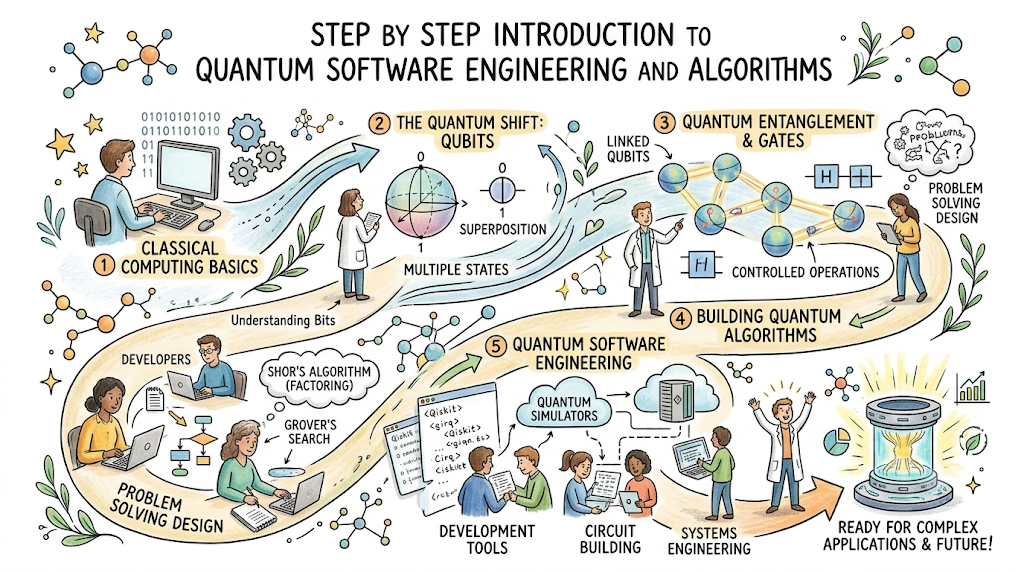
Introduction
The global tech landscape is experiencing a profound shift. For decades, classical microprocessors have advanced at a predictable pace, packing billions of transistors onto tiny silicon chips. However, physics is reaching its absolute limits. As silicon components shrink to the size of a few atoms, standard electrical currents begin to leak, causing traditional hardware to stall. This physical bottleneck has turned industry attention toward an entirely different paradigm of processing: quantum computing.
Traditional computers are exceptional at managing spreadsheets, streaming high-definition video, and executing standard business logic. Yet, they struggle immensely when faced with large-scale combinatorial problems. When a system requires calculating trillions of variables simultaneously—such as optimizing global logistics routes, simulating molecular bonds for healthcare, or cracking complex encryption codes—classical hardware must evaluate every option one after another. This sequential approach creates an insurmountable computational wall. At QuantumUting, we believe that demystifying these concepts is the first step toward building the software systems of tomorrow. By understanding how quantum algorithms operate, software developers, engineering students, and tech professionals can prepare for a new era of computational science.
Understanding Quantum Computing Fundamentals
What Is Quantum Computing?
Quantum computing is a completely new approach to processing information based on the principles of quantum mechanics. Instead of relying on the standard electrical currents used in everyday devices, quantum systems isolate subatomic particles, such as electrons or photons, to perform complex mathematical operations.
Classical Computing vs Quantum Computing
Classical systems process information using transistors that act as simple electronic switches. These switches represent distinct, isolated values. Quantum computing utilizes the intrinsic physical properties of microscopic particles, allowing systems to manage highly complex states of information that classical hardware cannot even represent.
What Is a Qubit?
Definition
A qubit, or quantum bit, is the foundational unit of information utilized by a quantum computer.
Why It Matters
Unlike a standard digital bit that is rigid and constrained, a qubit can hold vastly more complex information states, allowing a system to scale its processing capacity exponentially.
Beginner Example
Think of a traditional computer bit as a standard wall light switch that can only be turned completely ON or completely OFF. A qubit is like a sophisticated dimmer switch that can be set to ON, OFF, or any precise level of brightness in between.
Real-World Application
In advanced laboratory environments, specialized engineering teams use superconducting circuits cooled to temperatures colder than deep space to isolate and control these individual qubits.
Future Relevance
As hardware platforms stabilize, engineers will control millions of stable qubits, allowing systems to perform deep computations that are entirely impossible with classical chips.
In Simple Terms: A regular computer bit can only be a 0 or a 1. A qubit can be a 0, a 1, or any fluid combination of both at the exact same time.
Superposition Explained
Definition
Superposition is the physical ability of a quantum particle to exist in multiple distinct states or configurations simultaneously until it is observed or measured.
Why It Matters
This principle allows a quantum computer to evaluate millions of potential solutions to a complex problem at the exact same time, rather than checking them one by one.
Beginner Example
Imagine spinning a coin on a table. While the coin is actively spinning, it is not definitively a head or a tail. It exists in a fluid, continuous blur of both possibilities at the same time. Only when you slap your hand down and stop the coin does it collapse into a single state: heads or tails.
Real-World Application
Quantum software developers use superposition to load massive databases into a active processor simultaneously, drastically shortening search timelines.
Future Relevance
Superposition will serve as the foundation for rapid data analysis across vast, unstructured global data sets, transforming standard search technologies.
In Simple Terms: Superposition allows a quantum computer to keep all doors open at once during a calculation, instead of walking through them one at a time.
Entanglement Explained
Definition
Entanglement is a unique quantum phenomenon where two or more particles become deeply interconnected, causing the physical state of one particle to instantly dictate the state of the other, no matter how far apart they are.
Why It Matters
Entanglement enables qubits to share data instantaneously, creating a highly coordinated processing network where the computational power doubles with every qubit added.
Beginner Example
Imagine you have a pair of magical coins placed into two separate boxes. You give one box to a friend who travels to the opposite side of the world. The moment you open your box and see your coin lands on heads, your friend’s coin instantly stops spinning and lands on tails, perfectly reacting to your coin.
Real-World Application
This property is used to develop hyper-secure communication networks that alert operators instantly if an outside party attempts to intercept or observe the data transmission.
Future Relevance
Entanglement will drive the creation of a global quantum internet, allowing ultra-secure data transfers between research laboratories and financial hubs worldwide.
In Simple Terms: Entanglement acts like an invisible, instant data link between particles, allowing qubits to work together in perfect harmony.
Quantum Gates Explained
Definition
A quantum gate is a physical, mathematical operation that alters the state of one or more qubits, acting as the fundamental building block of quantum circuits.
Why It Matters
Just as classical logic gates (like AND, OR, NOT) manipulate regular bits to perform arithmetic, quantum gates manipulate the probabilities of qubits to guide a system toward a correct solution.
Beginner Example
Think of a quantum gate as a precise tap given to a spinning coin. By tapping the coin at a specific angle, you alter how it spins, changing the likelihood of whether it lands on heads or tails when it finally stops.
Real-World Application
Programmers compile high-level quantum code down into specific gate sequences, such as the Hadamard gate or the Controlled-NOT (CNOT) gate, to run simulations on real hardware.
Future Relevance
Standardized gate sets will allow developers to write cross-platform software that runs seamlessly on any type of quantum hardware architecture.
Key Takeaways
- Classical bits are strictly binary, while qubits use quantum mechanics to hold complex, fluid states.
- Superposition allows a system to process multiple possibilities at once, while entanglement links qubits for coordinated computational power.
- Quantum gates manipulate these states, serving as the essential building blocks for all quantum software programs.
What Are Quantum Algorithms?
Definition of Quantum Algorithms
A quantum algorithm is a step-by-step procedure designed to execute on a quantum computer. It consists of a carefully choreographed sequence of quantum gates that manipulate qubits to solve complex mathematical equations.
Why Quantum Algorithms Matter
Traditional algorithms are bound by linear mathematics. As a problem grows linearly, the time and computing resources needed to solve it often grow exponentially. Quantum algorithms break this barrier by utilizing physics to alter the very nature of information processing.
How Quantum Algorithms Work
Instead of calculating every wrong answer to a problem, a quantum algorithm uses constructive and destructive interference. It behaves like noise-canceling headphones, which use inverted sound waves to erase background noise. The algorithm amplifies the wave patterns of the correct answer while flattening and canceling out the wave patterns of incorrect answers. When the system is measured, the wrong answers vanish, leaving only the correct solution.
Quantum Speedup Explained
Quantum speedup describes how much faster a quantum algorithm can solve a problem compared to the absolute best classical algorithm available. This speedup is generally classified into two distinct types:
- Polynomial Speedup: The quantum system provides a steady, valuable acceleration, reducing a task that takes millions of steps down to thousands of steps.
- Exponential Speedup: The quantum system provides a massive leap in performance, reducing a calculation that would take a classical supercomputer billions of years down to just a few minutes.
Classical Algorithms vs Quantum Algorithms
| Feature | Classical Algorithms | Quantum Algorithms |
| Data Unit | Binary Bits (0 or 1) | Quantum Qubits (0, 1, or both) |
| Processing Method | Sequential or Basic Parallelism | Superposition and Entanglement |
| Core Mechanism | Voltage changes in transistors | Wave interference and probability shifts |
| Best Suited For | Daily software, web browsing, databases | Molecular simulation, cryptanalysis, optimization |
| Scaling Limitations | Fails when combinations scale excessively | Handles vast combinatorics efficiently |
Key Takeaways
- Quantum algorithms use wave interference to amplify correct answers and cancel out wrong ones.
- Quantum speedup can be polynomial or exponential, completely redefining what problems are solvable.
- These algorithms do not just run faster classical logic; they use entirely different physics to process data.
Building Blocks of Quantum Algorithms
To understand how a quantum algorithm functions in practice, it helps to examine how individual components assemble into a complete, working system.
[ Qubit Initialization ] ──> [ Quantum Gates ] ──> [ Quantum Circuit ] ──> [ Measurement ]
Qubits
The system begins by initializing a set of qubits into a known, predictable starting state. This baseline state is typically clean and uniform, serving as the raw canvas for the computation.
Quantum States
Once initialized, the qubits are driven into complex quantum states using specific external fields. These states hold the delicate mathematical probabilities that represent the problem data.
Quantum Gates
The algorithm applies a series of quantum gates in a precise order. Each gate shifts the orientation, phase, or relationship of the qubits, systematically executing the steps of the program.
Quantum Circuits
A quantum circuit is the collective diagram or pathway of gates operating on the qubits over a specific period. Developers design these circuits to guide the qubits through their calculations without disrupting their delicate states.
Measurement
The final step of any quantum algorithm is measurement. Up until this point, the data remains hidden in a cloud of probabilities. Measuring the qubits forces them to drop their quantum properties and collapse into standard 0s and 1s, which can be read and verified by a traditional computer.
Key Takeaways
- Every quantum algorithm moves systematically from initialization through gate manipulation to final measurement.
- Quantum circuits map out how information flows through gates over time.
- The act of measurement destroys the quantum state, turning the final result into standard digital data.
Most Important Quantum Algorithms for Beginners
1. Deutsch-Jozsa Algorithm
Definition
The Deutsch-Jozsa algorithm was one of the first quantum procedures ever designed that successfully demonstrated a definitive advantage over classical computing methods.
Simple Example
Imagine you have a coin that is either a standard coin with one head and one tail (balanced), or a trick coin with heads on both sides (constant). A classical computer must look at both sides of the coin to be completely sure which type it is. The Deutsch-Jozsa algorithm can determine if the coin is balanced or constant by looking at it only a single time.
Business Relevance
While the problem it solves is purely theoretical, this algorithm proved to the scientific community that quantum hardware could solve abstract logic problems faster than standard computing systems.
Future Impact
It serves as the introductory blueprint for teaching developers how to exploit quantum phase interference to evaluate global properties of a mathematical function.
In Simple Terms: This algorithm proved that a quantum system can evaluate the overall nature of a function in a single step, whereas a classical system requires multiple checks.
2. Bernstein-Vazirani Algorithm
Definition
The Bernstein-Vazirani algorithm is a specialized procedure designed to find a hidden binary string or secret code hidden inside a mathematical black box in a single attempt.
Simple Example
Imagine someone hides a secret zip code, like 54321, inside a computer program. A standard computer has to guess the numbers one by one, asking a series of questions to figure out the whole code. The Bernstein-Vazirani algorithm reads the entire hidden code all at once, solving the riddle instantly.
Business Relevance
This algorithm demonstrates how quantum structures can optimize database queries and find hidden patterns in complex data streams without performing repetitive searches.
Future Impact
The core concepts of this method are being adapted to develop advanced network diagnostics and error-checking protocols for quantum communication systems.
In Simple Terms: Instead of guessing a secret code character by character, this algorithm reveals the entire hidden message in a single operation.
3. Simon’s Algorithm
Definition
Simon’s algorithm solves a specialized mathematical problem focused on finding a specific periodic pattern or repeating cycle hidden within a large function.
Simple Example
Imagine a massive, complex clock that ticks in an unusual, repeating pattern of skips and jumps. To figure out exactly how long it takes for the entire pattern to repeat, a classical computer would have to sit and watch the clock tick for days. Simon’s algorithm analyzes the gears all at once and determines the exact repeating cycle almost instantly.
Business Relevance
Simon’s algorithm exposed critical vulnerabilities in classical cryptographic designs, prompting security experts to rethink how data is protected.
Future Impact
This work directly inspired the creation of more advanced algorithms, laying the groundwork for systems that can analyze complex periodic structures in data.
In Simple Terms: This algorithm excels at finding hidden, repeating patterns inside massive data sets far faster than traditional methods.
4. Grover’s Algorithm
Definition
Grover’s algorithm is a highly versatile quantum procedure that provides a significant polynomial speedup when searching through completely unstructured, unsorted databases.
Simple Example
Imagine you are looking for a single specific name in a massive city phone book containing millions of entries, but the book is completely randomized instead of being sorted alphabetically. A classical computer must read every single name one after another. Grover’s algorithm shifts the quantum probabilities so that the correct name stands out clearly, finding it in a fraction of the attempts.
Business Relevance
Modern enterprises manage massive volumes of unstructured data. Grover’s algorithm can drastically accelerate database searches, big data mining, and complex pattern-matching tasks across global corporate servers.
Future Impact
As data volumes scale, this algorithm will optimize logistics, streamline web search indexes, and allow organizations to process deep analytics queries in real time.
In Simple Terms: Grover’s algorithm acts like a high-powered metal detector for unsorted data, finding a needle in a haystack with remarkable speed.
5. Shor’s Algorithm
Definition
Shor’s algorithm is a powerful quantum procedure capable of finding the prime factors of extremely large integers with an exponential speedup compared to classical systems.
Simple Example
If you multiply two small prime numbers together, like 3 and 5, you get 15. Going backward from 15 to find 3 and 5 is easy. But if you multiply two prime numbers that are hundreds of digits long, a classical supercomputer would take billions of years to figure out what those original prime numbers were. Shor’s algorithm breaks this massive number down in minutes.
Business Relevance
Almost all modern digital security, including online banking, encrypted messaging, and corporate networks, relies on the fact that factoring large numbers is too difficult for classical computers. Shor’s algorithm proves that a large-scale quantum computer could break this standard encryption, forcing industries to build entirely new security infrastructures.
Future Impact
This algorithm completely changed the trajectory of quantum computing research. It forced global governments and financial institutions to invest heavily in post-quantum cryptography to secure sensitive data before powerful quantum hardware arrives.
In Simple Terms: Shor’s algorithm is famous because it can break the complex mathematical locks that currently secure the entire modern internet.
Key Takeaways
- Early algorithms like Deutsch-Jozsa and Simon’s provided the theoretical proof that quantum computing works.
- Grover’s algorithm provides a valuable polynomial speedup for searching unsorted databases.
- Shor’s algorithm delivers an exponential speedup for factoring numbers, redefining modern cybersecurity requirements.
How Quantum Algorithms Differ from Classical Algorithms
Sequential Processing vs Quantum Parallelism
Classical computers execute code line by line. Even with multi-core processors, they split tasks into discrete pipelines that run alongside each other. Quantum algorithms utilize quantum parallelism. Because qubits exist in a state of superposition, a quantum system evaluates all potential inputs to a problem simultaneously, processing a vast landscape of possibilities at once.
Search Problems
When searching an unindexed database, a classical algorithm uses linear search, checking items one by one. If there are $N$ items, it takes an average of $N/2$ steps to find the target. Grover’s algorithm utilizes quantum states to find the target in approximately $\sqrt{N}$ steps, offering a massive reduction in processing time as databases grow.
Optimization Problems
Finding the absolute most efficient route for hundreds of delivery trucks across a global supply chain creates too many combinations for standard hardware. A classical system settles for a close guess. Quantum algorithms evaluate all combinations at once, using interference to cancel out inefficient routes and highlight the single most optimal path.
Cryptographic Problems
Modern encryption relies on hard mathematical problems that classical computers cannot easily reverse. Quantum algorithms approach these problems from a completely different angle. By using phase estimation and period finding, they bypass the digital walls that keep classical systems locked out.
Computational Complexity
Computer science categorizes problems by how difficult they are to solve as they grow larger. Quantum algorithms shift problems out of hard complexity classes into manageable ones.
┌──────────────────────────────────────────────┐
│  Classical Complexity (Exponential Growth)   │  ──> Takes billions of years
└──────────────────────────────────────────────┘
                       VS
┌──────────────────────────────────────────────┐
│   Quantum Complexity (Polynomial Growth)    │  ──> Takes a few minutes
└──────────────────────────────────────────────┘
This fundamental shift turns problems that would take billions of years of classical calculation into tasks that take just a few minutes.
Key Takeaways
- Classical systems process tasks sequentially, while quantum systems use parallelism to evaluate all paths at once.
- Quantum algorithms reduce the steps needed for search tasks from linear scales down to square-root scales.
- Complex mathematical barriers that stop classical supercomputers are handled efficiently by quantum logic.
Real-World Applications of Quantum Algorithms
Cybersecurity and Cryptography
- Problem: Current encryption methods can be cracked by advanced factoring techniques.
- Quantum Approach: Organizations apply quantum-safe algorithms and Quantum Key Distribution (QKD) to protect data networks.
- Potential Benefits: This creates completely unhackable communication channels, protecting national infrastructure and sensitive corporate secrets from digital theft.
Drug Discovery and Healthcare
- Problem: Simulating how a new medicine interacts with human proteins requires tracking trillions of molecular combinations, a process that takes drug companies decades of manual laboratory testing.
- Quantum Approach: Quantum simulation algorithms model molecular structures down to the atomic level with perfect precision.
- Potential Benefits: This shortens the time needed to discover life-saving medications from decades down to days, allowing researchers to design customized therapies rapidly.
Financial Modeling and Risk Management
- Problem: Global markets fluctuate based on millions of shifting variables, making long-term risk assessment and portfolio optimization highly inaccurate.
- Quantum Approach: Financial institutions use quantum amplitude estimation to simulate thousands of market scenarios simultaneously.
- Potential Benefits: This allows banks to optimize investment portfolios, manage risk with extreme precision, and detect fraudulent trading patterns instantly.
Supply Chain and Logistics Optimization
- Problem: Managing fleet routing, warehouse inventory, and global shipping lanes involves billions of moving pieces that quickly overwhelm standard logistics software.
- Quantum Approach: Optimization algorithms calculate every possible variable, route, and delay concurrently.
- Potential Benefits: This minimizes global fuel consumption, shortens delivery timelines, and builds resilient supply chains that adapt to disruptions instantly.
Material Science
- Problem: Creating stronger, lighter, or more conductive materials requires understanding complex quantum interactions inside molecular matrices.
- Quantum Approach: Quantum systems simulate electronic structures to predict how new chemical compounds will behave.
- Potential Benefits: This accelerates the development of long-lasting solid-state batteries, high-efficiency solar cells, and room-temperature superconductors.
Key Takeaways
- Quantum algorithms solve the specific atomic-scale problems that hold back modern drug discovery and material science.
- Global logistics and financial markets benefit from the rapid, multi-variable calculations these systems provide.
- The security sector is actively adapting to quantum processing to protect global data infrastructure.
Quantum Algorithms in AI and Machine Learning
Quantum Machine Learning
Quantum Machine Learning (QML) integrates quantum processing into standard artificial intelligence architectures. Rather than replacing traditional machine learning models, QML infuses quantum subroutines into existing networks to optimize how complex data sets are analyzed.
Data Processing Improvements
Traditional AI models struggle to process hyper-dimensional data sets containing millions of complex features. Quantum algorithms map this data into vast quantum states, allowing systems to discover hidden correlations and structures that classical neural networks miss.
Optimization Advantages
Training deep neural networks requires adjusting billions of internal weights and biases to minimize errors. This optimization process can take weeks on massive classical server farms. Quantum optimization techniques find the ideal configuration much faster, accelerating AI training pipelines.
Future AI Possibilities
While general artificial intelligence remains a long-term concept, early QML algorithms show great promise for advancing autonomous driving systems, improving natural language processing models, and creating highly accurate weather prediction systems.
In Simple Terms: Quantum AI adds a high-powered mathematical engine to standard machine learning, helping computers spot patterns and learn much faster.
Key Takeaways
- Quantum Machine Learning speeds up the training process for large AI models.
- These algorithms process hyper-dimensional data sets far more effectively than classical networks.
- Early implementations complement existing AI systems rather than replacing them entirely.
Quantum Programming Frameworks
As the industry matures, soft engineering teams do not need to build physical quantum hardware to begin writing code. Several comprehensive software development kits (SDKs) allow developers to build, test, and run quantum circuits using standard programming languages like Python.
Qiskit
- Purpose: An open-source framework developed by IBM for working with quantum circuits, pulses, and algorithms.
- Beginner Suitability: Highly suitable for beginners due to its massive global community, extensive documentation, and free cloud access to real quantum hardware.
- Learning Benefits: Developers learn how to build circuits step-by-step and run them directly on active quantum systems over the cloud.
Cirq
- Purpose: Google’s specialized open-source framework designed for writing, manipulating, and optimizing quantum circuits for Noisy Intermediate-Scale Quantum (NISQ) processors.
- Beginner Suitability: Intermediate; it focuses heavily on the low-level details of specific hardware architectures.
- Learning Benefits: Provides excellent insight into how quantum software interacts with physical hardware constraints and error-correction methods.
PennyLane
- Purpose: A cross-platform Python library developed by Xanadu, designed specifically for quantum machine learning and quantum chemistry applications.
- Beginner Suitability: Highly suitable for data scientists and AI enthusiasts who want to blend quantum concepts with standard machine learning tools.
- Learning Benefits: Seamlessly connects quantum hardware with popular machine learning libraries like PyTorch and TensorFlow.
Ocean SDK
- Purpose: D-Wave’s specialized suite of open-source tools designed to solve complex optimization problems using quantum annealing.
- Beginner Suitability: Good for beginners focused entirely on logistics, routing, and industry optimization problems.
- Learning Benefits: Teaches developers how to reframe real-world problems into mathematical models that quantum systems can solve.
Amazon Braket
- Purpose: A fully managed cloud service that provides a unified development environment to access quantum computers from various hardware providers.
- Beginner Suitability: Excellent for enterprise developers who want to test their code across multiple physical architectures without locking themselves into one provider.
- Learning Benefits: Allows developers to compare how different types of quantum hardware execute the exact same algorithm.
Quantum Programming Frameworks Comparison
| Framework | Primary Developer | Best For | Learning Curve | Hardware Access |
| Qiskit | IBM | General Quantum Software | Beginner Friendly | Direct IBM Cloud Access |
| Cirq | NISQ Hardware Research | Intermediate | Google Quantum Computing Service | |
| PennyLane | Xanadu | Quantum Machine Learning | Beginner Friendly | Multi-platform Integration |
| Ocean SDK | D-Wave | Quantum Annealing | Intermediate | D-Wave Leap Cloud |
| Amazon Braket | Amazon | Multi-Hardware Testing | Professional | Diverse Third-Party Hardware |
Key Takeaways
- You do not need a physics degree to start coding; open-source Python libraries make quantum programming accessible today.
- Qiskit offers an excellent ecosystem for general beginners, while PennyLane excels at quantum machine learning.
- Cloud services like Amazon Braket allow developers to test their software across multiple hardware systems.
Challenges of Quantum Algorithms
Hardware Limitations
Building a physical quantum computer is a massive engineering challenge. Qubits must be kept completely isolated from the outside world. Any slight change in temperature, electromagnetic interference, or physical vibration can disrupt the delicate quantum state.
Noise and Errors
When a qubit interacts with its surrounding environment, it experiences decoherence, losing its quantum properties and introducing calculation errors into the program. Current systems are noisy, requiring a large portion of their computing power just to detect and correct these internal errors.
Limited Qubit Availability
While modern classical chips contain billions of stable transistors, contemporary quantum processors contain only dozens or hundreds of physical qubits. This constraint limits the scale and complexity of the algorithms developers can currently execute.
Algorithm Complexity
Designing a functional quantum algorithm requires a completely different mindset than traditional programming. Developers cannot simply copy classical logic over to a quantum system; they must design code from scratch using complex probability amplitudes.
Scalability Challenges
Scaling up a quantum computer requires more than just adding more particles to a chip. It involves building complex cooling systems, low-latency control wiring, and robust error-correction systems that can manage thousands of interconnected qubits simultaneously.
Key Takeaways
- Quantum hardware is highly sensitive to environmental noise, which can cause calculation errors.
- Current systems are constrained by small qubit counts, limiting the size of practical programs.
- Developing quantum code requires a fundamental shift in programming logic and software design.
Common Beginner Mistakes
Focusing Only on Theory
Many beginners spend months reading complex academic papers on quantum mechanics without ever writing a line of code. The best way to learn is by doing. Open up a development environment, import a framework like Qiskit, and build a simple circuit yourself.
Ignoring Linear Algebra Basics
Quantum computing is built on vectors, matrices, and complex numbers. Skipping these mathematical fundamentals makes it incredibly difficult to understand how quantum gates manipulate qubits. Spending a few days mastering linear algebra basics makes learning quantum algorithms much smoother.
Expecting Immediate Commercial Impact
Beginners often expect quantum computers to replace their personal laptops and solve all corporate data challenges immediately. In reality, quantum systems are specialized tools designed for specific complex problems, and widespread commercial adoption will roll out steadily over time.
Misunderstanding Quantum Speedup
A common misconception is that quantum computers simply run traditional software at hyper-fast speeds. Quantum hardware does not accelerate web browsing or video rendering; it provides an advantage only for specific algorithms designed around quantum physics.
Skipping Hands-On Practice
Reading about Grover’s or Shor’s algorithm provides a helpful conceptual overview, but you truly understand them only when you program them yourself. Use open-source simulators to visualize how your code alters qubit probabilities throughout a calculation.
Key Takeaways
- Balance your reading with hands-on coding practice using cloud-based simulators.
- Do not skip the mathematical basics; mastering basic linear algebra makes quantum concepts much clearer.
- Realize that quantum systems are highly specialized accelerators, not general replacements for everyday computers.
How to Start Learning Quantum Algorithms
Starting your journey into quantum software engineering can feel overwhelming, but following a structured learning path keeps your progress steady and manageable.
Step 1: Learn Quantum Computing Basics
Begin by mastering core concepts like qubits, superposition, and entanglement. Focus on developing a strong conceptual understanding before diving into the code.
Step 2: Understand Qubits and Gates
Study how basic quantum gates manipulate single qubits. Learn to use the Bloch Sphere to visualize how different operations shift a qubit’s position and phase.
Step 3: Study Foundational Algorithms
Examine early algorithms like Deutsch-Jozsa and Bernstein-Vazirani. These simpler procedures show you exactly how quantum interference works in practice, preparing you for more advanced topics.
Step 4: Practice Using Quantum Simulators
Write your first programs and test them using local simulators on your computer. Simulators give you a perfect environment to test ideas, catch bugs, and view circuit behaviors without needing real hardware access.
Step 5: Explore Quantum Programming
Once your code runs smoothly on a simulator, use platforms like Qiskit to send your circuits to real quantum processors over the cloud. Compare the real hardware results with your simulator data to see how noise impacts calculations.
Key Takeaways
- Start with core concepts before jumping into complex programming setups.
- Use simulators to test and debug your code safely and efficiently.
- Progress steadily from basic single-qubit gates to multi-qubit algorithms.
Future of Quantum Algorithms
Fault-Tolerant Quantum Computing
The ultimate goal of quantum engineering is achieving fault-tolerant quantum computing. This milestone describes a system that can run complex algorithms for hours without failing, automatically correcting internal errors using quantum error correction codes.
Quantum Advantage
Quantum advantage occurs when a quantum system solves a real-world, practical business problem significantly faster or cheaper than any classical supercomputer on Earth. As hardware continues to improve, industries approach this threshold across optimization, chemistry, and finance.
Hybrid Classical-Quantum Systems
The near future of enterprise computing relies on hybrid architectures. Instead of running an entire application on a quantum system, a traditional data center handles the bulk of the software logic, passing only the most complex mathematical bottlenecks to a quantum accelerator.
┌─────────────────────────────┐
│ Classical Data Center       │ ──(Handles regular code)
└─────────────────────────────┘
               │
               ▼  [Passes complex bottleneck]
┌─────────────────────────────┐
│ Quantum Processor Core      │ ──(Runs specialized algorithm)
└─────────────────────────────┘
Industry Adoption
Global enterprises across automotive, aerospace, finance, and energy sectors are establishing dedicated quantum computing teams. These organizations are writing custom algorithms today to ensure they are ready to capture market advantages the moment hardware scales up.
Emerging Research Areas
Active research teams explore new frontiers like Quantum Machine Learning, Quantum Neural Networks, and decentralized quantum sensing networks. These cutting-edge fields will expand what is possible in data analysis and automated discovery.
Key Takeaways
- Future systems will use robust error-correction codes to eliminate calculation noise entirely.
- Enterprise adoption focuses heavily on hybrid systems that blend classical and quantum power.
- Early preparation allows industries to capture immediate advantages as hardware reaches maturity.
Real-World Career Opportunities
The growth of the quantum computing industry creates an entirely new ecosystem of professional career paths for developers, engineers, and researchers.
Quantum Software Developer
- Role: Writes high-level quantum programs, builds application interfaces, and integrates quantum cloud services with existing corporate software systems.
- Required Skills: Proficiency in Python, experience with frameworks like Qiskit or PennyLane, and a solid understanding of software engineering best practices.
Quantum Research Scientist
- Role: Designs completely new quantum algorithms, explores complex computational theory, and advances error-correction methodologies.
- Required Skills: Advanced degree (PhD) in physics, mathematics, or computer science, along with deep expertise in quantum information theory.
Quantum Algorithm Engineer
- Role: Takes abstract mathematical concepts from research teams and refines them into efficient, real-world circuits optimized for specific hardware platforms.
- Required Skills: Strong background in linear algebra, computational complexity, and hands-on experience with quantum circuit optimization tools.
Quantum Computing Consultant
- Role: Bridges the gap between technical teams and business executives, helping enterprises identify how quantum technology can optimize their daily operations.
- Required Skills: Deep industry knowledge, excellent communication skills, and a clear understanding of what quantum algorithms can and cannot do.
Academic Research Roles
- Role: Teaches the next generation of students, publishes foundational research papers, and leads university-funded development labs.
- Required Skills: Strong passion for education, deep technical mastery, and a proven track record of academic publication.
Key Takeaways
- The industry requires both low-level physical scientists and high-level software developers.
- Software roles focus on Python proficiency and integrating quantum cloud services into traditional networks.
- Consultants play a critical role in helping businesses safely navigate adoption timelines.
Quantum Algorithm Comparison Table
| Algorithm | Primary Purpose | Computational Advantage | Primary Target Industries |
| Deutsch-Jozsa | Determines if a function is constant or balanced in one step | Exponential speedup over classical methods for this specific task | Academic Research, Theoretical Physics |
| Bernstein-Vazirani | Finds a hidden binary string inside a function in a single query | Linear to single-step reduction in processing time | Data Processing, Network Diagnostics |
| Simon’s | Discovers hidden periodic patterns inside large data sets | Exponential speedup over classical algorithms | Cryptanalysis, Security Foundations |
| Grover’s | Searches unstructured, unsorted databases efficiently | Quadratic/Polynomial speedup ($\sqrt{N}$ steps) | Logistics, Big Data Analytics, Web Search |
| Shor’s | Finds prime factors of extremely large integers | Exponential speedup over classical methods | Cybersecurity, Finance, Cryptography |
FAQ Section
What is a quantum algorithm?
A quantum algorithm is a step-by-step set of instructions designed to run on a quantum computer. It utilizes unique quantum mechanical principles, such as superposition, entanglement, and wave interference, to solve complex mathematical problems far faster than traditional computing software.
Is quantum computing difficult to learn?
While the underlying physics is complex, learning to program quantum algorithms is highly accessible for anyone with a basic background in Python and linear algebra. Modern open-source frameworks hide the complex low-level physics, allowing you to focus completely on circuit logic.
What is the most famous quantum algorithm?
Shor’s algorithm is widely considered the most famous quantum algorithm because it proved that a large-scale quantum computer could easily break the prime-number factorization methods that secure modern digital encryption and global financial networks.
Why is Shor’s algorithm important?
Shor’s algorithm is vital because it demonstrated the first clear, world-changing exponential speedup over classical supercomputers. Its creation launched the modern quantum computing race, forcing industries to develop post-quantum encryption standards to keep data safe.
Can I learn quantum computing without physics?
Yes, you can absolutely learn to build and run quantum software without a deep background in advanced physics. Modern quantum programming libraries treat qubits as mathematical structures, meaning you only need a basic understanding of vectors and matrices to get started.
What language is used for quantum programming?
Python is the primary programming language used throughout the quantum computing industry today. Major development frameworks, including IBM’s Qiskit, Google’s Cirq, and Xanadu’s PennyLane, are all built as open-source Python libraries.
How does Grover’s algorithm help businesses?
Grover’s algorithm helps organizations by drastically accelerating how fast they can search through massive, unindexed databases. It speeds up optimization tasks, improves pattern matching, and streamlines big data analytics across complex corporate networks.
Can quantum algorithms run on my regular computer?
Quantum algorithms cannot run directly on your personal computer’s hardware, but you can write your code locally and test it using a quantum simulator. You can also use cloud platforms to send your completed code to run on real quantum computers.
What is Noisy Intermediate-Scale Quantum or NISQ?
NISQ refers to the current generation of quantum computers. These processors contain a moderate number of qubits but lack complete error correction, meaning their calculations are still prone to environmental noise and short coherence times.
How long will it take for quantum algorithms to change daily technology?
Quantum algorithms are already transforming specialized fields like molecular research and logistics optimization behind the scenes. Widespread commercial impact across broader technology sectors will roll out steadily as hardware engineers build larger, fault-tolerant processors.
Final Summary
Quantum computing marks a fundamental departure from traditional information processing. By shifting from binary bits to fluid qubits, these systems harness the properties of subatomic physics to process data in ways classical supercomputers cannot replicate. Core concepts like superposition and entanglement allow systems to maintain vast combinations of data simultaneously, while quantum gates manipulate those probabilities to surface correct answers efficiently. While challenges like hardware noise, decoherence, and qubit limitations remain active engineering hurdles, the industry is moving steadily toward fault-tolerant systems. The near future relies on hybrid architectures, where classical data centers offload their most complex computational bottlenecks directly to quantum accelerators. Open-source Python frameworks like Qiskit, Cirq, and PennyLane make this technology highly accessible, allowing developers to build and test functional circuits using cloud-based simulators today.
