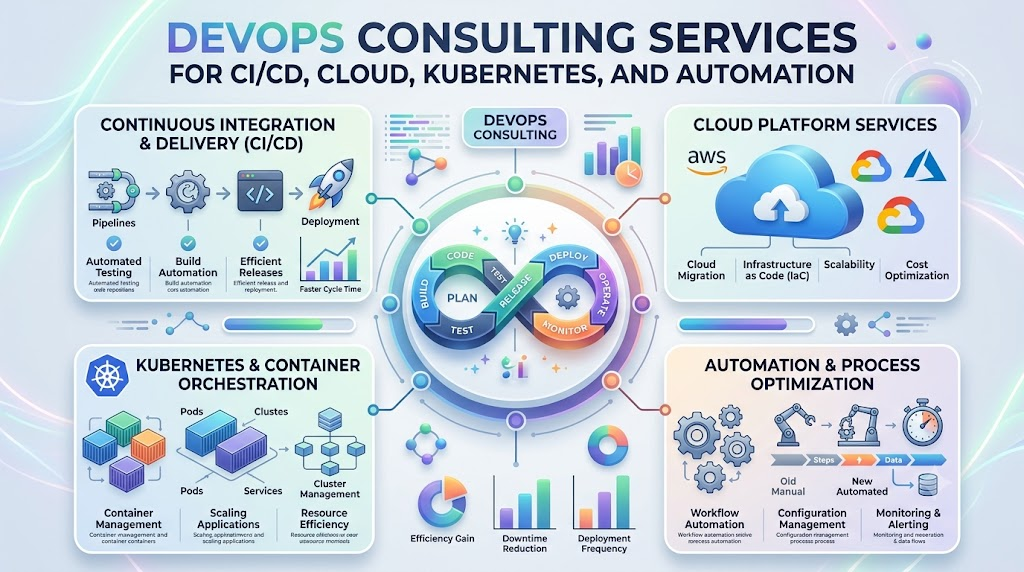
Introduction
Growing an engineering department introduces an unexpected paradox: adding more software developers frequently slows down your release cadence. When deployment cycles drag on, hotfixes disrupt sprint commitments, and infrastructure teams spend their days answering provisioning tickets, the problem is rarely developer skill. The true bottleneck is the connective tissue of delivery—how code gets validated, packaged, secured, and released. Senior technology executives leverage DevOps Consulting Services not to install another vendor tool, but to fundamentally redesign operational architecture for business agility. Bringing in external architectural expertise provides an unvarnished audit of the software supply chain, uncovers systemic friction, and aligns engineering pipelines with organizational goals. This executive guide explores how leadership teams utilize DevOps advisory to eliminate delivery gridlock, build platform resilience, and establish self-sustaining engineering systems.
The Engineering Leadership Dilemma: Speed Versus Stability
CTOs and Heads of Engineering face an ongoing trade-off: executive leadership demands faster product releases, while customers demand uncompromising system availability. In unoptimized delivery pipelines, these two goals actively undermine each other. Fast releases break production, and rigorous manual quality gates paralyze velocity.
This tension is where experienced architectural consulting changes the game. Modern software delivery proves that high deployment velocity and production stability actually reinforce one another when systems are backed by automated verification, immutable infrastructure, and robust telemetry.
Consulting advisors help technology leaders shift from reactive fire-fighting to proactive platform design. The focus transitions away from heroic individual interventions toward reliable, reproducible systems where releasing software is an unremarkable, automated daily event.
+-----------------------------------------------------------------------------------+
|                        The Leadership Delivery Dynamic                            |
|                                                                                   |
|   Traditional Friction:                                                           |
|   Feature Pressure ──> Manual QA Handoffs ──> High-Risk Infrequent Releases       |
|                                                                                   |
|   Modern Strategic Alignment:                                                     |
|   Autonomous Pipelines ──> Continuous Verification ──> Low-Risk Frequent Releases |
+-----------------------------------------------------------------------------------+
Architectural Cornerstones of Modern Delivery Systems
To resolve systemic delivery friction, an advisory engagement approaches an organization’s software lifecycle as a unified technical value stream. The engagement focuses on five interconnected architectural areas.
1. Decoupled Deployments and Progressive Delivery
When monolithic deployments require entire departments to coordinate midnight maintenance windows, innovation halts.
Consultants design continuous delivery architectures centered on progressive deployment patterns. Using blue-green cutovers, canary rollouts, and automated health checks, new versions can be exposed to fractional percentages of traffic. If telemetry flags abnormal error rates, traffic rolls back instantly without human intervention or customer disruption.
2. Infrastructure as Code and Declarative Control Planes
Manual dashboard configurations and unversioned infrastructure updates introduce hidden security risks and configuration drift.
An experienced consultant establishes immutable infrastructure standards using declarative toolchains such as Terraform or OpenTofu. By managing all networks, compute clusters, identity permissions, and persistence layers as auditable code, staging and production environments maintain absolute parity.
3. Supply Chain Security and Guardrail Architecture
Security checks placed at the tail end of a release cycle inevitably cause friction between security personnel and product managers.
Through integrated DevSecOps practices, policy verification moves directly into developer pull requests. Automated static analysis (SAST), software composition analysis (SCA), container vulnerability scanning, and cryptographic artifact signing happen automatically during build steps. Violations are surfaced to developers immediately when context is fresh, rather than weeks later in a compliance audit.
4. Container Workload Governance and Kubernetes Economics
Adopting managed container platforms like Amazon EKS, Azure AKS, or Google GKE provides autoscaling and workload resilience, but poor cluster design can trigger uncontrolled cloud costs and security misconfigurations.
Advisors establish hardened multi-tenant governance, define namespace boundaries, automate horizontal and vertical pod autoscaling, and implement resource request and limit policies that prevent cloud spend overruns.
5. Reliability Engineering Driven by SLOs
Monitoring dashboards filled with hundreds of arbitrary charts often obscure whether users are actually experiencing outages.
Consultants help leadership transition from basic infrastructure metrics to Site Reliability Engineering (SRE) principles. By defining Service Level Indicators (SLIs) and Service Level Objectives (SLOs), teams establish clear, data-driven error budgets. This objective framework resolves the age-old dispute between product teams pushing features and operations teams demanding freeze windows.
Strategic Operating Models: Comparing Delivery Options
Choosing how to source infrastructure and delivery expertise depends heavily on existing team maturity, budget structures, and project timelines:
| Model | Leadership Rationale | Primary Strength | Strategic Risk to Manage |
|---|---|---|---|
| In-House DevOps Teams | Long-term operational ownership and proprietary domain complexity | Seamless integration with company culture | High talent acquisition cost and single-point-of-failure retention risk |
| DevOps Consulting Services | Architectural modernization, complex cloud migrations, and platform retooling | Rapid infusion of battle-tested enterprise architecture patterns | Requires committed internal leadership to drive workflow adoption |
| Managed DevOps Services | Ongoing 24/7 cluster operations, patch management, and platform reliability | Offloads routine operational overhead from product developers | Can create operational blind spots if system handoffs are not clearly documented |
| DevOps Outsourcing | Surging delivery capacity needs or executing bounded infrastructure projects | Flexible resource scaling without recurring fixed payroll costs | Needs well-defined technical specifications to ensure consistent architectural quality |
The Shift Toward Platform Engineering and Developer Autonomy
One of the most consequential strategic shifts in modern enterprise IT is treating infrastructure as an internal product.
When infrastructure teams operate as traditional service desks, developers submit tickets to request a database, an IAM policy, or a new environment. This creates operational friction that frustrates both developers and operations engineers.
DevOps advisory teams address this by guiding organizations toward platform engineering principles. Instead of fulfilling manual tasks, the infrastructure team designs an Internal Developer Platform (IDP).
+-----------------------------------------------------------------------------------+
|                        Product Engineering Squads                                 |
|         (Focus: User Features, APIs, and Core Business Logic)                     |
+-----------------------------------------┬-----------------------------------------+
                                          │ Golden Paths (CLI / Web Interface / API)
+-----------------------------------------▼-----------------------------------------+
|                        Internal Developer Platform (IDP)                          |
|    - Automated Ephemeral Environments        - Self-Service Secret Provisioning   |
|    - Standard CI/CD Build Blueprints         - Built-in Security Policies         |
+-----------------------------------------┬-----------------------------------------+
                                          │ Automated Infrastructure Provisioning
+-----------------------------------------▼-----------------------------------------+
|                  Enterprise Cloud Foundation & Orchestration                      |
|                  (AWS, Azure, GCP, Kubernetes, Service Meshes)                    |
+-----------------------------------------------------------------------------------+
By curating documented “golden paths,” developers gain self-service provisioning for verified cloud resources within standardized security parameters. Product engineers ship faster without being forced to become infrastructure experts, while leadership retains centralized governance, audit compliance, and cost visibility.
Navigating Technical Trade-offs in Transformation
Enterprise engineering transformations require pragmatic compromise. Leaders must weigh architectural benefits against operational reality.
Abstraction vs. Developer Visibility
Creating seamless developer platforms reduces cognitive load, but shielding teams entirely from the realities of cloud execution can lead to poorly architected applications. Developers still need to understand how microservices scale, how network latency impacts latency-sensitive operations, and how distributed databases fail. The goal is removing operational friction, not producing engineers who do not understand production behavior.
Standardization vs. Squad Innovation
Enforcing a single programming language or database across every development team stifles experimentation, but total architectural freedom results in unmaintainable tool sprawl. An effective middle ground is standardizing the operational interface—ensuring that regardless of the backend language, all applications build into standardized containers, emit structured logs, expose standard health check endpoints, and utilize centralized secrets managers.
Pure Multi-Cloud vs. Pragmatic Cloud Utilization
Building fully cloud-agnostic architectures that run identically on any hyperscaler frequently drives up complexity and limits access to powerful managed services. Unless regulatory requirements dictate multi-provider parity, most organizations benefit by standardizing on cloud-agnostic application patterns (such as OCI containers and Kubernetes) while selectively utilizing the primary provider’s managed persistence and networking layers.
Critical Missteps That Derail Transformation Programs
Strategic delivery transformations fail when organizations treat them purely as technical upgrades rather than operational culture shifts.
- Purchasing Tools to Solve Cultural FracturesProcuring top-tier CI/CD platforms or orchestration software will not fix teams that actively distrust one another or gate releases behind lengthy committee approvals. Process design must lead tool deployment.
- Automating Broken Legacy HandoffsTranslating a six-week manual approval chain into automated notifications simply speeds up organizational friction. Leaders must be willing to simplify approval flows before writing automation scripts.
- Neglecting Internal UpskillingBringing in consultants to build modern infrastructure without pairing them alongside internal engineers leads to project failure the moment external advisors leave. Knowledge transfer must be treated as a primary project milestone.
- Optimizing for Deployment Velocity AloneShipping low-quality artifacts fifty times a day only accelerates production incidents. Velocity metrics must always be balanced by error budgets, change failure rates, and mean time to recovery.
Practical Tips
- Measure Value Streams Early: Map your software delivery pipeline from commit to production to locate where tasks spend idle time waiting for manual approvals.
- Treat Platforms as Products: Design your internal developer platform with direct input from the software engineers who will use it, iterating based on usability and release speed.
- Integrate Security as a Guardrail: Embed vulnerability scanning, dependency evaluation, and policy enforcement directly into continuous integration workflows to eliminate eleventh-hour release stalls.
- Align Teams Around Shared SLOs: Move past finger-pointing by using measurable Service Level Objectives to make objective decisions about when to ship features and when to prioritize reliability.
- Prioritize Sustainable Knowledge Transfer: Make collaborative pairing and architecture documentation non-negotiable deliverables so internal teams are fully empowered to maintain the platform long-term.
Frequently Asked Questions
What do DevOps consulting services focus on from an executive perspective?
DevOps consulting services focus on restructuring delivery pipelines, establishing cloud-native infrastructure patterns, integrating automated security gates, and improving deployment velocity while lowering change failure rates across enterprise systems.
How does architectural consulting differ from managed operational services?
DevOps consulting evaluates system strategy, designs cloud infrastructure, and implements modern CI/CD patterns to transform delivery workflows. Managed services focus on day-to-day operational maintenance, including 24/7 infrastructure monitoring, patch management, and active incident remediation.
When should an engineering organization bring in DevOps consultants?
Organizations typically seek consulting when release cadences slow down, infrastructure maintenance diverts developers from product features, legacy systems must be migrated to the cloud, or rapid growth creates tooling fragmentation across squads.
Does adopting modern DevOps practices reduce operational headcount?
It rarely eliminates personnel; rather, it shifts engineers from manual, low-leverage sysadmin tasks into high-value platform and reliability engineering roles that design reusable automation, maintain developer platforms, and optimize cloud architectures.
How does DevSecOps protect enterprise software delivery?
DevSecOps embeds security checks directly into automated build steps through SAST, container inspection, secrets scanning, and compliance-as-code. This ensures security issues are detected and resolved during development rather than halting releases right before production cutover.
Why is Kubernetes consulting a frequent component of delivery modernization?
Kubernetes offers standardized container orchestration and dynamic scaling across cloud providers. However, its networking, storage configurations, and access policies introduce architectural complexity that benefits from experienced design to prevent misconfigurations and resource waste.
What strategic value does an Internal Developer Platform deliver?
An Internal Developer Platform (IDP) provides self-service access to pre-approved cloud resources and standardized pipelines. It reduces developer cognitive load, eliminates provisioning ticket backlogs, and ensures organizational governance across diverse engineering squads.
Can early-stage startups benefit from DevOps consulting?
Yes. Engaging architectural consulting early helps startups avoid technical debt, configure secure cloud baselines, and implement streamlined delivery pipelines without over-engineering complex multi-cluster environments prematurely.
What metrics best evaluate the return on investment of a DevOps transformation?
ROI is best measured through industry-standard delivery indicators: lead time for changes, deployment frequency, mean time to restore service (MTTR), change failure rates, and overall cloud resource efficiency.
How should technology executives choose a DevOps advisory partner?
Leaders should choose partners who emphasize sustainable architecture, prioritize thorough knowledge transfer to internal staff, demonstrate strong multi-cloud and container proficiency, and align technical milestones with measurable business objectives.
Conclusion
Scaling modern software delivery requires more than introducing new automation scripts; it demands an architectural foundation that empowers product teams to release features safely, rapidly, and autonomously. Engineering leaders who succeed do so by designing deterministic delivery pipelines, treating infrastructure as code, and enforcing automated security policies from the outset. Partnering with an experienced firm for DevOps Consulting Services provides the strategic perspective and deep implementation expertise required to resolve systemic release friction, modernize cloud environments, and establish internal developer platforms. By collaborating with Cotocus, technology leaders can modernize their operational systems, reduce technical debt, and give their teams the confidence to deliver software at scale.
