Introduction
You land in a foreign country after a long flight. The airport is loud. Your phone shows no service. A long SIM card queue snakes past the baggage claim.
Nobody wants that landing-day stress. You just want a working phone for maps and messages. The good news is simple. Digital eSIMs fix this before you fly.
Roaming adds its own trap. Home carriers charge heavy daily fees abroad. Travelers open their bills at home and gasp. So smart planning pays twice. It saves time at the airport. It also blocks bill shock.
eSIMRoamly helps with this step. It works as an independent travel eSIM comparison and data research platform. This guide shows you how to pick the right plan. You will learn about data caps, network partners, prices, and tricks that save money.
What Is a Travel eSIM and How Does It Work?
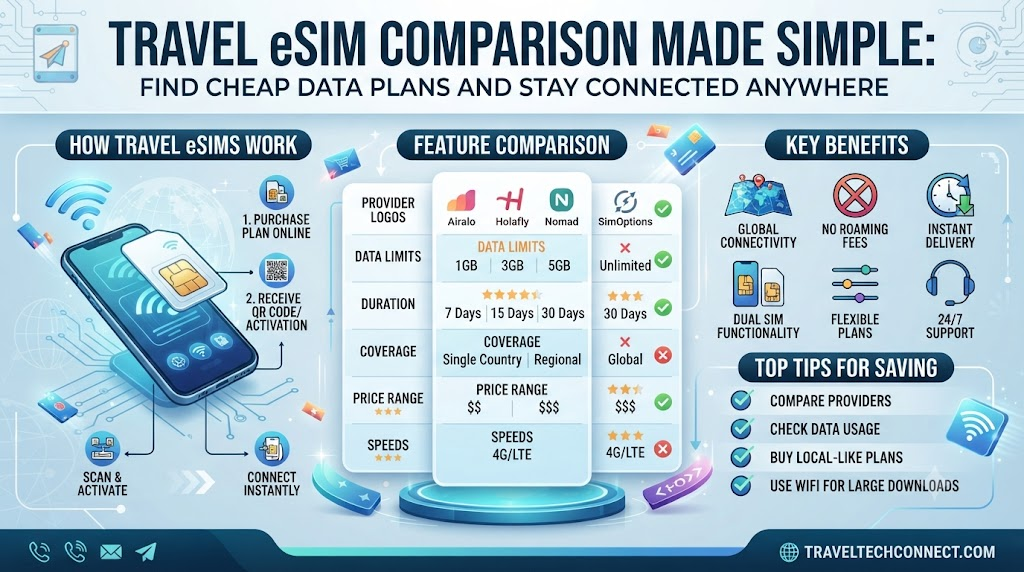
eSIM means embedded SIM. It is a tiny digital chip built inside your phone. It downloads a cell plan over Wi-Fi. No plastic card is needed.
Older phones need a physical SIM card. Modern phones can hold many digital profiles at once. Each profile acts like a virtual SIM card. You install it by scanning a QR code.
Travelers love one trick here. Your home number stays active on its normal line. So bank text messages still arrive on time. Meanwhile, the eSIM line feeds cheap travel data to your maps.
This combo matters more each year. Phones now carry both lines side by side. You pick which line does which job in your settings.
Choosing the Best Travel eSIM still takes some care. Plans differ in speed, size, and coverage. The right pick keeps your trip smooth from landing to takeoff.
Comparing Travel Connectivity: eSIM vs Physical SIM vs Carrier Roaming
Travelers can pick from four main paths. Each one trades cost against ease and speed. Some options eat time at airport counters. Others eat money through daily fees. So weigh each choice before you book. Here is how the main options stack up.
| Connection Method | Setup Convenience | Average Cost | Physical SIM Swapping Needed | Risk of Bill Shock |
|---|---|---|---|---|
| Digital Travel eSIM | Instant setup via QR code at home | Low to medium prepaid pricing | No physical card swapping | Zero surprise charges |
| Local Airport Physical SIM | Long waiting queues after landing | Moderate local retail cost | Requires opening tiny phone tray | Zero surprise charges |
| Home Carrier Daily Roaming | Automatic connection upon landing | Very expensive daily flat fees | Keeps original card in phone | High risk of hidden bills |
| Public Pocket Wi-Fi Rental | Must pick up and return hardware | High daily device rental fees | Connects via separate router | Low risk of extra bills |
Digital profiles also protect your stuff. You never pop open the tiny SIM tray in a busy terminal. Your home chip stays safely inside the phone. Nothing small gets lost or left behind. That also frees pocket space for tickets and keys instead of spare plastic cards.
Travel eSIM Comparison: What Smart Travelers Look For
Price alone tells you little. A cheap plan on a slow network costs more in wasted hours. So look deeper before you buy.
Start with network speed. Some plans run on 4G only. Others offer 5G where local towers support it. 4G is fine for maps and chat. 5G helps with big file uploads.
Next, check validity days. A seven-day plan suits a short city break. A thirty-day plan fits long trips. Also check when the clock starts. Some plans count days from first use.
Hotspot rules matter too. Tethering means sharing your phone data with a laptop or a partner’s phone. Some plans allow it. Some block it fully.
A real Travel eSIM Comparison also checks the local carrier behind each plan. A strong partner means fast subway data. A weak partner means dead zones in old towns. Verified provider data helps you dodge old 3G throttle traps. So compare eSIM plans on facts, not ads. The Best Travel eSIM fits your route, your days, and your data style.
How to Find Cheap eSIM Plans Without Falling for Traps
Cheap eSIM plans look simple at first glance. But the true cost hides in the details.
Do one piece of math first. Divide the plan price by its data size. That gives the cost per gigabyte. Compare that number across trip lengths. A big plan often beats two small ones on a long trip.
Now watch for traps. Some plans expire within twenty-four hours. That fits a layover but ruins a week-long stay. Some sellers add an activation fee at checkout. Some cards add foreign transaction costs on top.
Read the terms before you pay. Check the expiry window. Check the total at checkout. Then check with your bank about foreign card fees. Smart buyers see the full price first. Cheap eSIM plans stay cheap only when you count each cost.
International eSIM Plans for Multi-Country Adventures
Trips often cross borders. A train from Paris to Amsterdam passes two countries in one afternoon. Nobody wants to swap SIM cards at each stop.
Single-destination plans cover one country. They suit city trips and single-nation visits. They often offer the best local price.
Regional bundles cover whole zones. A Europe pack spans many nations at once. A Southeast Asia pack does the same. One profile follows you across each border.
Global plans cover more than one hundred nations. They suit long multi-stop journeys. The price per gigabyte runs higher, but the reach is huge.
International eSIM Plans work best when matched to your route. One regional profile keeps you linked on cross-border trains. Your maps, messages, and music keep working without a pause. So count your countries first. Then pick the zone that fits.
Unlimited Data eSIM Comparison: The Truth About Fair Use
Unlimited sounds perfect. But the fine print often tells a different story.
Fair Use Policy, or FUP, is the key term. In plain words, an advertised unlimited plan may slow down after a daily amount. Some plans give one or two gigabytes at full speed. Then the speed drops to a crawl for the rest of the day.
A crawl means trouble. Maps take ages to load. Videos buffer without end. Video calls break apart mid-sentence.
So a true Unlimited Data eSIM Comparison splits plans into two camps. Camp one holds full-speed lines with no daily cap. Camp two holds lines that throttle after a set amount. Throttle means the network slows your speed on purpose.
Check the cap size before you buy. Ask one simple question. How many full-speed gigabytes do I get each day? Your answer decides whether streaming works at night on hotel Wi-Fi breaks.
Evaluating the Best eSIM Providers in the Market
The market holds three kinds of sellers. Each has strengths worth knowing.
First come the big global travel brands. They sell plans for most countries. Their apps make setup simple. Their prices sit in the middle range.
Second come telecom marketplaces. They list many providers side by side. They suit travelers who like options and deep filters.
Third come direct carrier options. Local carriers sell their own eSIMs. These can offer the deepest local coverage.
But any seller is only as good as its support. So check the service basics before you buy. Does the team answer live chat fast? What are the refund terms? Do they list their local network partners openly?
The Best eSIM Providers pass all these checks. Strong support saves a trip when something breaks at midnight. Clear partner lists show the real network behind the brand. Open facts are the mark of a seller you can trust.
Destination Focus: Best eSIM for Japan
Japan rewards good planning. Trains run on the minute. Cities stack with subway lines. Mountain trails sit far from big towers.
Tokyo demands strong data. Maps and transit apps chew through gigabytes all day. Kyoto and Osaka need solid coverage too. Rural hikes need wide networks even more.
So the Best eSIM for Japan rides on tier-one networks. NTT Docomo and SoftBank are the big names here. Tier one means the major carriers with the most towers. Plans on these networks hold signal in subway stations and mountain valleys.
Budget plans sometimes ride on smaller networks. They cost less but lose signal in rural spots. That trade hurts on hikes and day trips away from the cities.
Check the partner name before you buy a Japan plan. One line of text decides whether your map loads on a mountain trail. City trips fly on almost any network. Remote travel needs the widest reach you can get.
Destination Focus: Best eSIM for USA
The USA spans a whole continent. A road trip can cross deserts, mountains, and plains in one week. Coverage changes with each mile.
Big cities like New York and Los Angeles enjoy dense tower grids. National parks sit far from major towns. Signal there depends on the carrier’s rural reach.
T-Mobile and AT&T anchor many travel plans. Each network has strong zones and weak zones. The Best eSIM for USA depends on your exact route.
So check one thing first. Which local network sits behind your plan? Then match that network to your stops. A canyon park may favor one carrier. A highway route may favor another.
Radio bands matter as well. American towers use certain frequency bands. Your phone must support them. Most modern phones do, but old models can miss a band.
Long flights add one more tip. Install your profile before the cross-country hop. Then your data works the moment you land.
Pre-Purchase Travel eSIM Evaluation Checklist
A good buy starts with a quick review. Ten minutes of checks prevents hours of travel pain. Each plan hides small details that change your trip. So run through the same checks before each purchase. Here is what smart travelers inspect.
| Evaluation Area | What to Inspect | Why It Matters |
|---|---|---|
| Device Compatibility | Check if phone is carrier-unlocked and eSIM-ready | Locked phones cannot install third-party profiles |
| High-Speed Cap | Look for daily full-speed data limit (FUP) | Prevents speed slowdowns in the middle of a trip |
| Hotspot & Tethering | Verify personal hotspot sharing permissions | Crucial for sharing data with a laptop or partner |
| Network Partner Quality | Confirm which local operator provides signal | Determines download speeds and rural coverage |
| Activation Timing | Check if validity starts on install or landing | Avoids wasting prepaid days while still at home |
| Voice & SMS Inclusions | Check if plan is data-only or includes a number | Important if you need to receive local calls |
Start with the unlock check at home. A carrier-locked phone refuses new digital profiles. Call your home carrier and ask for a full unlock. Do this days before you fly. Some carriers finish the same day. Others take longer, so give yourself time.
Finding Verified eSIM Deals and Discounts
Smart shoppers never pay full price. The eSIM market runs sales all year long.
Seasonal promotions drop prices around big holidays. Summer sales target beach travelers. Winter sales target snowbirds and holiday visitors. Big shopping events bring the deepest cuts.
Verified coupon codes also lower the bill. Some platforms test each code against live stores. That test confirms the code works before you click.
But stay sharp out there. Fake discount codes plague unverified coupon websites. Scrapers invent codes or repost dead ones. You copy a code, reach checkout, and watch it fail.
So treat eSIM Deals and Discounts like fresh produce. Fresh is good. Stale is useless. Check where a code came from. Look for a verification date. Then apply it with a smile, knowing the total truly dropped.
How eSIMRoamly Helps Travelers Make Informed Choices
Too many ads shout for your money. An independent platform plays a different role. It shows options side by side, with no bias toward one brand.
eSIMRoamly works this way. It serves as a transparent discovery and comparison platform for travel eSIMs. You can compare real landed costs, not just headline prices.
Landed cost means the total after taxes, fees, and extras. That number tells the truth. A plan with a low sticker price may lose to a cleaner rival.
The platform also leans on verified carrier data. Each listing shows the local network partners behind a plan. So you know what signal to expect before you land.
Trip length guides the final pick. A two-day conference needs a small burst plan. A month of slow travel needs a bigger bundle. eSIMRoamly helps you match plan to trip with facts in hand.
Real-Life Travel Scenarios
- A solo backpacker hops across five European countries on a regional Europe eSIM. One profile carries her through each border without a swap. She shares navigation maps and social updates from night trains, and her data never pauses between nations.
- A remote professional works from a small cafe in Tokyo. Her high-allowance Japan plan keeps video meetings smooth all day. She never touches the spotty cafe Wi-Fi. Her calls stay crisp from the first espresso to the evening train home.
- A family drives across California with one prepaid USA eSIM. The dad shares a hotspot from the driver’s seat. Every tablet in the car stays linked to highway navigation apps. The kids stream music while the map app guides the route.
- A business executive lands in Singapore for a two-day conference. She buys a short-term 3 GB plan from her airplane seat. The profile installs in seconds. By the time the doors open, her messages and maps are already live.
Common Mistakes to Avoid When Buying Travel eSIMs
- Locked phones block new profiles. Many buyers learn this at the airport when the install fails. Check your unlock status with your home carrier days before you fly.
- Some plans start their clock at the QR scan. Installed on Monday, a seven-day plan dies before Friday’s flight. Look for plans that start counting at first data use instead.
- Unlimited plans can throttle hard. Some drop to 128 kbps after a small daily amount. That speed cannot stream video or load maps well. Read the FUP terms before you trust the word unlimited.
- Panicked travelers delete active profiles while fixing issues. That kills the plan and often the refund chance. Try airplane mode and a phone restart first. Deleting should be the last resort.
- Your home line can still roam by mistake. Data roaming left on charges daily fees fast. Turn roaming off on your home SIM line. Keep it on only for the travel eSIM profile.
- Background apps eat data quietly. Cloud photo syncs can burn a whole plan overnight. Turn off auto updates and cloud backups before departure day.
- Airport Wi-Fi is not the place to start. Dead zones and slow hotspots stall downloads at the worst time. Buy and install your profile at home while your network is strong.
- Data-only means no phone number. Travelers often learn this when a restaurant booking call fails. Check whether your plan includes voice and SMS. Add a calling app if it does not.
Simple eSIM Setup and Activation Checklist
- Check device support. Open your phone settings and confirm the eSIM menu exists before buying anything.
- Confirm full unlock. Ask your home carrier to unlock the phone fully, then test the install with any profile.
- Save the QR code twice. Keep the install code on a second screen or a printed page in case one device dies.
- Install over home Wi-Fi. Scan and set up the digital profile before departure while your connection is strong.
- Enable data roaming on the eSIM only. After landing, switch on roaming for that one profile and keep the home line safe.
Frequently Asked Questions
1. What is the difference between an eSIM and a physical travel SIM card?
A physical SIM is a plastic chip you insert by hand. An eSIM is a digital chip built into your phone. You load a plan by scanning a QR code. Physical cards can get lost or damaged in transit. Digital profiles stay safe inside the device. Both connect to the same local towers abroad. The main differences are setup speed and ease of care.
2. How can I tell if my smartphone is unlocked and compatible with travel eSIMs?
Open your phone settings and look for an eSIM or add-plan menu. If the menu exists, your phone likely supports digital profiles. Next, test the unlock status. Borrow a SIM card from another carrier and insert it. If the phone finds signal, it is unlocked. If it asks for a code, it is locked. Your home carrier can confirm the status too.
3. When should I install my travel eSIM profile—before leaving home or after landing?
Install before you fly, but pick the right plan type. Some plans start their validity clock at the QR scan. Others start at first data use abroad. Buy at home while your Wi-Fi works well. Check the activation terms closely. Then scan, install, and wait to turn data on until you land.
4. Can I use my WhatsApp and home phone number while using a travel eSIM?
Yes, both keep working side by side. Your home number stays active on its normal line. Bank texts and calls arrive as usual. WhatsApp links to your home number too. Set your eSIM line as the data line in settings. Then let WhatsApp use that data connection. Messages flow while your home number stays untouched.
5. What does Fair Use Policy (FUP) mean on unlimited data eSIM plans?
FUP stands for Fair Use Policy. It is the fine print on unlimited plans. The plan may give a set amount of full-speed data each day. One or two gigabytes is common. After that, speeds drop hard, often to 128 kbps. At that pace, maps load slowly and video calls fail. So read the FUP terms before trusting the word unlimited.
6. Can I share my mobile data using personal hotspot with a travel eSIM?
Most travel eSIMs allow hotspot sharing, but not all. Tethering means your phone shares data with a laptop or a partner’s device. Check the plan terms before buying. Some plans cap the hotspot speed. Others block it fully. Family travelers should test the hotspot on day one. Then adjust the plan choice if sharing fails.
7. Which local network provides the best cellular coverage for tourists in Japan?
Japan’s strongest towers belong to the major carriers. NTT Docomo and SoftBank lead the pack. Their networks hold signal deep in subway stations and reach far into mountain regions. Tourist plans on these networks perform best in Tokyo, Kyoto, and Osaka. Check which partner sits behind your plan. Then enjoy fast maps on trains and trails alike.
8. How does coverage differ between major mobile networks when visiting the USA?
Coverage varies by carrier and region. T-Mobile performs well in many cities and on highways. AT&T reaches deep into rural zones and national parks. Urban trips suit either network. Remote road trips need careful route checks. Match the plan’s network to your exact stops. Also confirm your phone supports the local frequency bands.
9. What happens if I use up all my high-speed data before my trip ends?
Your data keeps working, but the speed changes. Most plans slow to a crawl after the high-speed amount runs out. That pace handles plain text messages fine. It struggles with maps and video. Some plans offer top-up packs you can buy mid-trip. Others let you install a fresh plan on the spot. So plan your gigabytes with a small buffer.
10. Do travel eSIM plans include a local phone number for voice calls and text messages?
Most travel eSIMs are data-only. They carry no local phone number. Messages and calls run through internet apps like WhatsApp. Some premium plans do include a local number and voice minutes. Check the plan details before buying if you need to place local calls. Restaurant bookings may need a calling app otherwise.
11. Why should travelers compare eSIM plans on an independent platform instead of buying the first ad they see?
Ads push one brand with polished promises. An independent platform shows many plans side by side. You see real landed costs, network partners, and cap sizes. That view exposes weak deals fast. It also surfaces hidden gems that ads never mention. Comparing takes five minutes and often saves real money on each trip.
12. How does eSIMRoamly help international travelers find verified mobile data plans?
eSIMRoamly gathers verified travel eSIM plans in one search-friendly space. You can filter by country, trip length, and data size. Each listing shows the local network partners and the true total cost. The platform checks provider data so listings stay fresh. So you can pick a plan with facts, not guesses, before your flight departs.
Conclusion
A great travel plan balances four things. Data size must match your days. Speed caps must match your apps. Network partners must match your route. And the price must reflect real value, not marketing shine. The best travelers check these four boxes before each trip. They install profiles at home over strong Wi-Fi. They confirm unlocks early. They read fair-use terms instead of trusting the word unlimited. Dear travelers, remember this always. Smart digital prep keeps overseas journeys stress-free and wonderfully connected. Compare with care, buy with facts, and let your phone fade into the background of a great adventure.
