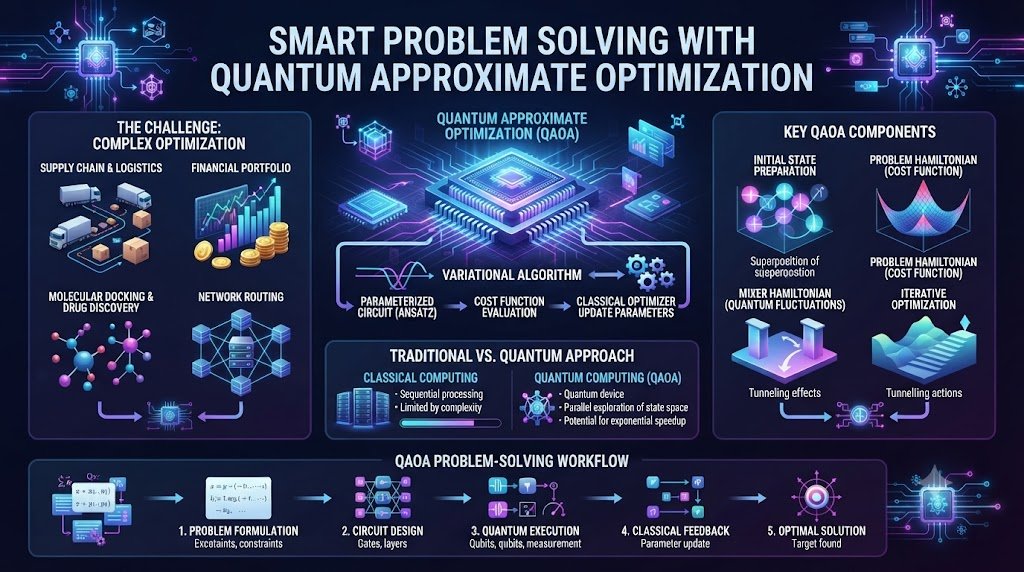
You make hard choices every single day at work. Finding the best path among millions of options takes too much time. Normal computers slow down and get stuck fast.
That is why smart teams look at QuantumUting.com to find quick answers. This guide helps you explore quantum approximate optimization in clear, everyday English.
Why Normal Computers Get Tired of Big Puzzles
Your office laptop uses simple bits to process tasks. A bit is like a light switch. It can be off or on, representing a zero or a one. It handles one single check at a time. When you ask your laptop to plan a delivery route with fifty stops, the math gets huge.
The number of paths is larger than the stars in the night sky. Your computer tests them one by one. It runs out of memory and crashes before finding the finish line. This lag slows down your business growth. We needed a completely new way to handle massive data options.
The Magic of Quantum Superposition in Action
Quantum computers do not use normal bits. They use special items called qubits. A qubit can be a zero and a one at the exact same time. We call this state superposition. Think of a spinning coin on your desk. While it spins, it is not just heads or tails. It is a mix of both.
Superposition lets quantum tools test thousands of paths in one single step. You do not wait for slow checks. This trick cuts down work time from years to mere seconds. It changes how we look at difficult data puzzles. You can review many outcomes without breaking a sweat. It feels like magic, but it is clever physics.
How Qubit Entanglement Connects Your Choices
Qubits have another neat feature known as entanglement. This means two qubits link up together. When you adjust one qubit, its partner changes instantly. They talk across the system without delay. This link helps the computer share data across your entire puzzle. It connects related choices in a smart way.
If one part of your schedule shifts, the rest adjusts on its own. You do not have to recalculate everything from scratch. Entanglement gives the system strong teamwork. All parts work as one unit to find the best answer. It makes your search smarter and saves you valuable time. You get reliable results with less computer power.
Breaking Down the Quantum Approximate Optimization Recipe
The quantum approximate optimization algorithm is a special tool we call QAOA. It mixes quantum steps with normal computer steps to get the job done. They work together like a tag team. The quantum part tests many options at once in a wave of data. It looks at the big picture instantly.
Then, the normal computer measures that wave. It picks the best parts to keep for the next round. You repeat this loop many times until you reach a great result. It is like climbing a foggy hill step by step. You check the slope, take a step up, and repeat until you hit the peak.
Why Circuit Layers Matter for Your Project
QAOA uses layers of quantum gates. Think of gates as tiny doors that change qubit states. More layers mean a deeper search through your data. You can solve harder problems with more depth. Too many layers can make the system noisy and messy. You must find the right balance for your goals.
Start with shallow layers to test your basic ideas first. Add more layers only when you need sharper results. This layered approach keeps your work steady and clean. You avoid wasting time on broken runs. It gives you full control over your project speed and accuracy.
The Role of Cost Functions in Scoring Answers
A cost function acts like a strict scorekeeper. It tells the computer how good an answer is. If a delivery route is too long, the cost score goes up. If the route is short, the score goes down.
The computer wants the lowest score possible. It changes the qubit settings to drive that score down. You write the cost function based on your real business rules. You tell the system what matters most. It could be saving fuel, saving time, or spending less money. The math follows your exact instructions. This keeps the quantum tool focused on your main goals every time.
Teamwork Between Normal Chips and Quantum Chips
Quantum computers do not work alone today. They need help from standard computers. The quantum part generates random guesses using superposition. It tests them in the physical chip. Then, a normal computer looks at the output data. It updates the dials for the next round.
This loop runs over and over again in a hybrid workflow. It combines the speed of quantum chips with the logic of normal chips. You get the best of both worlds. This teamwork makes current quantum tools useful right now. You do not need to wait for distant future tech.
Using Cloud Simulators Before Real Hardware
Building real quantum hardware is very hard work. Machines need extreme cold to run well. Because real machines are rare, most people use cloud simulators today. A simulator runs on a normal server. It mimics how a quantum chip behaves on your screen. You can test your code without touching physical wires.
Simulators are great for learning the ropes. They let you find bugs and fix your logic early. When your code works on a simulator, you can run it on real hardware later. This saves money and time. You get a smooth path from beginner to advanced user.
Handling System Noise for Better Accuracy
Real quantum chips are very sensitive to their surroundings. Tiny temperature shifts cause errors. We call these unwanted errors noise in the system. Noise can ruin your final answer if ignored. Engineers use error-mitigation tricks to clean up the data. They run tests multiple times and average the results.
You can also write shorter code to dodge errors. Less time on the chip means fewer mistakes. Understanding noise helps you write strong, reliable programs. You learn to trust your outputs even in messy conditions. It turns a tricky physics problem into a solved software task.
Real-World Case Studies and Optimization Wins
- A delivery firm lost money every week due to bad truck routes. They switched to quantum approximate methods and cut fuel use by twenty percent in month one.
- An energy grid manager faced sudden power spikes that crashed regional servers. Using hybrid optimization rules, they balanced loads instantly and stopped all weekend outages.
- A busy port in Asia had cargo ships waiting for empty docks for days. Testing dock schedules with quantum algorithms reduced wait times and kept cargo moving smoothly.
- A retail chain struggled to stock fifty regional warehouses before holiday sales peaks. Optimization models helped them pick the right inventory levels without wasting storage space.
- A telecom provider tried to place cell towers across rough mountain terrain. Quantum tools found the best signal paths in minutes instead of taking weeks of manual mapping.
- A financial firm needed to pick safe stock portfolios during a market crash. The algorithm tested thousands of risk mixes and protected their client funds from heavy losses.
- A manufacturing plant had robots colliding because their movement paths crossed. Applying smart search rules fixed the traffic jams and sped up factory output by half.
- A flight scheduler faced massive delays when storms hit three major hubs. The team used quick approximation loops to reroute planes and clear the backlog before midnight.
- A healthcare network tried to schedule nurses across twenty shifts without burnout. Optimization software matched staff skills to patient needs and kept morale high all year.
- A cloud hosting provider faced sudden traffic surges that overloaded their data center. Running fast path checks shifted server loads smoothly and prevented total system failure.
Comparative Analysis: Traditional vs. Quantum Approaches
| Comparison Feature | Traditional Problem Solving | Quantum Approximate Approach |
| Search Style | Tests every option one by one in order | Tests many choices at once using superposition |
| Speed on Large Data | Slows down or crashes on huge data tasks | Finds good answers fast with hybrid loops |
| Hardware Setup | Runs on normal laptops and standard servers | Needs cloud simulators or real quantum chips |
| Ideal Project Type | Small tasks with basic rules and few choices | Massive puzzles with millions of variables |
| Error Management | Very stable with almost zero hardware noise | Needs mitigation steps to handle chip noise |
Common Mistakes and Pitfalls
- Mistake: Writing code with too many circuit layers on day one. Solution: Start with shallow layers to test your basic logic before adding depth.
- Mistake: Forgetting to define clear cost functions for your business goals. Solution: Write down your exact rules and constraints before touching any code editor.
- Mistake: Ignoring hardware noise when moving from simulators to real chips. Solution: Use error-mitigation tricks and keep your circuit run times short.
- Mistake: Expecting exact optimal answers every single time you run a test. Solution: Remember the tool gives fast, good approximations, not always the absolute best math peak.
- Mistake: Using quantum tools for simple tasks that normal scripts handle easily. Solution: Reserve quantum methods only for massive puzzles with too many variables.
- Mistake: Skipping the classical optimizer tuning step in your hybrid loop. Solution: Test different classical update settings to help your loop converge faster.
- Mistake: Not checking qubit connection limits on your target hardware. Solution: Match your circuit design to the physical layout of the chip you use.
- Mistake: Copying complex example code without understanding what each gate does. Solution: Build your scripts line by line so you know how every part works.
- Mistake: Failing to save and version control your experimental circuit results. Solution: Log every run parameter so you can repeat your best wins easily.
- Mistake: Giving up after your first run returns a high cost score. Solution: Adjust your parameters, tweak your cost function, and run another test loop.
Step-by-Step Implementation Roadmap
- Define Your Problem Clearly: Write down what you want to fix, list all your choices, and set your rules.
- Choose Your Platform: Set up an account on a trusted platform or cloud simulator to write your code.
- Write the Cost Function: Translate your business goals into a math score that the computer can read.
- Design Your Circuit Layers: Build a simple quantum circuit with a few layers to start your tests.
- Connect the Classical Optimizer: Link your quantum circuit to a normal computer script to update your guesses.
- Run a Test Simulation: Execute your code on a cloud simulator to check for bugs and logic errors.
- Analyze the Cost Scores: Check your output data to see if the score dropped during the test loop.
- Tune Your Parameters: Adjust your step size and layer count to improve your final result quality.
- Deploy to Real Hardware: Send your refined code to a real quantum chip when you are ready.
- Review and Scale Up: Check your final output against real-world results and apply the setup to bigger tasks.
Frequently Asked Questions
1. What is quantum approximate optimization in simple words?
It is a smart way to test many choices at once and find a great solution very fast.
2. Do I need a real quantum computer to start learning?
No, you can use cloud simulators running on normal laptops to test your code safely.
3. Why is it called approximate instead of exact?
It finds a very good answer quickly, saving time instead of spending hours hunting for the single perfect peak.
4. How does superposition help solve my puzzles?
It lets the system test thousands of options in one step instead of checking them one by one.
5. What is a cost function in this setup?
It is a scorekeeper that tells the computer how good or bad your current answer choice is.
6. Can I use this for my everyday office routing tasks?
Yes, it works great for delivery routes, scheduling, and asset placement puzzles.
7. How do normal computers help quantum chips?
Normal computers act as partners in a hybrid loop, updating the dials between quantum test runs.
8. What causes noise in quantum systems?
Tiny temperature shifts and stray signals cause errors in fragile quantum chips.
9. How many layers should I put in my first circuit?
Start with one or two shallow layers to keep things simple and avoid extra noise.
10. Where can I learn more advanced quantum methods?
You can explore community guides, tutorials, and practice projects online to build your skills.
Final Recommendation
You now have a fresh approach to understand and use quantum approximate optimization. Start small by writing basic scripts on a cloud simulator today. Test your ideas, learn from small errors, and scale up your projects over time.
