Introduction
Your phone finds a cell tower in seconds. It does this in any city, in any country. How does it know which network to join? Think of a trip abroad. You land, turn off airplane mode, and a signal appears.
The answer sits on a tiny chip. Every SIM card holds hidden digital ID numbers. These numbers tell towers who you are and where you come from. They also make global roaming work. Roaming means using another company’s network when you travel.
Researchers, developers, and travelers often need to read these numbers. They want to know which company runs a network. That is hard without a clean source.
eSIMGlobo is an evidence-led global telecom provider directory. It is also a network research platform. This guide explains the key codes in plain words, so you can read them with confidence.
Understanding Cellular Identity: What Are MCC and MNC Codes?
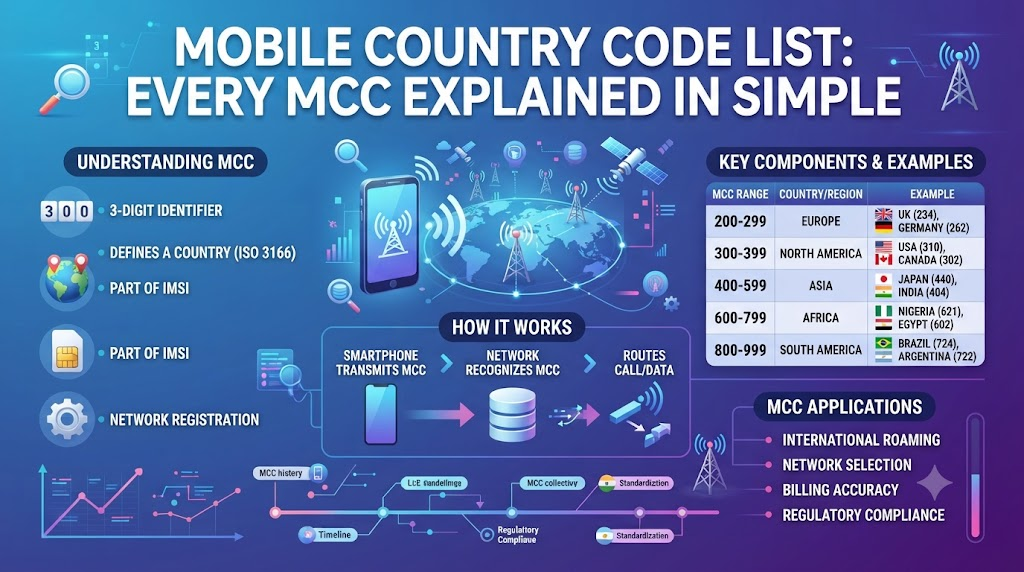
A Mobile Country Code, or MCC, is a three-digit number. It shows which country a network belongs to. For example, 310 points to the United States. And 204 points to the Netherlands.
A Mobile Network Code, or MNC, comes next. It has two or three digits. It shows the exact phone carrier inside that country. A carrier is the company that sells you phone service.
Put the two together and you get a clear address. The MCC says which country. The MNC says which company. Neither number works well alone.
These numbers live inside every SIM card. A SIM card is the small chip that holds your phone identity. When your phone starts, it reads the codes from the chip.
Next, the phone scans for radio signals nearby. Each tower sends out its own MCC and MNC. The phone matches them against the SIM and picks a network.
This match guides calls, texts, and mobile data. If the codes do not fit, the phone may look for a roaming partner.
Watch out for one thing. The numbers look simple, but one wrong digit points to a different company. Always check the full code.
Decoding the Telecom Stack: Codes, Networks, and Operators
Cellular identifiers work in layers. The first layer separates countries. The next layer separates carriers. The last layer picks out one single subscriber, which means one SIM line. Each layer has its own length, purpose, and owner. Think of a mailing address. The country comes first, then the street, then the house number. Codes follow a similar order. The table below shows them side by side.
| Telecom Identifier | Number Length | Primary Purpose | Real-World Example | Managing Body |
|---|---|---|---|---|
| Mobile Country Code (MCC) | 3 Digits | Identifies geographic territory or international scope | 310 (United States) / 204 (Netherlands) | ITU-T |
| Mobile Network Code (MNC) | 2 or 3 Digits | Identifies specific mobile carrier within a country | 260 (T-Mobile) / 04 (Vodafone) | National Regulators |
| PLMN Code (MCC + MNC) | 5 or 6 Digits | Identifies unique wireless network operator | 310260 / 20404 | Cellular Industry |
| IMSI Identifier | Up to 15 Digits | Identifies the unique individual subscriber line | Stored securely on SIM card chips | Mobile Operators |
A phone reads these numbers in a set order. First, it listens for radio signals. Each tower broadcasts its PLMN code. The phone compares that code with the list on the SIM. If it finds a match, it joins that network. If not, it checks for a roaming partner. This all happens in a few seconds. You never see any of it.
MCC MNC Lookup and Identifying Wireless Carriers
An MCC MNC Lookup is a simple search tool. You type in a five- or six-digit code. The tool then shows the legal company behind that code. It may also show the country and the brand name.
Say you see the code 310260. The first three digits are the MCC. The last three are the MNC. The lookup tells you the code belongs to a United States carrier.
Why does this matter? Many people need to know who runs a network. Developers check where a user connects from. Fraud analysts spot strange traffic. Engineers confirm that a partner network is real.
Good lookups rely on official records. The ITU-T E.212 standard is the base. ITU-T is the telecom arm of the International Telecommunication Union. E.212 is the rule book for these numbers.
The ITU publishes updates to its lists. National regulators add their own details. A strong lookup tool follows both sources. Then it shows when each record last changed.
Here is what to watch out for. A tool may show a brand name that differs from the real license holder. Another tool may use old data. Always check the date and the source.
Use a lookup before you trust any code. It takes seconds. It can save hours of confusion later. Keep a short note of each result. A saved note helps your team repeat the check.
PLMN Code Lookup and Cellular Network Routing
PLMN stands for Public Land Mobile Network. It is the full pair of country and carrier codes. So 310260 is one PLMN. And 20404 is another.
A PLMN Code Lookup tells you which network a code stands for. It works like the MCC MNC search, but you use the joined number. Many tools accept both styles.
PLMN codes matter most when people travel. Say you fly from Amsterdam to New York. Your phone leaves its home PLMN. It then looks for a local PLMN that has a roaming deal with your carrier.
A roaming agreement is a contract between two carriers. It lets one company’s customers use the other’s network. Your phone checks a preferred list on the SIM. Then it picks the best partner.
Radio bands matter too. A band is a slice of radio waves that carriers use. Carriers in different regions use different bands. Your phone must support the local bands, or it will not connect.
Watch out for a common trap. A PLMN may show up in a list, but the network may not use the band your phone needs. Check both the code and the band before a trip.
Researchers also use PLMN lookups to map roaming links between countries. This shows which carriers work together.
Mobile Network Operator Directory and Verified Network Holders
A Mobile Network Operator, or MNO, owns the physical gear. This includes radio towers and base stations. A base station is the equipment that talks to your phone by radio.
A Mobile Network Operator Directory lists these companies. It shows who holds each network code. It may also show the country, the brand, and the status.
Brand names can fool you. A shop may sell phone plans under a catchy name. But a different company may own the towers. The directory helps you tell the two apart.
So look for the official assignee. This is the legal company that holds the code. Many directories list it as the licensee or the holder.
Why does this matter? Real ownership affects trust, coverage, and risk. A fraud team wants to know who truly runs a network. A telecom buyer wants to know who to sign a deal with.
Verified data should link back to a proof. This may be an ITU record or a national filing. A line with no source is a weak line.
Watch out for mergers. Carriers join, split, and rename often. A directory must keep up. If it does not show update dates, treat it with care. Check a few entries by hand. If they look right, you can trust the rest more.
Global Telecom Provider Directory and International Coverage
The world has hundreds of countries and territories. Each one has its own phone networks. A Global Telecom Provider Directory brings them into one place.
Without such a directory, research is slow. You jump from site to site. Each site uses its own style. Data often conflicts. One clean database saves time.
A good directory goes beyond country lines. Some networks work across borders. Examples include shared-code networks. These use special codes that no single country owns.
Satellite carriers are one case. They serve ships, planes, and remote places. Maritime services also use special codes. Smart devices, such as trackers, may use them too. These devices need a link that works anywhere.
Cross-border data routing is another point. Data from your phone may travel through another country before it reaches the web. A directory helps you see these paths.
Here is what to watch out for. Do not assume a code always points to a single country. Some do not. Read the notes in the directory.
Also watch for coverage gaps. Small island states and territories are often missing from weak lists. Strong directories list them all, with clear notes on each. A wide list also helps travelers. They can learn which networks they may meet on a trip.
Mobile Network Codes by Country and Regional Numbering
Each country decides how it hands out network codes. In most places, a national regulator does the job. A regulator is a government body that oversees telecom. It gives each wireless carrier its own MNC under the country’s MCC.
When a new carrier starts, the regulator assigns a new code. When a carrier closes or merges, the code may be retired or moved. So the list changes over time.
Mobile Network Codes by Country show how crowded each market is. A country with many codes often has many carriers. A country with a few codes may have little competition. This is a rough guide, not a rule.
Look at Europe first. Many countries have three or four main operators plus some small ones. The Americas have large operators and many regional ones. Asia has big national carriers and fast-growing new ones. Africa has a mix, with mobile money and data growing quickly.
Do not guess from these patterns. Use the real data for each country. Look at the code, the carrier, and the status.
Next, compare nearby countries. Border regions may see signals from two countries. Phones may jump to a foreign tower by mistake. Codes help you spot this.
Here is what to watch out for. Some countries use both two-digit and three-digit MNCs. Read the full code every time. A missing zero can point to a different network.
Mobile Country Code List for Global Travelers and Researchers
A Mobile Country Code List is a table of three-digit numbers. Each row shows a country or territory. Some rows show shared ranges.
Travelers use the list to understand foreign SIM cards. Say you buy a local SIM in Japan. The MCC on that SIM will point to Japan. Your home SIM keeps its own home MCC.
Researchers use the list for roaming maps. They match each MCC to the carriers that partner with it. This shows how traffic moves between regions.
The ITU is the key body here. ITU stands for International Telecommunication Union. It is a United Nations agency. It assigns MCCs in clean three-digit blocks. Each block belongs to one country or to a special group.
The ITU also publishes changes. When a country splits or a new territory joins, the list updates. So always check the date on your list.
Here is what to watch out for. Some countries hold more than one MCC. The United States has several. So a single country does not always mean a single number. A good list also marks shared codes, so you do not mistake them for a country.
Keep a trusted list close. Compare it with new data once in a while. A short monthly check keeps your records clean.
Network Data Validation and Carrier Research Checklist
Good research follows steps. A quick checklist keeps you from skipping the key ones. Use the table below each time you check a carrier. Each row has a clear task and a clear reason. Together they help you prove that a code is real, current, and tied to the right company. Run through the list in order, and note what you find.
| Research Step | What to Check | Why It Matters |
|---|---|---|
| ITU-T E.212 Baseline | Official Assignment Status | Confirms legal code ownership from international records |
| National Regulator Filing | Local Frequency Licenses | Shows domestic operational approval and spectrum rights |
| Commercial Role Check | MNO vs MVNO Designation | Clarifies whether the provider owns physical cell towers |
| Active Brand Matching | Retail Trade Name | Connects technical network numbers to consumer brand logos |
| International Shared Codes | 901/902 Global Allocations | Identifies satellite, maritime, and specialized IoT networks |
| Data Timestamp Review | Date of Last Assignment Audit | Ensures decommissioned or merged network codes are updated |
Many websites copy carrier lists from other sites. Errors then spread like a rumor. Some lists are years old. Others invent entries to fill gaps. Always trace a code back to a first-hand record. If a list shows no source and no date, do not use it for important work. Treat every copied list as a clue, not as proof. A little caution here protects your project later.
Telecom Operator Database and Evidence-Led Research
A Telecom Operator Database holds facts about carriers. It lists codes, owners, countries, and status. Good ones also list sources.
Evidence matters because telecom data is easy to get wrong. Companies merge. Brands change. Codes move. A fact that was true last year may be false today.
Evidence-led research solves this. Each fact links to a proof. The proof may be an ITU record. It may be a national filing. It may be a license notice from a regulator.
So how do you link a record to a filing? Start with the baseline code. Find the matching regulator page or official notice. Note the date and the name of the holder. Then compare it with the database entry.
If the two match, mark the entry as checked. If they differ, flag it. Do not guess which one is right. Look for a third source.
Primary documents are best. A primary document is a source from the body that made the decision. News stories and blogs are second-hand. They can help, but they are not proof.
Here is what to watch out for. Some filings are in local languages. Use a careful translation, and keep the original. Also keep a log of when you checked each record.
MVNO Directory: Virtual Operators and Wholesale Networks
A Mobile Virtual Network Operator, or MVNO, sells phone service without owning towers. Think of it as a shop that rents space in someone else’s mall. The shop has its own name, prices, and customers.
The MVNO pays a host MNO for radio capacity. This deal is a wholesale agreement. Wholesale means selling in bulk to another business. The MVNO then sells plans to the public.
Why do MVNOs exist? They can offer low prices, niche plans, or special features. Some focus on travelers. Some focus on students or on one language group.
An MVNO Directory lists these brands. It shows who the host network is. It also shows whether the MVNO uses the host’s codes or its own. Many use the host’s PLMN. A few hold their own codes.
This matters for research. If you see a host PLMN, the traffic may come from the host or from any MVNO on it. You cannot tell which one from the code alone.
Watch out for a common error. An MVNO is not a tower owner. Do not list it as one. Check its legal terms and host details.
Also check that the deal is still active. Wholesale deals end, and MVNOs can switch hosts.
eSIM Provider Directory and Modern Digital Connectivity
An eSIM is a tiny digital chip built into a phone. It replaces the old plastic SIM card. You do not slide anything in. Instead, you download a mobile plan to the chip.
This is handy for travel. You can buy a plan before you fly. You scan a code or tap a link, and the plan installs. When you land, your phone connects.
An eSIM Provider Directory lists companies that sell these plans. It shows where each plan works. It also shows which local networks carry the data.
Why do the network partners matter? An eSIM plan still runs on real towers. Those towers belong to a local MNO. The plan works through a deal between the eSIM seller and that carrier.
So research three things. First, check the countries the plan covers. Second, check the partner networks. Third, check if the plan supports your phone. Not all phones support eSIM.
Here is what to watch out for. Coverage lists can look big, but speeds and data limits differ by country. Read the plan terms. Also check how you can top up or end the plan.
A directory with codes and partner names gives you the facts. You can then pick with care and avoid surprises abroad.
Developer Workflows: MCC MNC Lookup API and Data Integration
An API is a way for one program to ask another for data. An MCC MNC Lookup API lets your app send a code and get back facts. These facts may include the country, the carrier, and the status.
Who uses it? Software engineers, fintech platforms, and telecom product teams do. Each has a different goal, but the steps are alike.
First, your app reads the code from a SIM or a network event. Next, it sends the code to the API. The API replies in a fraction of a second. Your app then acts on the reply.
This helps detect SIM origins. Your app can see which country and carrier a user comes from. It can flag a mismatch between the claimed country and the real network.
It also helps stop SMS routing fraud. Some attackers send text messages through cheap, fake routes. A lookup can show when a route does not match the real carrier.
Finally, it helps tune data links. Teams can pick better partners by country.
Watch out for stale data. Cache results for a short time only, and refresh often. Also plan for errors, so your app does not break when the API is slow.
Real-Life Telecommunications Scenarios
- The app developer: A mobile app developer sends each new sign-up through an automated network lookup. The tool shows the user’s local carrier. The app then routes the two-factor text code through the lowest-cost local route. Costs drop, and users get their codes within seconds.
- The business traveler: An international business traveler lands in a new country with a roaming eSIM. She opens an online directory and enters the network code on her screen. The directory names the local partner network. She learns which carrier serves her and checks that coverage fits her trip.
- The security analyst: A telecom security analyst sees an unfamiliar PLMN code in a log. She looks it up and finds no match in official records. She flags the event as possible SIM-swap fraud or network spoofing, which means faking a network identity. The team then reviews the account.
- The IoT fleet manager: An IoT fleet manager tracks smart tracking sensors on trucks that cross borders. She checks country codes and network holders before each route. The sensors then join reliable partner networks abroad. IoT means everyday devices that connect to the internet.
Common Mistakes to Avoid in Telecom and Network Code Research
- Confusing a brand name with the real infrastructure owner. A shop brand may not own any towers. Check the official assignee in the directory. Then you know who truly runs the network.
- Mixing up dialing codes and MCCs. A code like +1 or +44 helps you call people. An MCC identifies a network’s country. They are different numbers. Always use the MCC list for network work.
- Using old carrier lists. Mergers and rebrands change the picture fast. An outdated list can point to a company that no longer exists. Check the date on every list, and refresh your data often.
- Missing shared ranges like 901 or 902. These codes do not belong to one country. They cover special networks, such as satellite or global services. Read the notes on each code before you link it to a place.
- Trusting unsourced blog lists. Some sites invent network assignments or copy errors. Verify each entry against ITU E.212 records and national filings. Only then add it to your own data for your project.
- Forgetting that an MVNO shares its host’s towers and codes. Many virtual carriers use the host PLMN. Do not count them as separate tower owners. Note the host network next to every MVNO entry.
- Assuming all operators use the same radio bands. Bands differ across continents. A phone may see a network but fail to connect. Check the band list for your device before you travel or sign a deal.
- Ignoring code status. Some assigned codes are for tests, not for public service. Others are no longer active. Check whether a code runs a live network, and record its status with a date.
Simple Telecom Data Research Checklist
- Verify the three-digit MCC against the official ITU list. Start here, because a wrong country makes every later step wrong.
- Confirm the MNC length. Check if it has two digits or three. A missing zero can point to another carrier.
- Check the combined PLMN code in a verified operator database. Look for a source and a date on the entry.
- Identify the legal company that holds the frequency license. Use the official assignee, not the shop brand.
- Review national regulator filings for recent changes. Look for mergers, transfers, or closed licenses.
Frequently Asked Questions
1. What is the difference between an MCC and an MNC?
An MCC is a three-digit number that shows the country. An MNC is a two- or three-digit number that shows the carrier in that country.
You need both to name a network. For example, 310 is the MCC for the United States, and 260 is the MNC for T-Mobile. Together they make 310260. The pair works like a country name plus a company name.
2. How do mobile phones use PLMN codes to select a cellular network?
A phone reads its home PLMN from the SIM. Then it scans for towers and reads the PLMN each one sends.
If a tower matches the home PLMN, the phone joins it. If not, the phone checks a list of roaming partners on the SIM. It picks the best match and connects. This happens in seconds, and you do not need to do anything.
3. Where do official Mobile Country Code and Network Code records come from?
The ITU assigns Mobile Country Codes under the E.212 standard. It lists them in public bulletins.
National regulators assign the network codes inside each country. Many publish these records on their sites. For the best proof, use these two sources first. This is the safest path to trust. A good directory then links each entry back to them and shows the date of the last check.
4. What is the difference between an MNO and an MVNO in a telecom directory?
An MNO owns the radio towers and holds the license to use certain radio waves. An MVNO does not. It rents capacity from a host MNO.
In a directory, the MNO entry shows the network code and the license holder. The MVNO entry shows its brand and its host network. Many MVNOs share the host’s PLMN code, so the host details matter most.
5. Why do some international networks use 901 or 902 country codes?
Some networks do not serve a single country. They work across borders, like satellite or maritime services. Examples include ships at sea and planes in flight.
The ITU set aside the 901 range for these international networks. The 902 range also serves special shared uses. Because no country owns these codes, you must read the notes on each entry. Do not link them to one place.
6. How does an MCC MNC lookup tool help stop financial and SMS fraud?
A lookup tool checks whether a code matches a real carrier. If a code is unknown, old, or from the wrong country, your system can flag it.
This helps stop SMS routing fraud and fake sign-ups. For finance apps, it can also spot a SIM that does not fit the user’s claimed location. The tool does not stop fraud alone, but it adds a fast, cheap check to your other defenses.
7. Can two different telephone companies share the exact same MCC and MNC?
No. Each PLMN code points to one network holder. The pair of MCC and MNC is unique.
But companies can work together. Two firms may share towers or share a network. An MVNO may also use its host’s code. So the code stays the same, but several brands may use it. That is why you must check the license holder, not just the brand on a store sign.
8. How does an eSIM profile connect to local physical cell towers abroad?
An eSIM profile is a digital file with your plan details and network codes. When you land abroad, your phone scans for local towers.
The profile tells the phone which partner networks it may use. The phone then joins a local tower through a roaming deal with that carrier. You get data without a new plastic SIM. Coverage depends on the partner network, so check the plan terms before you buy.
9. What is an IMSI number, and how does it relate to network codes?
IMSI stands for International Mobile Subscriber Identity. It is a number of up to fifteen digits stored on the SIM.
The first digits are the MCC and the MNC. The rest identify the single subscriber on that network. So the IMSI links one person’s line to one carrier. Networks use it to know who you are. Keep it private, because it is a sensitive ID.
10. Why do some network operators hold multiple MNC assignments in the same country?
Large operators often hold more than one MNC. Each code may serve a different network type or purpose.
For example, one code may serve the main brand, and another may serve a second brand. Others come from mergers, when a company buys another and keeps the old code. Some codes serve business or test networks. A directory should list each code and note what it is used for.
11. How do developers integrate an MCC MNC lookup API into their applications?
First, pick an API with clear sources and fresh data. Then send a code, such as 310260, in a simple web request. The API replies with the country, carrier, and status.
Your app reads the reply and acts on it. Store results for a short time to save calls. Add error handling for slow replies. Test with known codes before you go live, and keep a log of lookups for audits.
12. How does eSIMGlobo help researchers find verified global telecom information?
eSIMGlobo gathers network codes, carrier names, and partner details in one directory. It links entries to official records, such as ITU data and national filings.
Researchers can look up a code, check its holder, and see the date of the last review. Developers can also use the data in their own tools. The goal is simple: give you facts you can check, not guesses you must trust.
Conclusion
Every phone call and data session starts with a few hidden numbers. The MCC names the country. The MNC names the carrier. Together they form the PLMN, and the IMSI points to one subscriber. Each number tells a small story about who runs a network and where it works. Official ITU records and national filings give these numbers real meaning. Verified directories turn them into facts you can use, from MNO lists to MVNO brands and eSIM partners. Clear checks help you avoid old lists, mixed-up brands, and shared codes. eSIMGlobo brings this evidence together in one place. Keep your research simple, dated, and sourced. Reliable, evidence-backed telecom data powers seamless global communication, so keep checking your facts and keep building with confidence.
