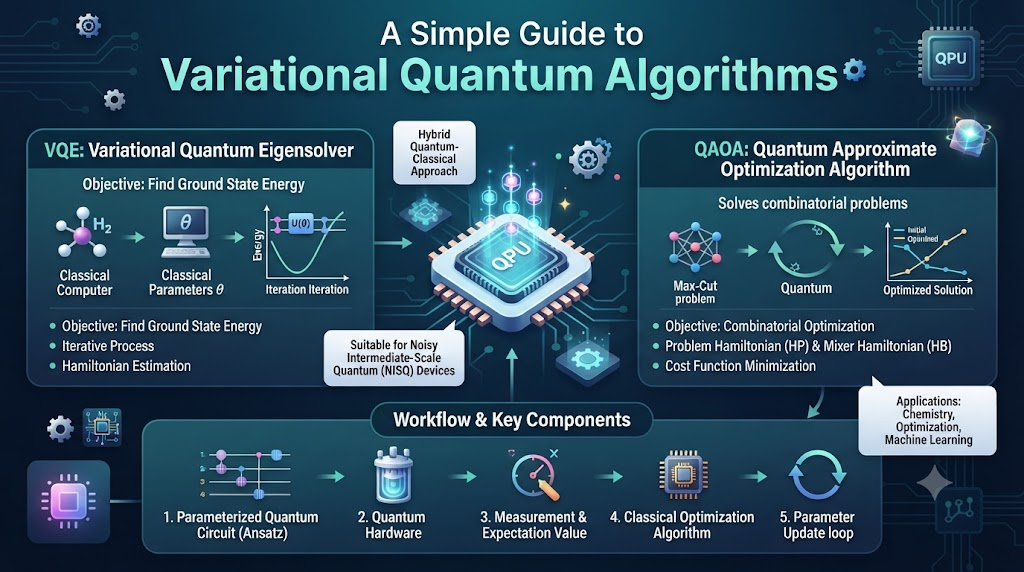
Quantum computers promise to solve hard problems fast. But today’s quantum machines have noisy bits and errors. We cannot run long math steps without losing our data.
This is where clever hybrid methods step in to save the day. You can mix regular computer power with small quantum steps. Learn more expert tips directly on QuantumUting.com.
These smart steps are called variational quantum algorithms. They let us test ideas on a quantum machine and fix them on a regular computer. Let us look at how you can use them today.
The Basics of Quantum Bits and Qubits
Regular computers use bits that are either zero or one. Quantum computers use qubits that can hold both states at once. This trick gives them huge power to test many options.
But noise ruins long calculations on these tiny machines. When qubits interact with the environment, they lose their data. We call this decoherence, and it stops us from running deep programs.
That is why scientists invented hybrid systems. You keep the quantum circuit short and sweet. You let a regular computer do the heavy lifting of fixing mistakes.
What Makes Hybrid Quantum Models Work
We do not make the quantum machine do all the work alone. Instead, we split the task into two parts. The quantum part tries out a trial state.
The regular computer looks at the output score and makes a better guess. This partnership forms a loop that gets smarter over time. You avoid long circuit runs that trigger hardware errors.
This setup matches the hardware we have right now. You can test these ideas on cloud quantum chips today without needing a massive machine.
Understanding the Variational Loop
The loop runs over and over again until you find a good answer. You start by sending a setup to the quantum machine. It applies gates and measures the output energy or score.
Next, the regular computer reads this score. It changes the dial settings for the next run. This cycle repeats many times.
Each round pushes your parameters closer to the ideal solution. You do not need perfection on the first try. The loop fixes small drifts automatically.
Designing Your First Quantum Circuit
You start with a clean slate of qubits. You apply a set of gates like rotations and flips. These gates have tunable angles that you control.
Changing these angles changes the final output state of your system. You want to pick an ansatz, which is just a trial circuit design. Your ansatz must match the problem you want to solve.
Keep your circuit layers small at first. Big circuits are hard for current hardware to run cleanly. Start small and add layers as your skills grow.
Choosing the Right Cost Function
You need a way to tell if your answer is good or bad. We use a math score called a cost function. A lower score means a better answer.
Your classical optimizer tries to drive this score down to zero. If your cost function is too flat, your optimizer gets lost. You want a score that gives clear hints on which way to turn.
Design your cost function to reflect real-world limits. This ensures your final answer works in actual production environments.
Overcoming Noise in Modern Hardware
Current quantum devices suffer from signal decay and random errors. Variational methods tolerate noise much better than deep circuits. The classical optimizer can adapt to slight errors during each run.
If a measurement is slightly off, the next loop corrects it. This built-in feedback makes hybrid algorithms very practical. You do not need a fault-tolerant machine to get useful results.
Engineers rely on this noise resilience every day. It bridges the gap between messy hardware and clean software needs.
Exploring Variational Quantum Eigensolver (VQE)
VQE helps scientists find the lowest energy state of molecules. Chemists use this to design new drugs and materials. It splits the hard math between the quantum chip and a laptop.
The quantum chip calculates energy expectations for a molecular bond. The laptop updates the electron angles based on that feedback. Together, they find stable molecular structures fast.
This tool is changing how we approach chemical research. You can simulate complex interactions that crash regular computers.
Unlocking Problems With Quantum Approximate Optimization
Optimization problems ask for the absolute best choice among millions. Logistics companies use these tools to plan delivery trucks. QAOA helps you find fast paths through complex networks.
You encode your routes into a cost function. The quantum circuit samples different path combinations. The classical loop picks the shortest route over time.
It turns impossible scheduling tasks into manageable math steps. Businesses save time and money using this exact approach.
Managing Classical Optimizer Bottlenecks
Your regular computer drives the whole process forward. Sometimes it gets stuck on flat parts of the energy landscape. We call these flat zones barren plateaus.
You need smart algorithms to jump out of these zones. Gradient-free optimizers or clever random restarts help you move past stuck points.
Monitoring your optimizer performance keeps your jobs on track. You save compute hours by catching slow loops early.
Scaling Up Your Quantum Workforce
Building these systems requires a mix of physics and coding skills. You do not need a physics degree to start building. Modern cloud tools let you run code on real hardware today.
Python libraries make writing quantum circuits simple and fun. You can define gates and run loops with just a few lines of code.
Teams that learn these skills early gain a huge market edge. Hybrid programming is the future of advanced computing tasks.
| Feature | Classical Computing | Quantum-Classical Hybrid |
| Core Engine | Binary bits and logic gates | Qubits and quantum gates |
| Noise Tolerance | High tolerance for errors | Moderate tolerance via loops |
| Best Use Case | Everyday data processing | Complex molecular and routing tasks |
| Hardware Need | Standard CPU or GPU | Cloud quantum processors |
Real-World Stories and Case Studies
- A chemical lab wanted to simulate a large molecule. Their regular computers ran out of memory. They used a variational quantum method to map molecular bonds and found the exact ground state energy.
- A delivery company faced complex route planning challenges. Traditional software took hours to find optimal paths. They applied a quantum optimization loop and cut route calculation times in half.
- A financial firm needed to manage portfolio risk quickly. Standard models failed during sudden market drops. They integrated a hybrid quantum optimizer to balance assets and lower overall risk.
- A manufacturing plant struggled with supply chain bottlenecks. They tested a quantum circuit approach to schedule factory shifts. This reduced idle machine time and boosted daily output significantly.
- A material science team aimed to build better solar panels. They used a variational algorithm to test crystal structures. The hybrid loop identified a high-efficiency compound within days.
- A telecommunication provider optimized mobile tower placements. Regular algorithms could not handle the dense urban grid. A quantum-assisted loop solved the placement matrix cleanly and efficiently.
- A cybersecurity group tested cryptographic key distributions. They used small quantum circuits to simulate interference patterns. This improved their encryption protocol strength against novel threats.
- An energy grid operator balanced power loads across cities. Sudden demand spikes caused local outages. A variational solver helped reroute electricity flows safely in real-time.
- An agricultural firm tracked crop disease spread patterns. They processed vast sensor datasets using a parameterized quantum circuit. The system predicted outbreak zones before major crop damage occurred.
- A retail chain optimized warehouse inventory stocking lists. They used hybrid algorithms to predict seasonal product demand. This lowered storage overhead costs and prevented stockouts.
Common Mistakes and Pitfalls
- Ignoring hardware noise limits. Problem: Running circuits that are too deep causes errors. Solution: Keep your quantum circuit shallow and let the classical optimizer handle adjustments.
- Choosing the wrong cost function. Problem: A poorly designed score function leads to flat optimization plates. Solution: Design smooth cost functions with clear gradient slopes toward the optimal answer.
- Selecting an inefficient classical optimizer. Problem: Slow optimizers take too many loop iterations to converge. Solution: Use gradient-free or robust gradient-based optimizers tailored for noisy functions.
- Overlooking parameter initialization values. Problem: Random start values can trap your system in poor local minima. Solution: Use smart physical insights or heuristic guides to pick better starting angles.
- Failing to budget execution time. Problem: Running thousands of cloud queue requests wastes valuable compute hours. Solution: Test your logic locally using quantum simulators before deploying to real hardware.
- Neglecting shot noise effects. Problem: Low measurement counts create misleading energy readings. Solution: Increase your shot count per circuit execution to ensure statistical accuracy.
- Mismanaging qubit connectivity limits. Problem: Hardware layouts restrict direct gate operations between distant qubits. Solution: Map your circuit gates to match the physical chip architecture carefully.
- Treating quantum outputs as deterministic. Problem: Expecting the exact same number every single time causes confusion. Solution: Acknowledge the probabilistic nature of measurements and average multiple runs.
- Writing overly complex ansatz structures. Problem: Massive ansatz designs blow up parameter counts and slow down learning. Solution: Start with simple ansatz layers and scale up only when needed.
- Skipping validation checks on classical results. Problem: Blindly trusting the optimizer leads to hidden software bugs. Solution: Validate final quantum parameters against known small-scale analytical solutions.
Step-by-Step Implementation Roadmap
- Define your problem clearly and map variables into binary or matrix forms.
- Choose the right variational algorithm type like VQE or QAOA for your task.
- Design a parameterized quantum circuit ansatz that fits your hardware constraints.
- Set up a classical optimization loop using libraries like PennyLane or Qiskit.
- Write your cost function script to measure output quality and energy scores.
- Test your complete hybrid pipeline using local software simulators first.
- Send your initial job batch to cloud-based quantum hardware providers.
- Monitor the convergence rate and adjust learning rates on your classical optimizer.
- Increase measurement shot counts to clean up statistical noise in your data.
- Analyze your final output parameters and deploy the solution to production workloads.
Final Recommendation and Next Steps
Start building your hybrid skills today with small simulator projects. Join developer communities to share code and learn from peers. Keep your circuits simple and scale up your algorithms as quantum hardware improves.
1. What are variational quantum algorithms?
They are hybrid programs that mix quantum circuits with classical computer optimization loops to solve hard math problems.
2. Why do we need hybrid quantum systems?
Current quantum hardware has too much noise to run long calculations without making big errors.
3. How does the classical optimizer help?
It reviews quantum output scores and tweaks circuit parameters to find better answers in the next run.
4. What is a variational quantum eigensolver?
It is a specific hybrid method used to find the lowest energy state of molecules and chemical bonds.
5. Can I run these algorithms on my laptop?
Yes, you can run small quantum simulations locally using software libraries before using cloud hardware.
6. What is a quantum circuit ansatz?
It is a trial structure of quantum gates with tunable angles that you adjust during the optimization loop.
7. How do I handle hardware noise?
You keep your circuits short, increase measurement shots, and rely on the optimizer to adapt.
8. What industries use these tools?
Chemistry, logistics, finance, and material science use them to solve complex resource allocation tasks.
9. Do I need a physics degree to start?
No, basic coding skills and an understanding of linear algebra are enough to start writing code.
10. Where can I learn more?
You can explore online tutorials, developer documentation, and guides on specialized quantum learning platforms.
