Introduction
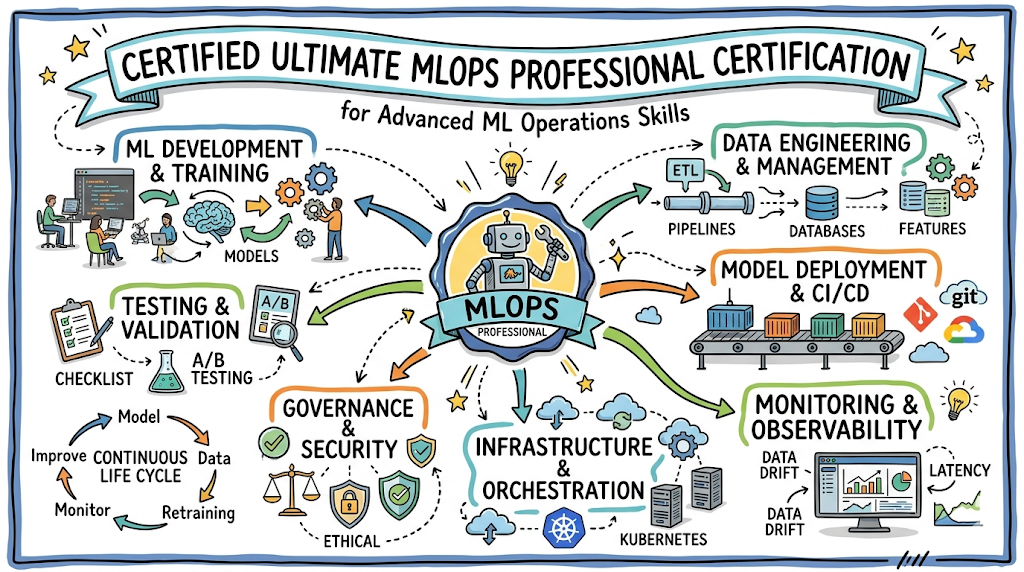
The Certified MLOps Professional is designed for engineers who want to bridge the gap between machine learning models and production-grade software operations. This guide is built for professionals navigating the complex intersection of data science, DevOps, and platform engineering to ensure models are scalable and reliable. By understanding the core tenets of this program, you can move beyond experimental notebooks and start building robust pipelines that deliver actual business value. This walkthrough helps you evaluate the depth of the curriculum and determine how it fits into your long-term career strategy at Aiopsschool.
What is the Certified MLOps Professional?
The Certified MLOps Professional represents a specialized standard for managing the entire lifecycle of machine learning models within an enterprise environment. It exists to solve the production gap where most models fail to provide value because they cannot be deployed, monitored, or updated efficiently. Unlike theoretical courses, this program emphasizes practical engineering disciplines such as CI/CD for ML, automated testing, and version control for datasets. It aligns perfectly with modern cloud-native workflows, ensuring that machine learning is treated as a first-class citizen in the software development lifecycle.
Who Should Pursue Certified MLOps Professional?
This certification is most beneficial for DevOps engineers, Site Reliability Engineers, and Data Engineers who are tasked with operationalizing artificial intelligence. Cloud architects and security professionals will also find immense value in learning how to govern and scale ML workloads without compromising system integrity. Beginners with a strong foundation in Linux and Python can use this to enter a high-growth field, while managers gain the technical vocabulary needed to lead cross-functional teams. Globally, and particularly within the rapidly evolving tech hubs, this credential signals a readiness for high-stakes enterprise projects.
Why Certified MLOps Professional is Valuable in the Future
The demand for MLOps is driven by the fact that enterprises are moving away from simple experimentation toward full-scale AI integration which requires permanent operational support. Longevity in this field is guaranteed because the underlying principles of automation, monitoring, and governance remain constant even as specific tools evolve. Professionals who master these workflows stay relevant by focusing on the logic of delivery rather than just the syntax of a single framework. The return on career investment is high, as companies are willing to pay a premium for engineers who can prevent model drift and ensure high availability.
Certified MLOps Professional Certification Overview
The program is delivered via the official training portal and is hosted on the Aiopsschool platform which provides a structured learning environment. The assessment approach is practical, moving away from simple multiple-choice questions toward performance-based evaluations that mirror real-world scenarios. It is structured into distinct tiers to accommodate different levels of technical maturity, ensuring a logical progression from basic concepts to complex architecture. This ownership of the curriculum ensures that the content remains updated with the latest industry shifts in Kubernetes, cloud services, and automation tooling.
Certified MLOps Professional Certification Tracks & Levels
The certification is categorized into three primary levels: Foundation, Professional, and Advanced, allowing for a customized journey based on prior experience. The foundation level focuses on the “what” and “why,” establishing a common language for teams, while the professional level dives deep into the “how” of automation and monitoring. Advanced tracks are designed for those looking to specialize in areas like security-focused MLOps or large-scale distributed training architectures. These levels align with standard career progression, moving from individual contributor roles to senior engineering and eventually architectural leadership positions.
Complete Certified MLOps Professional Certification Table
| Track | Level | Who it’s for | Prerequisites | Skills Covered | Recommended Order |
| Core MLOps | Foundation | Beginners & Managers | Basic IT Knowledge | ML Lifecycle, DevOps Basics | 1st |
| Engineering | Professional | DevOps & Data Engineers | Python, Linux, Docker | CI/CD for ML, Feature Stores | 2nd |
| Architecture | Advanced | Senior SREs & Architects | Kubernetes, Cloud Exp | Model Governance, Scalability | 3rd |
| Security | Specialist | Security Engineers | Professional Level Exp | MLSecOps, Data Privacy | Optional |
Detailed Guide for Each Certified MLOps Professional Certification
Certified MLOps Professional – Foundation
What it is
This entry-level certification validates a candidate’s understanding of the fundamental concepts and the business necessity of MLOps. It ensures that the professional can articulate the differences between traditional software and machine learning lifecycles.
Who should take it
It is suitable for project managers, junior engineers, and business analysts who need to collaborate with technical teams. It is also a great starting point for traditional IT administrators looking to understand the AI landscape.
Skills you’ll gain
- Understanding the ML pipeline phases
- Basic versioning for data and code
- Knowledge of model deployment strategies
- Familiarity with MLOps terminology and standards
Real-world projects you should be able to do
- Documenting a workflow for a simple ML model deployment
- Identifying bottlenecks in a manual machine learning process
- Creating a roadmap for team-wide MLOps adoption
Preparation plan
- 7–14 days: Focus on terminology and the high-level stages of the machine learning lifecycle.
- 30 days: Study case studies of successful MLOps implementations in large enterprises.
- 60 days: This level rarely requires 60 days if the candidate has a basic background in technology.
Common mistakes
- Overcomplicating the technical requirements before understanding the business logic.
- Skipping the fundamental definitions of data drift and model decay.
Best next certification after this
- Same-track option: Certified MLOps Professional – Professional
- Cross-track option: Certified DevOps Professional
- Leadership option: Certified Engineering Manager
Certified MLOps Professional – Professional
What it is
This level validates the technical ability to build, automate, and manage production-grade machine learning pipelines. It focuses on the hands-on application of tools to ensure models are reproducible and scalable.
Who should take it
This is designed for DevOps engineers, Data Engineers, and Software Developers with at least two years of experience. It is the core credential for those actively managing production environments.
Skills you’ll gain
- Implementation of CI/CD pipelines specifically for ML
- Automated monitoring and alerting for model performance
- Management of feature stores and dataset versioning
- Containerization of ML workloads using Docker and Kubernetes
Real-world projects you should be able to do
- Setting up an automated pipeline that retrains a model when new data arrives
- Implementing a monitoring dashboard that detects feature drift in real-time
- Building a scalable inference service that handles thousands of requests per second
Preparation plan
- 7–14 days: Review Python scripting and containerization basics.
- 30 days: Hands-on labs focusing on pipeline automation and cloud-specific ML services.
- 60 days: Deep dive into monitoring frameworks and troubleshooting complex deployment failures.
Common mistakes
- Focusing too much on model training and not enough on the infrastructure surrounding it.
- Neglecting the security aspects of data access and API endpoints.
Best next certification after this
- Same-track option: Certified MLOps Professional – Advanced
- Cross-track option: Certified SRE Professional
- Leadership option: Technical Lead / Principal Engineer
Choose Your Learning Path
DevOps Path
The DevOps path focuses on the seamless integration of machine learning into existing software delivery pipelines. Engineers in this track learn how to extend traditional CI/CD tools to handle the unique requirements of large datasets and non-deterministic model code. The emphasis is on building a unified developer experience where ML engineers can deploy as easily as web developers. This path is ideal for those who want to modernize their existing DevOps practices to support the next generation of intelligent applications.
DevSecOps Path
The DevSecOps path emphasizes the security and compliance aspects of the machine learning lifecycle. Professionals focus on protecting the data supply chain, ensuring model integrity, and preventing adversarial attacks on production endpoints. You will learn how to implement automated security scanning for ML libraries and manage sensitive training data within a zero-trust framework. This is critical for engineers working in highly regulated industries like finance, healthcare, or government.
SRE Path
The SRE path is centered on the reliability, availability, and performance of machine learning systems. Engineers learn how to define Service Level Objectives (SLOs) for model inference and how to handle the unique failure modes of ML in production. The focus is on building self-healing infrastructure that can gracefully handle model degradation or traffic spikes. This path is essential for those responsible for maintaining the uptime of large-scale AI services that the business depends on.
AIOps Path
The AIOps path teaches engineers how to apply artificial intelligence to enhance IT operations themselves. It focuses on using machine learning to analyze massive volumes of log and metric data to predict and prevent system outages. Professionals learn how to build automated incident response systems that learn from historical data to improve over time. This track is perfect for those who want to work at the cutting edge of autonomous infrastructure management.
MLOps Path
The MLOps path is the core journey for those specializing in the operationalization of data science models. It covers the entire spectrum from data ingestion and feature engineering to model deployment and continuous monitoring. You will learn how to build a feedback loop that allows models to be constantly improved based on their real-world performance. This path is the industry standard for anyone aiming to become a dedicated MLOps Engineer in a product-focused organization.
DataOps Path
The DataOps path focuses on the data engineering foundation that makes MLOps possible. It emphasizes the automation of data quality checks, the management of complex data pipelines, and the governance of data assets across the enterprise. Engineers learn how to treat data as a product, ensuring it is always available, clean, and ready for model training. This is a vital track for those who want to ensure that the fuel for the machine learning engine is of the highest quality.
FinOps Path
The FinOps path is dedicated to managing the variable costs associated with machine learning workloads. Cloud training and inference can become extremely expensive without proper oversight, so this path teaches engineers how to optimize resource allocation and select the right instance types. You will learn how to implement cost-tracking tags and automated scaling policies that balance performance with budget constraints. This is essential for professionals who need to prove the financial sustainability of their AI initiatives.
Role → Recommended Certified MLOps Professional Certifications
| Role | Recommended Certifications |
| DevOps Engineer | Certified MLOps Professional – Professional |
| SRE | Certified MLOps Professional – Professional & SRE Specialist |
| Platform Engineer | Certified MLOps Professional – Advanced |
| Cloud Engineer | Certified MLOps Professional – Foundation & Cloud Track |
| Security Engineer | Certified MLOps Professional – Security Specialist |
| Data Engineer | Certified MLOps Professional – DataOps Track |
| FinOps Practitioner | Certified MLOps Professional – FinOps Track |
| Engineering Manager | Certified MLOps Professional – Foundation |
Next Certifications to Take After Certified MLOps Professional
Same Track Progression
Deep specialization within MLOps involves moving toward the Advanced or Architectural levels where the focus shifts to enterprise-wide strategy. This includes mastering multi-cloud deployments, high-performance computing for training, and complex ethical AI governance. Professionals at this level are expected to design the platform that other teams use to build their models. It ensures you remain the top-tier technical authority within your organization for all things related to AI infrastructure.
Cross-Track Expansion
Broadening your skills into SRE or DevSecOps provides a more holistic view of the production environment. Understanding how model performance affects infrastructure reliability or how security vulnerabilities can be introduced in training data makes you a more versatile engineer. This cross-pollination of skills is highly valued in startups and small teams where engineers often wear multiple hats. It also prepares you for full-stack operational roles that oversee the entire technical stack.
Leadership & Management Track
For those looking to move away from day-to-day coding, the management track focuses on team building, budget management, and strategic planning. You will learn how to justify the return on investment of MLOps projects to stakeholders and how to structure teams for maximum efficiency. This transition is ideal for senior engineers who enjoy mentoring others and shaping the technical direction of the company. It allows you to leverage your technical depth while developing the soft skills needed for executive leadership.
Training & Certification Support Providers for Certified MLOps Professional
DevOpsSchool
DevOpsSchool is a leading global provider of technical training, specifically known for its extensive curriculum in automation and site reliability. They provide a massive library of hands-on labs and real-world project simulations that help students understand the complexities of modern software delivery. Their approach combines live instructor-led sessions with pre-recorded deep dives into specific toolsets like Jenkins, GitLab, and Terraform. The community support provided by DevOpsSchool is vast, allowing students to network with industry professionals and gain insights into current hiring trends. They focus on delivering practical knowledge that can be immediately applied in an enterprise setting, making them a preferred choice for corporate training.
Cotocus
Cotocus is highly regarded for its boutique approach to technical consulting and corporate upskilling. They specialize in high-end technical training for cloud migration, containerization, and advanced DevOps workflows. Their trainers are active consultants who deal with production infrastructure daily, bringing a level of expertise and realism to the classroom that is hard to find elsewhere. Cotocus designs its programs to address specific architectural challenges faced by modern organizations, moving beyond the standard syllabus to focus on custom solutions. This provider is an excellent fit for established professionals who are looking for a deep, mentor-driven experience rather than a generic overview.
Scmgalaxy
Scmgalaxy functions as a premier knowledge hub and training platform for the global software configuration management and DevOps community. They are famous for their exhaustive documentation, troubleshooting guides, and technical articles that serve as a reference for thousands of engineers worldwide. Their training programs are deeply integrated with this repository of knowledge, ensuring that students have access to technical detail long after their course is complete. Scmgalaxy emphasizes the how-to aspects of engineering, focusing on solving specific production bottlenecks and improving deployment velocity. It is a go-to resource for self-motivated learners who value thorough documentation and step-by-step technical guides.
BestDevOps
BestDevOps focuses on delivering high-impact, curated learning paths that strip away the marketing hype to focus on core technical competencies. They identify the most critical tools and methodologies used in the current market and build streamlined courses around them. Their instructors are typically senior engineers who provide a no-nonsense look at what it takes to succeed in modern IT operations. BestDevOps is known for its high-quality video content and practical assignments that mirror the tasks engineers perform in their daily jobs. This provider is ideal for individuals who need to gain specific skills quickly without having to navigate through unnecessary filler content.
devsecopsschool.com
Devsecopsschool.com is the primary destination for professionals who want to master the integration of security into the DevOps pipeline. They offer specialized courses that cover automated security testing, compliance-as-code, and the management of secure secret stores. Their curriculum is designed to transform traditional security professionals into security engineers who can code and automate. By focusing exclusively on the security aspects of the delivery lifecycle, they provide a depth of instruction that generalist providers simply cannot match. It is an essential resource for teams working in high-compliance industries who need to balance speed with rigorous security standards.
sreschool.com
Sreschool.com is dedicated to teaching the principles of Site Reliability Engineering, focusing on building systems that are both scalable and resilient. Their training modules revolve around the core SRE tenets such as error budgets, observability, and the elimination of manual toil. They teach students how to treat operations as an engineering problem, using software to manage and scale infrastructure. The courses at sreschool.com are designed to help organizations transition from a reactive firefighting mode to a proactive reliability-driven culture. This is a vital training provider for anyone looking to work at the scale of modern internet platforms.
aiopsschool.com
Aiopsschool.com leads the industry in training for artificial intelligence and machine learning operations. They bridge the gap between complex data science and robust infrastructure management, providing the most direct path to mastering MLOps. Their training environment is built to simulate real-world ML production clusters, giving students hands-on experience with model deployment and monitoring. As the primary host for the Certified MLOps Professional, they offer the most comprehensive resources for this specific certification track. They are the top choice for engineers who want to stay at the cutting edge of autonomous, AI-driven infrastructure management.
dataopsschool.com
Dataopsschool.com addresses the automation and orchestration needs of the modern data engineering world. They teach the DataOps methodology, which applies DevOps practices to the entire data lifecycle to improve quality and reduce cycle times. Their curriculum focuses on the automated testing of data pipelines, data versioning, and the deployment of data-intensive applications. By focusing on the fuel that powers machine learning, they provide a critical foundation for any MLOps initiative. This provider is perfect for data engineers and architects who want to bring more discipline and reliability to their data management processes.
finopsschool.com
Finopsschool.com provides specialized training for the emerging field of cloud financial management. They help engineers, finance professionals, and managers collaborate to optimize cloud spend and maximize business value. Their courses cover everything from cost allocation and tagging to the strategic use of reserved instances and savings plans. In a world where cloud costs can easily spiral out of control, the skills taught here are essential for the financial health of any modern tech organization. This provider is the standard for those who want to balance the technical flexibility of the cloud with fiscal responsibility and corporate accountability.
Frequently Asked Questions (General)
- How difficult is the Certified MLOps Professional exam?
The difficulty is moderate to high because it requires a combination of coding skills, operational knowledge, and an understanding of machine learning logic.
- How much time does it take to get certified?
Most professionals with a technical background spend between 30 to 60 days preparing, depending on their existing familiarity with Kubernetes and Python.
- Are there any specific prerequisites?
While there are no hard barriers, a working knowledge of Linux, basic Python scripting, and containerization concepts will significantly help your progress.
- What is the return on investment for this certification?
Engineers typically see a significant increase in salary and job opportunities as MLOps is one of the highest-paying and fastest-growing niches in tech.
- Can I take the exam online?
Yes, the certification is designed to be accessible globally through a secure online proctoring system on the official platform.
- Does the certification expire?
Most professional certifications require renewal or continuing education every two to three years to ensure you stay current with evolving tools.
- Is this better than a general DevOps certification?
It is not better but specialized. If you want to work specifically with AI and Data teams, this is much more relevant than a generalist cert.
- How does this help my career in global markets?
The tech sector is shifting from service-based to product-based AI development, making MLOps one of the most sought-after skills internationally.
- What tools are covered in the curriculum?
The focus is on industry standards like Docker, Kubernetes, Git, and various ML-specific tools for monitoring and pipeline orchestration.
- Is there a hands-on component?
Yes, the professional and advanced levels involve practical labs where you must demonstrate your ability to configure actual systems.
- Can managers benefit from this?
Absolutely. The foundation level is perfect for managers who need to understand the technical constraints and requirements of their teams.
- Which level should I start with?
If you have zero MLOps experience, start with the Foundation. If you are already a DevOps engineer, you might jump straight to the Professional level.
FAQs on Certified MLOps Professional
- What makes this certification different from Data Science certifications?
Data science certs focus on building models and algorithms. This certification focuses on the infrastructure, automation, and scaling required to make those models work in the real world.
- How does MLOps differ from traditional DevOps?
While DevOps focuses on code and binary deployments, MLOps adds the complexity of data versioning and model state. You are managing code, data, and the resulting model simultaneously.
- Will this certification help me if my company uses a specific cloud like AWS or Azure?
Yes, because the core principles of MLOps are cloud-agnostic. While specific cloud-native tools might change, the logic of CI/CD, monitoring, and governance remains the same.
- Do I need to be a mathematician to pass?
No. You need to understand the machine learning lifecycle and how models behave, but you do not need to write complex algorithms or perform high-level calculus.
- What is the role of Kubernetes in this certification?
Kubernetes is a central pillar of the professional level, as it is the industry standard for orchestrating the containers that run machine learning workloads at scale.
- How does this certification address model drift?
A major part of the curriculum is dedicated to monitoring production models to detect when their accuracy drops over time and automating the retraining process to fix it.
- Is MLOps just a trend or a long-term career?
As long as companies use AI, they will need someone to manage the infrastructure. It is a long-term evolution of the DevOps role, not a temporary trend.
- Can I transition from a manual QA role to MLOps using this?
It is a steep learning curve, but the Foundation level provides a great entry point. You will need to supplement it with strong Python and Linux skills.
Final Thoughts
From the perspective of a senior mentor who has seen various technical waves, the shift toward MLOps is one of the most significant transitions in the industry. We are moving out of the early days of AI experimentation and into a period of disciplined, professional engineering. If you are someone who enjoys the intersection of different fields and likes solving complex problems for intelligent systems, this certification is absolutely worth your time. It provides a structured way to gain a very specific, high-value skill set that sets you apart from the sea of generalist DevOps engineers. My advice is simple: do not just collect the certificate. Use the labs and the curriculum to build a portfolio of automated pipelines. The credential will get you the interview, but the practical ability to explain how you managed a production model failure will get you the job. Focus on the fundamentals, master the automation, and you will find yourself at the center of the next decade of technical innovation.
