The digital revolution has transformed every aspect of modern life, from global communications to complex financial systems. Yet, beneath the slick interfaces of our smartphones and supercomputers lies a fundamental limitation. Classical computers process information using silicon transistors that act as simple on-off switches. These systems are bound by the predictable laws of classical physics, restricted to evaluating options one after another. As humanity faces increasingly complex challenges in chemistry, optimization, and materials science, our traditional machines are running out of steam. For anyone eager to explore this technological frontier, mastering these concepts is the essential first step. At QuantumUting, we believe that demystifying these foundational principles empowers learners to appreciate the true potential of the ongoing quantum revolution. Let us dive deep into the world of quantum mechanics fundamentals and explore the nature of quantum states.
Key Takeaways
- Fundamental Units: Quantum states represent the complete mathematical description of a quantum system, serving as the foundation for qubits.
- Superposition and Entanglement: These states allow quantum systems to exist in multiple configurations at once and link particles across vast distances.
- Probabilistic Nature: A quantum state describes the probabilities of various outcomes, rather than a single, deterministic value.
- Measurement Collapse: Observing or measuring a quantum state forces it to choose a definitive classical value, altering its properties instantly.
What Is a Quantum State?
To understand what are quantum states, it helps to start with a simple, everyday definition. In the regular world, a “state” describes the condition of an object at a specific moment. For instance, a traffic light can be in a state of red, yellow, or green. A light switch can be in an on or off state. In the subatomic realm, a quantum state is the complete description of a quantum system, encapsulating all of its physical properties, such as position, momentum, spin, or polarization.
Think of a quantum state as the ultimate identity profile for a subatomic particle. It holds every piece of data regarding what the particle is doing, where it might be, and how it behaves. However, unlike classical objects, this identity is not fixed in a single, unchanging value. Instead, the state contains a spectrum of potential values, waiting to be revealed through interaction with the external environment.
Classical Bits vs Quantum States
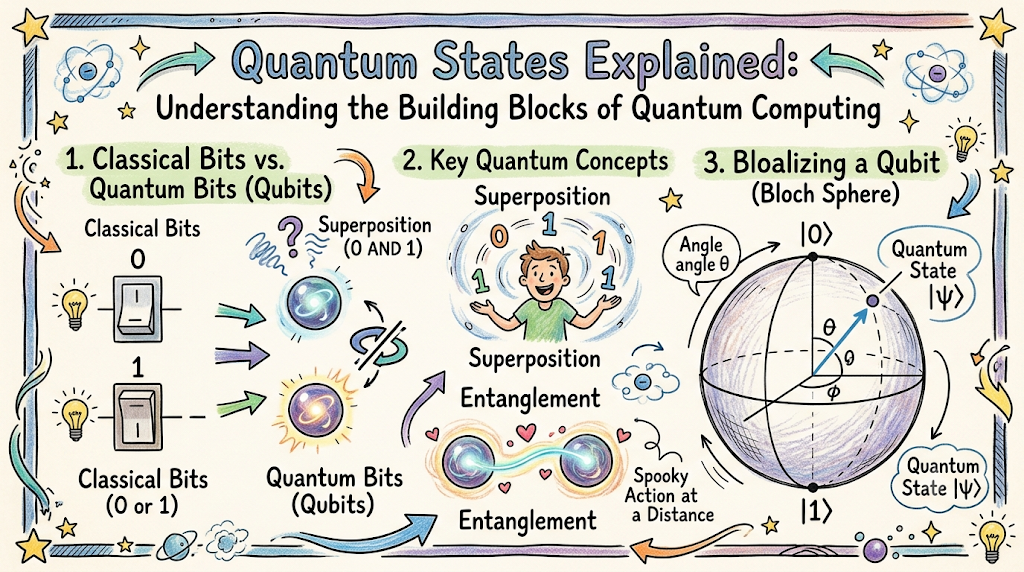
To grasp the mechanics of quantum computing basics, we must examine the core building blocks of information. Classical computers rely on the bit as their fundamental unit of data. A classical bit is rigid and binary, restricted to existing in one of two distinct physical states: 0 or 1. You can visualize a classical bit as a standard light switch that is either flipped up or down, with no middle ground or alternative options allowed.
Quantum systems replace the classical bit with the quantum bit, or qubit. Qubits and quantum states work hand in hand to break free from this binary restriction. Instead of being trapped in a rigid 0 or 1 position, a quantum state allows a qubit to inhabit a blend of both positions simultaneously. This unique physical characteristic means the system can process an immense landscape of data variations at the exact same moment.
Plaintext
[Classical Bit]  -->  ( 0 )  OR  ( 1 )        --> Standard Light Switch
[Quantum Qubit]  -->  ( 0 ) AND ( 1 ) Mixed   --> Spinning Sphere / Coin
To visualize this difference, imagine a coin resting flat on a wooden desk. It displays either heads or tails, representing a classical bit. Now, imagine spinning that same coin at high speed on the tabletop. Is it heads or tails? While it spins, it exists in a dynamic blur, a combination of both states at the same time. The spinning coin represents a qubit, and the dynamic blur represents its quantum state.
This capability introduces the concept of quantum superposition, where a system occupies multiple physical possibilities at once. Because quantum states can combine and overlap, they possess vastly more processing power than classical bits. As you add more classical bits to a computer, its processing capacity grows linearly. When you add more qubits, their combined quantum states expand exponentially, allowing a quantum computer to evaluate millions of pathways simultaneously.
Mathematical Representation of Quantum States
To work with these fluid systems, scientists require a precise language. Quantum mechanics fundamentals rely heavily on Dirac notation, which is also known as bra-ket notation. This system uses specific brackets to enclose symbols, turning abstract physical concepts into manageable algebraic expressions. A standard quantum state is written inside a “ket,” which looks like this: ∣ψ⟩. The Greek letter psi inside the lines serves as a universal label for the state vector.
A state vector is a mathematical arrow pointing in an abstract, multi-dimensional space. In classical geometry, a vector might tell you to move three steps right and four steps up on a flat grid. In quantum mechanics, the state vector points toward a specific blend of physical possibilities. For a single qubit, this vector moves within a conceptual space defined by two base positions, typically labeled as ∣0⟩ and ∣1⟩.
The mathematical equation for a single qubit state is written as:
∣ψ⟩=α∣0⟩+β∣1⟩
In this formula, α and β are complex numbers known as probability amplitudes. These amplitudes are critical because they dictate how much of the ∣0⟩ state and how much of the ∣1⟩ state are mixed together within the overall vector. They do not represent the direct percentages themselves, but they are the mathematical values used to calculate those percentages.
To determine the actual likelihood of a measurement outcome, scientists square the absolute values of these amplitudes. The probability of the state collapsing into ∣0⟩ is ∣α∣2, and the probability of collapsing into ∣1⟩ is ∣β∣2. Because the system must land in one of these two positions upon measurement, the sum of these squared probabilities must always equal exactly 1:
∣α∣2+β∣2=1
This elegant mathematical framework ensures that no matter how complex or fluid a quantum state becomes, it always conforms to predictable physical constraints when measured.
Superposition and Quantum States
The phenomenon of quantum superposition is the true engine of quantum computation. In everyday language, superposition describes the ability of a quantum state to exist in multiple configurations simultaneously. It is vital to note that this is not merely a case of a system fluctuating rapidly between different options, nor is it a sign of human ignorance about the true state. The particle genuinely occupies all available paths at the exact same moment.
This concept sounds like science fiction because it defies our daily observations. If you walk through an amusement park, you can only pass through one turnstile at a time. A subatomic particle, guided by its quantum state, can travel through multiple paths simultaneously, interacting with itself along the way. This capability allows a quantum device to explore an array of solutions to a complex problem all at once.
Types of Quantum States
Pure Quantum States
A pure quantum state represents a system that exists in complete isolation, perfectly shielded from the disruptive noise of the outside world. In this scenario, we possess the maximum amount of physical information allowed by the laws of nature regarding the system. A pure state can be described accurately by a single state vector, such as ∣ψ⟩. It represents the ideal condition for running quantum algorithms, where every probability amplitude is clean, defined, and completely uncorrupted by environmental interference.
Mixed Quantum States
In reality, keeping a quantum system perfectly isolated is incredibly difficult. When a system interacts with its surrounding environment, it loses its pristine isolation, transforming into a mixed quantum state. A mixed state cannot be represented by a single state vector. Instead, it is treated as a statistical mixture of different pure states, much like a deck of cards where you know the general odds of drawing a specific suit but cannot see the individual cards. Scientists use a mathematical tool called a density matrix to track these complex, real-world mixtures.
Entangled States
An entangled state occurs when two or more quantum particles interact in a way that links their physical states together permanently, regardless of the distance separating them. In an entangled state, you can no longer describe the individual properties of particle A or particle B independently. Instead, they share a single, unified quantum state. If you measure one particle and find it spinning upward, you instantly know its entangled partner is spinning downward, even if that partner is located on the opposite side of the galaxy.
Product States
Conversely, a product state describes a multi-particle system where no entanglement is present. In a product state, the individual components remain completely independent of one another. The total quantum state of the system is simply the mathematical product of each individual particle’s state vector. If you perform a measurement on particle A within a product state, it provides no information about particle B, and does not alter particle B’s behavior. This represents a lack of quantum correlation between the components.
Quantum Entanglement and States
Quantum entanglement stands as one of the most counterintuitive discoveries in modern science, so much so that Albert Einstein famously dismissed it as “spooky action at a distance.” At its core, entanglement is a deep, fundamental relationship between particles that fuses their individual identities into a single, collective quantum state. When two particles become entangled, their fates are locked together, defying our traditional understanding of space, time, and isolation.
This phenomenon establishes a powerful non-local correlation between distant objects. In the classical world, if you paint one marble blue and another marble red, place them in separate boxes, and ship one to Tokyo and the other to New York, opening the box in Tokyo tells you what is in New York. However, those marbles had fixed colors the entire time they were in transit. In a quantum entangled state, the two particles do not have fixed identities during their journey. They exist in a fluid superposition until the moment of observation.
Plaintext
Particle A (New York) <=========[ Entangled State ]=========> Particle B (Tokyo)
     |                                                              |
Measured: Snaps to UP                                       Instantly Snaps to DOWN
The real-world implications of this connectivity are profound. Because measuring one particle triggers an instantaneous response in its entangled partner, it allows for the creation of revolutionary technologies. This instantaneous correlation forms the backbone of quantum teleportation protocols, where the information of a quantum state is transferred from one location to another without traveling through the intervening physical space.
Measurement of Quantum States
The process of measurement in the quantum realm is fundamentally different from measurement in our daily lives. In the classical world, measuring an object is a passive act. If you use a ruler to measure the length of a wooden table, the table remains completely unaffected by the presence of the ruler. The property you are measuring exists independently of your observation. In quantum mechanics fundamentals, however, measurement is an active, disruptive intervention that fundamentally alters the system.
When a measurement device interacts with a quantum system, it triggers an immediate wavefunction collapse. The wavefunction is the mathematical entity that tracks the evolving probabilities of a quantum state. Before the measurement occurs, the wavefunction is spread out, mapping a wide variety of possible locations or configurations. The instant the measurement device makes contact, this spread-out cloud of probabilities condenses into a single, sharp point, forcing the system into a definitive state.
Quantum State Evolution
Quantum states are not static entities; they change, shift, and evolve continuously over time. When a quantum system is left completely undisturbed, its time-dependent behavior is governed by a fundamental equation of physics known as the Schrödinger equation. This equation allows scientists to predict exactly how the probability amplitudes of a quantum state will ripple and flow through space, ensuring that the evolution of an isolated quantum system remains entirely smooth and predictable.
In the context of quantum computing, this continuous evolution is manipulated through the deployment of quantum gates. Just as a classical computer uses logical gates (like AND, OR, and NOT) to flip silicon bits between 0 and 1, a quantum computer uses quantum gates to alter state vectors. These gates do not abruptly force a qubit to become a 0 or a 1. Instead, they gently rotate the state vector through its abstract mathematical space, shifting the probability amplitudes to modify the system’s underlying code.
Plaintext
Initial State |0>  -->  [ Quantum Gate (Hadamard) ]  -->  Superposition State
                                                              1/√2(|0> + |1>)
Every valid manipulation performed by a quantum gate relies on the concept of a unitary operation. In mathematics, a unitary operation is a transformation that preserves the total probability of a system, ensuring it always sums to exactly 1. More practically, unitary operations are completely reversible. If you apply a quantum gate to a state vector and alter its path, you can always apply a corresponding inverse gate to guide the state vector right back to its original starting position.
This reversibility is a core requirement of quantum computation. Because these operations do not destroy data along the way, they prevent the computational system from losing energy as heat, a common problem in classical silicon chips. By chaining together sequences of these unitary operations, developers construct complex quantum circuits. These circuits guide the evolution of quantum states through intricate pathways, executing advanced algorithms before a final measurement harvests the answer.
Real-World Applications of Quantum States
Quantum Computing Algorithms
The most prominent application of these principles lies in the development of custom quantum computing algorithms. Algorithms like Shor’s Algorithm leverage the properties of superposition and phase interference to factor massive integers in a fraction of the time required by classical machinery. This capability could potentially bypass modern RSA encryption protocols. Meanwhile, Grover’s Algorithm utilizes quantum state manipulation to search through unstructured databases exponentially faster than any traditional computer architecture.
Cryptography
Quantum states are paving the way for unbreakable security frameworks through Quantum Key Distribution (QKD). Traditional cryptography relies on math problems that are difficult for classical chips to solve but could eventually be cracked by advanced hardware. Quantum cryptography relies on the unyielding laws of physics. By transmitting secure cryptographic keys via individual quantum states (such as polarized photons), any attempt by an eavesdropper to intercept the key will cause the quantum states to collapse, instantly alerting the administrators to the security breach.
Quantum Simulation
Feynman famously noted that nature is quantum, so if you want to simulate nature, you need a quantum computer. Simulating the behavior of complex molecules on classical computers requires an impossible amount of memory because tracking every electron interaction involves an overwhelming number of variables. By using the controllable quantum states of qubits to directly mirror the natural quantum states of complex molecules, researchers can simulate chemical reactions with absolute precision, opening new frontiers in material science.
Drug Discovery
This talent for molecular simulation is poised to revolutionize the pharmaceutical industry through rapid drug discovery. Currently, creating life-saving medications requires years of expensive trial-and-error laboratory testing to see how chemical compounds interact with human proteins. Quantum computers will allow researchers to model these molecular interactions virtually, down to the behavior of individual atomic bonds. This capability could compress the timeline for developing new vaccines, cancer therapies, and antibiotics from decades into days.
Optimization Problems
Modern industries are constantly grappling with complex logistical challenges, such as determining the most efficient routes for global shipping fleets or managing risk portfolios in financial markets. These challenges are known as optimization problems, and they quickly overwhelm classical systems due to the sheer number of moving parts. Quantum states can evaluate millions of potential operational pathways simultaneously, helping logistics networks, manufacturing supply chains, and financial systems discover optimal solutions with unprecedented speed.
Why Quantum States Matter
At its core, the quantum state is the absolute foundation of quantum computing. Without a deep, functional mastery of how these states behave, none of our emerging quantum technologies could exist. Every piece of hardware currently being constructed by technology firms, from superconducting circuits to trapped ion traps, is designed with a single goal in mind: to generate, isolate, manipulate, and measure quantum states with extreme precision.
These states serve as the power behind quantum advantage. Quantum advantage is the historic threshold where a quantum processor can complete a specific calculation that would be practically impossible for any classical supercomputer to solve. This leap in performance cannot be achieved by simply adding more transistors or increasing clock speeds. It is unlocked by utilizing the unique mechanics of superposition and entanglement, allowing a system to evaluate complex mathematical landscapes that classical systems cannot even represent.
Furthermore, quantum states play an indispensable role in the architecture of quantum algorithms. Algorithms are not just static strings of code; they are dynamic choreographies that guide the evolution of state vectors. By arranging quantum gates in precise patterns, programmers can cause incorrect paths to destructively cancel each other out, while causing correct answers to amplify constructively. When the final measurement occurs, the system collapses onto the correct answer with incredibly high probability, translating abstract physics into real-world computational power.
Challenges in Working with Quantum States
| Challenge | Primary Impact | Potential Solution |
|---|---|---|
| Decoherence | Destroys quantum superposition states | Cryogenic cooling and physical isolation |
| Noise Sensitivity | Introduces calculation errors | Quantum Error Correction (QEC) protocols |
| Measurement Limitations | Destroys data upon observation | Non-destructive weak measurements |
| Hardware Instability | Limits scalable qubit architecture | Developing topological qubits |
The primary obstacle preventing us from building mass-market quantum computers is decoherence. A quantum state is an incredibly delicate structure that requires absolute isolation to maintain its superposition. When a qubit interacts with minimal environmental noise, such as temperature fluctuations, electromagnetic waves, or physical vibrations, its quantum properties leak out into the surroundings. This decoherence causes the system to lose its quantum capabilities, reverting back into a standard, slow classical system.
This vulnerability highlights the issue of noise sensitivity. Modern quantum devices are often referred to as Noisy Intermediate-Scale Quantum (NISQ) systems. Because today’s qubits are highly sensitive to their environments, even a tiny amount of interference can introduce errors into a calculation. To combat this, researchers are developing Quantum Error Correction (QEC) protocols. These systems spread the data of a single “logical qubit” across a large network of physical qubits, allowing the system to detect and correct errors without destroying the underlying state.
Another challenge involves measurement limitations. Because measuring a quantum state triggers an immediate wavefunction collapse, developers cannot step in halfway through a calculation to check on their progress without ruining the entire operation. This reality requires programmers to design algorithms where all the processing occurs blindly within an isolated environment, relying entirely on the final measurement to reveal the results.
Finally, hardware instability remains a significant hurdle. Building a system that can scale up to millions of qubits while keeping each one perfectly stable, cold, and interconnected requires complex engineering. Current quantum computers must be housed in specialized dilution refrigerators that maintain temperatures colder than deep space. Overcoming these mechanical constraints and stabilizing these delicate states across thousands of interconnected qubits is the defining scientific challenge of our generation.
Future of Quantum State Research
To overcome these roadblocks, the global scientific community is pouring immense resources into creating fault-tolerant quantum systems. A fault-tolerant system is an advanced architecture capable of running long, complex calculations even when individual physical qubits experience errors or decoherence. Achieving this milestone requires refining our control over quantum states so that errors are managed automatically, clearing the path for reliable, commercial-grade quantum computers.
A major focus of this research centers on building scalable qubit architectures. Today’s quantum devices operate with dozens or hundreds of qubits, but solving world-changing optimization and chemical problems will require systems with thousands or millions of stable qubits. Scientists are exploring various hardware designs, from silicon-based quantum dots that leverage existing semiconductor manufacturing techniques to topological qubits that use braided quantum paths to inherently protect data from environmental noise.
Plaintext
Current Era (NISQ)   --> High Noise, Limited Qubits, Manual Correction
Future Era (Scalable) --> Fault-Tolerant Systems, Millions of Stable Qubits
Another exciting frontier is the development of quantum machine learning (QML). This emerging field blends quantum computing basics with advanced artificial intelligence frameworks. Because quantum states can represent complex datasets with remarkable efficiency, they can be used to accelerate the training of machine learning models. This could allow neural networks to identify patterns within complex data, such as genomic sequences or global climate patterns, much faster than classical systems.
Finally, the immediate future of computing will likely be defined by hybrid quantum-classical systems. Instead of trying to use a quantum computer for every task, industries will deploy hybrid setups. In this ecosystem, a standard classical supercomputer manages the bulk of an application’s workflow, offloading specific, highly complex mathematical bottlenecks to a quantum processor. This collaborative approach allows us to harvest the unique power of quantum states today, while our hardware continues to mature.
FAQ Section
1.What is a quantum state in simple terms?
A quantum state is the complete physical and mathematical description of a quantum particle or system. You can think of it as a comprehensive identity profile that contains all the data regarding what a particle could do, including its position, spin, and energy levels. Unlike classical objects, a quantum state describes a landscape of multiple potential realities rather than a single, fixed value.
2.How is a quantum state different from a classical state?
The primary difference lies in certainty and multiplicity. A classical state is binary and deterministic; a standard light switch is either on or off, and looking at it does not change its position. A quantum state is probabilistic and fluid, allowing a system to exist in a blend of multiple options simultaneously, only locking into a definitive value when it interacts with an external measuring device.
3.What is superposition in quantum states?
Superposition is the ability of a quantum state to occupy multiple physical configurations at the exact same moment. This does not mean the system is moving rapidly between different positions, or that we simply lack information about it. Instead, the particle genuinely exists in an overlapping blend of all available paths simultaneously, allowing quantum systems to process vast combinations of data at once.
4.What happens when a quantum state is measured?
When a quantum state is measured, its delicate balance of multiple possibilities is disrupted by the interaction with the macroscopic world. The system instantly abandons its fluid, overlapping configuration and snaps into a single, definitive classical value. This transformation means that any complex quantum data held in the superposition is lost, leaving behind a standard binary result.
5.What is wavefunction collapse?
Wavefunction collapse is the rapid transition of a quantum system from a cloud of multiple probabilities into a single, definitive physical reality. The wavefunction is the mathematical tool that tracks the shifting odds of a quantum state. When an external measurement occurs, this spread-out field of probabilities collapses down to a single point, forcing the particle to choose one specific identity.
6.What is an entangled quantum state?
An entangled quantum state is a phenomenon where two or more particles become connected in such a way that their physical identities are unified, regardless of how far apart they travel. In an entangled state, you cannot describe the properties of one particle independently of its partner. Measuring one particle triggers an instantaneous response in the other, establishing a non-local connection that underpins quantum communication.
7.Can quantum states be observed directly?
No, quantum states cannot be observed directly in their fluid, overlapping condition. The moment you attempt to look at or measure a quantum state using standard laboratory equipment, you cause the state to collapse into a classical value. Scientists must infer the properties of a quantum state by running the exact same experiment thousands of times and analyzing the resulting statistical distributions.
8.Why are quantum states important in computing?
Quantum states are important because they serve as the fundamental language of qubits, replacing the rigid 0 and 1 bits of traditional computers. By utilizing properties like superposition and entanglement, quantum states allow a processor to hold, manipulate, and evaluate massive landscapes of information simultaneously, providing the foundation for quantum advantage.
9.What is a pure quantum state?
A pure quantum state represents a quantum system that is perfectly isolated from external environmental interference. In a pure state, we possess the absolute maximum amount of physical information allowed by nature regarding the system, which can be represented by a single, clean state vector. This pristine condition is ideal for running precise quantum algorithms.
10.How can beginners learn quantum states?
Beginners can start by mastering the fundamentals of classical computer science alongside basic linear algebra, focusing on concepts like vectors and matrices. From there, exploring conceptual analogies—like spinning coins or waves in an ocean—helps build intuition before moving on to formal quantum mechanics fundamentals and interactive coding frameworks like Qiskit.
Conclusion
Understanding what are quantum states is the essential key to unlocking the true potential of the ongoing quantum computing revolution. These fluid profiles do not merely represent an incremental upgrade to our existing data processing tools; they represent an entirely new way of interacting with the physical laws of our universe. From the shifting possibilities of superposition to the deep connectivity of entanglement, quantum states provide the core mechanics that make next-generation computation possible.
While significant engineering challenges like decoherence and noise sensitivity remain, the progress being made across global research labs is undeniable. As we transition from the noisy NISQ era into a new age of scalable, fault-tolerant systems, our ability to manipulate these delicate states will continue to sharpen. This progress will open new doors in medicine, material science, optimization, and cybersecurity, reshaping our technological landscape.
