Introduction
Traditional computers have completely transformed our modern lives, but they face a major challenge when trying to solve highly complex, multi-variable problems like simulating molecules for life-saving drugs or optimizing global logistics networks. This limitation exists because standard computers process information sequentially using rigid bits that can only ever be a 0 or a 1. Quantum computing breaks through this technological barrier by using the fascinating laws of physics to process data through quantum bits, or qubits. By utilizing a principle known as superposition, a qubit can exist as both a 0 and a 1 at the exact same time, allowing a quantum system to explore millions of solutions simultaneously and deliver a massive leap in processing power. To build your foundational knowledge, explore beginner-friendly guides, and keep up with these technological breakthroughs, make sure to visit QuantumUting.com for excellent quantum educational resources.
Understanding Quantum Computing
What is Quantum Computing?
Quantum computing is a completely new paradigm of computation that uses the principles of quantum mechanics to solve problems that are too complex for classical computers. Unlike your laptop or a corporate data center, which processes information using certainties, a quantum computer operates in a realm of probabilities. It does not simply do things faster; it does things completely differently by manipulating the fundamental properties of matter and light at the atomic and subatomic levels.
Difference Between Classical and Quantum Computers
To understand this shift, imagine a large maze. A classical computer tries to find the exit by exploring one path at a time. If it hits a dead end, it backs up and tries the next path, repeating this sequence until it finds the correct route.
A quantum computer, however, acts like a flood of water poured into the entrance of the maze. It travels down every single path, around every corner, and through every corridor simultaneously, finding the exit in one single, fluid operation. Classical computers rely on absolute silicon switches, whereas quantum computers use microscopic quantum systems to hold and manipulate fluid information.
Evolution of Quantum Computing
The concept began in the early 1980s when visionary physicists like Richard Feynman suggested that classical computers could never efficiently simulate systems that obey quantum laws, such as complex molecules. He proposed that building a computer based on quantum mechanics itself was the only logical solution.
Over the decades, this theoretical idea moved from chalkboard equations into high-tech physics laboratories. Today, the field has transitioned from basic academic research into a fast-growing commercial industry, backed by major technology firms, global research institutions, and specialized startups worldwide.
Why Quantum Computing Matters
We are rapidly approaching the physical limits of traditional silicon chips. As transistors shrink to the size of just a few atoms, they begin to leak electricity due to quantum tunneling, rendering standard computer logic unreliable.
Quantum computing matters because it bypasses these physical limits entirely. It offers a path forward to solve vital global problems, such as discovering life-saving medications, engineering hyper-efficient solar panels, optimizing global supply chains, and creating unbreakable cybersecurity networks.
Understanding Quantum Bits (Qubits)
What is a Qubit?
A qubit, short for quantum bit, is the fundamental unit of quantum information. Just as a classical bit is the basic building block of traditional computers, the qubit is the foundational element of all quantum computing architectures. It represents the physical hardware where quantum data is stored, manipulated, and processed.
Difference Between Bits and Qubits
The operational difference between bits and qubits lies in their flexibility and capacity for information. A standard bit is rigid, confined to binary certainty. A qubit is dynamic, holding a spectrum of possibilities.
Because qubits can hold these complex states, a quantum system can store and process exponentially more data than an equivalent number of classical bits, transforming how we calculate complex problems.
Binary States in Traditional Computing
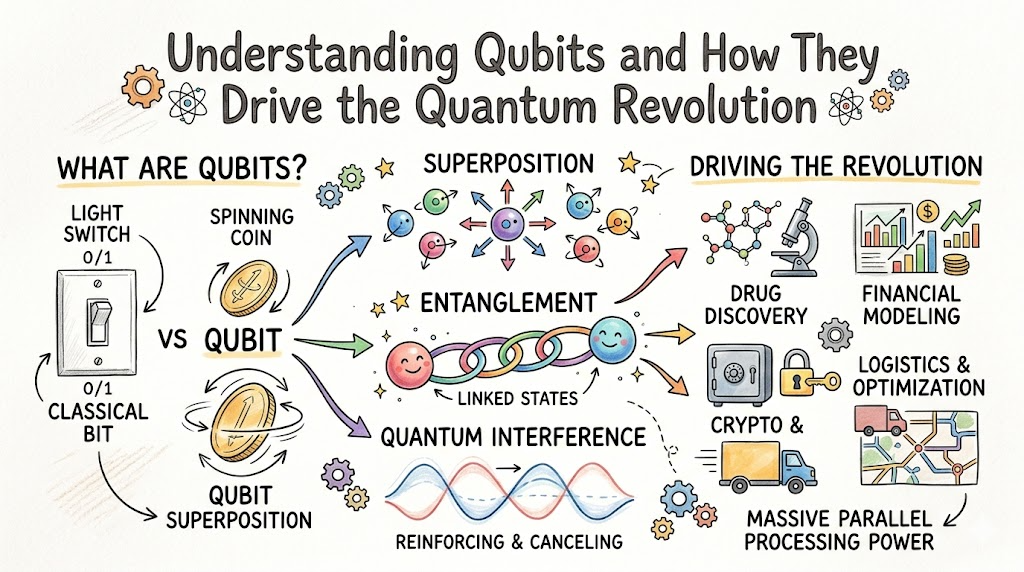
Traditional computing relies on a simple binary system. Think of a standard bit as a basic household light switch. It can only ever be in one of two distinct positions:
- 0 (OFF): No electrical current flows through the circuit.
- 1 (ON): Electrical current flows freely through the circuit.
Every image, video, word, and software program you interact with is broken down into billions of these simple zeros and ones. The computer processes these switches one by one at lightning speed, but each switch is strictly locked into a single state at any given moment.
Quantum States in Qubits
Instead of a static light switch, imagine a qubit as a coin spinning rapidly on a table. While the coin is spinning, is it heads or tails? It is a continuous, fluid blend of both states at the same time. It only becomes a definitive “heads” or “tails” when you slam your hand down flat on top of it to stop the spin.
In the quantum world, a qubit does not choose between 0 and 1 while it is calculating. It exists in a mathematical combination of both states simultaneously until the computation finishes and a final reading is taken.
Core Principles Behind Qubits
Superposition
Superposition is the remarkable ability of a qubit to exist in multiple states simultaneously. In a classical system, two bits can represent only one of four possible combinations at any given time: 00, 01, 10, or 11.
With superposition, two qubits can exist in all four combinations at the exact same moment. As you add more qubits, the processing capacity grows exponentially. For example, $n$ qubits can represent $2^n$ states simultaneously. This means 300 perfectly synchronized qubits can hold more data combinations than there are atoms in the observable universe.
Entanglement
Albert Einstein famously referred to quantum entanglement as “spooky action at a distance.” It is a unique phenomenon where two or more qubits become deeply interconnected. When qubits are entangled, the physical state of one qubit instantly dictates the state of its partner, no matter how far apart they are.
The Shoe Analogy: Imagine you place a pair of shoes into two identical, separate boxes and mix them up. You keep one box and ship the second box to a friend on the other side of the planet. The moment you open your box and discover a left shoe, you instantly know that your friend’s box contains the right shoe, even though you are thousands of miles apart.
In quantum computing, entangling qubits allows them to share information instantly, working together as a highly coordinated team to solve massive problems in parallel.
Quantum Interference
Quantum interference is the control mechanism used to steer a quantum computer toward the correct answer. Think of waves in an ocean. When two crests meet, they reinforce each other, creating a larger wave (constructive interference). When a crest meets a trough, they cancel each other out, leaving the water flat (destructive interference).
Quantum algorithms use interference to amplify the signals pointing toward the correct solution of a problem while canceling out the signals leading to incorrect paths. This ensures that when the final measurement occurs, the wrong answers disappear and the correct answer emerges clearly.
Measurement in Quantum Systems
In our daily lives, looking at an object does not change what it is. In the quantum world, however, the act of looking changes reality. While a qubit is processing, it remains in a delicate state of superposition, holding both 0 and 1.
The moment a quantum computer measures a qubit, its superposition collapses. The spinning coin stops, and the qubit instantly falls into a hard classical state of either a 0 or a 1. Because of this, quantum algorithms must be designed carefully to complete all calculations while the qubits are spinning, ensuring the final collapse reveals the useful data you need.
How Qubits Actually Work
Storing Information in Quantum States
To store information, scientists look for tiny physical objects that naturally obey quantum mechanics. These objects can be subatomic particles, like the spin of an electron (up or down), or individual particles of light, called photons, using their polarization (horizontal or vertical). By isolating these microscopic systems from the outside world, engineers can use their delicate internal properties to hold quantum data safely.
Quantum Gates and Operations
Traditional computers use silicon logic gates (like AND, OR, NOT) to manipulate bits and perform arithmetic. Quantum computers use quantum gates to manipulate qubits.
Unlike classical gates, quantum gates do not just flip a switch from 0 to 1. Instead, they act like gentle forces that tilt, rotate, and shift the balance of the spinning qubit. These gates alter the probabilities of the qubit’s states without forcing it to collapse prematurely, allowing complex math to happen smoothly in the background.
Manipulating Qubits
To change the state of a qubit, engineers interact with it using precise external energy sources:
- Microwave Pulses: Used to control superconducting qubits sitting inside specialized refrigerators.
- Laser Beams: Focused with extreme precision to alter the states of individual trapped ions.
By firing a pulse of microwaves or lasers at a specific frequency and duration, you can rotate a qubit exactly halfway between 0 and 1, putting it into a perfect state of superposition, or entangle it with a neighboring qubit.
Reading Quantum Information
Once a quantum algorithm completes its operations, the final results must be converted back into standard data that human engineers can read. The system opens up the isolated environment and measures the qubits.
This step destroys the delicate quantum states, forcing every qubit to pick a side and reveal either a 0 or a 1. This output forms a traditional binary string that is sent directly to a regular computer screen for analysis.
Error Correction in Quantum Systems
One of the biggest hurdles in quantum computing is that qubits are extremely sensitive. The slightest change in temperature, a stray electromagnetic wave, or even vibration can cause them to lose their quantum properties and ruin a calculation. This breakdown is called decoherence.
To fix this, scientists are developing Quantum Error Correction (QEC). QEC works by grouping multiple fragile physical qubits together to form a single, stable “logical qubit.” If one physical qubit fails due to outside noise, the surrounding qubits detect the error and correct it, keeping the calculation on track.
Types of Qubits
Building a reliable quantum computer requires choosing the right physical foundation for your qubits. Different tech companies and research labs are testing various approaches, and each method has its own distinct strengths and weaknesses.
| Qubit Type | Physical Foundation | Key Advantage | Main Challenge |
| Superconducting | Artificial circuits on silicon chips | Fast operation speeds | Requires near absolute zero temperatures |
| Trapped Ion | Individual atoms held by electric fields | Highly stable, low error rates | Slower operation speeds |
| Photonic | Individual particles of light (photons) | Can operate at room temperature | Hard to make photons interact with each other |
| Spin Qubits | Electron spins trapped in silicon | Fits well with existing chip manufacturing | Fragile quantum states |
| Topological | Split quasiparticles braiding in space | Built-in resistance to outside noise | Extremely difficult to create and verify |
Superconducting Qubits
Superconducting qubits are built using tiny engineered electrical circuits printed on standard silicon wafers. When cooled to extreme temperatures, these circuits lose all electrical resistance, allowing currents to flow indefinitely without losing energy.
This is currently one of the most widely used technologies in the industry. Its main advantage is that these qubits can be manufactured using existing semiconductor factories, making them easier to scale up on a chip. However, they are highly sensitive to outside noise and require massive cooling systems to work properly.
Trapped Ion Qubits
This approach uses actual, individual atoms (usually ions of elements like ytterbium or calcium) held floating in place inside a vacuum chamber by precise electrical fields. Engineers use finely tuned lasers to manipulate the internal quantum states of these trapped atoms.
Because every single atom of a given element is identical by nature, trapped ion qubits are uniform and stay stable for a long time. The trade-off is that manipulating floating atoms with lasers is a meticulous process, which makes running operations slower compared to solid-state systems.
Photonic Qubits
Photonic systems use individual particles of light, or photons, as qubits. Information is stored by altering the polarization or path of the light beam.
The biggest benefit of photons is that they do not interact easily with their surroundings, allowing them to operate at standard room temperatures without needing expensive cooling systems. The challenge, however, is that because photons do not interact with each other easily, making two photonic qubits talk to one another to perform logic operations is difficult.
Spin Qubits
Spin qubits trap individual electrons inside tiny structures called quantum dots, which are built directly into standard silicon wafers. Information is stored using the natural spin of the electron, which points up, down, or anywhere in between.
This method is highly attractive because it leverages the same silicon manufacturing processes used to build everyday computer chips. This makes it easier to integrate millions of qubits onto a single processor, though keeping the electron spins stable remains a technical challenge.
Topological Qubits
Topological qubits are a theoretical approach that stores information by braiding paths of quasiparticles across a two-dimensional surface. Instead of storing data in a single point, information is spread out across the structure’s shape.
This gives the system built-in protection against outside noise; bumping one part of the system won’t ruin the whole structure. While this design could be incredibly stable, creating these exotic states of matter in a lab is difficult, and researchers are still working to build reliable prototypes.
Real-World Applications of Qubits
As quantum hardware continues to mature, the immense processing power of qubits will solve industrial problems that are currently impossible to crack.
Quantum Cryptography
Our modern financial and communication networks rely on encryption keys that are hard for classical computers to crack because factoring giant numbers takes them thousands of years. A powerful quantum computer could break these standard encryption methods easily.
Fortunately, qubits also provide the solution. Quantum Key Distribution (QKD) uses the laws of physics to create completely unhackable security keys. If a cybercriminal tries to intercept a quantum key, the act of eavesdropping instantly collapses the qubits, alerting the network administrators and rendering the stolen data useless.
Drug Discovery and Healthcare
Developing a new life-saving medication currently takes over a decade and costs billions of dollars, largely because scientists must rely on trial-and-error testing in labs. Classical computers cannot accurately simulate how complex molecules interact with human proteins because there are too many electron configurations to calculate.
Qubits can simulate these quantum interactions naturally. This allows pharmaceutical companies to test millions of chemical compounds virtually, accelerating drug discovery from years down to days and paving the way for personalized medicine tailored to an individual’s DNA.
Financial Modeling
The global financial market is a massive, interconnected system filled with unpredictable variables. Investment banks and hedge funds use quantum algorithms to analyze market fluctuations, optimize large asset portfolios, and manage risk profiles in real time. By processing thousands of economic scenarios simultaneously, quantum systems help institutions make smarter decisions and stabilize portfolios during sudden market shifts.
Weather Forecasting
Predicting the path of a major hurricane or tracking long-term climate change requires analyzing a dense web of moving variables, including air currents, ocean temperatures, and barometric pressure changes.
Traditional supercomputers must rely on simplified models to keep up. Quantum computers can process all of these complex atmospheric variables at once, providing highly accurate, localized weather forecasts that can save lives during natural disasters.
Artificial Intelligence and Optimization
Artificial Intelligence relies on processing massive datasets and training deep neural networks. Quantum machine learning uses qubits to speed up these training processes dramatically.
Additionally, qubits excel at solving complex optimization problems, such as finding the most efficient delivery routes for global shipping fleets, reducing gridlock in smart cities, and streamlining factory supply chains to minimize waste.
Benefits of Quantum Computing with Qubits
Massive Parallel Processing
A classical computer must check solutions one by one, whereas a quantum computer evaluates an entire landscape of options simultaneously. By holding millions of possibilities in superposition at once, qubits allow businesses to sift through vast amounts of data and uncover optimal solutions in a fraction of the time.
Faster Complex Calculations
For specific mathematical problems, such as factoring massive numbers or searching unstructured databases, quantum computers offer incredible speed advantages. Calculations that would take a traditional supercomputer millennia to complete can be wrapped up by a quantum system in a matter of minutes.
Improved Optimization
Every business wants to maximize its output while minimizing costs. Whether you are managing an electrical grid, an airline schedule, or an investment fund, qubits can analyze millions of combinations to find the absolute best path forward, saving industries billions of dollars in operational costs.
Advanced Simulation Capabilities
To build better batteries, cleaner fertilizers, or stronger lightweight metals, we need to understand how atoms interact at a molecular level. Quantum computers simulate these chemical bonds precisely, allowing materials scientists to innovate rapidly without relying on slow, expensive laboratory testing.
Enhanced Problem-Solving
Quantum computing expands our ability to tackle completely new kinds of questions. It gives humanity a powerful tool to address complex, open-ended global challenges, like capturing carbon directly from the atmosphere or designing highly efficient energy grids for growing cities.
Challenges of Working with Qubits
Despite their incredible potential, building and maintaining a stable quantum computer is an immense engineering challenge.
Quantum Decoherence
Qubits are incredibly fragile. To maintain superposition, they must remain completely isolated from the outside world. If any stray heat, vibration, or electromagnetic wave leaks into the system, the qubits interact with their environment and lose their quantum properties. This breakdown, known as decoherence, abruptly halts the calculation and introduces errors into the data.
Noise and Error Rates
Because today’s quantum processors are susceptible to environmental noise, they experience higher error rates than classical computers. While a standard smartphone chip can run for years without a single bit flipping by mistake, current quantum chips require complex error-correction protocols just to complete a short calculation reliably.
Hardware Complexity
A quantum computer is not a simple desktop tower; it is a complex engineering facility. It requires specialized wiring, precise microwave shielding, custom laser arrays, and advanced control systems just to keep a handful of qubits stable and working together.
Temperature Requirements
Many types of qubits, particularly superconducting systems, must be kept at temperatures colder than deep space to work properly. They sit at the bottom of specialized cooling systems called dilution refrigerators, which maintain temperatures just a fraction of a degree above absolute zero ($-273.15^\circ\text{C}$). Operating these cooling systems requires significant energy and specialized infrastructure.
Scalability Challenges
While researchers have built functional quantum processors with tens or hundreds of physical qubits, solving major real-world problems will require systems with thousands or even millions of stable, error-corrected qubits. Scaling up production while keeping all those qubits perfectly synchronized and free from interference is one of the greatest engineering puzzles of our generation.
Quantum Computing vs Traditional Computing
To clearly see how these two systems compare, let’s look at their structural differences side by side.
Processing Power
Traditional computing power scales linearly; if you want more power, you add more silicon transistors to the chip. Quantum computing power scales exponentially. Every high-quality qubit you add to a quantum processor doubles the system’s total capacity to hold states simultaneously, creating massive leaps in processing power with a relatively small footprint.
Data Representation
Classical systems are binary, strict, and deterministic, meaning they process information using absolute truths of 0 or 1. Quantum systems are probabilistic, allowing data to exist in fluid combinations of 0 and 1 at the same time, expanding how information can be organized and manipulated.
Speed and Complexity
For daily tasks like word processing, browsing the web, or playing video games, quantum computers offer no advantage over classical computers. However, when it comes to highly complex, multi-variable mathematical problems, quantum computers outperform traditional supercomputers by exploring every possible solution at once.
Practical Limitations
Classical computers are cheap, rugged, stable, and can run anywhere from a warm office to a pocket. Quantum computers are delicate, expensive, and require highly controlled lab environments with extreme refrigeration or vacuum isolation to operate safely.
Real-World Use Cases
Traditional computers handle our everyday digital lives, business applications, and internet infrastructure. Quantum computers act as specialized tools for advanced science, tackling complex tasks like molecular modeling, deep cryptoanalysis, heavy industrial optimization, and high-level AI training.
Essential Technologies Supporting Qubits
Quantum Processors
The quantum processor chip is the heart of the hardware. It houses the actual physical qubits and the interconnected pathways that allow them to entangle and communicate. These chips are built with specialized materials and layout architectures designed to minimize noise and maximize qubit control.
Cryogenic Systems
Because heat is the enemy of quantum stability, advanced cryogenic systems are vital. Dilution refrigerators look like large, gold-plated chandeliers. They use a custom mix of liquid helium isotopes to cool the quantum processor chip down to near absolute zero, freezing out thermal noise so the qubits can maintain their superposition.
Quantum Algorithms
Hardware is useless without instructions. Quantum algorithms are specialized software programs written specifically to run on qubits. Famous examples include Shor’s Algorithm, which factors large numbers quickly, and Grover’s Algorithm, which searches unsorted databases at high speeds. These programs use quantum principles to find answers with far fewer steps than traditional software.
Quantum Simulators
Because quantum hardware is still developing and access can be limited, researchers use classical supercomputers to run quantum simulators. These simulators mimic the behavior of a small number of qubits on standard hardware, allowing software engineers to write and test quantum programs before running them on actual quantum devices.
Cloud-Based Quantum Platforms
You do not need a multi-million-dollar physics lab to experiment with quantum hardware today. Major technology firms offer cloud-based quantum platforms. By logging into these portals online, developers, researchers, and students can send code over the internet to run directly on real quantum computers located across the globe.
Career Opportunities in Quantum Computing
As industries prepare for this technical shift, the demand for skilled professionals who understand how to work with qubits is rising rapidly.
Skills Required for Quantum Professionals
Entering this field requires a strong foundation in physics and math, particularly linear algebra and complex probabilities. You also need solid computer science skills, including experience with programming languages like Python and specialized quantum development toolkits like Qiskit or Cirq.
Popular Quantum Computing Roles
The quantum job market spans several specialized disciplines:
- Quantum Software Engineer: Writes algorithms and develops software libraries optimized for quantum chips.
- Quantum Hardware Engineer: Designs, fabricates, and tests physical qubit chips and control hardware.
- Cryogenic Technician: Manages the complex ultra-cooling infrastructure that keeps quantum chips stable.
- Quantum Application Scientist: Connects corporate industries with quantum solutions, helping businesses translate real-world problems into quantum algorithms.
Certifications and Learning Resources
Many universities and online platforms now offer specialized certificates in quantum information science. Aspiring professionals can build up their skills by participating in open-source software projects, attending specialized hackathons, and studying textbook foundations covering quantum mechanics and computer science.
Learning Opportunities from QuantumUting.com
If you want to transition into this exciting industry, finding clear, accessible educational material is key. Platforms like QuantumUting.com offer guided learning pathways, breaking down complex physics concepts into practical, easy-to-understand lessons. Whether you are a software developer looking to pick up quantum programming or a curious student eager to master the basics, these resources give you a structured way to build your skills.
Future of Quantum Computing
Quantum Internet
Looking ahead, researchers are working to build a quantum internet. This network will use entangled photons to transmit quantum data between isolated quantum computers. Because quantum states cannot be copied or intercepted without destroying them, a quantum internet would provide a level of security that is physically impossible to hack using traditional methods.
AI and Quantum Integration
The intersection of Artificial Intelligence and quantum computing will likely trigger a massive wave of technological innovation. By using qubits to accelerate neural network training and process larger datasets, quantum-enhanced AI systems could discover patterns and solve problems far beyond the reach of current machine learning models.
Scalable Quantum Systems
The primary engineering goal for the coming decade is scaling up hardware safely. Researchers are focused on building modular quantum processors that link multiple smaller chips together. This design will help systems grow to thousands of logical qubits while keeping error rates low and maintaining stability.
Quantum Cloud Computing
In the future, quantum power will likely be consumed primarily through the cloud. Everyday businesses won’t buy physical quantum hardware; instead, they will subscribe to quantum cloud platforms, weaving quantum processing power into their existing IT infrastructure to solve specific, heavy-duty computational tasks.
Future Research and Innovation
We are just scratching the surface of what is possible in the quantum realm. Ongoing research into new materials, improved error correction, and novel qubit designs will continue to unveil unexpected breakthroughs, cementing quantum computing as a foundational pillar of future human innovation.
FAQ Section
- What is the difference between a bit and a qubit?
A classical bit can only exist in one of two rigid states, either a 0 or a 1, acting like a standard light switch. A qubit can exist in a fluid blend of both 0 and 1 simultaneously through a principle called superposition, acting like a rapidly spinning coin.
2. Do quantum computers replace traditional laptops?
No, quantum computers will not replace your everyday devices. They are highly specialized tools designed for heavy mathematical and scientific challenges. For day-to-day tasks like writing documents or watching videos, traditional computers remain the most efficient and practical tool.
3. Why must qubits be kept at ultra-cold temperatures?
Most qubits are incredibly sensitive to their surroundings. Even a tiny amount of heat can cause them to lose their delicate quantum properties and ruin a calculation. Cooling the system down to near absolute zero freezes out this thermal noise, keeping the qubits stable.
4. What is quantum entanglement in simple terms?
Quantum entanglement is a deep connection between a pair of qubits. When two qubits are entangled, their states become linked instantly. Changing the state of one qubit immediately updates the other, no matter how far apart they are.
5. Can a quantum computer break modern bank encryption?
A large-scale quantum computer with thousands of stable qubits could break current encryption methods. However, researchers are already implementing quantum-resistant encryption algorithms and Quantum Key Distribution to keep financial networks safe well before these large systems become common.
6. How can I start learning about quantum computing today?
You can start by learning linear algebra and Python programming basics. Exploring educational platforms like QuantumUting.com provides excellent beginner-friendly tutorials, clear articles, and practical insights to help you build your quantum knowledge from scratch.
Conclusion
The development of quantum computing marks a profound shift in how humanity processes information. By stepping away from the rigid binary logic of traditional silicon chips and embracing the fluid laws of quantum mechanics, we are opening the door to a new era of computational power. At the absolute center of this revolution is the qubit, using superposition and entanglement to solve problems that once seemed impossible. While major engineering challenges like decoherence and hardware scaling remain, the progress happening in labs and corporate research centers worldwide is undeniable. From transforming medicine and securing global communications to optimizing industries and supercharging artificial intelligence, the practical benefits of qubits will reshape our world.
