Introduction
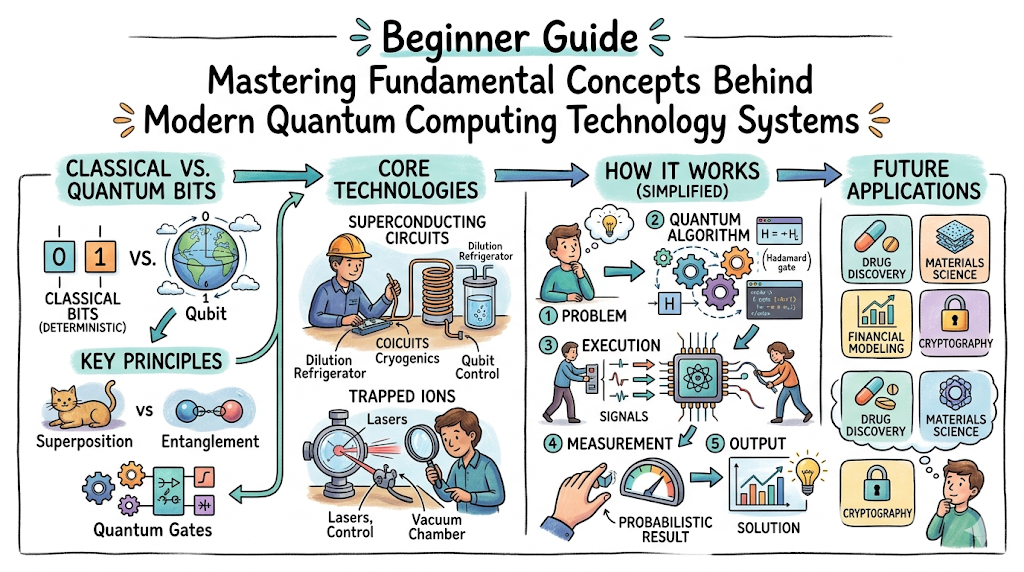
In the era of hyper-scale data and increasingly complex computational challenges, traditional binary systems are reaching their physical limits. While classical computers—the machines we use for everything from web browsing to data analysis—have defined the digital age, they struggle to solve problems where the number of variables grows exponentially. Enter quantum computing: a transformative paradigm that moves beyond simple ones and zeros to harness the fundamental laws of nature. Quantum computing leverages the principles of quantum mechanics—such as superposition and entanglement—to process information in ways that were once considered theoretical. By moving from binary bits to quantum bits (qubits), these systems can explore vast solution spaces simultaneously, offering a path to breakthrough discoveries in medicine, materials science, cryptography, and financial modeling. For those ready to move from curiosity to competence, QuantumUting offers the foundational knowledge, structured learning paths, and expert resources required to master this emerging field and prepare for the future of computational science.
The Origin of Quantum Computing
The Limits of Traditional Computers
Traditional computers operate on binary logic. Every task, from browsing the web to complex database management, boils down to a sequence of bits. While incredibly fast for linear tasks, they struggle when the number of variables in a problem grows exponentially.
The Birth of Quantum Mechanics in Computing
Scientists realized that nature does not behave like a binary computer. At the atomic scale, particles exist in states that standard logic cannot describe. Researchers proposed that if we built a computer based on these laws, we could simulate nature itself much more accurately.
Global Growth of Quantum Research
Today, universities, government labs, and global tech giants invest billions in this space. The goal is to build stable machines capable of performing tasks that traditional supercomputers cannot manage. This global interest is accelerating the transition from theoretical research to practical experimentation.
Defining Modern Quantum Computing
The Core Foundation of Quantum Systems
Modern systems rely on specific quantum behaviors. Qubits are the heart of these machines. Through phenomena like superposition and entanglement, they hold much more information potential than standard bits, allowing for a massive increase in processing capability.
Classical Bits vs. Quantum Bits
Think of a traditional bit as a light switch that is either on or off. A qubit is more like a spinning coin. While it spins, it is both heads and tails at the same time. Only when you stop the coin—or measure the qubit—does it settle into a single state.
Quantum Gates and Quantum Circuits
To perform work, we use quantum gates. These are the equivalent of the logic gates in your phone or PC. By stringing these gates together into circuits, we guide qubits to perform specific calculations that lead to an answer.
The Quantum Problem-Solving Mindset
Quantum computing is not about replacing traditional computers. It is about adding a new tool for specific, high-complexity tasks. By looking at all possible answers at once, these machines find the “best” result far faster than a standard processor could.
The 7 Core Principles of Introduction to Quantum Computing for Beginners
1. Quantum Superposition
In simple terms, superposition allows a qubit to represent multiple values at the same time. This is the primary driver of quantum speed, as it lets the machine hold a vast amount of data potential in a very small number of qubits.
2. Quantum Entanglement
Entanglement links two qubits so that the state of one instantly influences the other, regardless of distance. It creates a deeply interconnected system where changing one part of the machine affects others, enabling complex coordinated operations.
3. Quantum Interference
This principle involves fine-tuning the paths of qubits so that wrong answers cancel each other out while the correct answer is amplified. It is the mathematical “magic” that makes the result of a quantum calculation clear.
4. Quantum Measurement
Measurement is the act of observing the system. When you look at a qubit, its superposition collapses into a definitive zero or one. The challenge is designing algorithms that ensure the state you measure is the correct answer to your problem.
5. Quantum Parallelism
Because qubits exist in superposition, they perform massive numbers of calculations at once. A quantum system with enough qubits can process a volume of possibilities that would take a standard computer a literal lifetime to finish.
6. Quantum Error Correction
Quantum states are extremely fragile and sensitive to heat or noise. Error correction involves using extra qubits to check for and fix mistakes, ensuring that the final calculation remains accurate even when individual qubits fail.
7. Hybrid Quantum-Classical Computing
Most practical applications use a hybrid model. The classical computer handles the routine work and sends the most difficult, high-complexity portions of the task to the quantum processor to be solved.
Key Quantum Computing Concepts Every Beginner Must Know
Classical Computing vs. Quantum Computing — Explained Simply
- Classical: Uses binary bits (0 or 1). Good for sequential, logical tasks.
- Quantum: Uses qubits (0, 1, or both). Good for parallel, probabilistic tasks.
Qubits — The Building Blocks of Quantum Systems
A qubit is the smallest unit of quantum information. Whether using trapped ions or superconducting circuits, these systems allow us to harness the unique behavior of subatomic particles for computational power.
Quantum Algorithms and Problem Solving
Algorithms are the instructions given to a quantum machine. They are used for optimizing supply chains, breaking down complex chemical bonds for new materials, and testing the strength of modern encryption methods.
Quantum Noise and Stability Challenges
“Noise” is interference from the environment that disrupts qubits. Decoherence is the technical term for when a qubit loses its quantum state. Managing this is currently the biggest hurdle in building larger machines.
Quantum Computing in Scientific Research
This technology is changing how we look at medicine. By simulating molecules with perfect accuracy, researchers can discover new life-saving drugs without needing years of trial-and-error in a physical lab.
The Four Major Areas of Quantum Technology
- Computing: Solving hard math and logic problems.
- Communication: Creating unhackable data networks.
- Sensing: Detecting magnetic fields with extreme precision.
- Cryptography: Building and testing new security standards.
Traditional Computing vs. Quantum Computing — What’s the Real Difference?
The Philosophy Difference
Classical systems are deterministic; they follow a strict path to an answer. Quantum systems are probabilistic; they deal with waves of possibility, narrowing them down to the most likely correct outcome.
Roles & Responsibilities Compared
- Physicists: Design the hardware and understand the underlying nature of qubits.
- Quantum Developers: Write the algorithms that run on these unique machines.
- Classical Engineers: Build the infrastructure that supports and feeds data to quantum processors.
Can Classical and Quantum Systems Work Together?
They must. A quantum computer will never be used to write an email or browse the web. It will exist in the cloud, accessed by classical systems when a specific hard task needs to be solved.
Which Learning Path Should Beginners Follow?
Start with the basics of linear algebra and Python. You do not need a degree in physics to understand the logic, but a comfort with numbers and logical patterns is helpful for any beginner.
Real-World Use Cases of Quantum Computing
Quantum Computing in Healthcare and Drug Discovery
Simulating how a drug interacts with a human protein requires massive computing power. Quantum machines can simulate these interactions accurately, significantly shortening the path to new medicine.
Quantum Computing in Finance
Banks use these systems for “Monte Carlo” simulations, which help predict market risks. Even a small increase in accuracy can save millions during a volatile financial event.
Quantum Computing in Cybersecurity
Current encryption protects your data, but quantum machines might eventually crack it. This has sparked a global race to build “quantum-safe” encryption that can resist future quantum attacks.
Quantum Computing in Logistics and Optimization
Trucking companies and airlines use quantum logic to optimize routes. Finding the most efficient path through hundreds of stops is a classic problem that quantum hardware solves efficiently.
Quantum Tools Used by Researchers and Developers
Researchers use cloud-based platforms to run experiments on real hardware located in distant labs. This “quantum-as-a-service” model allows anyone with an internet connection to practice.
Common Mistakes Beginners Make While Learning Quantum Computing
Mistake 1 — Thinking Quantum Computers Replace Traditional Computers
You will still use your phone and laptop for years to come. Quantum systems are highly specialized tools for tasks that traditional machines simply cannot handle in a reasonable timeframe.
Mistake 2 — Ignoring Basic Mathematics and Physics Concepts
While you don’t need a Ph.D., understanding vectors and matrices is vital. The language of quantum computing is mathematics, and the logic is built on foundational physics principles.
Mistake 3 — Expecting Instant Practical Applications
We are still in the early stages of building stable hardware. Most current work is focused on experimentation and proving that these systems can work at scale.
Mistake 4 — Confusing Quantum Theory with Science Fiction
Movies often make it sound like magic. In reality, it is a demanding engineering discipline. Avoid falling for sensationalist claims about “instant” results or telepathic machines.
Mistake 5 — Focusing Only on Theory Without Practical Exploration
Theory is fine, but you will learn faster by running your first simple circuit on a simulator. Many tools are free to use and provide immediate feedback on your logic.
Mistake 6 — Ignoring the Role of Classical Computing
Never forget that the quantum machine needs a classical computer to input the task and interpret the result. They are partners, not rivals.
Essential Quantum Computing Tools & Technologies
Quantum Development Frameworks
Qiskit, Cirq, and PennyLane are the most popular frameworks. They allow you to write quantum circuits in Python and translate them into code that actual hardware can run.
Quantum Hardware Platforms
Different labs use different methods, such as superconducting loops kept at near-zero temperatures or ions held in place by lasers. Each approach has unique pros and cons.
Quantum Simulation Tools
Simulators run on your classical laptop. They act as a training ground, letting you test your code without needing to wait for time on a real, expensive quantum machine.
Cloud-Based Quantum Platforms
Platforms like IBM Quantum Experience or Azure Quantum let you log in via the web and execute your programs on real quantum processors around the world.
Quantum Programming Languages
Most development is done using Python. If you know how to write a simple script in Python, you are already halfway to writing your first quantum circuit.
Becoming a Quantum Computing Professional — Career Roadmap
Essential Skills Every Beginner Should Learn
- Basic Python programming.
- Linear algebra (vectors and matrices).
- High-school level physics.
- A logical, problem-solving mindset.
Step-by-Step Quantum Learning Path
- Learn Python basics.
- Study the concept of a qubit and superposition.
- Use a simulator to build your first “Hello World” quantum circuit.
- Explore deeper concepts like entanglement and algorithms.
- Join an online community to keep up with industry trends.
Certifications and Learning Programs Worth Exploring
Several university and industry-led certification programs now exist. They provide a structured way to prove your skills and understand the standard terminology used in the field.
Educational Resources with [QuantumUting]
QuantumUting provides extensive learning pathways designed for beginners. Their resources help you bridge the gap between abstract physics concepts and practical, hands-on programming.
The Future of Quantum Computing
Quantum-Powered Scientific Discovery
We expect major breakthroughs in materials science. Creating more efficient batteries, solar panels, and carbon-capture technology will be far easier with quantum simulation.
Quantum AI and Advanced Simulations
AI currently requires vast amounts of data and compute time. Quantum systems may eventually provide the speed needed to train AI models that are far more capable than today’s versions.
Enterprise Adoption of Quantum Technologies
As hardware becomes more stable, businesses will integrate quantum modules into their cloud infrastructure to solve logistics and data-processing tasks automatically.
Skills That Will Matter Most in Future Quantum Careers
The future belongs to those who understand the interface between hardware and software. Being a “Quantum Application Specialist” will be a highly valuable role as companies seek to harness this power.
FAQ Section
- Is a physics degree required to start learning?
No. While a background in physics helps, anyone with a logical mind and a willingness to learn mathematics can start exploring. Many developers learn as they go by using simulators. - How much math do I really need?
You should be comfortable with vectors, matrices, and basic probability. These are the tools used to describe what a qubit is doing at any given moment. - Will quantum computers make my passwords insecure?
Eventually, yes. This is why researchers are already working on “quantum-safe” encryption that can stand up to the power of future quantum systems. - Can I run quantum code on my home computer?
You can run simulations of quantum code on your computer. To run code on a real quantum processor, you access it via the cloud, which is standard practice for the entire industry. - What are the most popular programming languages for this field?
Python is the undisputed leader. Almost all the major quantum development frameworks are built to work directly with Python code, making it very accessible. - What is the job market like for quantum developers?
It is a growing, niche field. Organizations are actively hiring people who can understand both classical software engineering and the unique requirements of quantum circuit design.
Final Summary
Quantum computing represents a massive leap in how we process information and solve the world’s most difficult problems. By harnessing the strange behavior of qubits, we open doors to new medicines, cleaner energy, and optimized systems that were once only theoretical. While the hardware is still evolving, the opportunity to learn and contribute to this field has never been better. Your journey into this exciting technology starts with curiosity and a simple circuit simulation. Take the first step today by building your foundational skills and exploring the expert learning programs available at QuantumUting.
