Introduction
The global landscape of technology is experiencing a profound shift toward next-generation computing architectures. For decades, classical computers have powered our digital world, advancing from room-sized machines to sleek chips in our pockets. However, classical hardware faces physical limitations when tackling ultra-complex problems, such as simulating molecular bonds or optimizing massive global logistics networks. Classical systems rely on transistors that express data as either ones or zeros. As these transistors shrink to the size of a few atoms, they encounter unpredictable quantum effects that disrupt traditional processing. This physical barrier has accelerated scientific interest in quantum systems, which harness the laws of subatomic physics rather than working against them. To truly understand this technological leap, one must explore the key principles of quantum mechanics in computing. This guide, provided by QuantumUting, breaks down these advanced concepts into digestible, practical insights. By learning how subatomic behavior transforms data processing, you can position yourself at the forefront of modern quantum technology.
What Is Quantum Computing?
Quantum computing is an advanced computational paradigm that uses the principles of quantum mechanics to process information in ways that classical computers cannot. Instead of using traditional silicon-based transistors to process binary bits, a quantum computer utilizes quantum mechanical states to perform complex calculations.
The fundamental difference lies in how information is processed:
- Classical Computers: Use binary bits representing a strict state of either 0 or 1. They solve problems sequentially, processing one calculation at a time per core.
- Quantum Computers: Use quantum bits, or qubits, which can exist in multiple states simultaneously. This allows the system to evaluate vast numbers of possibilities at the same time.
The evolution of quantum technology stems from theoretical physics concepts proposed in the 1980s by scientists like Richard Feynman. The core philosophy behind quantum systems is to mimic nature itself. Since nature operates on quantum mechanical principles at the atomic level, simulating molecules, chemical reactions, and material sciences requires a computer built on those exact same principles.
Why Quantum Mechanics Matters in Computing
The integration of quantum mechanics in computing unlocks immense processing advantages that could revolutionize global industries. By exploiting subatomic behavior, quantum systems provide massive parallel processing capabilities, allowing them to solve highly complex problems in minutes that would take classical supercomputers thousands of years to calculate.
This speed advantage has profound implications across several critical domains:
- Cryptography and Security: Quantum systems can rapidly factor large numbers, which challenges current encryption standards while paving the way for unbreakable quantum cryptography.
- AI and Advanced Simulations: Quantum computing accelerates machine learning algorithms by processing massive datasets simultaneously and finding optimal solutions faster.
- Scientific and Enterprise Applications: Industries can model molecular structures for rapid drug discovery or optimize financial portfolios with unprecedented accuracy.
For example, a logistics enterprise trying to find the most efficient delivery route across hundreds of global cities faces an exponential explosion of choices. A classical computer must check each route one by one. A quantum computer analyzes all paths simultaneously, instantly identifying the optimal solution.
Key Principles of Quantum Mechanics in Computing
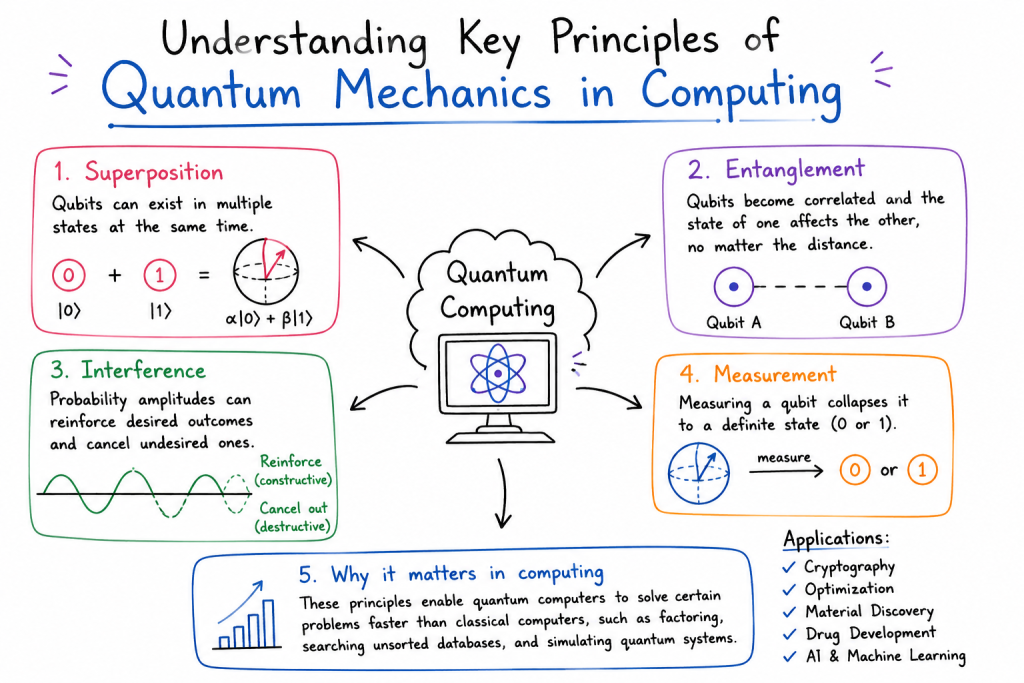
To understand how these machines function, we must examine the specific principles of quantum mechanics in computing that drive their performance.
Qubits
The fundamental unit of data in a quantum system is the qubit. Unlike a classical bit, which is locked into being a 0 or a 1, a qubit can be made from an atom, an electron, or a photon. The physical properties of these subatomic particles allow them to hold much more complex informational states.
Superposition
Superposition is the ability of a qubit to exist in a combination of both 0 and 1 states at the same time. Think of a coin lying on a table: it is either heads or tails. Now think of a spinning coin: it behaves as a blur of both states simultaneously until you stop it. Superposition allows quantum computing systems to hold and process vast amounts of data at once.
Quantum Entanglement
Entanglement is a unique quantum phenomenon where two or more qubits become deeply interconnected. When qubits are entangled, the state of one instantly dictates the state of the other, no matter how far apart they are. In computing, this links qubits together so that adding more qubits increases the processing power exponentially, rather than linearly.
Quantum Interference
Quantum interference is a principle used to control quantum states and guide them toward the correct answer. Through computational algorithms, quantum systems create constructive interference to amplify the correct signals (answers) and destructive interference to cancel out the incorrect signals (errors).
Quantum Tunneling
Quantum tunneling allows particles to pass through physical barriers that would be impassable in classical physics. In quantum computing components, tunneling helps electrons move through microscopic barriers, enabling unique hardware configurations and faster state transitions within specialized processors.
Quantum Gates
Similar to classical logic gates (AND, OR, NOT), quantum gates manipulate the states of qubits. However, quantum gates operate by rotating the mathematical probabilities of a qubit’s state. These gates change the superposition and entanglement of qubits to execute specific quantum algorithms.
Measurement in Quantum Systems
In a quantum system, observing a particle forces it to choose a definite state. Before measurement, qubits exist in a fluid state of possibilities. The moment a measurement occurs, the superposition collapses, and the qubits yield standard classical bits (0s and 1s) as the final output.
Quantum Coherence and Decoherence
Coherence refers to the delicate state where qubits remain in their quantum forms, allowing them to perform calculations. Decoherence occurs when external interference—such as temperature changes or electromagnetic fields—disrupts the system, causing the qubits to lose their quantum properties and introduce calculation errors.
Quantum Computing Workflow Explained
Executing a program on a quantum system follows a specialized workflow that bridges classical programming with quantum physics:
- Data Encoding: The user inputs classical data, which the system converts into quantum states by initializing specific qubits.
- Quantum State Preparation: The system isolates the qubits and places them into precise operational starting positions.
- Quantum Operations and Gates: The quantum algorithm applies a sequence of quantum gates, forcing the qubits into states of superposition and entanglement to run parallel computations.
- Interference Optimization: The algorithm uses quantum interference to systematically cancel out incorrect computational paths while strengthening the correct path.
- Measurement: The system measures the qubits, collapsing their fragile quantum states into a readable classical dataset of 0s and 1s.
- Error Correction: Advanced software protocols analyze the final output to identify and remove any errors caused by environmental decoherence.
Popular Quantum Computing Technologies & Platforms
The quantum computing ecosystem includes hardware systems, development frameworks, cloud networks, and simulators that allow developers to test code without physical quantum hardware.
Major industry pioneers have created accessible platforms for research and development:
- IBM Quantum: Offers real quantum cloud computing access using superconducting hardware alongside the widely adopted Qiskit framework.
- Google Quantum AI: Focuses on quantum supremacy research and provides the Cirq Python library for writing quantum circuits.
- Microsoft Azure Quantum: Provides a cloud environment integrating various quantum hardware providers and development tools.
- D-Wave: Specializes in quantum annealing systems optimized for complex industrial optimization problems.
| Platform | Purpose | Difficulty Level | Common Usage |
| IBM Quantum / Qiskit | Gate-based quantum development | Intermediate | General quantum algorithm research |
| Google Quantum AI / Cirq | Noisy Intermediate-Scale Quantum software | Advanced | Hardware-specific algorithm design |
| Azure Quantum | Multi-hardware cloud ecosystem | Intermediate | Enterprise quantum testing and physics simulation |
| D-Wave Systems | Quantum annealing optimization | Beginner-Friendly | Logistics, routing, and supply chain analysis |
Architecture of Quantum Computing Systems
The physical architecture of a quantum computer looks radically different from a desktop PC or a server rack.
- Quantum Processors: Specialized chips containing qubit architecture made from materials like superconducting circuits or trapped ions.
- Cooling Systems: Massive dilution refrigerators that lower the internal chamber temperature to nearly absolute zero (0.015 Kelvin), making it colder than deep space to protect qubits from heat-induced decoherence.
- Quantum Circuits: Networks of quantum gates that direct the flow of quantum information.
- Classical-Quantum Integration: Traditional computers act as the control interface, sending microwave signals or laser pulses to manipulate the qubits and receiving the data after measurement.
- Error Correction Systems: Specialized hardware layers designed to monitor qubit stability and flag errors caused by environmental noise.
Roles and Responsibilities in Quantum Computing
As the industry expands, career paths are diversifying beyond theoretical physics into software engineering and business operations.
Quantum Researcher
- Skills: PhD in Physics, deep understanding of quantum mechanics, mathematics.
- Responsibilities: Discovering new quantum properties, improving qubit stability, and designing physical hardware components.
- Career Growth: Vital role in academic institutions, government labs, and foundational tech R&D divisions.
Quantum Software Engineer
- Skills: Python programming, familiarity with Qiskit or Cirq, classical software architecture.
- Responsibilities: Writing code to interface with quantum processors, building APIs, and compiling classical algorithms into quantum circuits.
- Career Growth: High demand as enterprise companies build out custom quantum software stacks.
Quantum Algorithm Developer
- Skills: Advanced linear algebra, computer science theory, complexity analysis.
- Responsibilities: Designing new algorithmic frameworks that use superposition and entanglement to solve specific industrial problems.
- Career Growth: Core position within financial firms, cybersecurity groups, and logistics corporations.
Computational Scientist
- Skills: Chemistry, materials science, data modeling, basic quantum programming.
- Responsibilities: Using quantum tools to simulate molecular interactions, discover new materials, or optimize chemical processes.
- Career Growth: Expanding rapidly within pharmaceutical, energy, and automotive research sectors.
Beginner Roadmap for Learning Quantum Computing
Entering this field requires a structured learning order to avoid feeling overwhelmed by the underlying physics and math.
- Mathematics Basics: Focus on linear algebra fundamentals, including vectors, matrices, complex numbers, and probability theory.
- Physics Concepts: Learn basic quantum physics terms, specifically wave-particle duality, states, and probability amplitudes.
- Python Programming Basics: Master Python, as it is the standard language used for almost all major quantum software frameworks.
- Quantum Computing Fundamentals: Study how bits differ from qubits, and understand the core principles of quantum mechanics in computing.
- Quantum Frameworks: Install Qiskit or Cirq, and start writing simple programs to build basic quantum circuits.
- Quantum Algorithms: Study classic foundational workflows like the Deutsch-Jozsa, Grover’s Search, and Shor’s algorithms.
- Cloud Quantum Platforms: Connect your local code to cloud platforms like IBM Quantum to run your programs on real quantum hardware.
- Practical Simulations: Regularly write and test code on local simulators to observe how quantum interference and measurement work in real time.
Certifications & Learning Resources
Professional certifications help validate your understanding of quantum systems and software development practices. Relying on platforms like the QuantumUting learning ecosystem can guide you from basic concepts to advanced algorithmic implementation.
| Certification | Level | Best For | Skills Covered |
| IBM Quantum Developer Certification | Intermediate | Software developers and engineers | Qiskit coding, quantum circuits, execution management |
| Quantum Computing Fundamentals Certificates | Beginner | Students and tech professionals | Basic quantum theory, qubit operations, industry use cases |
| Advanced Quantum Algorithms Credentials | Advanced | Researchers and data scientists | Variational solvers, error mitigation, complex mathematics |
Real-World Use Cases of Quantum Computing
Quantum computing principles are transitioning out of pure laboratory environments and into practical industrial trials.
- Drug Discovery: Pharmaceutical companies use quantum systems to simulate molecular interactions accurately, reducing the time required to discover life-saving medications.
- Financial Modeling: Investment firms apply quantum algorithms to optimize massive portfolios, calculate risk metrics, and analyze market variables simultaneously.
- Cybersecurity: Organizations use quantum key distribution to create encrypted communication networks that are immune to interception.
- Climate Simulations: Scientists model complex atmospheric chemistry to find better carbon-capture materials and design more efficient solar cells.
- Logistics and Supply Chains: Shipping enterprises run quantum optimization models to manage fleet routing, minimize fuel consumption, and streamline global delivery schedules.
Benefits of Quantum Computing
The adoption of quantum systems offers several key operational benefits for high-performance computing tasks:
- Faster Complex Calculations: Processes multidimensional datasets in fractions of the time required by standard servers.
- Improved Optimization: Evaluates countless variables at once to pinpoint the most cost-effective and efficient solutions for businesses.
- Advanced Scientific Simulations: Solves complex atomic and molecular models, removing the need for slow, expensive chemical trial-and-error.
- Better Encryption Possibilities: Drives the creation of quantum-resistant security protocols to protect sensitive global data.
- AI and Machine Learning Advancements: Dramatically speeds up the training phases of large language models and pattern recognition systems.
Challenges in Quantum Computing
Despite the massive potential of quantum computing principles, the industry faces real physical limitations that require ongoing research.
- Hardware Instability: Qubits are highly sensitive to their environments, requiring extreme isolation to prevent calculation errors.
- Qubit Errors: Modern systems are considered Noisy Intermediate-Scale Quantum (NISQ) machines, meaning they still experience high error rates compared to classical chips.
- Decoherence: Even tiny changes in temperature, vibration, or stray electromagnetic waves can cause qubits to drop out of their quantum states prematurely.
- High Infrastructure Costs: Building and maintaining dilution refrigerators and specialized quantum chips requires millions of dollars in capital investments.
- Skill Shortages: There is a significant gap between the number of available jobs and technical professionals who understand both quantum physics and software engineering.
Common Beginner Mistakes
- Ignoring physics and mathematics fundamentals before trying to write complex quantum code.
- Jumping directly into advanced algorithms without understanding basic qubit manipulation and gates.
- Focusing exclusively on theoretical equations instead of writing code on accessible cloud quantum simulators.
- Expecting immediate commercial adoption across all everyday applications like gaming or word processing.
- Believing that quantum computers will completely replace classical computers for standard daily tasks.
Best Practices for Learning Quantum Computing
- Start with the absolute fundamentals of linear algebra and vector multiplication.
- Practice writing basic quantum circuits on free cloud simulators every week.
- Master the conceptual mechanics behind superposition and entanglement before moving to complex programming.
- Use available open-source frameworks like Qiskit to run experiments on real, cloud-connected hardware.
- Join online developer communities to share code, discuss problems, and collaborate on small project-based learning assignments.
Future of Quantum Computing
Over the coming years, the technology will evolve from experimental testbeds into fault-tolerant quantum systems that use millions of physical qubits to correct processing errors autonomously. Hybrid classical-quantum computing will become the standard architecture, where traditional data centers offload highly complex tasks to quantum co-processors in the cloud.
As enterprise adoption scales, quantum networking will develop to link separate quantum computers together, building a highly secure, distributed quantum internet. These advancements will systematically reshape global cryptography, deep-tech research, and AI optimization systems worldwide.
FAQs
- What is quantum computing in simple words?
Quantum computing is a type of computing that uses the laws of subatomic physics to solve complex problems that are too difficult or slow for traditional computers.
- How are qubits different from bits?
A classical bit can only represent a 0 or a 1 at any given time. A qubit can represent a 0, a 1, or both simultaneously thanks to a principle called superposition.
- Is quantum computing difficult to learn?
It requires dedication, particularly in learning basic linear algebra and programming, but structured resources make it highly accessible to beginners.
- Does quantum computing require coding?
Yes, developers write quantum programs using standard programming languages, primarily Python, to build and run quantum circuits.
- What industries use quantum computing?
The primary industries exploring this technology include pharmaceuticals, finance, logistics, cybersecurity, automotive development, and aerospace engineering.
- Can beginners learn quantum mechanics?
Yes, beginners can learn the core conceptual principles of quantum mechanics used in computing without needing a deep background in advanced academic physics.
- Is quantum computing replacing classical computing?
No, quantum computers are specialized systems meant to handle highly complex calculations, while classical computers will remain the standard for daily business and personal tasks.
- Which programming languages are used in quantum computing?
Python is the dominant language used in the field, supported by specialized development frameworks like Qiskit, Cirq, and Q#.
- Why do quantum computers need to be so cold?
They require extreme cold temperatures near absolute zero to keep the fragile qubits stable and protect them from environmental noise and decoherence.
- What is a quantum algorithm?
A quantum algorithm is a step-by-step set of instructions designed to run on a quantum computer, using properties like superposition and entanglement to solve a problem.
Conclusion
As a mentor in this space, my best advice is to focus on building a rock-solid understanding of core foundational concepts. The field of advanced computing is growing rapidly, but the professionals who succeed are those who take the time to master basic quantum principles, write consistent code, and adapt to new architectural shifts. Avoid the industry marketing hype, focus on the practical science, and commit to continuous hands-on experimentation. The long-term opportunities in this sector are vast, and the journey begins with mastering the basics.
