Introduction
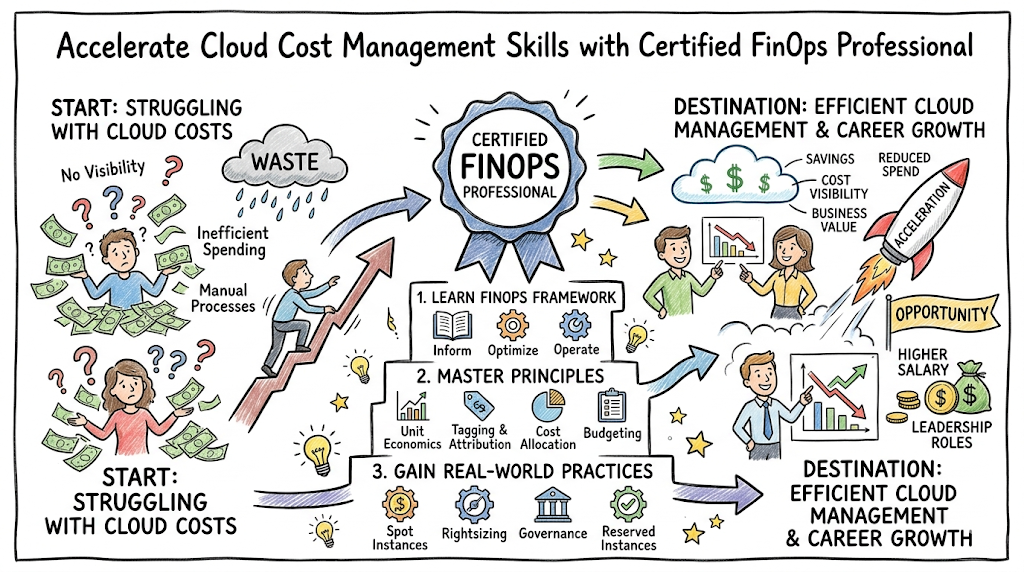
The Certified FinOps Professional designation is the gold standard for individuals looking to master the intersection of cloud finance and engineering. This guide is designed for professionals who recognize that cloud spending is no longer just an IT concern but a core business metric that requires technical precision. Whether you are navigating the complexities of multi-cloud environments or trying to optimize unit economics, understanding FinOps is essential for modern career growth. By following this roadmap, engineers and managers can move beyond simple cost-cutting to a sophisticated model of cloud value management. This comprehensive overview is supported by resources from FinOpsSchool to help you navigate your Certified FinOps Professional journey effectively.
What is the Certified FinOps Professional?
The Certified FinOps Professional represents the highest level of mastery within the FinOps framework, focusing on the cultural shift and operational changes required for cloud financial management. Unlike basic certifications that focus on tool-specific billing, this program emphasizes production-focused learning and the ability to drive organizational change. It exists to bridge the gap between finance, engineering, and business leadership by providing a shared language and set of practices.
This certification aligns with modern engineering workflows where developers have more control over infrastructure costs than ever before. In an enterprise setting, it validates that a professional can implement the Inform, Optimize, and Operate lifecycle at scale. It moves the conversation away from rigid budgeting toward dynamic, real-time financial accountability in cloud-native environments.
Who Should Pursue Certified FinOps Professional?
This certification is tailored for SREs, DevOps engineers, and cloud architects who are responsible for the infrastructure they build and maintain. It is equally valuable for financial analysts and procurement professionals who need to understand the technical nuances of variable cloud spending. Engineering managers and technical leaders will find it indispensable for building high-performing teams that are fiscally responsible without sacrificing speed.
From a global perspective, the demand for these skills is skyrocketing as enterprises move from initial cloud migration to a mature optimization phase. In India, where the cloud ecosystem is expanding rapidly across fintech, e-commerce, and SaaS, having this credential provides a significant competitive advantage. It proves that you are not just a builder of systems, but a steward of company resources and business value.
Why Certified FinOps Professional is Valuable and Beyond
As cloud adoption becomes the default for global enterprises, the focus has shifted from getting to the cloud to staying in the cloud sustainably. The longevity of this certification is tied to the fact that it teaches principles rather than just specific cloud provider tools. It allows professionals to stay relevant even as the underlying technologies, such as Kubernetes or serverless, continue to evolve and change.
Large-scale enterprises are increasingly adopting FinOps as a mandatory practice to avoid uncontrolled cloud sprawl. This means that professionals who hold the Certified FinOps Professional credential offer a high return on investment for their employers. By aligning engineering decisions with business outcomes, you become a strategic asset capable of influencing the company’s bottom line and operational efficiency.
Certified FinOps Professional Certification Overview
The program is delivered via the official training platforms and hosted on FinOpsSchool. This certification structure focuses on deep technical and organizational proficiency rather than superficial knowledge. It includes rigorous assessment approaches that test a candidate’s ability to handle real-world scenarios, such as managing shared costs or optimizing containerized workloads.
Ownership of the FinOps process is a central theme, teaching candidates how to distribute accountability across various departments. The curriculum is structured to cover advanced topics like commitment-based discounts, forecasting, and unit metrics. It ensures that the professional can lead a FinOps team and establish a center of excellence within their organization.
Certified FinOps Professional Certification Tracks & Levels
The journey typically begins at a foundation level, where the basics of cloud terminology and the FinOps lifecycle are established. From there, the professional level—the Certified FinOps Professional—requires a much deeper understanding of implementation and cultural leadership. Advanced tracks often involve specializations in specific architectural patterns like serverless or big data cloud costs.
These levels align directly with career progression, moving from a practitioner role to a strategic leadership position. Specialization tracks allow DevOps and SRE professionals to integrate financial metrics directly into their CI/CD pipelines and monitoring dashboards. As you advance, the focus shifts from individual optimization tasks to building automated, self-healing systems that manage costs autonomously.
Complete Certified FinOps Professional Certification Table
| Track | Level | Who it’s for | Prerequisites | Skills Covered | Recommended Order |
| Core FinOps | Foundation | Beginners, Finance | Basic Cloud Knowledge | Lifecycle, Terminology | 1 |
| Core FinOps | Professional | Lead Engineers, Managers | Foundation Level | Strategy, Optimization | 2 |
| Technical | Specialist | SRE, Cloud Architects | Professional Level | Automation, Kubernetes | 3 |
| Leadership | Executive | CTOs, VP Engineering | Professional Level | Governance, Policy | 4 |
Detailed Guide for Each Certified FinOps Professional Certification
Certified FinOps Professional – Professional Level
What it is
This certification validates an individual’s ability to lead a FinOps practice and implement complex financial management strategies across an entire organization. It confirms expertise in advanced optimization, reporting, and cultural transformation.
Who should take it
Senior DevOps engineers, Cloud Architects, and FinOps practitioners with professional cloud experience should pursue this. It is ideal for those responsible for significant cloud budgets and cross-functional team leadership.
Skills you’ll gain
- Advanced cloud cost forecasting and budgeting.
- Implementation of unit economics for cloud services.
- Management of shared costs and unallocated spending.
- Designing automated guardrails for cost governance.
- Building a FinOps Center of Excellence.
Real-world projects you should be able to do
- Develop a multi-cloud cost allocation strategy for a global enterprise.
- Design an automated dashboard that tracks cost per customer transaction.
- Implement a container cost-sharing model for shared Kubernetes clusters.
Preparation plan
- 7–14 days: Review the official FinOps framework documentation and core lifecycle concepts.
- 30 days: Engage with real-world case studies and practice advanced cost-allocation calculations.
- 60 days: Implement a pilot FinOps project in a sandbox environment and participate in community peer reviews.
Common mistakes
- Focusing only on cost-cutting rather than value realization.
- Ignoring the cultural aspect of getting engineers to care about costs.
- Failing to understand the difference between amortized and unblended costs.
Best next certification after this
- Same-track option: FinOps Specialist (focusing on containers or data).
- Cross-track option: Certified Kubernetes Administrator (CKA).
- Leadership option: MBA in Technology Management or Executive Leadership programs.
Choose Your Learning Path
DevOps Path
In the DevOps world, FinOps is often referred to as FinDevOps. The goal here is to integrate cost visibility directly into the developer workflow. This path focuses on ensuring that every time a developer makes a change to the infrastructure via code, they understand the financial implications. Professionals on this path learn to build automated alerts within Jenkins or GitHub Actions that trigger when a pull request might significantly increase cloud spending.
DevSecOps Path
The security path for FinOps involves balancing cost with compliance and risk management. It ensures that security tools and logging practices do not create unnecessary cost leaks. Professionals learn to optimize the cost of data egress for security logs and manage the expense of high-availability security architectures. This path is critical for ensuring that staying secure does not become a financial burden that limits business agility.
SRE Path
Site Reliability Engineers use FinOps to balance the Error Budget with the Financial Budget. This path focuses on the cost of reliability, such as the expense of running multi-region failover systems. SREs learn to use FinOps data to decide if a high uptime requirement is financially justified by the business value it generates. It bridges the gap between performance metrics and the dollars spent on infrastructure.
AIOps Path
The AIOps path focuses on using artificial intelligence to automate the FinOps lifecycle. Professionals learn to implement machine learning models that predict cloud spending patterns and identify anomalies in real-time. This path involves building systems that can automatically purchase Reserved Instances or Savings Plans based on historical usage data. It represents the future of autonomous cloud financial management where human intervention is minimized.
MLOps Path
MLOps professionals deal with unique cost challenges related to GPU usage and massive datasets. This path focuses on optimizing the cost of model training, hyperparameter tuning, and model deployment. Practitioners learn how to manage expensive specialized hardware and automate the shutdown of training clusters to prevent runaway costs. It is essential for any organization looking to scale their artificial intelligence initiatives sustainably.
DataOps Path
Data pipelines can be notoriously expensive due to data transfer and processing fees. The DataOps path for FinOps focuses on the unit cost of data processing per petabyte. Professionals learn to optimize SQL queries, manage cold and hot storage costs, and select the most cost-effective data ingestion tools. This ensures that the data-driven culture of an organization remains profitable and scalable.
FinOps Path
The pure FinOps path is for those who want to specialize entirely in cloud financial management. It involves deep dives into vendor negotiations, organizational change management, and high-level reporting for the board of directors. These practitioners act as the central nervous system of the cloud-spending culture. They are responsible for setting the standards and policies that all other paths—DevOps, SRE, and Data—will follow.
Role → Recommended Certified FinOps Professional Certifications
| Role | Recommended Certifications |
| DevOps Engineer | Certified FinOps Professional + CKA |
| SRE | Certified FinOps Professional + Reliability Specialization |
| Platform Engineer | Certified FinOps Professional + Infrastructure as Code |
| Cloud Engineer | Certified FinOps Professional + Vendor Specific Architect |
| Security Engineer | Certified FinOps Professional + Cloud Security Cert |
| Data Engineer | Certified FinOps Professional + Big Data Specialization |
| FinOps Practitioner | Certified FinOps Professional + Advanced Practitioner |
| Engineering Manager | Certified FinOps Professional + Executive Leadership |
Next Certifications to Take After Certified FinOps Professional
Same Track Progression
Deep specialization within the FinOps domain involves looking at specific technologies. You might pursue advanced certifications in Kubernetes cost management or cloud-native observability. These credentials prove that you can apply FinOps principles to the most complex, modern architectures. It positions you as a subject matter expert who can handle the nuances of ephemeral resources and microservices.
Cross-Track Expansion
Broadening your skills often means moving into broader cloud architecture or security domains. Taking a Professional Cloud Architect or a Security Specialist exam complements your FinOps knowledge by giving you the technical depth to implement the changes you recommend. This makes you a versatile professional who can not only identify where money is being wasted but can also go into the system and fix it themselves.
Leadership & Management Track
For those looking to move into the C-suite or high-level management, focusing on business strategy is the next logical step. Certifications in ITIL or Project Management can help bridge the gap between technical execution and corporate governance. This transition allows you to move from managing cloud bills to shaping the entire digital transformation strategy of a multi-national corporation.
Training & Certification Support Providers for Certified FinOps Professional
DevOpsSchool
DevOpsSchool provides a robust ecosystem for professionals looking to master FinOps within the broader DevOps context. Their training methodology is centered on long-term skill acquisition rather than just passing an exam. They offer extensive hands-on labs and a community-driven learning environment that helps students understand the practical application of FinOps tools. Their instructors are typically industry veterans who bring real-world scenarios into the classroom, making the complex topic of cloud finance much more accessible. They focus on the integration of cost metrics into CI/CD pipelines, which is a critical skill for any modern engineer. The support provided extends beyond the classroom, offering a vast network of peers and resources to ensure students can implement FinOps principles effectively in their daily work.
Cotocus
Cotocus stands out by offering a consulting-led approach to FinOps training. They do not just teach the theory; they show how to apply it to solve specific business problems. Their programs are highly customized to the needs of the enterprise, ensuring that teams can implement FinOps principles immediately after training. Cotocus focuses on the cultural shift required for FinOps, providing workshops that bring engineering and finance teams together. This boutique approach makes them a preferred choice for organizations that need to see immediate results in their cloud optimization efforts and overall financial governance. Their training modules are designed to be interactive, encouraging students to bring their own cloud billing data to the sessions for real-time analysis and optimization.
Scmgalaxy
Scmgalaxy is a treasure trove of technical resources and deep-dive tutorials for the engineering community. Their support for FinOps learners involves a massive library of blogs, videos, and scripts that simplify the implementation of cost-management tools. They focus heavily on the practical aspect of FinOps, providing step-by-step guides for automating cost reports and setting up budget alerts across different cloud providers. Scmgalaxy is the go-to resource for the hands-on practitioner who needs to find a script or a configuration template to solve a specific infrastructure cost issue quickly and efficiently. Their community forums are active and provide a platform for engineers to share their challenges and solutions, creating a collaborative learning environment that is invaluable for those pursuing certification.
BestDevOps
BestDevOps focuses on the career transition aspect of FinOps, helping professionals from traditional finance or IT roles move into the cloud economy. Their training programs are structured to build confidence through repeated practice and mentorship. They offer a clear roadmap for beginners, starting with the basics of cloud billing and moving up to complex architectural optimization. BestDevOps is known for its supportive learning community and focus on the latest industry trends. Their goal is to ensure that every student not only earns the certification but also has the skills to thrive in a high-pressure corporate environment. They provide resume assistance and interview preparation tailored specifically for FinOps roles, making them a comprehensive partner for career growth in this field.
Devsecopsschool.com
Devsecopsschool.com is the primary resource for integrating security into the FinOps lifecycle. They recognize that security and cost are often at odds, and their training shows how to balance these two critical domains. Their curriculum covers the cost of security compliance, the financial impact of data breaches, and how to optimize security monitoring budgets. By focusing on the Security in DevSecOps, they provide a unique perspective on FinOps that is essential for industries with high regulatory requirements, such as banking and healthcare. Their courses teach students how to build secure, cost-effective architectures that do not compromise on safety. This specialized focus ensures that graduates are equipped to handle the complex trade-offs required in modern enterprise environments.
Sreschool.com
Sreschool.com approaches FinOps from the perspective of reliability and system performance. They teach students how to quantify the cost of downtime and how to build cost-aware resilient systems. Their training is highly technical, focusing on the use of telemetry and observability data to drive financial decisions. Students learn how to build dashboards that show the direct correlation between system latency and infrastructure cost. This focus on the SRE persona ensures that reliability engineers can defend their budget requests with hard data, proving the business value of every redundant server and failover system. Their methodology bridges the gap between deep technical metrics and financial reporting, making them an essential support provider for those in platform engineering roles.
Aiopsschool.com
Aiopsschool.com is at the forefront of the next generation of cloud management, focusing on the intersection of AI and operations. Their FinOps training emphasizes automation and predictive analytics. They teach students how to build and deploy machine learning models that can manage cloud costs autonomously. This includes everything from automated rightsizing to predictive purchasing of cloud capacity. Aiopsschool.com is the ideal choice for engineers who want to stay ahead of the curve and lead the transition toward self-healing, self-optimizing cloud environments. Their curriculum is designed to challenge students to think beyond manual optimization, providing the tools and knowledge needed to implement advanced AIOps strategies that drive significant financial value for their organizations.
Dataopsschool.com
Dataopsschool.com addresses the massive and often hidden costs associated with modern data pipelines and big data ecosystems. Their training focuses on the unit cost of data, teaching students how to optimize storage, ingestion, and processing. They provide specialized knowledge on managing the costs of tools like Snowflake, Databricks, and various cloud-native data warehouses. For professionals working in data-heavy organizations, this school provides the specific skills needed to prevent data lakes from becoming cost swamps. They emphasize the importance of data governance as a primary driver of financial efficiency in the cloud. Graduates from this program are capable of designing data architectures that are not only high-performing but also fiscally sustainable and scalable.
Finopsschool.com
Finopsschool.com is the dedicated specialist for this specific certification, providing the most focused and up-to-date curriculum available. As the primary hosting site for the Certified FinOps Professional, they offer a direct path to mastery with resources that are perfectly aligned with the exam objectives. Their community is composed entirely of FinOps practitioners, providing an unparalleled networking opportunity for students. They focus on the three pillars of FinOps: Inform, Optimize, and Operate, ensuring a holistic understanding of the discipline. Finopsschool.com is the central hub for anyone serious about making FinOps their primary career focus and leadership domain. Their deep dive into the FinOps framework ensures that every student understands the organizational change required to succeed.
Frequently Asked Questions (General)
- How difficult is the Certified FinOps Professional exam?The exam is considered moderately difficult because it tests both technical cloud knowledge and business financial concepts. It requires a solid understanding of how cloud billing works across different vendors.
- What are the prerequisites for taking this certification?While there are no strict prerequisites, it is highly recommended to have a foundational understanding of cloud computing and at least some experience in a cloud-related role.
- How long does the certification remain valid?Most certifications in this domain are valid for two to three years, after which you may need to recertify to show you are up-to-date with the latest cloud changes.
- Can a non-technical person pass this exam?Yes, finance and procurement professionals can pass, but they will need to put in extra effort to understand cloud architectural concepts like auto-scaling and containers.
- How much time should I dedicate to studying?A working professional should plan for about 30 to 60 days of consistent study, depending on their existing experience with cloud billing and operations.
- Is there a lot of math involved in the exam?The math is generally limited to basic arithmetic and understanding percentages, such as calculating discounts, savings, and amortized costs.
- Does this certification focus only on AWS?No, the Certified FinOps Professional is vendor-agnostic and covers principles that apply to AWS, Azure, Google Cloud, and even private cloud environments.
- What is the average salary for a FinOps Professional?Salaries vary by region, but certified professionals often see a significant increase in compensation, frequently reaching high-level brackets in global markets.
- Are there hands-on labs in the training?Most high-quality training providers include labs where you work with real billing exports and optimization tools to practice what you have learned.
- Can I take the exam online?Yes, the exam is typically offered as a proctored online test, allowing you to take it from the comfort of your home or office.
- How does FinOps differ from traditional IT budgeting?Traditional budgeting is static and annual, while FinOps is dynamic and real-time, allowing for continuous adjustment as cloud usage changes.
- Is FinOps relevant for small startups?Absolutely. While large enterprises save more in total dollars, startups need FinOps to ensure their limited capital is not wasted on inefficient infrastructure.
FAQs on Certified FinOps Professional
- What is the primary difference between the Foundation and Professional levels?The Foundation level focuses on terminology and basic concepts, whereas the Professional level focuses on implementation, leadership, and solving complex real-world financial scenarios.
- How does the exam test the Operate phase of the FinOps lifecycle?The exam uses scenario-based questions to see if you can establish a culture of accountability and build automated systems that maintain cost efficiency over time.
- Is understanding Unit Economics required for this certification?Yes, you must be able to calculate and explain how much it costs to support specific business outcomes, such as a single customer transaction or an API call.
- Does the certification cover container-specific costs?Yes, it includes sections on managing shared costs within Kubernetes and other container orchestration platforms, which is a major part of modern cloud spending.
- How should I prepare for the cultural transformation questions?Review case studies on how to align engineering, finance, and business teams. You need to understand the social and organizational hurdles to FinOps adoption.
- Are vendor-specific discount programs like Reserved Instances covered?The exam covers the general principles of commitment-based discounts and how to manage them across a multi-cloud portfolio.
- What role does automation play in the Professional certification?Automation is a key theme, as the certification validates your ability to design systems that automatically alert or correct cost anomalies without human intervention.
- How does the certification address multi-cloud environments?It teaches you how to create a unified financial reporting structure that aggregates data from multiple cloud providers into a single source of truth.
Final Thoughts: Is Certified FinOps Professional Worth It?
In my experience mentoring engineers, I have seen many technical trends come and go. However, the need for fiscal responsibility in technology is not a trend; it is a permanent shift in how business is conducted. The Certified FinOps Professional is worth the investment because it positions you at the center of where business strategy meets technical execution. It makes you a more versatile professional who can speak to both the how of engineering and the why of business profitability.
If you are looking for a way to differentiate yourself in a crowded market, this is it. Companies are no longer impressed by people who can just spin up servers; they want people who can spin up the right servers at the right price. My advice is to approach this certification not as a test to be passed, but as a framework to be mastered. The skills you gain will serve you well for the rest of your career, regardless of which cloud provider becomes dominant in the market.
