Introduction
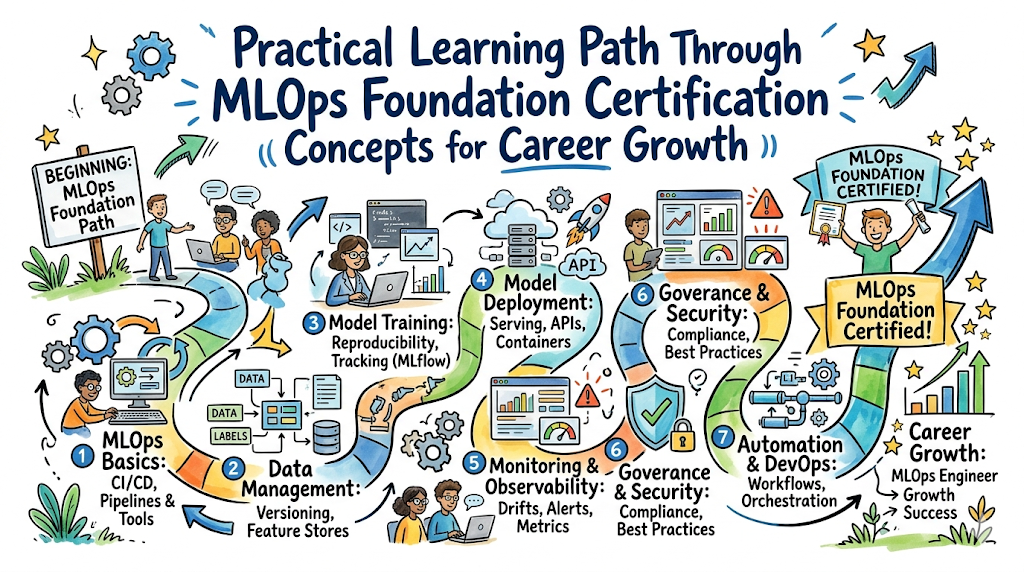
The journey toward mastering production-grade artificial intelligence begins with a solid understanding of operationalizing machine learning. This comprehensive guide explores the MLOps Foundation Certification, a program designed to bridge the gap between data science experimentation and enterprise-level software engineering. Whether you are a DevOps engineer looking to support data teams or a data scientist aiming to deploy models more reliably, understanding these core principles is essential. Throughout this article, we will examine how AIOps School provides the necessary framework for professionals to gain these critical skills. By the end of this guide, you will have a clear roadmap for your career progression and a deep understanding of why this specific certification is a cornerstone for modern engineering roles.
What is the MLOps Foundation Certification?
The MLOps Foundation Certification represents a paradigm shift in how technical professionals approach the lifecycle of machine learning models. It exists because the industry has recognized that building a model in a notebook is fundamentally different from maintaining that model in a high-traffic production environment. This certification emphasizes real-world, production-focused learning, moving beyond theoretical mathematics to focus on automated testing, deployment strategies, and infrastructure management. It aligns perfectly with modern engineering workflows by treating models as first-class citizens in the CI/CD pipeline, ensuring that enterprise practices for reliability and scalability are applied to every data project.
Who Should Pursue MLOps Foundation Certification?
This certification is specifically designed for a broad spectrum of technical professionals who interact with data-driven applications. DevOps engineers and SREs who find themselves managing GPU clusters or model registries will find the curriculum directly applicable to their daily tasks. Cloud professionals and security engineers will benefit from learning how to protect data pipelines and ensure compliance during model training. It is equally valuable for beginners entering the field who want a structured path, as well as engineering managers who need to understand the technical debt associated with poor ML operations. For the global market and the rapidly growing tech hubs in India, this certification provides a standardized language for cross-functional collaboration.
Why MLOps Foundation Certification is Valuable and Beyond
The demand for professionals who can manage the full machine learning lifecycle is growing at an exponential rate as enterprises move past the pilot phase of AI adoption. This certification offers long-term career longevity because it focuses on core operational principles rather than specific, fleeting tools that may change every few months. By mastering the fundamentals of versioning data, tracking experiments, and monitoring model drift, professionals can remain relevant across various cloud providers and tech stacks. The return on time and career investment is significant, as companies are actively seeking individuals who can reduce the time it takes to move a model from development to a revenue-generating production state.
MLOps Foundation Certification Overview
The program is delivered via the official portal at MLOps Foundation Certification and is hosted on the AIOps School platform. This certification is structured to provide a practical assessment approach, ensuring that candidates are tested on their ability to solve real engineering problems rather than just memorizing definitions. It covers various levels of expertise, from initial understanding to deep technical mastery, and is owned by an organization committed to keeping the curriculum updated with the latest industry standards. The ownership and structure ensure that the certification holds weight during technical interviews and internal performance reviews within large-scale enterprises.
MLOps Foundation Certification Tracks & Levels
The certification is divided into three primary levels to accommodate professionals at different stages of their career journey. The Foundation level introduces the core concepts of the ML lifecycle and basic pipeline automation. The Professional level dives deeper into advanced orchestration, feature stores, and complex model deployment strategies like canary releases or blue-green deployments. Finally, the Advanced level focuses on architectural design, cost optimization for large-scale training, and global model governance. These levels are designed to align with career progression, moving a practitioner from a team contributor to a technical lead or architect role over time.
Complete MLOps Foundation Certification Table
| Track | Level | Who it’s for | Prerequisites | Skills Covered | Recommended Order |
| Core MLOps | Foundation | Beginners, IT Admins, Junior DevOps | Basic Linux, Python | CI/CD for ML, Data Versioning, Model Tracking | First |
| Engineering | Professional | SREs, DevOps Engineers, Data Engineers | Foundation Cert, Kubernetes | Automated Pipelines, Feature Stores, Monitoring | Second |
| Architecture | Advanced | Solutions Architects, Tech Leads | Professional Cert, Experience | Global Scalability, Governance, Cost Ops | Third |
| Management | Strategic | Engineering Managers, Product Owners | Basic Technical Knowledge | ROI Analysis, Team Structuring, Strategy | Optional |
Detailed Guide for Each MLOps Foundation Certification
MLOps Foundation Certification – Foundation Level
What it is
This level validates your understanding of the foundational principles required to operationalize machine learning. It focuses on the intersection of data science and traditional DevOps practices to ensure a smooth flow of models.
Who should take it
This is suitable for junior engineers, IT administrators transitioning to data-centric roles, and data scientists who want to understand the infrastructure side of their work. It requires minimal prior experience in machine learning but a strong interest in automation.
Skills you’ll gain
- Understanding the ML lifecycle (CRISP-DM vs. MLOps).
- Version control for both code and datasets.
- Basic automated testing for data pipelines.
- Containerization basics for model packaging.
- Knowledge of model registries and experiment tracking.
Real-world projects you should be able to do
- Set up a Git-based workflow for a simple machine learning project.
- Automate a basic data cleaning script using standard CI tools.
- Deploy a model as a simple REST API using a container.
Preparation plan
- 7–14 days: Focus on vocabulary, the ML lifecycle, and basic container concepts.
- 30 days: Implement three small automation scripts and study data versioning tools.
- 60 days: Conduct full mock exams and build a complete end-to-end basic pipeline.
Common mistakes
- Ignoring the importance of data versioning compared to code versioning.
- Focusing too much on the math of the models rather than the deployment process.
- Underestimating the complexity of model monitoring.
Best next certification after this
- Same-track option: MLOps Professional Certification.
- Cross-track option: SRE Foundation Certification.
- Leadership option: AIOps Manager Certification.
MLOps Foundation Certification – Professional Level
What it is
This certification validates your ability to design and implement complex, automated machine learning pipelines at scale. It proves you can handle production-level challenges like model drift and automated retraining.
Who should take it
Experienced DevOps engineers, SREs, and data engineers who are responsible for maintaining production ML environments. It requires a solid grasp of container orchestration and advanced scripting.
Skills you’ll gain
- Advanced orchestration using tools like Kubeflow or MLflow.
- Implementation of Feature Stores for reusable data assets.
- Automated model retraining triggers based on performance metrics.
- Security practices for protecting sensitive training data.
- Deep monitoring of model drift and system health.
Real-world projects you should be able to do
- Build a self-healing pipeline that retrains a model when accuracy drops.
- Implement a centralized feature store for multiple data science teams.
- Configure a production-grade Kubernetes cluster for ML workloads.
Preparation plan
- 7–14 days: Review advanced Kubernetes and distributed systems concepts.
- 30 days: Deep dive into specific MLOps frameworks and orchestration tools.
- 60 days: Build a multi-stage pipeline with automated rollbacks and testing.
Common mistakes
- Over-engineering the pipeline for small, simple models.
- Failing to account for the latency introduced by feature stores.
- Neglecting the security of the model artifacts during transit.
Best next certification after this
- Same-track option: MLOps Advanced Architect.
- Cross-track option: FinOps Practitioner.
- Leadership option: CTO/VP Engineering Track.
Choose Your Learning Path
DevOps Path
Engineers on this path focus on integrating machine learning into existing CI/CD pipelines. The goal is to treat ML models exactly like software code, ensuring that every change is tested, packaged, and deployed automatically. This path emphasizes the use of Jenkins, GitLab CI, or GitHub Actions in conjunction with ML-specific tools. It is ideal for those who want to ensure that infrastructure is consistent and reproducible across all environments.
DevSecOps Path
The security-focused path centers on the integrity of the data and the privacy of the models. Practitioners learn how to implement secure supply chains for model artifacts and ensure that training data is not compromised. This involves scanning containers for vulnerabilities and managing identity and access for data lakes. It is a critical path for those working in regulated industries like finance or healthcare.
SRE Path
The Site Reliability Engineering path focuses on the availability and performance of the models in production. Engineers learn how to set up Service Level Objectives (SLOs) for model latency and accuracy. This path involves deep dives into monitoring, alerting, and incident response specifically tailored for ML drift. It is the perfect route for professionals who care about system uptime and user experience.
AIOps Path
This path focuses on using artificial intelligence to improve traditional IT operations. While MLOps is about managing ML models, AIOps is about using ML to monitor logs, predict outages, and automate root cause analysis. Professionals here learn how to deploy AI models that manage the infrastructure itself. It is a highly specialized track for those looking to automate the modern data center.
MLOps Path
The dedicated MLOps path is for those who want to be the primary architects of the machine learning lifecycle. It covers everything from data ingestion to model decommissioning. Practitioners become experts in experiment tracking, model registries, and production monitoring. This is the most comprehensive path for those who want a career centered entirely on the operational side of artificial intelligence.
DataOps Path
DataOps is focused on the rapid, reliable delivery of high-quality data to the data science teams. This path emphasizes data orchestration, quality testing, and pipeline observability. Engineers learn how to automate the movement of data from various sources into the training environments. It is a foundational path because, without good DataOps, MLOps cannot succeed in the long run.
FinOps Path
The FinOps path is becoming increasingly important as the cost of training large models continues to rise. This track focuses on the financial management of cloud resources used for machine learning. Practitioners learn how to track spending, optimize GPU utilization, and ensure that AI projects remain within budget. It is ideal for those who want to combine technical knowledge with financial accountability.
Role → Recommended MLOps Foundation Certifications
| Role | Recommended Certifications |
| DevOps Engineer | MLOps Foundation, Professional Level |
| SRE | MLOps Foundation, SRE Professional |
| Platform Engineer | MLOps Professional, Kubernetes Master |
| Cloud Engineer | MLOps Foundation, Multi-Cloud Architect |
| Security Engineer | MLOps Foundation, DevSecOps Professional |
| Data Engineer | DataOps Foundation, MLOps Foundation |
| FinOps Practitioner | FinOps Foundation, MLOps Foundation |
| Engineering Manager | MLOps Foundation, AIOps Manager |
Next Certifications to Take After MLOps Foundation Certification
Same Track Progression
After completing the foundation level, the most logical step is to move toward the Professional and Advanced levels within the same ecosystem. This allows for a deep specialization where you move from understanding the concepts to being the person who designs the entire system. Deep specialization is highly rewarded in the current market, as enterprises are looking for “subject matter experts” who can handle the nuances of distributed training and large-scale model deployment.
Cross-Track Expansion
If you prefer to be a generalist, expanding into SRE or DevSecOps is an excellent choice. Broadening your skills allows you to understand how MLOps fits into the larger organizational infrastructure. For instance, combining MLOps with FinOps makes you an invaluable asset to any company looking to scale their AI initiatives while keeping costs under control. This cross-track expansion ensures you are not siloed into a single technical domain.
Leadership & Management Track
For those looking to transition out of hands-on coding and into leadership, the AIOps Manager or technical leadership tracks are ideal. These certifications focus on the business value of AI, team building, and strategic planning. They prepare you to lead cross-functional teams of data scientists and engineers, helping you speak the language of both the boardroom and the server room.
Training & Certification Support Providers for MLOps Foundation Certification
DevOpsSchool
DevOpsSchool has established itself as a premier institution for technical training, offering a wide array of courses that cover the entire software development lifecycle. Their approach is deeply rooted in practical, hands-on labs that simulate real-world production environments. With a vast library of resources and a community of experienced instructors, they provide candidates with the tools needed to master complex automation tasks. Their curriculum is updated frequently to reflect the latest shifts in the DevOps landscape, ensuring that students are always learning relevant skills. For those pursuing MLOps, DevOpsSchool provides a strong foundation in the underlying CI/CD and infrastructure principles required for success.
Cotocus
Cotocus is known for its consulting-led approach to technical training, focusing on bridging the gap between classroom learning and corporate requirements. They specialize in high-end technology stacks and provide customized training solutions for both individuals and large enterprises. Their instructors are often active consultants who bring real-world troubleshooting experience into the training sessions. This practical focus helps students understand not just how a tool works, but how it behaves under stress in a production setting. Cotocus is particularly effective for those who need to understand the architectural implications of their technical choices. Their commitment to quality has made them a trusted partner for many fortune 500 companies.
Scmgalaxy
Scmgalaxy is a comprehensive knowledge hub and training provider that focuses on Source Code Management, Build, and Release engineering. They offer an extensive collection of tutorials, blogs, and community forums that support continuous learning beyond the formal classroom. Their training programs are designed to be accessible yet rigorous, covering everything from basic version control to advanced deployment strategies. Scmgalaxy emphasizes the importance of the “Software Supply Chain,” which is a critical component of any MLOps strategy. By focusing on the integrity of the code and the automation of the build process, they prepare students for the foundational challenges of modern engineering.
BestDevOps
BestDevOps focuses on providing curated, high-quality learning paths for professionals looking to accelerate their careers in cloud-native technologies. Their training philosophy centers on simplicity and clarity, breaking down complex topics into manageable modules. They offer a range of certification preparation courses that are specifically designed to help candidates pass their exams on the first attempt. With a focus on the most in-demand tools and practices, BestDevOps ensures that their students are highly marketable. Their mentorship programs provide an additional layer of support, helping students navigate their career choices and technical challenges with confidence.
devsecopsschool.com
As the name suggests, devsecopsschool.com is the go-to destination for integrating security into the modern engineering workflow. They recognize that security cannot be an afterthought and must be baked into every stage of the pipeline. Their training covers a wide range of topics, including container security, automated compliance, and secure coding practices. For MLOps professionals, this provider is essential for learning how to protect sensitive data and model artifacts. Their courses are designed to be practical, showing students how to use automated tools to find and fix vulnerabilities early in the development cycle. They are a leader in promoting the “shift-left” security philosophy.
sreschool.com
sreschool.com is dedicated to the art and science of Site Reliability Engineering, focusing on the principles of scalability, availability, and performance. Their curriculum is built around the core SRE tenets pioneered by major tech giants, making it highly relevant for enterprise environments. They teach students how to manage risk, use error budgets, and implement deep observability. For those in the MLOps field, sreschool.com provides the necessary framework to ensure that machine learning models are reliable and performant. Their focus on reducing “toil” through automation is a key takeaway for any engineer looking to improve their operational efficiency.
aiopsschool.com is at the forefront of the AIOps and MLOps revolution, providing specialized training that combines data science with IT operations. They offer a structured path for professionals to learn how to operationalize artificial intelligence and use AI to improve IT infrastructure. Their certification programs, including the MLOps Foundation, are highly regarded for their technical depth and practical relevance. The school provides a unique blend of theoretical knowledge and hands-on experience, ensuring that graduates can immediately contribute to complex AI projects. By focusing on the future of IT operations, aiopsschool.com prepares its students for the most advanced roles in the industry.
dataopsschool.com
dataopsschool.com focuses on the critical discipline of DataOps, ensuring that data is delivered reliably and efficiently to those who need it. They teach students how to build automated data pipelines, implement data quality checks, and manage data orchestration. Their training is essential for anyone involved in the machine learning lifecycle, as the quality of the model is entirely dependent on the quality of the data. By emphasizing collaboration between data providers and data consumers, they help organizations break down silos and speed up their data initiatives. Their courses are practical and tool-agnostic, focusing on the core principles of data management.
finopsschool.com
finopsschool.com addresses the growing need for financial accountability in the cloud-native era. They provide training on the FinOps framework, which helps organizations optimize their cloud spending and increase business value. For MLOps and AIOps professionals, this training is vital for managing the high costs associated with training and running large models. They teach students how to track usage, allocate costs, and implement optimization strategies. By bringing together finance, engineering, and business teams, finopsschool.com helps organizations make data-driven decisions about their infrastructure investments. Their certifications are a key asset for anyone looking to take on a leadership role in cloud management.
Frequently Asked Questions (General)
- How difficult is the MLOps Foundation Certification?The foundation level is designed to be accessible for those with a basic background in IT or data science. It focuses on concepts rather than deep coding, making it manageable with 30 days of consistent study.
- What is the recommended study time?For a working professional, 4 to 6 weeks of dedicated study for about an hour a day is usually sufficient to grasp the core concepts and pass the exam.
- Are there any prerequisites?There are no hard prerequisites for the foundation level, but a basic understanding of Linux commands and Python programming will be very helpful.
- How long does the certification remain valid?Most certifications in this field are valid for two to three years, after which you are encouraged to take a recertification exam or move to a higher level.
- What is the return on investment (ROI)?Certified professionals often see a significant bump in salary and are eligible for specialized roles that are currently in high demand globally.
- Does the exam focus on specific tools like AWS or Azure?No, the foundation exam is generally tool-agnostic, focusing on the principles of MLOps that can be applied to any cloud provider or software stack.
- Is this certification recognized globally?Yes, the standards taught are based on industry-wide practices, making the certification valuable in both the Indian and international job markets.
- Can I take the exam online?Yes, the certification is designed to be accessible globally through online proctored testing environments.
- How does MLOps differ from DevOps?While DevOps focuses on the software development lifecycle, MLOps adds the complexity of data versioning, model drift, and retraining cycles to the process.
- Do I need to be a data scientist to pass?No, this is an engineering and operations certification. You need to understand the ML lifecycle, but you do not need to be an expert in building complex algorithms.
- Are there practice exams available?Yes, most training providers like AIOps School offer mock exams and practice questions to help you prepare for the actual assessment.
- What happens if I fail the exam?Most programs allow for a retake after a short waiting period, though you should check the specific policy of the hosting platform.
FAQs on MLOps Foundation Certification
- What is the core focus of this specific certification?It focuses on the operational principles of the machine learning lifecycle, from data ingestion to production monitoring.
- Does it cover Kubernetes?It introduces container orchestration as a primary method for deploying models, though deep Kubernetes mastery is reserved for the professional level.
- How does it handle data versioning?It teaches the importance of tracking datasets alongside code to ensure experiments are reproducible.
- Is monitoring drift included?Yes, understanding how to monitor for both data drift and concept drift is a key component of the curriculum.
- What role does CI/CD play?The certification teaches how to extend traditional CI/CD to include automated model testing and deployment.
- Is Python required?A basic reading knowledge of Python is recommended as most MLOps tools and scripts are written in it.
- Does it cover cloud-specific ML services?While the principles are general, the course often provides examples using popular cloud services to ground the concepts in reality.
- Why is AIOps School the provider?AIOps School specialized in the intersection of AI and Ops, providing a curriculum that is specifically tailored to this high-growth niche.
Final Thoughts: Is MLOps Foundation Certification Worth It?
As a mentor who has seen the transition from manual server racking to automated cloud-native deployments, I can say with confidence that MLOps is the next major frontier in engineering. This certification is not just another badge for your profile; it is a fundamental shift in how you view the lifecycle of modern applications. If you want to move beyond being a generalist and become a specialist in one of the most high-impact areas of technology, this is the right path. It requires effort and a willingness to learn across domains, but the career stability and intellectual satisfaction it provides are immense. My advice is to stop overthinking and start building—the industry needs professionals who can turn AI dreams into production realities.
