Introduction
The demand for reliable, automated cloud infrastructure is absolutely exploding. As enterprise architectures shift aggressively toward cloud-native ecosystems, microservices, and rapid deployment cycles, the role of the DevOps engineer has evolved from a niche specialty into a core business necessity. If you want to command top compensation and work on cutting-edge systems, this field is your launchpad. A structured learning path and a comprehensive roadmap matter far more than accumulating disconnected certificates. True proficiency requires a unified understanding of cloud platforms, Infrastructure as Code (IaC), container orchestration, and continuous integration/continuous deployment (CI/CD) systems. This guide provides an objective, analytical evaluation of the leading industry Best DevOps Certification to help you invest your time and resources effectively.
Why DevOps Certifications Matter
While practical engineering capabilities remain the ultimate benchmark of a professional’s value, formal certifications serve specific strategic purposes within the enterprise IT ecosystem:
- Structured Knowledge Acquisition: Preparing for a well-designed exam forces you to study a technology comprehensively, uncovering features, edge cases, and architectural best practices you might never encounter during routine daily tasks.
- Validation of Competency: For professionals transitioning from adjacent fields—such as traditional system administration or software development—certifications offer objective, third-party validation of modern cloud-native skills.
- Enterprise Alignment: Many consulting firms, managed service providers (MSPs), and systems integrators must maintain specific quotas of certified staff to retain their partner status with major cloud vendors, making certified candidates highly attractive during hiring cycles.
- Hands-on Verification: Performance-based examinations (such as Linux Foundation assessments) validate that a candidate can configure resources, debug live issues, and manage clusters through a command-line interface under time constraints.
Who Should Read This Guide
This analysis is designed for technology professionals aiming to optimize their career trajectories within infrastructure operations, including:
- Academic Graduates & Industry Freshers: Entry-level individuals seeking an orderly, progressive framework to break into systems operations.
- Software Engineers & Developers: Programming professionals looking to master CI/CD pipelines, containerization, and cloud deployment models.
- Systems Administrators & Linux Engineers: Infrastructure specialists transitioning from legacy bare-metal or virtualized environments to automated cloud architectures.
- Cloud & Platform Engineers: Experienced specialists looking to validate their expertise in advanced automation, infrastructure scaling, and multi-cloud environments.
- Site Reliability Engineers (SREs) & Security Professionals: Engineers focused on system resilience, performance monitoring, and building secure compliance guardrails into deployment pipelines.
Types of DevOps Certifications
The professional credential landscape is broadly categorized into six primary domains:
Foundation Certifications
These conceptual credentials focus on culture, high-level terminology, and cross-functional methodologies without requiring deep command-line testing or complex architectural design.
Tool-Based Certifications
Highly specific, technical evaluations centered on a single core technology. Examples include managing container runtimes via Docker, orchestrating container workloads via Kubernetes, managing declarative infrastructure using Terraform, or controlling version history with Git.
Cloud DevOps Certifications
Comprehensive platform tracks provided by major cloud vendors (AWS, Microsoft Azure, Google Cloud Platform) that validate an engineer’s ability to architect, secure, deploy, and monitor automated environments using proprietary cloud services.
DevSecOps Certifications
Specialized pathways emphasizing the shift-left security paradigm, focusing on automated container vulnerability scanning, secrets management, compliance policy as code, and securing CI/CD delivery pipelines.
SRE and Platform Engineering Certifications
Advanced certifications concentrated on maintaining production availability, defining service level objectives (SLOs), managing comprehensive telemetry/observability stacks, and building internal developer platforms.
Advanced Framework Certifications
Niche disciplines addressing specialized industry trends, including GitOps workflows, automated machine learning pipelines (MLOps), data delivery engineering (DataOps), and cloud cost optimization frameworks (FinOps).
Best DevOps Certifications at a Glance
| Certification | Best For | Level | Main Focus | Difficulty | Recommended Role | Link |
| DevOps Certified Professional (DCP) | Core Lifecycle Automation | Foundational | CI/CD, Git, Jenkins, Core Workflows | Low | Junior DevOps Engineer | View Course |
| DevSecOps Certified Professional (DSOCP) | Pipeline Vulnerability Scanning | Advanced | Shift-Left Security, SAST/DAST, Compliance | High | DevSecOps Engineer | View Course |
| Site Reliability Engineering (SRE) | System Resiliency & Observability | Advanced | SLOs, Error Budgets, Chaos Engineering | High | Site Reliability Engineer | View Course |
| Master in DevOps Engineering (MDE) | End-to-End Enterprise Strategy | Expert | Architecture Design & Production Release | High | Senior DevOps Architect | View Course |
| Master in Azure DevOps | Microsoft Ecosystem Specialists | Advanced | Azure Pipelines, Boards, Repos Setup | Medium | Azure Cloud Engineer | View Course |
| AWS Certified DevOps Professional | Amazon Web Services Architecture | Advanced | AWS Developer Tools, CloudFormation, Auto Scaling | High | AWS Infrastructure Engineer | View Course |
| Master in Python Programming | Infrastructure Automation Scripting | Intermediate | Scripting, Custom CLI Tools, API Automation | Medium | Automation Engineer / Developer | View Course |
| Certified Kubernetes Administrator (CKA) | Production Container Orchestration | Advanced | Cluster Architecture, Networking, Troubleshooting | High | Kubernetes Specialist | View Course |
| Docker Certified Associate (DCA) | Application Containerization | Intermediate | Image Optimization, Container Runtimes, Volumes | Medium | Systems Administrator | View Course |
| Google Cloud DevOps Engineer | Google Cloud Native Platforms | Advanced | GKE Administration, GCP Operations Suite | High | GCP Cloud Engineer | View Course |
| Master in Data Science | Enterprise Data Engineering | Advanced | Statistical Analytics, Scalable Data Pipelines | High | Data Infrastructure Engineer | View Course |
| Hashicorp Certified Terraform Associate | Multi-Cloud Infrastructure as Code | Intermediate | Declarative State Files, Module Management | Medium | Cloud Automation Specialist | View Course |
| Master in Artificial Intelligence | Intelligent System Automation | Advanced | Neural Networks, Automated Model Training | High | AI Operations Specialist | View Course |
| Master in Deep Learning | Advanced Model Topologies | Advanced | Complex Layer Compute, Topology Deployments | High | Deep Learning Engineer | View Course |
| GitOps Certified Professional (GOCP) | Declarative Continuous Delivery | Intermediate | ArgoCD, Flux, Git-Driven Cluster State | Medium | Platform Engineer | View Course |
| Envoy ISTIO Certification Training | Microservices Service Mesh | Advanced | Traffic Splitting, mTLS Encryption, Sidecars | High | Network Infrastructure Architect | View Course |
| Prometheus with Grafana | Cloud-Native Systems Monitoring | Intermediate | Time-Series Metrics, Dashboard Visuals, Alerting | Medium | Monitoring & Operations Engineer | View Course |
| MLOps Certification Training Course | Machine Learning Pipeline Scale | Advanced | Model Lifecycle Automation, Data Versioning | High | MLOps Engineer | View Course |
| Master in Machine Learning | Predictive Operational Algorithms | Advanced | Supervised/Unsupervised Modeling Deployments | High | ML Infrastructure Engineer | View Course |
| Master in AppDynamics | Enterprise Performance Tracking | Intermediate | APM Dashboards, JVM/CLR Code Diagnostics | Medium | Application Support Engineer | View Course |
Detailed Certification Deep Dive
1. Certified Kubernetes Administrator (CKA)
What It Is
The CKA is a rigorous, 100% performance-based examination administered by The Linux Foundation and the Cloud Native Computing Foundation (CNCF). Rather than answering multiple-choice questions, candidates must solve real-world configuration and operational problems on live Kubernetes clusters through a command-line interface.
Who Should Take It
Systems administrators, cloud engineers, and DevOps professionals responsible for provisioning, maintaining, securing, and troubleshooting production Kubernetes environments.
Best Career Fit
- Kubernetes Administrator
- Cloud Infrastructure Engineer
- Site Reliability Engineer (SRE)
Difficulty Level
Advanced / High
Career Scope
Kubernetes is the industry standard for container orchestration. The CKA credential is highly respected by hiring managers due to its practical format, making it a powerful differentiator for infrastructure engineering roles.
Skills You Will Learn
- Provisioning high-availability production clusters.
- Configuring cluster networking, CoreDNS, and Ingress controllers.
- Managing storage components via PersistentVolumes and Claims.
- Troubleshooting broken node components, kubelet failures, and misconfigured control planes.
- Implementing cluster security rules, Role-Based Access Control (RBAC), and network policies.
Tools Covered
- Kubernetes (
kubectl,kubeadm) - Container Runtimes (
containerd) - Linux System Utilities (
journalctl,systemctl)
Exam Details
- Format: Performance-based hands-on lab
- Duration: 2 Hours
- Passing Score: 66%
- Validity: 3 Years
- Cost: $395 USD (Varies by regional discounts and bundles)
Study Roadmap
- Master fundamental Linux administration, command-line navigation, and YAML syntax.
- Learn core containerization concepts using Docker or Podman.
- Complete structured practical courses.
- Build a Kubernetes cluster from scratch using bare-metal nodes or virtual machines.
- Practice speed and precision drills using exam simulators.
Real-World Use Cases
Engineers use these skills to upgrade production clusters safely without causing user downtime, debug failed container deployments, resolve application network routing issues, and configure secure namespaces for distinct engineering teams.
Pros
- High industry credibility due to the practical, hands-on exam format.
- Ensures actual command-line troubleshooting proficiency.
- Forces a comprehensive understanding of container orchestration architecture.
Cons
- Steep learning curve for professionals lacking prior Linux command-line experience.
- Can be stressful due to strict time limits during the live lab exam.
Best Recommendation
An essential choice for intermediate infrastructure engineers working in containerized environments. It should be pursued once you have established a solid baseline in Linux and general cloud networking.
2. HashiCorp Certified: Terraform Associate
What It Is
A foundational to intermediate credential that validates an engineer’s understanding of open-source Infrastructure as Code (IaC) principles, declarative configuration syntax, and the operational workflows of HashiCorp Terraform.
Who Should Take It
Cloud engineers, developers, and systems operators looking to automate infrastructure provisioning predictably across multiple cloud providers.
Best Career Fit
- DevOps Automation Engineer
- Cloud Infrastructure Architect
- Platform Engineer
Difficulty Level
Intermediate / Medium
Career Scope
Terraform is the market leader for cloud-agnostic Infrastructure as Code. Holding this certification demonstrates you can confidently build, version, and maintain infrastructure state across major public clouds.
Skills You Will Learn
- Writing declarative configuration files using HashiCorp Configuration Language (HCL).
- Managing critical Terraform state files securely within remote backends.
- Building reusable infrastructure modules to standardize environment deployments.
- Executing structured resource cycles via planning, applying, and destroying phases.
- Managing provider configurations, variables, and sensitive credentials safely.
Tools Covered
- HashiCorp Terraform CLI
- Terraform Cloud / Enterprise
- Public Cloud Provider APIs (AWS, Azure, GCP providers)
Exam Details
- Format: Multiple-choice, multiple-select, and fill-in-the-blank questions
- Duration: 1 Hour
- Passing Score: Roughly 70% (scaled scoring)
- Validity: 2 Years
- Cost: $70 USD (Subject to vendor adjustments)
Study Roadmap
- Read the official HashiCorp Terraform documentation thoroughly.
- Install the Terraform CLI locally and configure it to interact with a cloud provider’s free tier.
- Write simple configurations to deploy basic resources like virtual machines, storage buckets, and virtual private networks.
- Experiment with breaking states, resource importing, and module creation.
- Take practice sample exams to get comfortable with the fast-paced question format.
Real-World Use Cases
Engineers use Terraform to spin up identical development, staging, and production environments globally within minutes, tracking all infrastructure modifications clearly inside git repositories for review.
Pros
- Affordable exam entry fee.
- Validates cloud-agnostic skills that apply to AWS, Azure, and GCP environments alike.
- Highly valued by enterprise teams seeking to avoid vendor lock-in.
Cons
- The exam format is predominantly theoretical rather than performance-based.
- Does not evaluate complex architectural patterns or deep programming logic.
Best Recommendation
Highly recommended for any engineer focused on infrastructure automation. It serves as an accessible entry point to modern automation concepts before diving into more complex, platform-specific certification tracks.
3. AWS Certified DevOps Engineer – Professional
What It Is
An advanced, comprehensive certification that tests an engineer’s capacity to design, manage, secure, and maintain automated distributed applications on the Amazon Web Services cloud platform.
Who Should Take It
Experienced cloud engineers and system architects who have spent significant time configuring and maintaining production workloads inside the AWS ecosystem.
Best Career Fit
- Senior AWS Cloud Engineer
- DevOps Solutions Architect
- Principal Platform Automation Specialist
Difficulty Level
Advanced / High
Career Scope
As AWS maintains a dominant share of the public cloud market, this credential carries substantial premium weight for enterprise roles, migration teams, and AWS Premier Partner consultancies.
Skills You Will Learn
- Building automated CI/CD deployment pipelines utilizing AWS developer services.
- Implementing advanced scaling, blue/green deployments, and canary release strategies.
- Enforcing multi-account security compliance rules using AWS Organizations and Control Tower.
- Designing automated self-healing mechanisms and proactive logging systems across infrastructure.
- Managing complex infrastructure state configurations with AWS CloudFormation.
Tools Covered
- AWS CodePipeline, CodeBuild, CodeDeploy
- AWS CloudFormation, Systems Manager, OpsWorks
- Amazon CloudWatch, X-Ray, CloudTrail
- AWS Auto Scaling, IAM, Organizations
Exam Details
- Format: Multiple-choice and multiple-select complex scenario questions
- Duration: 180 Minutes
- Passing Score: 750 / 1000
- Validity: 3 Years
- Cost: $300 USD
Study Roadmap
- Earn the AWS Certified SysOps Administrator or Developer Associate credential to build your baseline knowledge.
- Gain comprehensive, hands-on experience configuring multi-account AWS architectures.
- Complete deep-dive technical courses.
- Study whitepapers on AWS DevOps best practices, deployment methodologies, and disaster recovery strategies.
- Take full-length, timed practice tests to build your stamina for long, scenario-based questions.
Real-World Use Cases
Engineers leverage these skills to build fully automated deployment pipelines that automatically test application code, patch underlying operating systems, scan container images for security flaws, and scale web applications dynamically based on user traffic.
Pros
- High market recognition and strong earning potential for senior positions.
- Deeply evaluates architectural problem-solving and disaster recovery planning.
- Validates mastery of the broad AWS systems management ecosystem.
Cons
- Long, complex scenario questions can be mentally exhausting during testing.
- Ties your certification path explicitly to proprietary AWS vendor tools.
Best Recommendation
An ideal choice for senior cloud practitioners looking to validate expert-level competency within AWS-heavy engineering organizations.
DevOps Certification Comparison Table
| Certification | Best For | Level | Main Focus | Difficulty | Recommended Role |
| DevOps Foundation | Beginners | Entry | Core DevOps principles, culture, lean integration | Low | Project Manager, Junior Practitioner |
| Terraform Associate | Multi-Cloud Automation | Associate | Infrastructure as Code syntax, state configuration | Medium | DevOps Engineer, Automation Specialist |
| CKA | Containerized Ops | Intermediate | Live cluster management, network setup, troubleshooting | High | Kubernetes Administrator, SRE |
| AWS DevOps Pro | AWS Enterprise Systems | Advanced | Comprehensive AWS automation, governance, resilience | High | Senior AWS Cloud Engineer, DevOps Architect |
| Azure DevOps Expert | Microsoft Enterprise | Advanced | Visual Studio, Azure DevOps pipelines, boards | High | Azure Infrastructure Engineer, Release Lead |
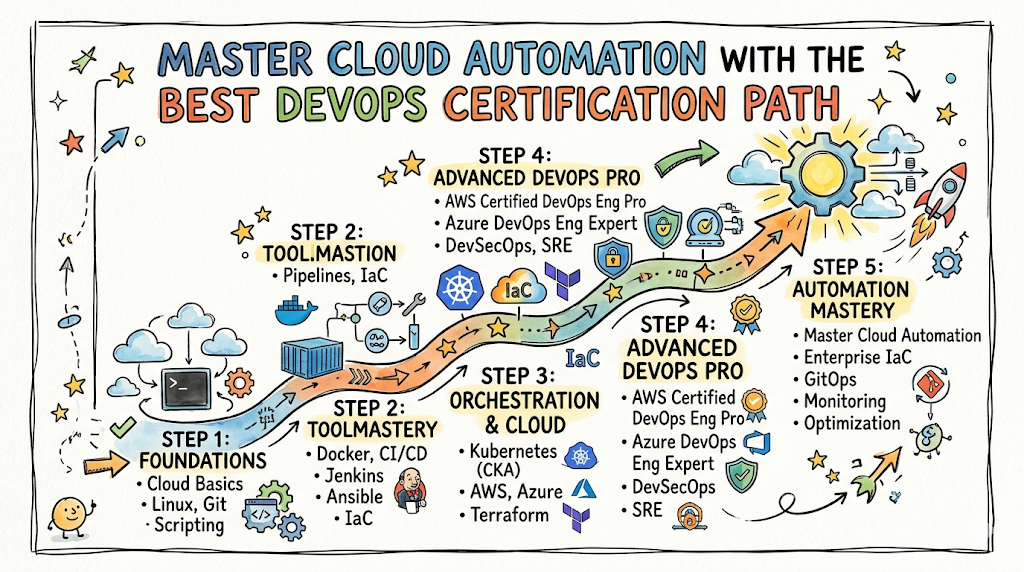
DevOps Certification Roadmap
Phase 1: The Beginner Path
- Core Fundamentals: Focus on Linux system fundamentals, shell scripting (Bash), fundamental Git version control, and core networking concepts (IP routing, DNS, HTTP protocols).
- Basic Containers: Learn how to write basic Dockerfiles, manage local volume data, and network independent host containers.
- Target Credential: DevOps Foundation (optional validation of conceptual frameworks).
Phase 2: The Intermediate Path
- Infrastructure Automation: Transition from manual infrastructure creation to declarative code paradigms.
- Basic Cloud Operations: Build infrastructure configurations across cloud virtual servers and global networks.
- Target Credential: HashiCorp Certified: Terraform Associate alongside a baseline Cloud Associate credential (such as the AWS Solutions Architect Associate).
Phase 3: The Advanced Path
- Production Orchestration: Move from simple single-host container platforms to production cluster systems.
- Enterprise Automation: Design multi-account infrastructure frameworks, zero-downtime application release pipelines, and secure cloud environments.
- Target Credentials: Certified Kubernetes Administrator (CKA) followed by the AWS Certified DevOps Engineer – Professional or Azure DevOps Engineer Expert.
Phase 4: The Specialized Path
- Domain Focus: Branch out based on your specific team needs, such as platform engineering, site reliability engineering, or strict security governance.
- Advanced Disciplines: DevSecOps vulnerability monitoring, GitOps declarative system synchronization (ArgoCD), and platform telemetry tracing.
- Target Focus Areas: OpenSSF security frameworks, FinOps cost monitoring, or platform reliability engineering methodologies.
Recommended Certification Path by Role
DevOps Beginner / Fresher
- Linux System Administration Fundamentals (Non-certified baseline study)
- Git Version Control and Basic Networking
- HashiCorp Certified: Terraform Associate (To understand automation patterns)
Cloud Engineer
- Cloud Associate Credential (e.g., AWS Solutions Architect Associate)
- HashiCorp Certified: Terraform Associate
- Cloud Professional DevOps Credential (e.g., AWS DevOps Professional)
Kubernetes Engineer
- Docker Container Fundamentals
- Certified Kubernetes Administrator (CKA)
- Certified Kubernetes Application Developer (CKAD) or GitOps Fundamentals
DevSecOps Engineer
- Cloud DevOps Associate Platform Baseline
- Certified Kubernetes Security Specialist (CKS)
- Practical DevSecOps frameworks or third-party container scanning certifications
Site Reliability Engineer (SRE)
- Linux Command-Line Deep Dive & Systems Programming (Go/Python)
- Certified Kubernetes Administrator (CKA)
- Google Cloud Professional Cloud DevOps Engineer (SRE Methodology-heavy)
Real-World Career Scenarios
Scenario A: The Career Changer
An engineer working in traditional Linux system administration wants to move into modern cloud engineering.
- Strategy: Instead of attempting advanced cluster orchestration immediately, they focus on learning cloud provider networks and declarative infrastructure by earning the Terraform Associate and an AWS Associate track. This bridges the gap between old-school hardware management and code-driven deployments.
Scenario B: The Web Developer
A backend software developer wants to build and manage their own application pipelines rather than passing code off to an isolated infrastructure operations team.
- Strategy: They focus on understanding local runtimes and cluster deployments by studying Docker systems and pursuing the CKA, allowing them to optimize application packaging and runtime orchestration.
Scenario C: The Cloud Professional
An infrastructure professional with years of cloud migration experience needs to step into a leadership role designing global software delivery platforms for an enterprise.
- Strategy: They target the AWS DevOps Engineer – Professional or Azure DevOps Engineer Expert tracks. This validates their expertise in high-level automated compliance, multi-region failovers, and governance frameworks across thousands of resources.
Common Mistakes to Avoid
- Jumping Into Kubernetes Too Early: Many learners attempt the CKA exam before mastering basic Linux permissions, package managers, and standard networking protocols, resulting in confusion during configuration failures.
- Collecting Certificates Without Building Projects: Accumulating certifications using brain dumps or purely theoretical learning tracks creates a false impression of competence that falls apart during practical technical interviews.
- Neglecting System Administration Basics: Modern cloud systems run predominantly on Linux. Disregarding core operating system concepts makes it incredibly difficult to troubleshoot underlying container or cloud-init issues.
- Over-Focusing on Proprietary Tools: Relying exclusively on one cloud vendor’s internal deployment ecosystem leaves engineers vulnerable to shifts in industry demand. Balance proprietary certifications with open-source tools like Git and Terraform.
Hands-On Projects
To turn your certification knowledge into practical skills, try building these portfolio projects:
Project 1: Multi-Environment IaC Factory
- Objective: Write clean, modular Terraform code that deploys an isolated Virtual Private Cloud (VPC) complete with public/private routing tables, internet gateways, and secure virtual machine instances.
- Why It Matters: Validates your ability to organize production-ready variables, manage state files securely, and design multi-environment deployments.
Project 2: Containerized CI/CD Delivery Pipeline
- Objective: Build a pipeline using GitHub Actions, GitLab CI, or Jenkins that triggers automatically on code commits. The pipeline should run unit tests, build a Docker image, scan it for vulnerabilities, and push it to a private container registry.
- Why It Matters: Demonstrates a practical understanding of continuous integration systems and secure container practices.
Project 3: High-Availability GitOps Kubernetes Cluster
- Objective: Set up a Kubernetes cluster using an orchestration engine and deploy an application using a GitOps controller like ArgoCD. Ensure your application state synchronizes automatically whenever changes are made to your Git repository.
- Why It Matters: Reflects modern cloud-native operational standards, combining declarative configuration with automated drift correction.
Tools and Free Learning Resources
- Linux & Systems Practice: Utilize interactive sandboxes for gamified Linux command-line practice, or online tutorials for clear, foundational documentation.
- Interactive Container Labs: Use browser platforms to practice container orchestration and troubleshooting directly without spending money on cloud resources.
- Official Code Repositories: Explore public repositories containing example Terraform templates, sample Kubernetes manifests, and reference pipeline configurations.
- Cloud Vendor Free Tiers: Take advantage of the introductory free tiers provided by AWS, Azure, and GCP to practice provisioning real cloud infrastructure safely under low-cost caps.
How to Choose the Right DevOps Certification
When mapping out your certification journey, evaluate these key factors to ensure a strong return on your investment:
                  [ Assess Your Current Level ]
                                |
          +---------------------+---------------------+
          |                                           |
    [ Beginner ]                                [ Experienced ]
          |                                           |
[ Focus on Linux, Git,                      [ Align with Target Job ]
  & Terraform Associate ]                             |
                                    +-----------------+-----------------+
                                    |                                   |
                          [ Container Focused ]               [ Cloud Focused ]
                                    |                                   |
                              [ CKA Exam ]                   [ AWS/Azure DevOps Pro ]
1. Current Technical Baseline
Be honest about your starting point. If you cannot configure basic IP tables or write a shell script, skip the advanced multi-cluster orchestration exams for now. Start with foundational tools like Git and Terraform to build your confidence and command-line skills.
2. Immediate Employer & Market Requirements
Analyze local job boards or discuss needs with your current engineering leadership team. If your company or target employer is committed to an Azure migration, pursuing an advanced AWS credential right now won’t deliver immediate career value.
3. Financial & Time Commitments
Performance-based assessments like the CKA require significant, dedicated study time and hands-on practice. Ensure you can commit the necessary hours to run practical labs and experiments so you don’t end up wasting expensive exam registration fees.
Frequently Asked Questions (FAQs)
1. Which DevOps certification is best for beginners?
The HashiCorp Certified: Terraform Associate or standard Cloud Associate tracks are excellent starting points. From a decision-maker’s viewpoint, these show an immediate capacity to manage real resources predictably, skipping theoretical fluff.
2. Is Kubernetes certification worth it?
Absolutely. Industry leaders favor the CKA because its performance-based format instantly separates theoretical text-readers from engineers who can log into a broken environment, isolate a fault, and restore services under pressure.
3. Which cloud certification is best for DevOps?
Invest in the platform where your target enterprise market operates. AWS Certified DevOps Engineer – Professional controls the largest overall footprint, but corporate environments tied to legacy Microsoft licensing prioritize the Azure DevOps Expert track.
4. Is Terraform certification useful?
Yes. From an enterprise strategy perspective, hiring cloud-agnostic talent reduces multi-cloud lock-in risks. Holding a Terraform certification tells an architecture team that you can seamlessly manage infrastructure state across diverse environments.
5. Do DevOps engineers need coding skills?
Yes. While you aren’t building commercial consumer software, you must write automated systems scripts, construct pipeline workflows, and debug infrastructure definitions. Without these skills, you cannot build true automation.
6. How long does DevOps certification preparation take?
Expect a realistic timeline of 2 to 4 weeks for entry automation certs. For advanced tier targets like the CKA or AWS Professional, prepare for 3 to 6 months of active lab engineering to truly handle the scenario variations.
7. Is Docker certification worth it?
While containerization is non-negotiable, enterprise architecture teams rarely look for runtime certs alone. It is far more efficient to jump directly to the CKA, which validates container management within a complete production cluster framework.
8. Which certification is best for SRE roles?
The CKA paired with the Google Cloud Professional Cloud DevOps Engineer exam provides a powerful framework. Google’s track is uniquely tailored around core Site Reliability Engineering data models, system telemetry, and reliability metrics.
9. Which DevOps certification has highest salary value?
The AWS DevOps Professional and the CKA systematically pull top premium compensation. They indicate to an organization that an engineer is capable of handling complex disaster scenarios and heavy architectural governance.
10. Should beginners start with Kubernetes?
No. Starting with Kubernetes without baseline skills is a recipe for operational failure. Master basic Linux operating systems, host-level container isolation, and basic networking configurations first before attempting cluster management.
11. Is DevOps certification enough to get a job?
No. A certification gets your profile past automated screening systems, but it will not survive a practical technical interview. You must back your credentials with a public portfolio of functional infrastructure code and live pipeline projects.
12. Which DevOps certification roadmap is best?
The optimal strategy requires progressive scaling. Establish core systems engineering baselines with Linux, enforce infrastructure blueprints via Terraform, adopt a major cloud provider ecosystem, and culminate with production container operations via the CKA.
Final Recommendation
Certifications are valuable structural milestones, but they should never replace hands-on engineering practice. True expertise is built by breaking environments, diagnosing system failures, and writing clean automation code.
For optimal career growth, pick a dominant cloud platform, master foundational infrastructure tools like Terraform, and validate your container orchestration skills with the CKA. Focus your energy on building real, automated projects that demonstrate you can deliver reliable software infrastructure in production environments.
