Introduction
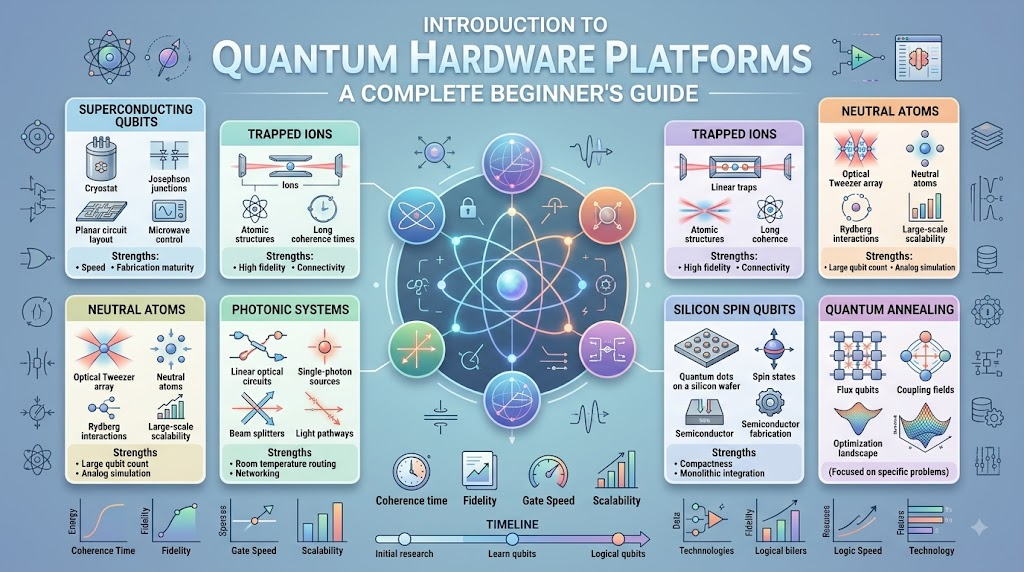
Unlike classical computers that rely universally on silicon transistors, a quantum computer is not built from a single type of hardware; instead, researchers use distinct physical systems—such as superconducting circuits, trapped ions, neutral atoms, photonic systems, silicon spin qubits, and quantum annealers—to implement physical qubits and execute quantum information pipelines from high-level algorithms to physical control pulses and measurement. Choosing a specific hardware platform fundamentally dictates operational speed, qubit connectivity, error rates, physical scalability, and control complexity, with no single architecture emerging as a universal winner because each targets different engineering trade-offs. To explore in-depth guides, circuit design tutorials, and practical insights across these diverse technologies, visit QuantumUting.com.
What Is a Quantum Hardware Platform?
In simple terms, a quantum hardware platform is the complete physical technology stack used to create, isolate, manipulate, and measure quantum states.
A functional system requires far more than bare physical qubits. It encompasses an integrated hardware stack:
$$\text{Physical Qubits} \longrightarrow \text{Control Electronics} \longrightarrow \text{Measurement Systems} \longrightarrow \text{Classical Computing} \longrightarrow \text{Software Interface}$$
+-------------------------------------------------------------+
|                      Software Interface                     |
|           (SDKs, Compilers, Optimization Passes)            |
+-------------------------------------------------------------+
                              |
                              v
+-------------------------------------------------------------+
|               Classical Computing Infrastructure            |
|       (Job Orchestration, Runtime Feedback, Decoding)       |
+-------------------------------------------------------------+
                              |
                              v
+-------------------------------------------------------------+
|            Control Electronics & Measurement Chain          |
|    (Microwave Generators, Arbitrary Waveform Generators,    |
|             Lasers, Low-Noise Amplifiers, ADCs)             |
+-------------------------------------------------------------+
                              |
                              v
+-------------------------------------------------------------+
|             Physical Environment & Shielding                |
|      (Dilution Refrigerators, Ultra-High Vacuum, Cryostats, |
|                 Magnetic / Radiation Shields)               |
+-------------------------------------------------------------+
                              |
                              v
+-------------------------------------------------------------+
|                       Physical Qubits                       |
|   (Transmons, Trapped Ions, Neutral Atoms, Photons, Spins)  |
+-------------------------------------------------------------+
Classical computers remain essential in today’s quantum infrastructure. Classical processors calibrate the equipment, generate pulse sequences, decode readout signals, correct errors in real time, and translate high-level code into physical pulses.
Why Are There Different Quantum Hardware Platforms?
Building a reliable quantum processor is an immense challenge in experimental physics. Qubits rely on delicate quantum properties—such as superposition and entanglement—that are vulnerable to environmental interference.
Hardware engineers face several persistent hurdles:
- Environmental noise: Stray heat, electromagnetic radiation, and mechanical vibrations disrupt quantum information.
- Loss of coherence: Qubits quickly lose their quantum behavior over time through decoherence.
- Operational errors: Applying quantum logic gates can introduce physical inaccuracies.
- Precise control: Manipulating individual qubits without disturbing neighboring qubits requires tight tolerances.
- Measurement disturbance: Reading the state of a qubit without introducing crosstalk requires isolated measurement lines.
- Scaling complexity: Adding more qubits multiplies the physical wiring, laser routing, and calibration overhead.
Different hardware platforms address these challenges using different physical media:
The Engine Analogy: Think of quantum platforms like different vehicle engines. An internal combustion engine, an electric motor, and a jet turbine all generate motion, but each relies on distinct physical principles, fuels, operating ranges, and engineering trade-offs.
Major Types of Quantum Hardware Platforms
1. Superconducting Qubits
Superconducting processors use micro-fabricated electrical circuits cooled to millikelvin temperatures. At these temperatures, electrical resistance drops to zero, allowing the circuit to behave as an artificial atom with discrete, quantum energy levels.
                  Superconducting Transmon Loop
                 +-----------------------------+
                 |                             |
                 |      | | Capacitor (C)      |
                 |      | |                    |
                 |                             |
                 |      [X] Josephson          |
                 |      [X] Junction (LJ)      |
                 |                             |
                 +-----------------------------+
                                |
               Microwave Drive Line & Readout Resonator
- How it works: A key component is the Josephson junction—a thin insulating barrier sandwiched between two superconducting layers. It introduces non-linear electrical inductance, allowing engineers to isolate two specific energy states as $\vert{}0\rangle$ and $\vert{}1\rangle$.
- Control and measurement: Qubits are manipulated using precise microwave pulses tuned to specific frequencies (typically 4–8 GHz) and measured via coupled readout resonators.
- Main strengths: Rapid gate speeds (nanosecond scale), mature semiconductor-style lithography, and direct integration with established microwave electronics.
- Main challenges: Requires dilution refrigerators operating at ~10–20 millikelvin, complex coaxial wiring arrays, susceptibility to material defects, and crosstalk between adjacent circuit traces.
- Typical focus: Universal gate-based quantum computing, quantum chemistry simulations, and quantum error correction testbeds.
2. Trapped-Ion Quantum Computers
Trapped-ion systems use individual charged atoms (ions), such as ytterbium, calcium, or beryllium, suspended in free space.
                    Trapped-Ion Linear Chain

           RF Electrode (+)               RF Electrode (+)
         ===================================================
                 o       o       o       o       o   <-- Suspended Ions
         ===================================================
           RF Electrode (-)               RF Electrode (-)
                                 ^
                                 | Focused Laser Beams
- How it works: Ions are trapped in ultra-high vacuum chambers using oscillating radio-frequency and static electromagnetic fields (Paul traps or surface traps). Qubit states are encoded within the natural, stable internal electronic or hyperfine energy levels of each ion.
- Control and measurement: Focused laser pulses or microwave fields drive transitions between energy states. Multi-qubit gates utilize the shared vibrational modes (phonons) of the ion chain inside the trap. Measurement is performed by laser-induced fluorescence.
- Main strengths: Identical qubits provided by nature, long coherence times (seconds to hours), high-fidelity single- and two-qubit operations, and all-to-all qubit connectivity within an ion chain.
- Main challenges: Slower gate speeds (microsecond to millisecond scale), complex optical and laser-shaping systems, and difficulty managing very long chains of ions without splitting and shuttling.
- Typical focus: High-fidelity gate operations, quantum algorithm testing, and quantum chemistry modeling.
3. Neutral-Atom Quantum Computers
Neutral-atom architectures use individual, uncharged atoms (such as rubidium or cesium) trapped in arrays of laser beams called optical tweezers.
                  Neutral-Atom 2D Optical Lattice

                     (•)     (•)     (•)     (•)

                     (•)     (•)=====(•)     (•)  <-- Rydberg Interaction
                              |
                     (•)     (•)     (•)     (•)

                  Laser Tweezer Traps (Configurable)
- How it works: Tightly focused lasers create microscopic potential wells that hold individual neutral atoms in 1D, 2D, or 3D geometries.
- Interaction mechanism: To execute multi-qubit gates, laser pulses excite the atoms into high-energy Rydberg states. In these states, atoms swell in size and interact across micrometers via the Rydberg blockade mechanism, preventing adjacent atoms from simultaneously exciting and enabling conditional logic.
- Main strengths: Support for hundreds to thousands of identical atomic qubits, dynamic spatial rearrangement during circuit routines, flexible connectivity, and native support for analog Hamiltonian simulation.
- Main challenges: Precise multi-laser alignment, atom loss during runtime, gate operational speed, and laser cooling and trapping requirements.
- Typical focus: Combinatorial optimization, large-scale analog quantum simulation, and zoned fault-tolerant logical qubit architectures.
4. Photonic Quantum Computing
Photonic platforms use discrete particles of light—photons—to encode and process quantum information.
                     Photonic Quantum Circuit

   Single-Photon       +--------------+
   Source 1  --------> | Beam         | -----\ /----- Interferometer ---> Single Photon
                       | Splitter (BS)|       X                           Detector (SPDs)
   Single-Photon ----> |              | -----/ \----- Phase Shifter ----> Single Photon
   Source 2            +--------------+                                   Detector (SPDs)
- How it works: Qubits are encoded in specific degrees of freedom of photons, including polarization, path, arrival time, or continuous field variables.
- Control and measurement: Photons travel through integrated optical waveguides on a chip, interacting with beam splitters, phase shifters, and interferometers. Readout is handled by high-efficiency superconducting nanowire single-photon detectors (SNSPDs).
- Main strengths: Photons maintain quantum states at room temperature, travel across fiber networks with low signal loss, and leverage existing silicon photonics manufacturing lines.
- Main challenges: Photons do not readily interact with one another (requiring probabilistic measurements or complex optical non-linearities for two-qubit gates), optical loss within waveguides, and the need for high-efficiency on-demand single-photon sources.
- Typical focus: Measurement-based quantum computing, linear optical quantum computing, distributed architectures, and quantum communication networks.
5. Silicon Spin Qubits
Silicon spin platforms adapt traditional semiconductor manufacturing to trap individual electrons or holes inside microscopic electrostatic potential wells called quantum dots.
                    Silicon Spin Quantum Dot Gate

                    [ Gate 1 ]   [ Gate 2 ]   [ Gate 3 ]  <-- Metal Electrodes
                 ---------------------------------------
                           Silicon / Silicon-Germanium
                                 ( e- )       ( e- )      <-- Trapped Electron Spins
                 ---------------------------------------
- How it works: Electrodes pattern tiny electrostatic traps within silicon or silicon-germanium heterostructures. The spin orientation (up or down) of the trapped particle serves as the qubit state.
- Control and measurement: Controlled via oscillating magnetic or electric fields (such as electric dipole spin resonance), while readout relies on spin-to-charge conversion techniques monitored by single-electron transistors.
- Main strengths: Compact physical footprint (nanometer scale), potential compatibility with commercial semiconductor cleanrooms, and high qubit device density.
- Main challenges: Extreme sensitivity to charge noise and interfacial defects in the host crystal, demanding sub-micron fabrication tolerances, and tight cryogenic engineering requirements (typically operating around 1 Kelvin).
- Typical focus: High-density integrated quantum circuits and spin-based quantum simulation.
6. Quantum Annealing Hardware
Quantum annealing is a specialized hardware approach tailored for combinatorial optimization problems rather than universal gate-based computation.
             Physical Ising Formulation on Annealing Graph

                       ( Q1 ) -------------- ( Q2 )
                         |   \              /  |
                         |     \          /    |
                         |       ( Q3 )        |
                         |    Coupling (Jij)   |
                       ( Q4 ) -------------- ( Q5 )
                        Local Bias (hi) Applied
- How it works: Optimization challenges are mapped onto an energy minimization model (such as an Ising spin glass or Quadratic Unconstrained Binary Optimization / QUBO problem). Superconducting loops serve as tunable magnetic flux qubits, interconnected by controllable magnetic couplers.
- Execution flow: The processor initializes in a simple, known ground state. Over a designated schedule, the initial quantum magnetic field is gradually turned down while the problem Hamiltonian is introduced. Through quantum tunneling, the system settles toward a low-energy configuration that corresponds to an optimal or near-optimal solution to the original problem.
- Main strengths: High physical qubit counts (thousands of qubits on a single chip) and specialized efficiency for specific industrial routing, scheduling, and logistics problems.
- Main challenges: Cannot execute arbitrary quantum logic gates (not universal), limited inter-qubit connectivity graphs, and susceptible to thermal noise during the final stages of the anneal.
- Typical focus: Operational research, traffic flow routing, portfolio optimization, and graph coloring problems.
Quantum Hardware Platforms at a Glance
| Platform | Physical Qubit Implementation | Operating Environment | Primary Strength | Major Engineering Challenge | Typical Application Focus |
| Superconducting | Lithographic LC circuits with Josephson junctions | Deep cryogenic (~10–20 mK) | Nanosecond gate speeds; mature fabrication | Wiring complexity; material defects; crosstalk | Universal gate computing; quantum chemistry |
| Trapped Ion | Suspended individual ionized atoms | Ultra-high vacuum; room temp or cryogenic | Long coherence times; high gate fidelity | Slower gate operations; complex laser optics | High-accuracy algorithms; quantum logic research |
| Neutral Atom | Neutral atoms held in optical tweezer laser arrays | Ultra-high vacuum; optical tables | Hundreds of identical qubits; flexible geometry | Laser control complexity; atom loss; gate fidelity | Analog quantum simulation; optimization |
| Photonic | Photons encoded in polarization, path, or timing | Room-temp routing; cryogenic detectors | Networkable; low environmental thermal decoherence | Probabilistic two-qubit gates; optical signal loss | Linear optical computing; quantum networking |
| Silicon Spin | Electron or hole spins in silicon quantum dots | Cryogenic (~1 K) | Nanometer footprint; semiconductor fab alignment | Material charge noise; strict physical tolerances | Dense monolithic processors; spin models |
| Quantum Annealing | Superconducting loops acting as flux qubits | Deep cryogenic (~15 mK) | High physical qubit count for optimization | Non-universal logic; limited graph connectivity | Combinatorial optimization; QUBO problems |
What Is a Physical Qubit?
In quantum hardware, a physical qubit is an actual physical system—a microscopic circuit, trapped ion, neutral atom, photon, or electron spin—that stores quantum information.
  +-------------------------------------------------------------+
  |                        Logical Qubit                        |
  |  Encoded across multiple entangled physical qubits to      |
  |  detect and correct errors without destroying data.         |
  +-------------------------------------------------------------+
         |               |               |               |
         v               v               v               v
    [Phys Qubit]    [Phys Qubit]    [Phys Qubit]    [Phys Qubit] ...
A logical qubit, by contrast, is an abstract, error-protected unit of quantum information distributed across a collection of entangled physical qubits using a Quantum Error Correction (QEC) code (such as the surface code).
Physical qubits are inherently noisy. Unwanted interactions with their surroundings cause bit-flip ($X$) and phase-flip ($Z$) errors. To run deep, complex algorithms, quantum systems must group multiple physical qubits together to build fault-tolerant logical qubits that detect and correct internal errors in real time.
How Quantum Hardware Controls Qubits
Executing a quantum program requires applying precise electromagnetic pulses to transform the underlying physical states:
$$\text{Control Pulse} \longrightarrow \text{State Transformation} \longrightarrow \text{Quantum Gate} \longrightarrow \text{Readout}$$
- Microwaves: Used in superconducting and silicon spin processors to alter energy level populations and perform single-qubit rotations.
- Focused lasers: Used in trapped-ion and neutral-atom systems to adjust electronic states, excite Rydberg levels, and cool atomic motion.
- Phase shifters and beam splitters: Used in photonic systems to redirect and interfere optical wavepackets.
- Baseband voltage pulses: Applied across gate electrodes to shift quantum dot potential wells and tune electrostatic exchange interactions.
A timing drift of a single nanosecond or a slight phase offset in a control pulse will degrade gate fidelity, turning an intended logic operation into a noisy approximation.
Why Quantum Computers Need Specialized Environments
Quantum processors depend on controlled environments to shield physical qubits from ambient noise:
+---------------------------------------------------------------+
|                    Specialized Environments                   |
|                                                               |
|  [Dilution Refrigerator]  --> Temperatures near 10-20 mK      |
|  [Ultra-High Vacuum]      --> Pressures below 10^-10 mbar     |
|  [Mu-Metal Shielding]     --> Attenuates stray magnetic fields|
|  [Vibration Isolation]    --> Dampens mechanical resonances   |
|  [Laser Stabilization]    --> Locks optical phase & frequency |
+---------------------------------------------------------------+
- Cryogenic cooling: Superconducting circuits, silicon spin qubits, and certain photonic detectors require dilution refrigerators (operating down to 10–20 millikelvin) to suppress thermal excitations that destroy quantum states.
- Ultra-high vacuum (UHV): Trapped-ion and neutral-atom processors place qubits inside vacuum chambers pumped down below $10^{-10}\text{ mbar}$ to prevent background air molecules from colliding with the atoms.
- Electromagnetic and radiation shielding: Multi-layered mu-metal shielding and cryoperm barriers isolate processors from Earth’s magnetic field, radio signals, and thermal radiation.
- Vibration dampening: Optical tables and floating pneumatic mounts isolate laser pathways and trapped particles from building vibrations.
Important Quantum Hardware Performance Metrics
Evaluating a quantum processor requires looking at multiple performance characteristics:
+-------------------+---------------------------------------------------+
| Metric            | What It Measures                                  |
+-------------------+---------------------------------------------------+
| Qubit Count       | Total number of physical quantum elements         |
| Gate Fidelity     | How closely an operation matches ideal math (e.g. |
|                   | 99.9%)                                            |
| Coherence Time    | Usable lifespan of quantum states (T1 and T2)     |
| Gate Speed        | Duration required to execute a single/two-qubit   |
|                   | gate                                              |
| Connectivity      | Which qubits can interact directly without SWAP   |
|                   | gates                                             |
| Readout Fidelity  | Accuracy when measuring the final output state    |
| Error Rate        | Probability of an error occurring during an       |
|                   | operation                                         |
| Circuit Depth     | Maximum consecutive gate layers executable before |
|                   | noise dominates                                   |
+-------------------+---------------------------------------------------+
- Qubit count: The total number of addressable physical qubits on the processor.
- Gate fidelity: A percentage value (such as 99.5% or 99.9%) indicating how closely a physical gate matches its theoretical mathematical operation. Two-qubit gate fidelity is a primary benchmark for processor quality.
- Coherence time ($T_1$ and $T_2$): $T_1$ (relaxation time) measures how long a qubit remains in its excited state before decaying to ground; $T_2$ (dephasing time) measures how long a qubit preserves phase coherence in a superposition.
- Gate speed: The time it takes to complete an operation (typically nanoseconds for superconducting circuits, microseconds for trapped ions).
- Connectivity: The hardware graph defining which qubits can interact directly. All-to-all connectivity allows any two qubits to interact directly, whereas planar nearest-neighbor lattices require extra routing gates to entangle distant qubits.
- Readout fidelity: The probability of correctly recording the qubit state ($\vert{}0\rangle$ or $\vert{}1\rangle$) during terminal measurement.
- Error rate: The complement of fidelity ($1 – \text{Fidelity}$); lower error rates preserve computational integrity longer.
- Circuit depth: The number of sequential gate layers a program can run before accumulated physical errors make the output unreadable.
Why Qubit Count Alone Does Not Tell the Whole Story
Comparing quantum computers strictly by physical qubit count can be misleading. A 1,000-qubit processor with a 2% two-qubit error rate and limited connectivity can solve fewer practical computational steps than a 100-qubit processor with 0.05% error rates and flexible connectivity.
             Physical Qubit Trade-Off Relationship

                 High Qubit Count + Low Fidelity
                               =
                 Accumulated Errors Limit Circuit Depth

                 Moderate Qubit Count + High Fidelity
                               =
                 Deeper Executable Circuits, Usable Results
Every two-qubit gate adds operational error. If a processor has poor fidelity, low coherence, or constrained connectivity, errors accumulate after only a few layers of gates, turning the output into random noise.
Useful quantum processing capacity depends on balanced engineering: high fidelity, long coherence times, broad connectivity, and low readout errors working in concert.
Quantum Hardware and Error Correction
Because physical qubits interact with their surroundings, quantum hardware requires active error management. Hardware errors fall into three main categories:
- Decoherence: Environmental coupling causes the qubit to lose its quantum phase or decay to ground.
- Control inaccuracies: Tiny calibration errors in pulse amplitude, frequency, or duration.
- Measurement noise: Readout errors that occur when recording the final physical states.
To address these challenges, researchers use Quantum Error Correction (QEC) protocols:
$$\text{Physical Qubits} \longrightarrow \text{QEC Code (e.g., Surface Code)} \longrightarrow \text{Logical Qubits} \longrightarrow \text{Fault-Tolerant Computing}$$
QEC codes store quantum information across an array of entangled physical qubits. Ancilla qubits continuously check for bit-flip and phase-flip errors through syndrome measurements without collapsing the protected logical state.
Building a fault-tolerant quantum computer will require thousands—often tens of thousands—of stable physical qubits to support reliable, error-corrected logical qubits for deep calculations.
Quantum Hardware vs Classical Hardware
| Feature | Classical Computer | Quantum Computer |
| Basic Information Unit | Bit ($0$ or $1$) | Qubit ($\vert{}0\rangle$, $\vert{}1\rangle$, or coherent superposition) |
| Information Representation | Deterministic voltage levels | Probability amplitudes and relative quantum phase |
| Fundamental Operations | Boolean logic gates (AND, OR, NOT) | Unitary quantum logic gates ($H$, CNOT, Phase) |
| Error Handling | Built-in voltage margins; low error rates | Active quantum error correction across physical qubits |
| Operating Environment | Standard ambient room temperature | Often requires millikelvin cryogenics or high-vacuum arrays |
| Control Mechanism | Digital logic circuits on chip | Analog microwave, optical laser, or RF pulse lines |
| System Architecture | Standalone von Neumann architecture | Hybrid quantum-classical co-processor structure |
Quantum computers are not universal replacements for classical computers. They function as specialized co-processors (QPUs) that accelerate specific classes of mathematical, chemical, and optimization problems within a hybrid quantum-classical computing workflow.
How Quantum Hardware Connects With Software
Running a quantum algorithm involves a specialized compilation and execution pipeline:
+-------------------------------------------------------------+
|                 1. High-Level Algorithm                     |
|           (Written in Qiskit, Cirq, Q#, etc.)               |
+-------------------------------------------------------------+
                              |
                              v
+-------------------------------------------------------------+
|               2. Compilation & Transpilation                |
|       - Translates abstract gates to native hardware gates   |
|       - Maps virtual qubits to physical hardware layout     |
|       - Inserts SWAP operations to match connectivity       |
+-------------------------------------------------------------+
                              |
                              v
+-------------------------------------------------------------+
|                 3. Pulse-Level Scheduling                   |
|        (Converts gate instructions to calibrated pulses)    |
+-------------------------------------------------------------+
                              |
                              v
+-------------------------------------------------------------+
|               4. Control Hardware Execution                 |
|           (Drives physical qubits on the processor)         |
+-------------------------------------------------------------+
- Algorithm design: A developer writes a quantum circuit using software frameworks such as Qiskit, Cirq, or Q#.
- Compilation and transpilation: The framework’s compiler analyzes the physical topology of the target hardware, translates abstract gates into the machine’s native gate set (such as $CZ$, $\sqrt{iSWAP}$, or Molmer-Sorensen gates), maps virtual qubits to physical qubits, and optimizes the overall circuit depth.
- Pulse-level scheduling: The compiler breaks down native gates into time-ordered microwave or laser pulse schedules.
- Hardware execution: The control electronics deliver the analog pulse sequences to the physical qubits and read out the final measurement distributions.
Different hardware backends feature distinct native gate sets and physical layouts, meaning a circuit compiled for a superconducting processor will be transpiled differently than one prepared for a trapped-ion or neutral-atom system.
Quantum Hardware Access Through the Cloud
Most developers, students, and researchers interact with real quantum hardware remotely via cloud platforms.
+-------------------------------------------------------------+
|                     Cloud Workflow Model                    |
|                                                             |
|   [Client Workstation]                                      |
|      | Write Circuit Script (e.g., Python)                  |
|      v                                                      |
|   [Cloud Quantum API]                                       |
|      | Authentication, Transpilation & Job Queueing         |
|      v                                                      |
|   [Cryostat / Optical Laboratory]                           |
|      | QPU Pulse Synthesis, Execution & Measurement         |
|      v                                                      |
|   [Client Dashboard]                                        |
|        Retrieve Bitstrings, Histograms & Error Mitigation   |
+-------------------------------------------------------------+
Quantum Simulator vs Real Quantum Hardware
- Quantum simulator: A classical software program running on regular CPUs or GPUs that models ideal or noisy quantum mathematics. Simulators are fast, accessible, and provide complete access to the statevector for small systems ($\le 30\text{–}40$ qubits), but classical memory demands scale exponentially with added qubits ($2^N$).
- Real quantum hardware: Physical processors that process quantum states directly. They reflect real-world physical noise, decoherence, and calibration drift, while scaling without classical statevector memory limits.
Cloud access makes it straightforward to run experiments on physical quantum processors, but jobs are subject to queue times, calibration schedules, and device availability.
Hypothetical Example: Running the Same Circuit on Different Platforms
Note: This is a hypothetical educational walkthrough to illustrate how physical architectures handle the same high-level circuit.
Consider a simple, fundamental quantum circuit:
- Initialize two qubits in the $|00\rangle$ state.
- Apply a Hadamard ($H$) gate to Qubit 0.
- Apply a controlled-NOT ($\text{CNOT}$) gate between Qubit 0 and Qubit 1 to generate a Bell state: $\frac{1}{\sqrt{2}}(|00\rangle + |11\rangle)$.
- Measure both qubits across 1,000 shots.
       High-Level Abstract Circuit
       q_0: ──|0⟩──[ H ]──■──[ M ]
                          │
       q_1: ──|0⟩─────────X──[ M ]
       Superconducting Transpilation (Planar Lattice)
       q_0: ──[Rz(π/2)]──[X(π/2)]──[Rz(π/2)]──■───────[ M ]
                                              │ (CZ)
       q_1: ──────────────[Rz]────[X(π/2)]────■──[Rz]─[ M ]
       (Fast execution in nanoseconds; nearest-neighbor constraint)

       Trapped-Ion Transpilation (Linear Ion Chain)
       ion_0: ──[R(θ,φ)]──■──────────────────[R(θ,φ)]──[ M ]
                          │ (MS Gate)
       ion_1: ──[R(θ,φ)]──■──────────────────[R(θ,φ)]──[ M ]
       (All-to-all connectivity; microsecond execution; high fidelity)
Execution on Superconducting Hardware
- Compilation: The hardware compiler converts the abstract Hadamard and CNOT gates into microwave single-qubit rotations ($X_{\pi/2}$, $Z$) and native two-qubit operations (such as a Cross-Resonance or $CZ$ gate).
- Speed: The circuit completes quickly (nanosecond timescale).
- Output: The measurement distribution yields $\vert{}00\rangle$ and $\vert{}11\rangle$ roughly 48% of the time each, with an occasional error readout (such as $\vert{}01\rangle$ or $\vert{}10\rangle$ at ~2% each) caused by minor gate imperfections and readout noise.
Execution on Trapped-Ion Hardware
- Compilation: The system transpiles the entangling gate into a native Molmer-Sorensen ($MS$) laser pulse sequence, interacting through the collective vibrational motion of the trapped ions.
- Connectivity: The ions can interact directly without adding intermediate routing gates, even if they are not immediate physical neighbors.
- Speed: The operation takes longer to complete (microseconds).
- Output: Higher two-qubit gate fidelities mean the output closely approaches the ideal 50/50 distribution of $\vert{}00\rangle$ and $\vert{}11\rangle$, with minimal noise bitstrings.
Execution on Neutral-Atom Hardware
- Compilation: The compiler translates the entangling step into targeted laser pulses tuned to excite the selected atoms into high Rydberg energy levels.
- Arrangement: If the two target atoms sit far apart on the optical array, the tweezer control system can physically shift them within range before applying the gate pulse.
- Output: The output distribution yields a clear Bell state signature, with noise characteristics reflecting specific optical and atom-retention fidelity parameters.
How to Choose a Quantum Hardware Platform
Because no single architecture excels in every category, matching your problem to the right hardware platform depends on your specific goals:
                      Hardware Selection Guide

    What is your primary experimental focus?
    │
    ├── Fast gate iterations & rapid sampling
    │   └── Superconducting Circuits
    │
    ├── Maximum gate accuracy & all-to-all connectivity
    │   └── Trapped-Ion Systems
    │
    ├── Large atom arrays & analog Hamiltonian simulation
    │   └── Neutral-Atom Arrays
    │
    ├── Optical network integration & distributed nodes
    │   └── Photonic Quantum Systems
    │
    ├── High-density solid-state footprint & semiconductor fab
    │   └── Silicon Spin Qubits
    │
    └── Combinatorial optimization (Ising / QUBO formulations)
        └── Quantum Annealing
- For fast gate operations: Superconducting circuits offer nanosecond gate speeds, making them practical for running thousands of circuit iterations (shots) quickly.
- For high-fidelity gate operations: Trapped-ion systems provide long coherence times and low two-qubit error rates, useful for high-accuracy algorithm benchmarking.
- For large-scale atomic arrays and analog simulation: Neutral-atom platforms support hundreds of configurable atomic sites, suitable for analog quantum simulation and structured optimization research.
- For quantum networking and distributed systems: Photonic systems interface directly with fiber-optic infrastructures, making them natural candidates for quantum communications and networked topologies.
- For combinatorial optimization: Quantum annealers provide a specialized architecture built to evaluate Ising-type energy landscapes without requiring universal gate decompositions.
- For learning and daily experimentation: Cloud-accessible quantum simulators and open-access hardware backends let you test circuits, study noise behavior, and practice error mitigation techniques at low cost.
Common Misconceptions About Quantum Hardware
- Misconception 1: More qubits always means a more powerful quantum computer.
- Reality: Qubit count only reflects capacity. Without high gate fidelity, low error rates, sufficient coherence time, and broad connectivity, added qubits cannot run deeper circuits reliably.
- Misconception 2: Quantum computers will completely replace classical computers.
- Reality: Quantum processors are specialized co-processors (QPUs) designed for specific mathematical problems. Classical processors will continue to handle operating systems, user interfaces, database storage, and general-purpose computing.
- Misconception 3: All quantum computers require temperatures near absolute zero.
- Reality: While superconducting and silicon spin platforms require millikelvin cryogenics, photonic processors guide light at room temperature (though their single-photon detectors may require cooling), and trapped-ion systems operate in both ambient-temperature and cryogenic vacuum chambers.
- Misconception 4: Quantum computers are automatically faster for every problem.
- Reality: Quantum computers only provide performance advantages for specific problem classes where quantum algorithms (such as Shor’s, Grover’s, or quantum phase estimation) alter the computational complexity. For everyday tasks like web browsing or text editing, classical computers remain faster and more efficient.
- Misconception 5: A quantum processor can run any circuit equally well.
- Reality: Physical hardware layouts, native gate sets, and connectivity graphs strongly influence performance. A circuit that runs cleanly on an all-to-all trapped-ion machine may require numerous error-prone SWAP gates on a planar superconducting grid.
- Misconception 6: Quantum hardware is already fully fault tolerant at scale.
- Reality: Modern systems operate primarily in the Noisy Intermediate-Scale Quantum (NISQ) and early logical qubit demonstration eras. Large-scale fault-tolerant systems using thousands of error-corrected logical qubits remain an active engineering goal.
- Misconception 7: Quantum hardware and quantum simulators are identical.
- Reality: Simulators use classical math to model ideal or simulated noisy quantum states without physical hardware noise. Physical hardware manipulates real quantum systems and encounters authentic environmental noise, calibration drifts, and physical limitations.
- Misconception 8: One hardware platform has already won the race.
- Reality: The field remains an active multi-platform effort. Superconducting circuits, trapped ions, neutral atoms, photonics, and silicon spin systems are progressing in parallel, each offering distinct advantages for different use cases.
Beginner Roadmap for Learning Quantum Hardware
1. Classical Foundations    --> Logic gates, binary computing, linear algebra
2. The Qubit Concept        --> Statevectors, Bloch sphere representation
3. Fundamental Principles   --> Superposition, entanglement, interference
4. Quantum Logic Gates      --> Pauli-X, Y, Z, Hadamard, Phase, CNOT, CZ
5. Circuit Construction     --> Building simple multi-qubit quantum circuits
6. Physical Architectures   --> Studying superconductors, ions, atoms, photons
7. Quantum Noise Models     --> Decoherence, T1/T2 relaxation, gate infidelity
8. Error Correction Basics  --> Syndromes, surface codes, physical vs logical
9. Simulator Testing        --> Testing and debugging algorithms on local simulators
10. Cloud Hardware Runs     --> Executing jobs on real QPUs via cloud SDKs
- Step 1: Learn Classical Computing Basics — Review basic binary logic, matrix multiplication, and linear algebra.
- Step 2: Understand Qubits — Learn the mathematical representation of a qubit state ($\vert{}\psi\rangle = \alpha\vert{}0\rangle + \beta\vert{}1\rangle$) and its visualization on the Bloch sphere.
- Step 3: Learn Superposition and Entanglement — Explore how quantum systems represent combined states and non-classical correlations across multiple qubits.
- Step 4: Understand Quantum Gates — Study single-qubit rotations ($X, Y, Z, H, S, T$) and multi-qubit entangling gates ($CNOT, CZ, \text{SWAP}$).
- Step 5: Learn Basic Quantum Circuits — Practice assembling simple algorithms, such as Bell state creation and Quantum Teleportation protocols.
- Step 6: Study Physical Qubit Technologies — Learn how different physical systems (superconducting circuits, trapped ions, neutral atoms, photons) realize quantum states.
- Step 7: Learn Quantum Noise — Study how environmental interactions cause decoherence, amplitude damping ($T_1$), and phase damping ($T_2$).
- Step 8: Understand Error Correction — Learn the basic principles of syndrome measurement, stabilizer codes, and how physical qubits combine to build logical qubits.
- Step 9: Use Quantum Simulators — Model ideal and noisy circuits on classical computers to verify your code before deploying to hardware.
- Step 10: Experiment With Cloud Quantum Hardware — Submit compiled circuits to real quantum processors over the cloud, analyze the output distributions, and practice basic error mitigation techniques.
Role of QuantumUting.com
Learning quantum computing means understanding both abstract software and the physical machines that run it. QuantumUting.com provides structured educational resources that bridge the gap between quantum software and physical hardware:
- Hardware architecture breakdowns: Clear guides explaining physical qubit implementations, cryogenic requirements, and control systems.
- Programming tutorials: Practical walkthroughs using popular quantum SDKs to write, transpile, and optimize circuits.
- Simulator and hardware workflows: Practical comparisons between running ideal simulations on classical computers and deploying noisy circuits to physical quantum processors.
- Core algorithmic concepts: Plain-English explanations of quantum logic, superposition, entanglement, and error correction strategies.
Whether you are a software developer exploring quantum libraries or an engineer curious about hardware constraints, QuantumUting helps you build a solid foundation in modern quantum technology.
Future of Quantum Hardware Platforms
Quantum hardware engineering is moving forward on several fronts:
+-------------------------------------------------------------+
|              Key Directions in Hardware Scaling             |
|                                                             |
|  - Transition from NISQ systems to Fault-Tolerant QPUs      |
|  - Demonstrations of high-threshold Logical Qubits          |
|  - Optical interconnects for Modular Multi-Core QPUs        |
|  - Neutral-Atom arrays scaling to thousands of sites        |
|  - On-chip cryo-CMOS integration for Silicon Spin and       |
|    Superconducting processors                               |
|  - Hybrid Quantum-Classical HPC data center integration     |
+-------------------------------------------------------------+
- Fault-tolerant quantum computing: Moving from noisy physical processors to reliable logical qubits using real-time error correction.
- Logical qubit operations: Demonstrating high-fidelity multi-qubit logic gates between error-corrected logical qubits.
- Scaling neutral-atom arrays: Expanding optical tweezer platforms to control thousands of atomic qubits within dynamically reconfigurable architectures.
- Advanced trapped-ion shuttling: Developing micro-fabricated surface traps (QCCD architectures) that shuttle ions across dedicated processing zones.
- Cryogenic classical control integration: Placing control electronics (Cryo-CMOS) directly inside dilution refrigerators to reduce the mass of coaxial wiring.
- Photonic quantum networks: Building low-loss optical interconnects to link multiple discrete quantum processors into distributed, modular systems.
- Coexistence of platforms: Different hardware architectures will likely continue to progress alongside one another, each supporting distinct workloads across simulation, optimization, communications, and fault-tolerant computing.
Frequently Asked Questions
What is a quantum hardware platform?
A quantum hardware platform is the physical technology used to isolate, control, and measure quantum states. It includes the physical qubits, control electronics, environmental shielding, and the classical computing interfaces needed to run quantum operations.
What are the main types of quantum hardware?
The leading quantum hardware platforms include superconducting circuits, trapped ions, neutral atoms, photonic systems, silicon spin qubits, and quantum annealing systems.
What is a physical qubit?
A physical qubit is a real physical system—such as a superconducting circuit, an individual trapped ion, a neutral atom, a single photon, or an electron spin—that encodes quantum information in its quantum states.
How do superconducting quantum computers work?
Superconducting processors use micro-fabricated circuits with Josephson junctions cooled to millikelvin temperatures. At these temperatures, the circuit loses electrical resistance and behaves as an artificial atom whose energy states are controlled using microwave pulses.
What are trapped-ion quantum computers?
Trapped-ion systems suspend individual charged atoms in vacuum chambers using electric fields. Qubits are stored in the internal electronic states of the ions and manipulated with focused lasers or microwave fields.
What are neutral-atom quantum computers?
Neutral-atom quantum systems use laser beams known as optical tweezers to hold individual uncharged atoms in arrays. Multi-qubit interactions are triggered by exciting the atoms into high-energy Rydberg states.
What is photonic quantum computing?
Photonic quantum computing uses particles of light (photons) as qubits. Information is encoded into properties like polarization, spatial path, or time-bin, and processed using optical waveguides, beam splitters, and single-photon detectors.
Why do some quantum computers require cryogenic cooling?
Superconducting and silicon spin processors require extreme cooling (down to ~10–20 millikelvin) to achieve superconductivity and prevent ambient heat from exciting the physical qubits and destroying their quantum states.
Why is qubit count not enough to compare quantum computers?
Qubit count only indicates capacity. Computational performance depends on gate fidelity, coherence time, physical connectivity, gate speed, and readout accuracy. A smaller, high-fidelity system can often run deeper circuits than a larger, noisier machine.
How can beginners learn about quantum hardware?
Beginners should build a foundation in linear algebra and quantum logic gates, test circuits on classical simulators, and study how different physical platforms implement quantum operations. Cloud platforms make it easy to deploy real quantum programs on physical processors to observe hardware performance firsthand.
Conclusion
The journey toward practical quantum computing relies on diverse physical architectures—spanning superconducting circuits, trapped ions, neutral atoms, photonics, silicon spin qubits, and quantum annealers—each defined by unique engineering trade-offs in gate speed, coherence time, connectivity, and environmental requirements. Understanding these underlying platforms is essential, as raw qubit count alone does not determine performance; true computational capability depends equally on gate fidelity, error rates, circuit depth, and physical scalability. As the industry advances from noisy processors toward fault-tolerant logical systems, different hardware approaches will continue to coexist to power distinct simulation, optimization, and general-purpose workloads.
