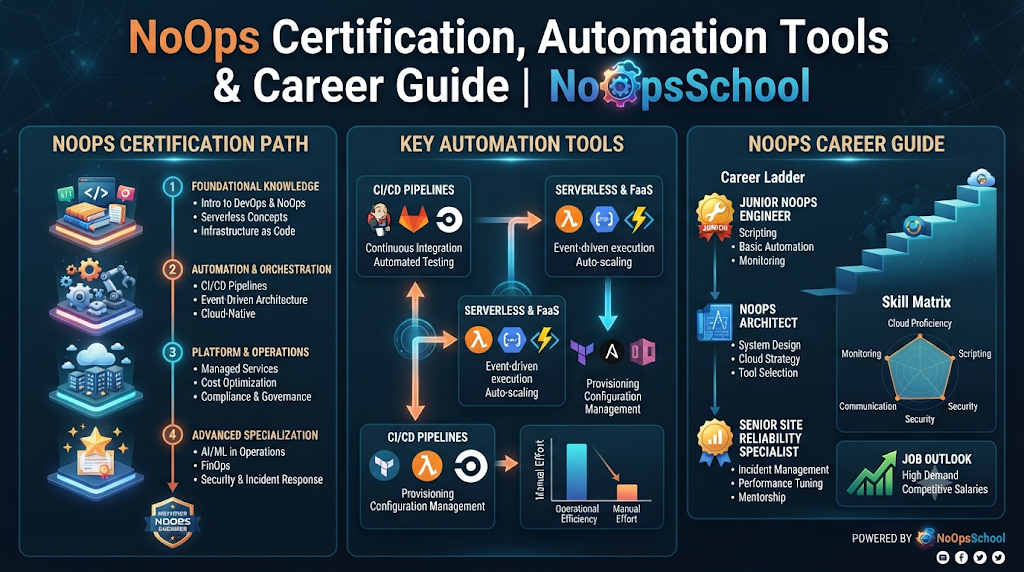
Every growing software organization eventually hits a familiar ceiling: engineering headcount increases, yet feature delivery slows down because senior people spend half their week babysitting infrastructure. Instead of designing resilient products, architects review routine firewall tickets and developers wait days for staging environments. Exploring what is NoOps from a leadership and architecture perspective reveals how modern teams break that bottleneck by turning repeatable operations into governed, self-service software.
At NoOpsSchool, we work with engineers, architects, and technology managers who want practical ways to scale cloud operations without scaling manual overhead. Rather than treating automation as a replacement for engineering judgment, this guide explains how policy-driven infrastructure works, how it relates to DevOps, which technical stacks power it, and how teams build the skills to run it safely.
Reframing Operations as a Product, Not a Ticket Queue
In traditional IT setups, every infrastructure change travels through a human queue—provision a database, open a port, deploy a release, restart a hung worker. NoOps (“No Operations”) flips that model on its head. Rather than filing tickets for routine tasks, product developers interact with automated, self-service platforms that enforce security, compliance, and reliability rules automatically behind the scenes.
Does that mean an organization runs without operational engineers? Never. Complex cloud systems still demand sharp architectural decisions, capacity planning, security governance, vendor management, and deep investigation when rare failures occur. What changes is where human intelligence goes: away from repetitive clicking and toward engineering the automated guardrails themselves.
Three Signals Your Organization Is Ready for Deeper Automation
- Environment Bottlenecks Stall Releases: Developers lose days waiting for manual test clusters, cloud permissions, or database clones.
- Outages Stem From Human Configuration Drift: Production behaves differently from staging because someone applied a manual hotfix weeks earlier and forgot to document it.
- Senior Talent Spends Too Much Time on Toil: High-leverage engineers spend more hours on routine maintenance than on architectural improvements.
NoOps vs DevOps: Evolution of Ownership and Automation
Technical leaders frequently ask where NoOps vs DevOps draws the line. Rather than two opposing camps, think of them as sequential layers of maturity. DevOps united software developers and operations specialists around shared accountability, continuous integration, and fast feedback loops. NoOps extends those exact principles by encoding operational best practices directly into self-service infrastructure platforms so routine work happens automatically.
| Operational Dimension | Legacy IT Operations | DevOps Culture & Practices | NoOps-Driven Architecture |
|---|---|---|---|
| Environment Creation | Manual ticketing and hand-built servers | Infrastructure as Code scripts run by engineers | Self-service templates triggered via Git pull requests |
| Release Execution | Scheduled maintenance windows and manual steps | Automated CI/CD pipelines with peer approvals | Policy-verified pipelines, GitOps sync, and automated rollbacks |
| Reliability & Recovery | Manual monitoring alerts and late-night logins | Shared observability, runbooks, and scripted remediation | Native self-healing probes, auto-scaling, and AIOps noise reduction |
| Primary Human Focus | Routine server administration and patching | Pipeline maintenance and cross-team coordination | Platform design, security policy, cost governance, and novel incidents |
The Technical Building Blocks: NoOps Automation Tools
Achieving reliable, low-touch operations requires combining several focused NoOps automation tools into a cohesive delivery workflow:
- Infrastructure as Code (Terraform and OpenTofu): Express networks, clusters, IAM policies, and managed databases as declarative code stored in Git so every infrastructure change is peer-reviewed and repeatable.
- Containerization and Orchestration (Docker and Kubernetes): Package workloads consistently and rely on Kubernetes to schedule pods, balance traffic, scale capacity, and replace unhealthy containers automatically.
- Continuous Delivery and GitOps (GitHub Actions, GitLab CI/CD, Argo CD): Automate testing and artifact builds on every commit, while GitOps controllers continuously reconcile live cluster state against Git repositories.
- Observability and Intelligent Telemetry (Prometheus, Grafana, OpenTelemetry): Capture metrics, logs, and distributed traces across services, pairing them with AIOps correlation to separate real user impact from background noise.
- Managed Cloud and Serverless Primitives (AWS, Microsoft Azure, Google Cloud): Shift operating system patching and underlying server upkeep to managed services and serverless functions wherever workload patterns fit.
Architectural Example: Policy-Driven Provisioning and Automated Resilience
Consider how a platform team combines declarative infrastructure with automated Kubernetes traffic management. First, an OpenTofu or Terraform configuration provisions an encrypted, tagged database instance automatically through version control:
Terraform
resource "aws_db_instance" "orders_db" {
  identifier             = "orders-service-prod"
  engine                 = "postgres"
  engine_version         = "16.3"
  instance_class         = "db.t4g.medium"
  allocated_storage      = 50
  storage_encrypted      = true
  backup_retention_period = 7
  skip_final_snapshot    = false

  tags = {
    Service   = "orders-api"
    ManagedBy = "opentofu"
  }
}
Next, inside Kubernetes, a PodDisruptionBudget ensures that automated node upgrades or scaling events never take down too many replicas at once:
YAML
apiVersion: policy/v1
kind: PodDisruptionBudget
metadata:
  name: orders-api-pdb
spec:
  minAvailable: 2
  selector:
    matchLabels:
      app: orders-api
By encoding backup retention, encryption, and minimum availability directly into declarative files, operational safety becomes automatic rather than optional.
Seven Practical Steps to Roll Out Automation Without Disruption
Trying to replace every manual workflow in one quarter creates fragile automation that teams quickly abandon. A phased rollout builds trust alongside capability:
- Measure Operational Toil First: Audit recurring tickets, deployment delays, and manual recovery steps over two to four weeks to pinpoint high-friction bottlenecks.
- Enforce Single-Source Version Control: Put every configuration file, deployment manifest, and policy rule into Git before automating execution.
- Standardize Reusable IaC Modules: Build vetted Terraform or OpenTofu modules with built-in security tags, encryption, and state locking.
- Automate Verification in CI/CD: Run unit tests, container vulnerability scans, and policy checks automatically on every pull request.
- Instrument End-to-End Observability: Deploy metrics, structured logs, and traces before turning on automated actions so engineers always have clear visibility.
- Introduce Guardrailed Self-Healing: Enable automated horizontal scaling, health-probe restarts, and canary rollbacks while preserving human sign-off for high-risk schema or network changes.
- Review Metrics and Refine: Track deployment frequency, change failure rate, and recovery speed monthly to guide your next automation investment.
Practical Scenarios Across Growing Engineering Organizations
- Self-Service Staging Environments: Instead of sharing a single fragile staging server, developers open a branch that automatically provisions an isolated preview stack via Terraform and Argo CD, runs automated checks, and deletes the stack after merge.
- Zero-Touch Traffic Spike Handling: During an unexpected promotional surge, Kubernetes horizontal pod autoscalers and managed cloud load balancers expand capacity within seconds and scale back down once traffic normalizes—controlling both latency and cloud spend.
- Automated Compliance Guardrails: Policy-as-code checks inside CI pipelines automatically block unencrypted storage buckets or public security groups before infrastructure code ever reaches production.
Balancing Speed, Cost, and Governance
Automation unlocks faster releases, consistent environments, and calmer on-call rotations—but thoughtful leaders plan around real constraints:
- Engineering Investment Up Front: Building clean self-service modules and automated test suites takes deliberate time before operational savings compound.
- Blast Radius Management: Automated pipelines can propagate a faulty configuration across multiple environments rapidly if canary stages and policy checks are skipped.
- Continuous Upkeep: Cloud provider APIs, Kubernetes versions, and security baselines evolve constantly, requiring ongoing maintenance of automation code.
Common Mistakes to Avoid
- Automating Chaos: Streamlining a poorly understood manual workflow simply produces errors faster; simplify the process first.
- Neglecting Rollback Drills: Automated deployments must be paired with equally tested, one-click rollback procedures.
- Removing Human Accountability: Automation executes rules, but engineering leaders and architects remain accountable for reliability, security, and budgets.
Developing Team Capabilities, Credentials, and External Support
Sustaining automated cloud platforms requires clear role ownership across technical and leadership tracks:
- Engineers focus on building reusable IaC modules, maintaining CI/CD and GitOps pipelines, operating container platforms, and wiring observability.
- Architects focus on multi-account cloud topology, resilience patterns, security boundaries, and long-term automation strategy.
- Managers focus on governance frameworks, team enablement, risk management, cost accountability, and iterative operational improvement.
For professionals and organizations strengthening these capabilities, NoOpsSchool provides structured learning, credentials, and advisory options:
- Role-Based Learning and Credentials: Individuals can pursue a NoOps training course alongside targeted credentials—such as NoOps certification, NoOps engineer certification, NoOps architect training, and NoOps manager certification—to organize technical skills around practical operational responsibilities. (Courses and certifications build structured knowledge and professional credibility, while real-world mastery grows through hands-on implementation.)
- Advisory and Specialized Project Execution: Organizations modernizing legacy workflows can engage NoOps consulting services for operational assessments and automation roadmaps, or hire NoOps freelancers when they need focused, short-term help with Terraform, Kubernetes, or automated monitoring under internal security oversight.
Frequently Asked Questions (FAQs)
1. What is NoOps from an engineering management perspective?
NoOps is an operational strategy that turns routine infrastructure provisioning, deployments, and basic recovery into automated, policy-driven self-service workflows—allowing engineers to focus on architecture, reliability, and product delivery.
2. How does NoOps vs DevOps affect team structure?
DevOps builds collaboration and shared ownership between development and operations teams, while NoOps builds on that foundation by encapsulating repeatable operational tasks into automated platforms and self-service tooling.
3. Does NoOps eliminate the need for cloud or infrastructure engineers?
No. Organizations still need skilled engineers and architects to design resilient platforms, enforce security and compliance policies, manage cloud costs, and investigate complex production incidents.
4. Which NoOps automation tools form a practical starting stack?
A solid starting stack includes Git for version control, Terraform or OpenTofu for Infrastructure as Code, Docker and Kubernetes for container orchestration, GitHub Actions or Argo CD for automated delivery, and Prometheus with OpenTelemetry for observability.
5. How do a NoOps training course and NoOps certification support career growth?
They provide a structured curriculum covering cloud infrastructure automation, IaC, containers, delivery pipelines, and governance, helping professionals build organized, role-relevant capabilities.
6. What separates engineer, architect, and manager focus areas?
Engineers focus on hands-on pipelines, IaC, and cluster operations; architects focus on system design, scalability, and security guardrails; and managers focus on governance, risk control, and team workflows.
7. When do organizations benefit most from NoOps consulting services?
Consulting adds strong value during cloud migrations, platform modernization initiatives, operational bottleneck assessments, or when establishing standardized CI/CD and security automation practices.
8. How should companies safely hire NoOps freelancers for specific projects?
Define clear project milestones, enforce least-privilege access controls, require all code and documentation to live inside internal Git repositories, and conduct thorough peer reviews before production deployment.
9. Is automation-driven operations practical for mid-sized or smaller teams?
Yes—leveraging managed cloud services, simple IaC templates, and automated CI/CD pipelines allows smaller teams to maintain high reliability without building a large dedicated operations department.
10. How do teams prevent automated pipelines from causing widespread outages?
Use progressive rollouts (canary or blue-green deployments), automated policy and security gates, comprehensive observability alerts, and tested one-step rollback workflows.
Conclusion
Scaling cloud operations sustainably means designing systems where routine tasks happen automatically and human expertise focuses on architecture, security, and continuous improvement. By combining Infrastructure as Code, container orchestration, GitOps delivery, and clear governance, organizations turn operational friction into reliable momentum.
Explore NoOpsSchool to discover role-aligned training courses, certification pathways, consulting services, and automation resources tailored to your team’s next stage of cloud maturity.
