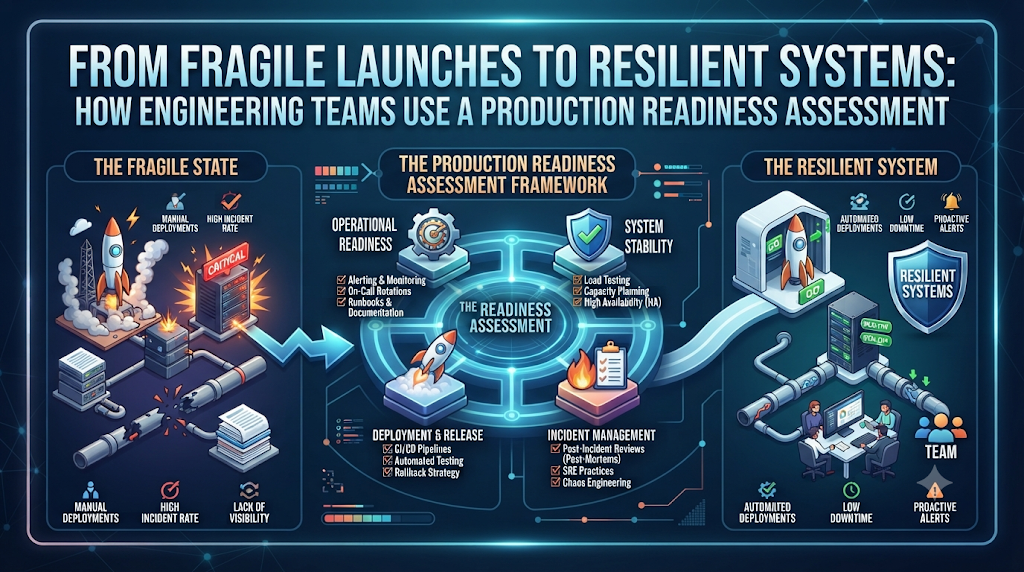
Every software organization hits a predictable inflection point. In the early days, a handful of engineers know every server, database query, and deployment quirk by heart. As the product scales, new microservices multiply, release velocity climbs, and suddenly a routine Friday deployment triggers a cascade of timeouts nobody saw coming. Adopting a structured production readiness assessment helps growing teams replace tribal memory with repeatable engineering standards—without slowing down product innovation.
At OpsRoadmaps, we approach operational excellence from an organizational architecture perspective: reliability is never an accident of heroics, nor is it solved by buying another dashboard tool. This guide explores how technical leaders, platform engineers, and SREs evaluate operational readiness, connect service-level checks to broader engineering maturity, and build practical roadmaps for long-term stability.
Why Traditional Launch Reviews Fall Short
In many organizations, “getting ready for production” still means a frantic Slack thread twenty-four hours before a release deadline. Someone asks if monitoring is turned on, another engineer pastes a link to a half-finished wiki page, and the team hopes for the best.
That ad-hoc approach breaks down because modern distributed systems fail in complex ways. A production readiness assessment changes the conversation from “Can we deploy this code?” to “Can we operate, observe, secure, and recover this service under real-world stress?”
Shifting From Gatekeeping to Shared Enablement
When readiness reviews feel like a bureaucratic wall, product developers naturally try to bypass them. High-performing organizations design readiness around shared enablement:
- Clear expectations up front: Developers know the exact reliability, security, and telemetry baseline required from day one of building a service.
- Self-service defaults: Platform teams bake compliant templates, pipelines, and alert rules into starter repositories so doing the right thing is also the easiest path.
- Continuous verification: Instead of checking readiness once and forgetting it, teams re-evaluate critical services as traffic patterns, dependencies, and compliance needs evolve.
Connecting Service Readiness to Organizational Maturity
Evaluating a single microservice is only one layer of operational health. To sustain reliability across dozens of teams, engineering leaders connect individual readiness checks with broader capability frameworks:
- DevOps maturity assessment: Examines end-to-end delivery speed, deployment automation, automated testing, and cross-team collaboration across the whole engineering organization.
- Platform engineering adoption roadmap: Guides teams in building golden paths and internal developer platforms that reduce cognitive load while enforcing production standards automatically.
- SRE adoption roadmap: Introduces practical reliability engineering practices—such as Service Level Objectives (SLOs), error budgets, toil reduction, and blameless postmortems.
- Incident management maturity model: Evaluates how teams detect, triage, communicate during, resolve, and learn from live service disruptions.
- DevSecOps implementation roadmap: Shifts vulnerability scanning, secrets hygiene, and least-privilege access controls directly into everyday CI/CD workflows.
- Observability maturity model: Measures whether engineers can diagnose novel, unknown failure modes using correlated logs, metrics, and distributed traces rather than staring at disconnected host graphs.
- Cloud cost optimization roadmap: Connects infrastructure efficiency and FinOps accountability to engineering decisions so reliability does not come with runaway cloud waste.
Important Perspective: Maturity models and readiness scores are diagnostic tools for prioritizing improvements—they are neither independent compliance audits nor guarantees against future incidents.
Five Core Pillars of a Production Readiness Assessment
Whether you are launching a customer-facing API or migrating a legacy monolith to containers, an effective assessment examines five interconnected pillars.
| Assessment Pillar | Core Engineering Questions | Concrete Evidence to Verify |
| 1. Fault Tolerance & Scaling | What happens when a downstream dependency slows down or an availability zone fails? | Multi-zone replicas, timeouts, circuit breakers, autoscaling rules, and tested database failover |
| 2. Delivery & Safe Rollbacks | How quickly and safely can we ship a fix—or undo a bad release? | Automated CI/CD pipelines, progressive rollouts (canary/blue-green), and documented rollback steps |
| 3. Telemetry & Actionable Alerts | Will we know users are affected before support tickets pile up? | Structured logs, RED/USE metrics, distributed tracing, SLO burn-rate alerts, and linked runbooks |
| 4. Security & Secrets Hygiene | Are credentials, network paths, and container images locked down? | Short-lived IAM credentials, vault-managed secrets, image vulnerability scans, and network policies |
| 5. Ownership & Cost Guardrails | Who owns this service at 2:00 AM, and are compute resources bounded? | Defined on-call rotation, escalation contacts, CPU/memory limits, and workload cost tagging |
Step-by-Step: Rolling Out Readiness Reviews Across Teams
If your organization has never run formal readiness reviews before, starting with a 60-item spreadsheet will stall immediately. Roll out the practice incrementally:
- Tier Your Services by Business Criticality: Separate Tier-1 revenue or customer-critical services from internal batch jobs. Apply strict readiness criteria to Tier-1 workloads first.
- Co-Create a Lightweight Baseline: Bring together one SRE, one security engineer, and two product developers to agree on 10–15 non-negotiable checks—such as a Kubernetes production readiness checklist for containerized services.
- Require Evidence, Not Checkmarks: Ask teams to link directly to their Grafana dashboard, Terraform module, PagerDuty escalation policy, and rollback runbook rather than simply answering “Yes.”
- Automate Objective Policy Checks: Move mechanical rules (such as container resource limits, non-root execution, and required cost tags) into CI pipeline checks or Kubernetes admission policies.
- Track Post-Launch Action Items: When a service launches with known medium-risk gaps, log those items with clear owners and target dates so technical debt does not become permanent.
- Review Quarterly or After Major Incidents: Update your baseline whenever a postmortem reveals a blind spot that existing checks missed.
Practical Configuration Example: Enforcing Kubernetes Readiness Standards
In container orchestration environments, many production outages stem from missing resource boundaries or poorly tuned health checks. Below is a practical Kubernetes Deployment configuration demonstrating explicit resource guardrails, security context restrictions, and separated startup, readiness, and liveness probes:
YAML
apiVersion: apps/v1
kind: Deployment
metadata:
  name: billing-gateway
  namespace: core-payments
  labels:
    app: billing-gateway
    tier: critical
spec:
  replicas: 3
  strategy:
    type: RollingUpdate
    rollingUpdate:
      maxUnavailable: 0
      maxSurge: 1
  selector:
    matchLabels:
      app: billing-gateway
  template:
    metadata:
      labels:
        app: billing-gateway
    spec:
      securityContext:
        runAsNonRoot: true
        runAsUser: 10001
      containers:
        - name: gateway
          image: registry.example.com/billing-gateway:2.3.0
          ports:
            - containerPort: 8443
          resources:
            requests:
              cpu: "500m"
              memory: "512Mi"
            limits:
              cpu: "1000m"
              memory: "1Gi"
          startupProbe:
            httpGet:
              path: /health/startup
              port: 8443
            failureThreshold: 12
            periodSeconds: 5
          readinessProbe:
            httpGet:
              path: /health/ready
              port: 8443
            periodSeconds: 10
          livenessProbe:
            httpGet:
              path: /health/live
              port: 8443
            periodSeconds: 20
Separating startupProbe, readinessProbe, and livenessProbe prevents Kubernetes from killing slow-starting applications prematurely while ensuring traffic only routes to pods genuinely ready to serve requests.
Real-World Scenarios: Assessment and Incident Diagnosis in Action
Scenario A: Scaling a Multi-Tenant SaaS API Before Enterprise Onboarding
A B2B software team prepares to onboard its largest enterprise customer, which will triple peak API traffic. Running a targeted production readiness assessment three weeks early reveals two hidden risks: background worker queues have no dead-letter handling, and container memory limits are absent on non-critical reporting pods. By adding dead-letter queues, setting memory limits to prevent noisy-neighbor node exhaustion, and testing horizontal pod autoscaling under synthetic load, the team completes the enterprise onboarding smoothly.
Scenario B: Systematic Kubernetes CrashLoopBackOff Troubleshooting
During a routine configuration rollout, a newly deployed pod repeatedly restarts and enters CrashLoopBackOff. Following a disciplined Kubernetes CrashLoopBackOff troubleshooting workflow prevents guesswork and avoids disruptive cluster changes:
- Check pod state and recent scheduler/kubelet events:Bash
kubectl get pods -n core-payments kubectl describe pod billing-gateway-7d9f8c-abc12 -n core-payments - Inspect logs from both the current container and the crashed previous instance:Bash
kubectl logs billing-gateway-7d9f8c-abc12 -n core-payments kubectl logs billing-gateway-7d9f8c-abc12 -n core-payments --previous - Match symptoms to root causes:
- Exit code
137withOOMKilledindescribe podindicates the container exceeded its memory limit. - Exit code
1with stack traces points to missing environment variables, invalid secrets, or database connection failures at startup. - Repeated probe failures in events suggest misconfigured paths, ports, or overly tight timeout thresholds.
- Exit code
- Roll back or patch safely: Revert the faulty config or image tag via your GitOps/CI pipeline and confirm pods stabilize in
Runningstatus withREADY 1/1. (Avoid manually deleting pods or force-deleting stateful resources in production without verifying controller behavior first.)
Measuring Operational Improvement Over Time
To ensure readiness initiatives create tangible value rather than paperwork, engineering leaders track balanced outcome metrics:
- Deployment Frequency & Lead Time for Changes: Derived from DORA research, showing whether teams can deliver small improvements rapidly.
- Change Failure Rate & Mean Time to Restore (MTTR): Measuring how often releases cause customer-impacting degradation and how fast responders restore service.
- SLO Compliance & Error Budget Burn Rate: Keeping reliability discussions objective by tying engineering priorities to agreed user-experience targets.
- Alert-to-Incident Ratio: Tracking how many pages represent real actionable issues versus noisy false positives that erode on-call morale.
- Unit Infrastructure Cost: Monitoring cloud spend per transaction, tenant, or workload so scaling remains financially sustainable.
Common Pitfalls That Undermine Readiness Programs
- Making Readiness an Ivory-Tower Audit: When central teams grade developers without offering reusable templates or platform tooling, resentment replaces collaboration.
- Copying Big-Tech Standards Blindly: A 25-engineer startup does not need the multi-region active-active complexity of a global hyperscaler—right-size your requirements to actual business risk.
- Treating Dashboard Creation as Observability: Having fifty charts means nothing if engineers cannot trace a slow request across microservices during an outage.
- Forgetting Human Sustainability: Even well-architected systems fail if on-call engineers lack clear runbooks, escalation paths, or recovery time after major incidents.
How OpsRoadmaps Helps Organizations Build Operational Clarity
OpsRoadmaps is designed specifically for engineering teams and technical leaders looking to evaluate operational health, uncover capability gaps, and build structured improvement roadmaps across 42 engineering operations disciplines.
Instead of offering generic individual tutorials, OpsRoadmaps provides structured assessments, explainable maturity evaluations, prioritized findings, technical checklists, architecture blueprints, and troubleshooting runbooks spanning production readiness, DevOps, SRE, platform engineering, Kubernetes, incident management, DevSecOps, observability, and FinOps—helping teams turn self-assessed gaps into clear, measurable engineering plans.
Frequently Asked Questions (FAQs)
1. What is the main purpose of a production readiness assessment?
Its primary goal is to verify that a software service and its supporting infrastructure, security controls, telemetry, and on-call processes are prepared to handle live production traffic safely before major launches or scaling events.
2. How often should teams conduct a production readiness assessment?
Teams should run a review before initial launch, ahead of major architectural or traffic changes, and periodically (such as semi-annually) for critical services to catch configuration and operational drift.
3. How does a DevOps maturity assessment complement service readiness?
A DevOps maturity assessment evaluates organization-wide software delivery, automation, testing, and collaboration capabilities, providing the broader context needed to make individual service readiness repeatable.
4. What are the essential items in a Kubernetes production readiness checklist?
A practical Kubernetes production readiness checklist covers explicit CPU/memory requests and limits, startup/readiness/liveness probes, multiple replicas with pod disruption budgets, non-root security contexts, network policies, centralized logging/metrics, and tested rollback procedures.
5. When should an organization start a platform engineering adoption roadmap?
Organizations typically initiate a platform engineering adoption roadmap when multiple product teams start duplicating CI/CD pipelines, Kubernetes manifests, and cloud provisioning scripts—creating cognitive overload and inconsistent security standards.
6. How does an SRE adoption roadmap improve reliability without halting feature work?
An SRE adoption roadmap introduces Service Level Objectives (SLOs) and error budgets, giving product and operations teams a shared, data-driven rule for when to prioritize feature velocity versus reliability engineering.
7. What distinguishes levels in an incident management maturity model?
Lower levels in an incident management maturity model rely on ad-hoc heroics and chaotic communication, while higher levels feature automated detection, defined incident commander roles, tested runbooks, blameless postmortems, and tracked remediation.
8. Where should teams begin on a DevSecOps implementation roadmap?
Most teams start a DevSecOps implementation roadmap by automating secrets detection, dependency vulnerability scanning, and container image checks directly inside pull-request pipelines before enforcing stricter runtime policies.
9. How do organizations use an observability maturity model?
An observability maturity model helps teams progress from basic infrastructure uptime checks to unified logs, metrics, and distributed tracing mapped directly to user journeys and business SLOs.
10. What drives success in a cloud cost optimization roadmap?
A successful cloud cost optimization roadmap combines accurate resource tagging, right-sizing over-provisioned workloads, autoscaling idle capacity, and giving engineering teams direct visibility into the cost impact of their architectural choices.
11. What is the fastest way to narrow down Kubernetes CrashLoopBackOff troubleshooting?
Start by running kubectl describe pod to check exit codes and probe events, then inspect kubectl logs --previous to capture the exact error message emitted right before the container terminated.
12. Can a readiness score replace security audits or compliance certifications?
No. Readiness assessments help teams identify operational gaps and reduce engineering risk, but they do not replace formal third-party security audits or regulatory compliance certifications.
Conclusion
Building resilient software systems requires aligning architecture, automation, observability, security, and team ownership before emergencies strike. A well-structured production readiness assessment gives engineering organizations a shared language for evaluating risk, eliminating preventable failure modes, and scaling delivery sustainably.
Start small this week: select one business-critical service, verify its health probes, alerts, and rollback runbook against a focused checklist, and explore OpsRoadmaps assessments and engineering roadmaps to prioritize your team’s next operational milestones.
