Introduction
When public administration transitions social services, judicial dockets, transit passes, and civic records to digital platforms, the objective is administrative efficiency. Yet from a civic and public policy perspective, modernizing public systems without guaranteeing universal access turns essential public services into gated environments. A citizen who cannot afford a desktop connection or who lacks the skills to parse online credentialing forms is effectively locked out of public life. Addressing this systematic divide requires viewing digital inclusion programs as vital public infrastructure. Just as municipal governments treat roads, clean water, and regional electricity as essential public goods, modern governance must treat digital access with equivalent institutional seriousness. True civic equity requires moving past temporary broadband subsidy vouchers toward permanent public digital pipelines, community-led literacy frameworks, and strict data governance. To explore how civic-minded organizations lead these systemic initiatives, visit Cotocus Foundation.
Understanding Digital Inclusion Programs as Public Infrastructure
From a public policy and governance standpoint, digital inclusion programs are structural interventions that ensure every resident possesses the foundational access, hardware, and competence needed to exercise their civic rights and participate in the regional economy.
Rather than viewing digital adoption as an optional consumer choice, public administrators increasingly recognize that a lack of connectivity impairs civic administration. When citizens cannot access web portals, paper processing backlogs grow, transit systems face fare bottlenecks, and public health campaigns experience uneven reach.
Comprehensive public inclusion initiatives serve low-income households, rural townships, older citizens living on fixed incomes, and public school families. These programs operate across public spaces such as municipal libraries, community development hubs, neighborhood recreation complexes, and local adult learning centers to deliver sustained, policy-backed support.
Why Digital Inclusion Programs Are Critical for Civic Stability
When public infrastructure ignores digital disparities, the social and economic consequences spread across local government systems:
- Erosion of Civic Participation: Public comment hearings, voter education materials, municipal council broadcasts, and zoning variance requests increasingly require online engagement, disenfranchising households without consistent connectivity.
- Workforce Development Bottlenecks: Local employers struggle to fill mid-level vacancies when the local labor pool lacks foundational software fluency, dampening regional economic development.
- Public Health Disparities: Telehealth services and preventive municipal health alerts fail to reach the most vulnerable populations when households lack digital fluency and secure devices.
- Administrative Resource Strain: Government departments face inflated operating costs when forced to maintain emergency redundant manual systems because online portals remain inaccessible to large segments of the public.
By establishing permanent, public-backed digital inclusion programs, regional authorities safeguard democratic participation, foster economic stability, and ensure public investments benefit all constituents.
The Five Policy Pillars of Civic Digital Inclusion
From a public administration perspective, sustainable digital equity requires institutional coordination across five policy pillars:
- Broadband as a Regulated Public Utility: High-speed internet must be treated as an essential utility, ensuring reliable, uncapped, and affordable connectivity across historically neglected neighborhoods and rural corridors.
- Standardized Public Hardware Allocations: Families require keyboard-equipped workstations and laptops capable of handling complex civic forms, employment applications, and education modules.
- Institutionalized Digital Literacy Programs: Municipal recreation centers and public libraries must offer structured, standardized literacy instruction adapted to the linguistic diversity of the community.
- Accessible Public Service Architecture: Public sector websites must adhere to universal accessibility standards, function on low-bandwidth connections, and offer straightforward navigation across multiple languages.
- Community-Based Civic Technical Support: Establishing physical help desks in local public facilities where residents can troubleshoot device errors and receive assistance with public portals without fees.
Regulated Connectivity + Public Hardware + Civic Literacy + Accessible Portals + Local Help Desks = Civic Equity
The Role of a Technology Nonprofit Organization
Commercial technology providers focus primarily on enterprise sales, customer monetization, and proprietary lock-in. A technology nonprofit organization operates with a civic-minded mandate: advancing open access, safeguarding user rights, and closing systemic divides through mission-driven interventions.
Nonprofit organizations serve as essential execution partners for municipal and state agencies. They understand neighborhood realities, hold deep local trust, and design interventions that align with community needs rather than profit metrics. Nonprofits coordinate open-source digital toolkits, maintain free neighborhood computer labs, and manage corporate social impact partnerships that direct private investment toward under-resourced public facilities.
By partnering with local governments and guiding technology volunteer opportunities, technology nonprofits help civic agencies build public digital infrastructure that prioritizes privacy, affordability, and human dignity.
Institutionalizing Digital Literacy Programs Across Public Spaces
Public digital literacy initiatives must focus on concrete civic tasks rather than abstract computer science concepts. Effective municipal digital literacy programs emphasize practical, everyday proficiencies:
- Accessing Municipal Services: Navigating public housing portals, paying utilities securely, filing municipal property records, and booking clinic appointments.
- Civic and Information Literacy: Cross-referencing public records, identifying official government notices, spotting scam alerts, and evaluating online information sources.
- Defensive Cybersecurity for Citizens: Securing personal identification numbers, using two-factor authentication for government logins, and avoiding identity theft scams.
- Employment and Administrative Tools: Creating and formatting professional resumes, navigating civil service portals, and submitting verification documents.
- Educational Portal Navigation: Reviewing student attendance records, engaging with teacher communications, and supporting children with remote learning platforms.
When public training focuses on tangible civic and economic milestones, residents build practical agency and engage more deeply with their communities.
Governing AI for Social Impact and Responsible AI Research in the Public Sector
Municipalities and public agencies increasingly adopt automated decision systems, predictive analytics, and conversational artificial intelligence to streamline social benefit processing, transit management, and constituent inquiries.
When implemented with strong public accountability, AI for social impact can help municipal agencies handle administrative workloads. Automated transcription tools make city council hearings accessible to hearing-impaired residents, while intelligent intake tools help staff match families with suitable housing and public assistance programs.
However, unmonitored automated governance creates serious civil rights and policy risks:
- Algorithmic Disenfranchisement: Automated benefit verification models trained on historical data often misclassify non-traditional income earners, unjustly denying essential services to vulnerable families.
- Digital Hallucinations in Public Information: Using unverified conversational agents for legal, medical, or tax questions can give incorrect instructions to citizens who rely on official channels for guidance.
- Surveillance and Citizen Privacy Risks: Integrating commercial AI systems that retain constituent queries for private model training compromises citizen confidentiality and violates public records laws.
Protecting the public interest requires grounding public policy in rigorous responsible AI research. Algorithmic public systems must remain explainable, subject to regular civil rights audits, open to public scrutiny, and backed by clear human appeal mechanisms for every automated administrative decision.
Fostering Regional Youth Innovation Programs
A modern civic strategy must cultivate local technical talent rather than relying solely on imported industry specialists. Through public youth innovation programs, municipal agencies, libraries, and school districts help young people develop technical solutions to community challenges.
An effective civic innovation pipeline encourages practical civic problem-solving:
Identify Civic Challenge → Public Data Research → Solution Prototyping → Community Input → Testing → Municipal Adoption
By connecting youth with mentors through structured technology education programs, public initiatives demystify technical disciplines like data analytics, geographic information systems, and software development. The goal is to cultivate analytical reasoning, civic engagement, and collaborative problem-solving skills that strengthen the regional workforce and empower youth to improve their neighborhoods.
Executing Nonprofit Digital Transformation for Social Service Agencies
Regional safety nets rely heavily on community-based organizations to distribute food assistance, provide shelter services, and deliver workforce training. Yet many of these agencies operate with outdated computers, fragmented spreadsheets, and unsecure networks.
Strategic nonprofit digital transformation modernizes social service delivery without distracting from direct human care:
- Workflow and Data Audits: Identifying operational bottlenecks, paper-handling delays, and privacy gaps across social service workflows.
- Unified Case Management Systems: Transitioning from paper forms to encrypted, cloud-based case management tools that streamline client intake.
- Workforce Upskilling for Case Managers: Providing paid professional development hours for social workers and program coordinators to build confidence with digital case systems.
- Data Privacy and Protection Compliance: Safeguarding sensitive client records through role-based access permissions, multi-factor logins, and strict data-retention schedules.
Modernizing community-based service organizations reduces administrative overhead, protects confidential client records, and speeds up the delivery of essential public resources.
Structuring Effective Corporate and Volunteer Partnerships
Municipal budgets are rarely sufficient to cover all community technology upgrades. Well-designed corporate social impact partnerships allow private technology firms and academic institutions to contribute to public digital infrastructure in a transparent, accountable manner.
High-impact public-private partnerships focus on sustainable, long-term contributions:
- Refurbished Enterprise Equipment Fleets: Donating commercial-grade laptops and desktop computers with standardized specifications to public libraries and community centers.
- Capital and Infrastructure Grants: Providing grant funding for high-speed fiber-optic connections in public housing developments and community centers.
- Civic Technical Volunteering: Connecting software developers, cybersecurity specialists, and systems administrators with public programs through technology volunteer opportunities.
Corporate volunteer initiatives must be coordinated closely with public agency guidelines. Volunteers should receive clear orientation on public sector ethics, community safeguarding standards, and inclusive instruction, ensuring their technical expertise directly supports public policy objectives.
Practical Implementation Example
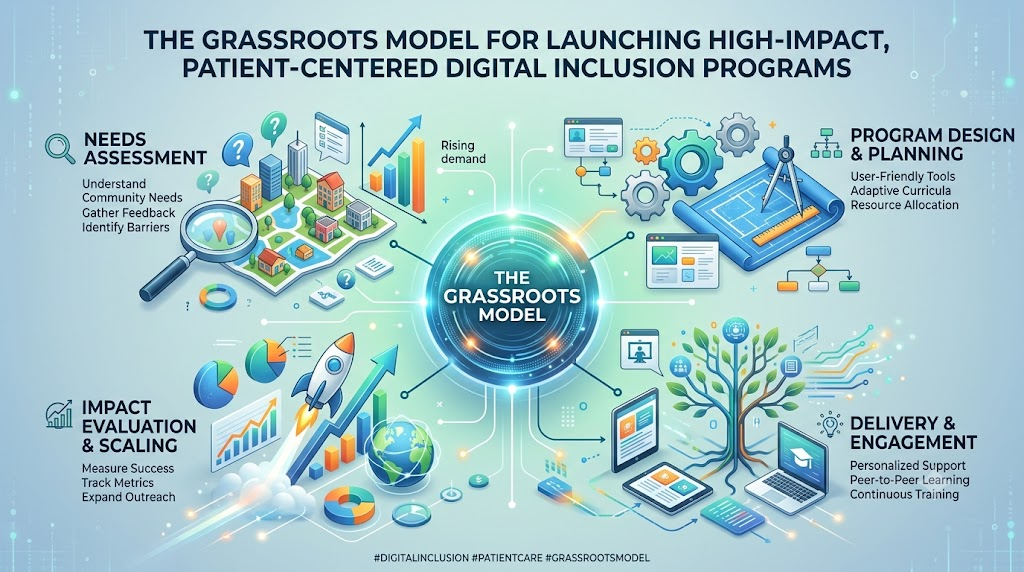
The following model demonstrates how a regional government agency or municipal coalition can plan, fund, and deploy an enduring digital equity initiative across multiple neighborhood hubs:
Step 1: Regional Access and Infrastructure Audit
Analyze municipal broadband coverage, census household device rates, and transit-corridor connectivity to map underserved neighborhoods.

Step 2: Inter-Agency Policy and Resource Alignment
Coordinate library systems, public housing authorities, and parks departments to designate accessible facilities for community digital learning labs.

Step 3: Standardized Hardware and Connectivity Procurement
Procure uniform, refurbished enterprise laptops and establish dedicated, gigabit fiber connections across all participating municipal centers.

Step 4: Standardized Civic Literacy Curriculum
Develop a modular, multilingual curriculum centered on navigating municipal services, employment portals, cybersecurity basics, and digital communications.

Step 5: Coordinated Public-Volunteer Staffing
Staff community labs with dedicated municipal coordinators supported by trained corporate and university volunteers to provide consistent, one-on-one assistance.

Step 6: Policy Auditing and Program Review
Collect anonymous feedback and monitor facility usage to adjust lab hours, expand language offerings, and allocate resources based on demonstrated demand.
Impact Measurement and Key Considerations
Evaluating a public digital inclusion program requires tracking long-term civic participation, economic mobility, and administrative access.
| Policy Level | Civic Objective | Public Metric |
| Activity | Public service provision | Dedicated public lab hours; operational workstations maintained |
| Output | Direct community participation | Number of citizens completing digital literacy courses |
| Outcome | Independent civic agency | Residents successfully filing online benefits, taxes, or employment applications |
| Long-Term Impact | Regional equity and stability | Increased household broadband adoption; measurable growth in local digital workforce participation |
Policy Benefits and Administrative Challenges
Policy Benefits
- Streamlines municipal operations by making online civic portals universally accessible.
- Reduces economic inequality by preparing under-resourced residents for digital employment.
- Maximizes public investment by coordinating resources across libraries, schools, and recreation centers.
- Strengthens democratic participation by making public meetings and records accessible to all households.
Administrative Challenges
- Securing permanent municipal funding beyond initial short-term grant cycles requires continuous legislative advocacy.
- Upgrading public hardware fleets demands long-term replacement reserves and dedicated maintenance budgets.
- Reaching residents who lack trust in government institutions requires careful collaboration with grassroots community groups.
- Evolving cybersecurity risks require ongoing updates to public lab software and patron privacy protocols.
Frequently Asked Questions (FAQs)
Why do modern public policy leaders view digital inclusion programs as essential public infrastructure?
Because government services, educational platforms, healthcare, and employment applications have moved almost entirely online. Without structured public programs, households without internet access or digital skills are effectively locked out of civic, economic, and social life.
How does treating broadband as a public utility improve digital inclusion?
Treating connectivity as a utility ensures that service is regulated, affordable, uncapped, and universally available across all neighborhoods, preventing private internet service providers from neglecting low-income or rural communities.
What core elements make municipal digital literacy programs effective?
Effective programs focus on practical civic and economic skills: navigating government portals, applying for jobs online, managing two-factor authentication, avoiding online fraud, and accessing digital healthcare, all taught in the native languages of the community.
What role does AI for social impact play in regional public administration?
AI can assist overburdened municipal agencies by automating transcriptions of public meetings, providing initial multilingual translations for civic notices, and helping staff direct residents to appropriate social services, provided these systems remain under strict human supervision.
Why is responsible AI research vital for public policy adoption?
Public sector automated systems must remain transparent, fair, and accountable. Responsible research audits algorithmic tools to prevent biased decisions in social welfare distribution, protects constituent data privacy, and ensures clear human appeal processes for all automated choices.
How do technology nonprofits assist local governments with digital equity?
Technology nonprofits bring deep community trust, agile operational models, and focused expertise. They help cities establish public learning centers, manage refurbished hardware distribution, train volunteers, and ensure public programs align directly with neighborhood needs.
How do youth innovation programs support local economic development?
These programs teach young people critical thinking, coding, data analysis, and collaborative problem-solving through real-world civic projects. This prepares local students for modern careers, helping regions build their own skilled technical workforce.
What is the primary operational hurdle in nonprofit digital transformation?
The primary challenge is managing organizational change within underfunded agencies. Sustainable transformation requires providing dedicated, paid staff training and adopting straightforward, secure tools rather than imposing expensive, complicated software without adequate support.
How should municipal leaders structure corporate social impact partnerships?
Civic leaders must ensure corporate partnerships address actual community priorities rather than corporate marketing goals. Productive agreements focus on multi-year operational funding, donations of standardized enterprise-grade hardware, and structured, long-term technical volunteering.
What are the primary responsibilities for participants in technology volunteer opportunities?
Volunteers must approach public spaces with patience, humility, and a commitment to clear communication. They should follow public safeguarding protocols, respect participant privacy, and focus on empowering learners to solve problems independently.
Conclusion
Achieving true digital equity requires treating connectivity, hardware, and digital literacy as fundamental public goods. When digital inclusion programs are built into public policy, technology ceases to be a barrier and becomes a powerful platform for civic participation, economic mobility, and community self-determination. By integrating thoughtful technology education programs, ethical public research, and responsible corporate partnerships, regional leaders can create resilient communities where every resident has the opportunity to thrive. When governments, educators, and community organizations unite around inclusive public policy, digital systems fulfill their highest civic purpose: supporting democratic access and strengthening community life. The ongoing initiatives of Cotocus Foundation reflect this commitment to equitable civic access, responsible technology adoption, and community-centered progress.
