Introduction
We are living through a pivotal moment in the history of computation. For nearly a century, classical computers powered by binary logic gates have transformed every aspect of human civilization—from predicting weather patterns to modeling aerodynamic structures and connecting billions of people instantaneously. However, as silicon transistors approach fundamental physical limits, classical architectures encounter intractable barriers when tackling highly complex mathematical and physical problems. Enter Quantum Computing. By exploiting the exotic principles of quantum mechanics—such as superposition, entanglement, and quantum interference—quantum systems perform specific classes of computations exponentially faster than even the world’s most powerful supercomputers.
What is Quantum Computing?
To understand quantum tools, we must first understand what quantum computing actually is. At its core, quantum computing is a non-classical paradigm that utilizes the principles of quantum mechanics to process information.
In classical computing, the fundamental unit of information is the bit, which exists strictly in one of two binary states: 0 or 1. Think of a classical bit as a light switch that is either completely OFF or completely ON.
In quantum computing, the fundamental unit of information is the qubit (quantum bit). Thanks to the physical laws operating at atomic and subatomic scales, qubits possess unique physical behaviors:
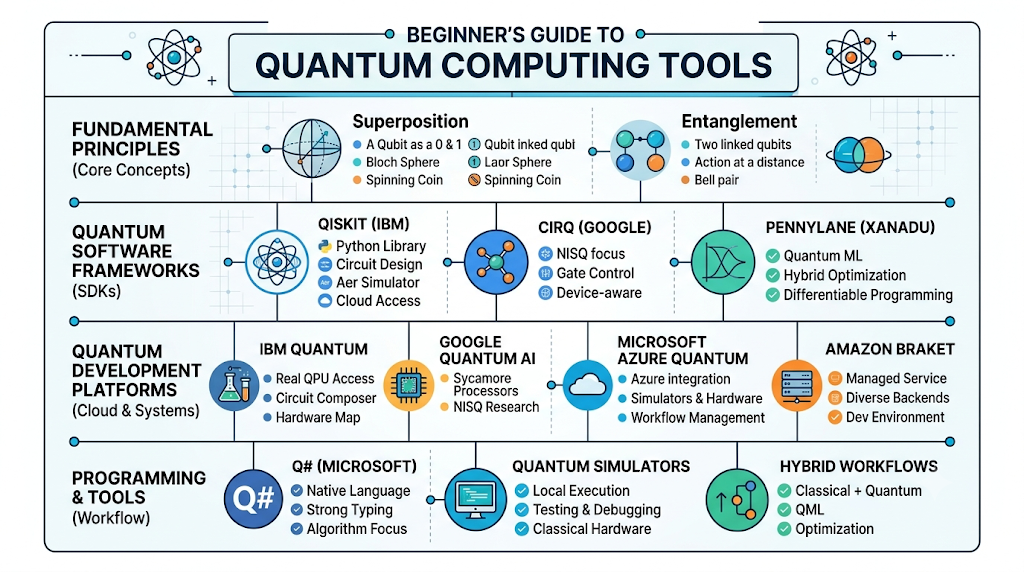
- Superposition: A qubit can exist in a state representing 0, 1, or any complex linear combination of both simultaneously. Imagine a spinning coin: while spinning, it is neither purely heads nor purely tails, but a blend of both states until it lands.
- Entanglement: Two or more qubits can become inextricably linked such that the quantum state of one instantaneously dictates or correlates with the state of another, regardless of the distance separating them.
- Quantum Interference: Quantum algorithms use interference to amplify the probability of reaching correct computational solutions while canceling out incorrect outcomes, much like noise-canceling headphones neutralize unwanted sound waves.
Why Quantum Computing Matters
Classical supercomputers are extraordinary at handling sequential and structured computations. However, when faced with combinatorial optimization, molecular modeling, or multi-variable system simulations, the number of possibilities grows exponentially.
For example, simulating a simple caffeine molecule requires accounting for all electron-electron interactions. A classical computer would require more memory bits than there are atoms in the known universe to calculate these exact quantum interactions. A quantum computer, by contrast, uses native quantum hardware where qubits directly mimic the physical behavior of electrons and molecules.
Key Impact Areas:
- Pharmaceuticals & Materials Science: Accelerating drug discovery by simulating chemical reactions at the molecular level without costly lab experimentation.
- Financial Modeling: Optimizing global investment portfolios, assessing risk, and detecting fraud in real-time across billions of variables.
- Logistics & Supply Chain: Solving complex routing and distribution challenges (e.g., the Traveling Salesperson Problem) instantly.
- Artificial Intelligence & Machine Learning: Enhancing pattern recognition, model training speeds, and high-dimensional vector space mapping via Quantum Machine Learning (QML).
- Cryptography: Developing post-quantum cryptographic standards to safeguard global data infrastructure against future quantum decryption threats.
How Quantum Computing Differs from Classical Computing
To appreciate why specialized quantum software tools are necessary, let us compare classical and quantum paradigms side by side:
| Feature | Classical Computing | Quantum Computing |
| Basic Unit | Bit ($0$ or $1$) | Qubit ($\vert{}0\rangle$, $\vert{}1\rangle$, or superposition) |
| Underlying Physics | Classical Electromagnetism / Newtonian Physics | Quantum Mechanics (Superposition, Entanglement) |
| Information Capacity | Scales linearly ($N$ bits = $N$ states) | Scales exponentially ($N$ qubits = $2^N$ simultaneous states) |
| Error Rates | Ultra-low (Fault-tolerant hardware) | High (Noisy Intermediate-Scale Quantum / NISQ era) |
| Operating Environment | Room temperature | Near absolute zero (approx. 15 millikelvin) or specialized optics |
| Primary Use Cases | General-purpose tasks, web browsing, databases | Molecular simulation, complex optimization, cryptography, QML |
| Development Style | Boolean logic gates (AND, OR, NOT) | Quantum circuit gates (Hadamard, CNOT, Pauli-X/Y/Z) |
What Are Quantum Computing Tools?
When developers write quantum code, they do not manually calibrate lasers or adjust microwave pulses inside dilution refrigerators. Instead, they rely on a layered stack of quantum computing tools.
Quantum computing tools encompass software development kits (SDKs), domain-specific programming languages, cloud execution platforms, compilers, and simulators. These tools bridge the gap between high-level algorithmic logic written in languages like Python and low-level pulse signals sent to physical hardware.
+-------------------------------------------------------------+
|              High-Level Application Layer                  |
|    (Quantum AI, Optimization, Chemistry, Cryptography)      |
+-------------------------------------------------------------+
                              |
                              v
+-------------------------------------------------------------+
|            Quantum SDKs & Languages (Python/Q#)            |
|       (Qiskit, Cirq, PennyLane, Q#, Strawberry Fields)      |
+-------------------------------------------------------------+
                              |
                              v
+-------------------------------------------------------------+
|            Quantum Circuit Compiler & Transpiler            |
|      (Optimizes gates for specific hardware topology)       |
+-------------------------------------------------------------+
                              |
               +--------------+--------------+
               |                             |
               v                             v
+------------------------------+ +----------------------------+
|   Quantum Simulator (CPU/GPU)| | Real Quantum Hardware (QPU) |
|  (Local testing / No noise)  | |  (IBM, Rigetti, IonQ, etc) |
+------------------------------+ +----------------------------+
Key Features of Quantum Computing Platforms
When evaluating a quantum development toolkit or cloud environment, beginners should assess several essential architectural features:
- Circuit Abstraction: The framework should allow users to build quantum circuits intuitively by placing quantum gates onto individual qubit wires.
- Transpilation & Optimization: High-performing tools automatically re-map theoretical circuits to match the physical connectivity (coupling map) of specific Quantum Processing Units (QPUs).
- Simulator Support: Local or cloud-hosted classical simulators allow developers to debug algorithms without spending cloud execution credits or waiting in hardware queues.
- Hybrid Quantum-Classical Execution: Modern applications (like VQE and QAOA) require tight feedback loops between classical CPUs/GPUs and QPUs.
- Noise Modeling: Accurate frameworks can simulate realistic environmental noise, decoherence, and readout errors to prepare algorithms for real-world execution.
Top Quantum Computing Tools Every Beginner Should Know
The table below summarizes the top tools, frameworks, and cloud services in the quantum ecosystem today:
| Tool / Platform | Primary Developer | Best Use Case | Supported Languages | Difficulty Level |
| Qiskit | IBM | General Quantum Computing & IBM Hardware | Python | Beginner to Advanced |
| Cirq | Google Quantum AI | NISQ-era Circuit Design & Google Hardware | Python | Intermediate |
| Azure Quantum | Microsoft | Cloud Multi-Hardware Access & Q# Development | Q#, Python | Intermediate |
| Amazon Braket | Amazon Web Services | Multi-Vendor Cloud Execution & Simulation | Python | Beginner to Intermediate |
| PennyLane | Xanadu | Quantum Machine Learning & Differentiable Programming | Python | Beginner to Intermediate |
| Q# | Microsoft | Enterprise Quantum Software Architecture | Q#, Python, C# | Intermediate to Advanced |
| TensorFlow Quantum | Google / Waterloo | Hybrid Quantum-Classical AI Models | Python | Advanced |
| Strawberry Fields | Xanadu | Continuous-Variable Photonic Quantum Computing | Python | Intermediate |
In-Depth Tool Breakdown
IBM Quantum Platform
The IBM Quantum Platform is the world’s most accessible cloud-based quantum ecosystem. It provides users with direct public access to utility-scale superconducting quantum computers. Through its web interface (IBM Quantum Composer and Lab), beginners can drag and drop quantum gates visually or program directly in Jupyter Notebooks.
Google Quantum AI
Google Quantum AI focuses on advancing Noisy Intermediate-Scale Quantum (NISQ) computing and achieving quantum advantage. It provides researchers with access to processors like Sycamore. Google emphasizes precise gate-level manipulation and noise characterization.
Microsoft Azure Quantum
Microsoft Azure Quantum is a cloud service that aggregate hardware access from leading quantum vendors—including IonQ, Quantinuum, and Rigetti—under a single cloud ecosystem. It allows developers to test algorithms across multiple hardware architectures without writing separate codebases for each.
Amazon Braket
Amazon Braket is AWS’s fully managed quantum computing service. It enables developers to design circuits in a unified environment and run them on diverse hardware technologies, including trapped-ion, superconducting, and neutral-atom processors.
Qiskit
Developed by IBM, Qiskit is the most widely adopted open-source quantum SDK in the world. It is divided into core modules covering circuit synthesis, provider integration, and application modules (such as Qiskit Nature for chemistry and Qiskit Machine Learning).
Cirq
Cirq is Google’s open-source Python framework designed specifically for writing, manipulating, and optimizing quantum circuits for NISQ computers. Unlike Qiskit, which abstracts hardware details away, Cirq gives developers explicit control over gate timings and qubit layouts.
PennyLane
Created by Xanadu, PennyLane is the premier open-source library for Quantum Machine Learning, quantum chemistry, and quantum optimization. Its killer feature is automatic differentiation: it treats quantum circuits like neural network layers in PyTorch or TensorFlow.
Q#
Q# (Q-sharp) is Microsoft’s domain-specific programming language created specifically for quantum algorithm development. It cleanly separates quantum algorithms from classical orchestration logic, featuring rich typing, native control structures, and high scalability.
TensorFlow Quantum
TensorFlow Quantum (TFQ) is a library for hybrid quantum-classical machine learning. Co-developed by Google and the University of Waterloo, TFQ allows AI researchers to blend quantum data with classical neural network architectures using familiar Keras APIs.
Strawberry Fields
Strawberry Fields is a specialized Python library developed by Xanadu for photonic (light-based) quantum computing. Unlike qubit-based systems that use discrete states (0 and 1), Strawberry Fields targets continuous-variable (CV) quantum architectures using optical modes.
How to Choose the Right Quantum Computing Tool
Choosing your first quantum development stack depends heavily on your existing background and primary objectives:
- If you are a complete beginner: Start with Qiskit. It boasts the largest community, extensive documentation, free access to real IBM QPUs, and simple Python syntax.
- If you are an AI / Machine Learning practitioner: Choose PennyLane. Its seamless integration with PyTorch and TensorFlow makes building hybrid quantum neural networks intuitive.
- If you are interested in hardware physics & NISQ research: Pick Cirq. It offers direct control over physical qubit geometries and noise channels.
- If you want multi-hardware enterprise flexibility: Opt for Amazon Braket or Microsoft Azure Quantum. Both let you switch between trapped-ion, neutral-atom, and superconducting devices effortlessly.
Programming Languages Used in Quantum Computing
You do not need to invent a brand-new programming language to write quantum software. Most tools leverage existing languages:
- Python: The undisputed standard in quantum software engineering. Almost all major SDKs (Qiskit, Cirq, PennyLane, Strawberry Fields) operate as Python libraries.
- Q#: A dedicated quantum language designed by Microsoft for strong type safety and large-scale quantum algorithm architecture.
- C / C++: Used under the hood in high-performance quantum simulators (like Qiskit Aer) to accelerate linear algebra computations.
- Julia: Gaining traction among scientific researchers for high-performance quantum state vector modeling.
Building Your First Quantum Program
Let us look at a practical code example. We will use Qiskit in Python to construct a fundamental quantum state: the Bell State (a two-qubit maximally entangled state).
Step 1: Install Qiskit
Bash
pip install qiskit qiskit-aer
Step 2: Create and Execute the Bell State Circuit
Python
from qiskit import QuantumCircuit
from qiskit_aer import AerSimulator

# Step 1: Create a quantum circuit with 2 qubits and 2 classical bits
qc = QuantumCircuit(2, 2)

# Step 2: Put Qubit 0 into Superposition using a Hadamard Gate
qc.h(0)

# Step 3: Entangle Qubit 0 and Qubit 1 using a Controlled-NOT (CNOT) Gate
qc.cx(0, 1)

# Step 4: Measure both qubits and store results in classical bits
qc.measure([0, 1], [0, 1])

# Step 5: Simulate the circuit using a classical local simulator
simulator = AerSimulator()
job = simulator.run(qc, shots=1000)
result = job.result()

# Step 6: Display the measurement counts
counts = result.get_counts()
print("Quantum Measurement Results:", counts)
Expected Output:
Plaintext
Quantum Measurement Results: {'00': 502, '11': 498}
Explanation: Because Qubit 0 and Qubit 1 were entangled, they both collapsed into $\vert{}00\rangle$ approximately 50% of the time and $\vert{}11\rangle$ approximately 50% of the time. The states $\vert{}01\rangle$ and $\vert{}10\rangle$ never occur—proving true quantum entanglement!
Quantum Simulators vs Real Quantum Hardware
When executing quantum programs, developers choose between classical simulators and physical QPUs:
Quantum Simulators
- How They Work: Classical CPUs and GPUs execute matrix multiplication to mimic exact quantum state evolution.
- Pros: Free, zero queue times, deterministic results, perfect for debugging.
- Cons: Memory scales exponentially ($2^N$). Classical systems hit a wall around 40–50 qubits.
Real Quantum Hardware (QPUs)
- How They Work: Physical quantum systems (superconducting circuits, trapped ions, neutral atoms) execute pulses.
- Pros: Capable of true quantum speedup beyond classical limit.
- Cons: Subject to noise, thermal fluctuations, state decay (decoherence), and cloud waiting queues.
Real-World Applications of Quantum Computing
Quantum tools are actively used across key industries:
- Battery Technology: Simulating lithium and solid-state battery chemistry to increase energy density for electric vehicles.
- Financial Optimization: Running Quantum Approximate Optimization Algorithms (QAOA) to optimize global supply networks and trade settling.
- Drug Discovery: Finding lead candidate molecules by simulating binding affinity on target proteins.
- Machine Learning: Accelerating high-dimensional classification using Quantum Support Vector Machines (QSVM).
Common Challenges Beginners Face
Learning quantum computing comes with a distinct learning curve. Common hurdles include:
- Counterintuitive Physics: Concepts like superposition and entanglement defy macroscopic everyday experience.
- Mathematical Prerequisite Gaps: Quantum mechanics is expressed through linear algebra, complex numbers, Dirac notation ($\vert{}\psi\rangle$), and tensor products.
- Hardware Noise & Errors: Running code on NISQ devices yields noisy probabilistic results rather than clean mathematical outputs.
- Rapidly Changing Ecosystem: Frameworks update frequently, leading to deprecated functions and changing syntax.
Best Practices for Learning Quantum Computing
- Master the Basics of Linear Algebra: Focus on vectors, matrices, eigenvalues, eigenvectors, and inner/outer products.
- Start with Simulators First: Always build, test, and debug your quantum circuits on local classical simulators before sending jobs to real hardware queues.
- Learn Quantum Gate Operations: Master basic single-qubit gates (X, Y, Z, H, S, T) and multi-qubit gates (CNOT, SWAP, CZ).
- Join Open-Source Communities: Participate in Qiskit Slack, Cirq GitHub discussions, and regional Quantum Hackathons.
- Code Every Day: Theory makes sense on paper, but writing code brings quantum concepts to life.
Step-by-Step Learning Roadmap
Follow this 5-stage roadmap to become a proficient quantum developer:
[ Stage 1: Mathematical Foundations ]
   └─ Linear Algebra, Complex Numbers, Probability Theory

[ Stage 2: Classical Programming Proficiency ]
   └─ Python, NumPy, Jupyter Notebooks

[ Stage 3: Fundamental Quantum Mechanics & Circuits ]
   └─ Qubits, Dirac Notation, Quantum Gates, Measurement

[ Stage 4: Hands-On SDK Mastery ]
   └─ Qiskit / PennyLane, Building Algorithms (Grover's, Shor's, VQE)

[ Stage 5: Cloud Deployment & Specialization ]
   └─ IBM Quantum, Amazon Braket, QML, Post-Quantum Security
Career Opportunities in Quantum Computing
As global investments in quantum technology surge, demand for quantum-literate talent is skyrocketing across several roles:
- Quantum Software Engineer: Designs, tests, and optimizes quantum algorithms and SDK integrations.
- Quantum Information Scientist: Researches core quantum error correction, gate fidelity, and hardware-software co-design.
- Quantum Algorithm Researcher: Develops specialized algorithms for chemistry, finance, or machine learning optimization.
- Quantum Applications Developer: Translates industry domain problems (e.g., in logistics or finance) into quantum circuits.
- Quantum Cloud Solutions Architect: Helps enterprises deploy hybrid classical-quantum cloud infrastructure on AWS or Azure.
Future Trends in Quantum Technologies
Looking ahead, several major technological shifts will shape the future of quantum development tools:
- Fault-Tolerant Quantum Computing (FTQC): Moving beyond the noisy NISQ era toward logical qubits protected by quantum error correction (QEC).
- Quantum-AI Convergence: Native integration of quantum algorithms into deep learning pipelines to process complex multidimensional datasets.
- Photonic and Neutral-Atom Hardware Scale: Rapid progress in room-temperature photonic processors and scalable neutral-atom architectures.
- Standardized Quantum Compilation: Unified compiler backends that compile quantum code seamlessly across completely different physical QPU architectures.
Frequently Asked Questions
Q1: Do I need a Ph.D. in Physics to become a quantum developer?
No. While a Ph.D. is valuable for hardware engineering and fundamental physics research, software developers can write quantum programs using high-level SDKs like Qiskit or PennyLane with a strong grasp of Python and linear algebra.
Q2: Which quantum computing tool is best for absolute beginners?
IBM’s Qiskit is widely regarded as the best starting tool due to its massive community support, comprehensive open-source documentation, interactive tutorials, and free access to real cloud quantum hardware.
Q3: Can classical computers simulate quantum computers perfectly?
Classical computers can simulate quantum circuits perfectly for small numbers of qubits (under ~30-40 qubits). However, because memory requirements double with every added qubit, simulating large-scale quantum circuits becomes computationally impossible for classical hardware.
Q4: What programming language is most used in quantum computing?
Python is the dominant programming language across the quantum industry. Almost every major software development kit—including Qiskit, Cirq, PennyLane, and Strawberry Fields—is built as a Python library.
Q5: What is the difference between Qiskit and Cirq?
Qiskit (developed by IBM) provides a higher-level abstraction designed for general-purpose quantum computing and application development, whereas Cirq (developed by Google) offers lower-level control over circuit timings and hardware topology on NISQ devices.
Q6: Can I run quantum computing code on my regular personal laptop?
Yes. You can install tools like Qiskit or PennyLane on any standard laptop and run quantum programs locally using classical simulators. When you are ready for real hardware, your laptop acts as the client sending jobs to cloud quantum servers.
Q7: What is Quantum Machine Learning (QML)?
Quantum Machine Learning is an emerging discipline that combines quantum computing algorithms with machine learning models. Frameworks like PennyLane and TensorFlow Quantum allow developers to build hybrid neural networks that leverage quantum speedups.
Q8: How much does it cost to use quantum cloud platforms like Amazon Braket or IBM Quantum?
IBM offers a robust free access tier for public quantum systems. Amazon Braket and Azure Quantum use pay-as-you-go pricing models based on the number of execution tasks and shots requested on physical QPUs.
Q9: Will quantum computing replace classical computing?
No. Quantum computers are not meant to replace classical computers for everyday tasks like word processing or web browsing. Instead, they will operate alongside classical supercomputers as specialized accelerators for complex domain problems.
Q10: How long does it take to learn quantum programming?
With a background in Python programming and basic linear algebra, a dedicated beginner can learn to build basic quantum circuits within a few weeks and advance to hybrid algorithms in 3 to 6 months.
Conclusion
Quantum computing represents a fundamental shift in how humanity processes information. The transition from theoretical physics to practical software engineering is already well underway. Thanks to powerful open-source toolkits like Qiskit, Cirq, and PennyLane, along with cloud access provided by IBM Quantum, Amazon Braket, and Azure Quantum, the barrier to entry has never been lower.
