Are you dreaming of a brighter future, a flourishing career, and a high quality of life in Canada? You are not alone. Millions of skilled professionals, students, and families worldwide aspire to call Canada home. The country offers incredible career growth, world-class healthcare, safe neighborhoods, and a welcoming environment for immigrants. However, before you pack your bags and book your flights, you must understand how Canada selects its immigrants. Canada does not pick applications randomly. Instead, it relies on a highly structured, merit-based selection model. This is where the Canada PR Points Calculator becomes your most crucial tool. Navigating the immigration landscape can feel overwhelming for first-time applicants. You might be wondering how your age, degree, or work experience impacts your chances. This comprehensive guide will break down the entire Express Entry system and the Comprehensive Ranking System (CRS). By the end of this article, you will know exactly how to calculate, evaluate, and maximize your score to achieve your Canadian immigration goals.
What Is Canada PR Points Calculator?
The Canada PR Points Calculator is an online evaluation tool that measures your eligibility for Canadian permanent residency. It uses a dynamic point allocation framework to assess your profile based on specific personal and professional credentials.
Canada uses a points-based immigration system to maintain a fair, transparent, and efficient selection process. Instead of processing applications on a first-come, first-served basis, Canada prioritizes candidates who possess skills that match the economic needs of the country. This system helps the Canadian government identify newcomers who can easily integrate into the local workforce and contribute to the national economy.
To understand your journey, you must differentiate between two distinct point systems used in the process:
- The Eligibility Score (The 67-Point Grid): This is the entry gate for the Federal Skilled Worker Program (FSWP). You must score at least 67 out of 100 points based on six selection factors just to enter the Express Entry pool.
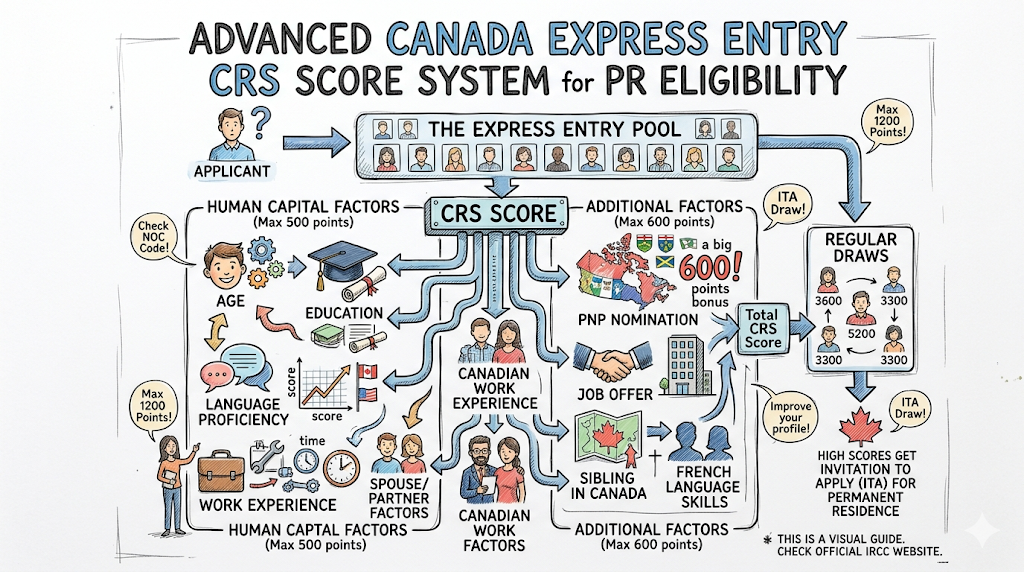
- The CRS Invitation Score (The 1200-Point Scale): Once you pass the eligibility gate and enter the pool, you are ranked against other candidates using the Comprehensive Ranking System (CRS). This system is scored out of 1,200 points. The highest-ranking candidates receive an Invitation to Apply (ITA) during regular Express Entry draws.
For example, if a candidate has higher IELTS scores and Canadian work experience, their CRS score may increase significantly, moving them closer to receiving an ITA. Conversely, a candidate with lower language scores might qualify to enter the pool but will need to improve their profile to receive an invitation.
How Canada PR Points System Works
The Comprehensive Ranking System calculates your points based on a specific set of core factors. Let us look closely at how points are distributed across these key components.
Age Points
Age plays an important role in the Canadian immigration point system. Canada awards the highest points to individuals in their prime working years, specifically between ages 20 and 29. After age 30, the points awarded for age begin to decrease gradually each year.
| Age | Points (With Spouse) | Points (Without Spouse) |
| 18 years of age | 90 | 95 |
| 19 years of age | 95 | 105 |
| 20 to 29 years of age | 100 | 110 |
| 30 years of age | 95 | 105 |
| 35 years of age | 70 | 75 |
| 40 years of age | 45 | 50 |
| 45 years of age or more | 0 | 0 |
Education Points
Your level of education is highly valued by Immigration, Refugees and Citizenship Canada (IRCC). To claim points for education completed outside of Canada, you must obtain an Educational Credential Assessment (ECA) from an approved organization like WES.
- Doctoral level university degree (Ph.D.): 140 points (with spouse); 150 points (without spouse)
- Master’s degree or professional degree needed to practice in a licensed profession: 126 points (with spouse); 135 points (without spouse)
- Two or more post-secondary credentials (one must be at least a 3-year program): 119 points (with spouse); 128 points (without spouse)
- Bachelor’s degree or a three-year program at a college or university: 112 points (with spouse); 120 points (without spouse)
- Two-year program at a college or university: 91 points (with spouse); 98 points (without spouse)
- One-year program at a college or university: 84 points (with spouse); 90 points (without spouse)
Language Proficiency (IELTS / CELPIP / PTE)
Language skills are heavily weighted because communication is vital to your economic success in Canada. You can take approved tests for English (IELTS, CELPIP, or PTE Core) or French (TEF or TCF).
Points are assigned based on Canadian Language Benchmark (CLB) levels. Reaching CLB 9 in all four language abilities (Listening, Reading, Writing, Speaking) unlocks massive bonus points within the skill transferability matrix.
- CLB 10 or higher: 32 points per ability (with spouse); 34 points per ability (without spouse)
- CLB 9: 29 points per ability (with spouse); 31 points per ability (without spouse)
- CLB 8: 22 points per ability (with spouse); 23 points per ability (without spouse)
- CLB 7: 16 points per ability (with spouse); 17 points per ability (without spouse)
Work Experience
You can claim points for both foreign work experience and Canadian work experience. The work experience must fall under an eligible National Occupational Classification (NOC) TEER category (TEER 0, 1, 2, or 3).
- Foreign Work Experience: Non-Canadian work experience does not grant direct points on its own under the core factors. Instead, it combines with your language scores or Canadian work experience in the Skill Transferability section to yield up to 50 points.
- Canadian Work Experience: Working inside Canada provides direct core points. One year of Canadian experience gives 35 points (with spouse) or 40 points (without spouse). Five years of Canadian experience provides up to 70 points (with spouse) or 80 points (without spouse).
Spouse Points
If you apply with a spouse or common-law partner, your core point distribution shifts slightly. Your spouse can contribute up to 40 points to your total CRS score through their own qualifications.
- Spouse Education: Up to 10 points for a Master’s or Ph.D. degree.
- Spouse Language Proficiency: Up to 20 points for scoring CLB 9 or higher in official language tests.
- Spouse Canadian Work Experience: Up to 10 points for 5 years of skilled work experience in Canada.
Additional Points
The Express Entry system offers lucrative additional points that can instantly boost your profile standing in the pool.
- Provincial Nomination (PNP): 600 points (The ultimate boost)
- Qualifying Arranged Employment (Job Offer): 200 points for TEER 0 major group jobs; 50 points for all other eligible TEER 0, 1, 2, or 3 jobs
- French Language Skills: 50 points for strong French skills (even as a second language)
- Post-Secondary Education in Canada: 15 points for a 1 or 2-year program; 30 points for a degree or credential of 3 years or longer
- Sibling in Canada: 15 points if you or your spouse have a sibling living in Canada as a citizen or PR
Canada Express Entry System Explained
The Express Entry system is an online management system used by the Canadian government to process permanent residency applications for skilled workers. It manages three federal economic immigration programs, while also interacting with provincial systems.
1. Federal Skilled Worker Program (FSWP)
This program is designed for skilled professionals who have overseas work experience. It requires applicants to meet specific criteria regarding work experience, language proficiency, and education, while scoring at least 67 points on the FSWP selection grid.
2. Canadian Experience Class (CEC)
The CEC program is tailored for individuals who already have at least one year of skilled Canadian work experience. This program is highly popular among international students who graduated from Canadian institutions and transitioned onto a Post-Graduation Work Permit (PGWP).
3. Federal Skilled Trades Program (FSTP)
This pathway targets qualified tradespersons in specific industrial, construction, electrical, and maintenance sectors. Applicants must hold a valid Canadian job offer or a certificate of qualification from a Canadian provincial authority.
4. Provincial Nominee Program (PNP)
Most Canadian provinces and territories have their own immigration streams aligned with the federal Express Entry system. When a province selects you from the Express Entry pool through an enhanced PNP stream, you receive a nomination certificate. This certificate adds 600 points to your profile, guaranteeing an Invitation to Apply in the subsequent draw.
CRS Score Breakdown
The Comprehensive Ranking System score is divided into four main sections. The maximum possible score you can achieve is 1,200 points.
| CRS Component Section | Maximum Points with Spouse | Maximum Points without Spouse |
| Section A: Core / Human Capital Factors | 460 Points | 500 Points |
| Section B: Spouse or Common-Law Partner Factors | 40 Points | 0 Points |
| Section C: Skill Transferability Factors | 100 Points | 100 Points |
| Section D: Additional Points | 600 Points | 600 Points |
| Total Maximum CRS Points | 1200 Points | 1200 Points |
Core Human Capital Factors (Section A)
This section looks directly at your individual profile assets. It evaluates your age, level of education, language abilities, and Canadian work experience. If you apply without a spouse, you can get up to 500 points here. If you apply with a spouse, you can get up to 460 points.
Skill Transferability Factors (Section C)
This section combines different profile factors to determine how easily you can transition into the Canadian economy. Points are awarded based on two main combinations:
- Education + Language Skills / Canadian Work Experience: Up to 50 points.
- Foreign Work Experience + Language Skills / Canadian Work Experience: Up to 50 points.
Step-by-Step Example Calculation
To make the points calculation easier to visualize, let us walk through a practical scenario featuring a realistic candidate profile.
Candidate Profile:
- Age: 29 Years Old
- Education: Master’s Degree (Evaluated by WES)
- Work Experience: 3 Years of continuous foreign skilled work experience as a Software Engineer
- Language Scores: IELTS Results displaying Listening 8.5, Reading 8.0, Writing 7.5, Speaking 7.5 (Equivalent to CLB 9 across all modules)
- Marital Status: Single (Applying without a spouse)
Let us calculate this candidate’s estimated score step-by-step using the Canada PR Points Calculator logic:
In this scenario, our candidate achieves a competitive baseline score of 469 points. Depending on current draw trends and category-based selection targets, this candidate stands in a solid position but should look for opportunities to optimize their profile further.
How to Improve CRS Score
If your calculated score sits below the recent draw cut-offs, there is no need to panic. The Express Entry pool is dynamic, and you can actively take strategic steps to raise your ranking while your profile remains active.
1. Maximize Language Test Results
Improving your language score is the fastest and most reliable way to boost your CRS score. Moving from CLB 8 to CLB 9 across all modules does not just give you small incremental points; it triggers massive bonus points in the Skill Transferability section. For instance, hitting CLB 9 can instantly add up to 50 points to your profile.
2. Learn French as a Second Language
Canada places an immense premium on bilingual candidates. If you already speak basic French or are willing to learn, sitting for the TEF or TCF exam can reward you up to 50 additional points. Furthermore, IRCC frequently runs category-based Express Entry draws targeting French speakers at lower general CRS scores.
3. Pursue a Provincial Nomination (PNP)
Securing a provincial nomination is the single most powerful profile enhancement option available. A nomination automatically adds 600 points to your Express Entry profile, which guarantees an invitation in the next draw. You can achieve this by monitoring and applying to Express Entry-linked provincial streams that match your occupation.
4. Gain Additional Skilled Work Experience
If you are under 30, remaining in your current job to complete another year of skilled work experience can improve your score. It increases points within the skill transferability matrices when paired with high language scores.
5. Elevate Educational Qualifications
Completing a new educational milestone can elevate your standing. For example, if you hold a Bachelor’s degree, adding a one-year post-graduate certificate can qualify you for the “Two or more post-secondary credentials” category, which provides a notable point increase.
Provincial Nominee Programs (PNPs)
Provincial Nominee Programs allow individual Canadian provinces to nominate immigration applicants who possess skills and experience needed in their local economies. If you do not have a high enough CRS score for a general federal draw, targeting specific PNPs can open an alternative path.
Let us take a closer look at four major provincial programs that actively utilize Express Entry alignments:
- Ontario Immigrant Nominee Program (OINP): Ontario regularly scans the Express Entry pool for tech workers, healthcare professionals, and human capital candidates, issuing Notifications of Interest (NOIs) to qualified individuals.
- Alberta Advantage Immigration Program (AAIP): Alberta frequently invites candidates from the Express Entry pool with scores starting well below standard federal draw cut-offs, especially if they have ties to the province or work in high-demand sectors.
- Saskatchewan Immigrant Nominee Program (SINP): Operating via an International Skilled Worker stream, Saskatchewan targets specific in-demand occupations and utilizes its own point grid to invite candidates to apply for provincial nomination.
- British Columbia Provincial Nominee Program (BCPNP): British Columbia manages targeted draws for tech professionals, early childhood educators, and healthcare workers through weekly invite rounds linked directly to regional labor market requirements.
Documents Required
To calculate your points accurately and eventually submit a complete application, you must gather verifiable documentation. You should begin collecting these documents early to avoid unexpected delays.
- Valid Passport: Your primary identity and travel document. Ensure it has at least six months of validity remaining.
- Educational Credential Assessment (ECA): A report that verifies your foreign degree, diploma, or certificate is equal to a completed Canadian credential.
- Official Language Test Results: Valid score sheets from IELTS, CELPIP, PTE Core, TEF, or TCF tests. Remember that language test results are valid for only two years from the test date.
- Proof of Work Experience: Formal reference letters from previous and current employers detailing your specific job titles, duties, salary, and employment duration.
- Proof of Funds: Official bank certificates and statements demonstrating you possess the mandatory settlement funds required to support yourself and your family in Canada.
- Police Clearance Certificates: Records showing you do not have a criminal history. You need a certificate from every country where you have lived for six consecutive months or more since turning 18.
- Medical Examination: A medical assessment cleared by an IRCC-approved panel physician to prove you are not medically inadmissible to Canada.
Processing Time & PR Process
Understanding the steps and timelines of the Express Entry process will help you plan your relocation efficiently.
The Step-by-Step Pathway:
- Create Your Profile: Enter your personal, language, education, and career details into the online Express Entry portal to receive your starting CRS score.
- Enter the Pool: Your profile remains active in the pool for up to 12 months while you wait for a draw that matches your score or profile type.
- Receive an ITA: When IRCC executes an Express Entry draw matching or falling below your score, you receive an official Invitation to Apply.
- Submit Your e-APR: You have exactly 60 calendar days from the date you receive your ITA to upload all supporting documents, pay your fees, and submit your Electronic Application for Permanent Residence (e-APR).
- Biometrics & Medical Validation: Shortly after submission, you will receive instructions to provide your biometrics fingerprints and photos at a local collection center.
- Receive Your COPR: Once your application is fully processed, you will receive your Confirmation of Permanent Residence (COPR) visa, allowing you to move to Canada.
Estimated Processing Timelines
While individual timelines can vary depending on background checks and application complexity, IRCC aims to process the majority of Express Entry applications within 6 months from the day they receive your complete e-APR submission.
Common Mistakes to Avoid
A single calculation error or filing oversight can cause your profile to be rejected or disqualified. Below are the most common pitfalls applicants encounter:
- Inaccurate Points Self-Calculation: Claiming points for work experience or educational levels before you hold official ECA reports or language test results can lead to a miscalculated score. If you enter the pool with an inflated score and receive an ITA, your application will likely be rejected for misrepresentation.
- Relying on Expired Language Test Results: Language tests are only valid for two years. If your test expires while your profile is active in the pool, your score will drop automatically, or your application will become invalid.
- Selecting the Wrong NOC Code: Choosing an incorrect National Occupational Classification code that does not match your actual daily job duties can cause your application to be rejected during official review.
- Uploading Incomplete Documentation: Submitting employment reference letters that lack details like duties, hours worked per week, or company letterheads will cause processing delays or outright rejection.
- Misunderstanding the PNP Interlink System: Assuming that entering the federal Express Entry pool automatically submits an application to every provincial stream can cause you to miss valuable nomination opportunities.
Real-Life Case Studies
Let us explore three distinct real-life case studies to see how different candidates used profile improvement strategies to successfully navigate the points system.
Case Study 1: The Young IT Professional
- Candidate Profile: Deep, a 26-year-old software developer with a Bachelor’s degree and 2 years of foreign work experience.
- Initial Score: Deep entered the pool with an IELTS score equivalent to CLB 8. His initial calculated CRS score was 415 points, which was too low to receive an ITA during regular draws.
- Improvement Strategy: Deep dedicated two months to focused language preparation and retook the IELTS exam, successfully raising his scores to CLB 9 across all categories. He also completed a short one-year post-graduate distance education certificate to qualify for the “two or more credentials” point bonus.
- Final Result: These two key changes increased his CRS score by 65 points, raising his final score to 480 points. He received an ITA in the next targeted STEM category draw.
Case Study 2: The Married Couple Optimizing Points
- Candidate Profile: Maria (Primary Applicant) and her husband Carlos, both 31 years old, holding Bachelor’s degrees and working in marketing management.
- Initial Score: Maria applied as the principal applicant. Because Carlos had not taken a language test or completed an ECA, their starting score sat at 395 points.
- Improvement Strategy: To optimize their score, Carlos completed an ECA for his degree and sat for the IELTS exam, achieving a solid CLB 8. Meanwhile, Maria enrolled in an intensive French course, eventually passing the TEF exam with a score equivalent to CLB 7.
- Final Result: Carlos’s credentials added 18 points under spouse factors, and Maria’s French skills unlocked 50 additional bilingual points. Their total score rose to 463 points, which allowed them to successfully qualify for a French-targeted invitation draw.
Case Study 3: The Healthcare Worker Utilizing PNP
- Candidate Profile: Sunita, a 34-year-old experienced registered nurse with a 3-year diploma in nursing and 6 years of hospital experience.
- Initial Score: Due to her age and diploma credential, Sunita’s baseline federal CRS score was 380 points, putting her far below regular federal draw cut-offs.
- Improvement Strategy: Knowing her baseline score was low, Sunita targeted specific Provincial Nominee Programs that prioritize healthcare workers. She submitted an Expression of Interest directly to the Ontario Immigrant Nominee Program (OINP) Human Capital Priorities stream.
- Final Result: Recognizing her in-demand nursing background, Ontario issued her a provincial nomination. This added 600 points to her profile, instantly raising her score to 980 points and securing her an ITA in the following Express Entry round.
Frequently Asked Questions
What is a good CRS score?
A good CRS score depends on the types of draws IRCC is conducting. Generally, scores ranging between 470 and 510 are competitive for standard all-program draws. However, if your occupation qualifies for targeted category-based draws (such as STEM, healthcare, or trades), you can frequently receive an ITA with a much lower score.
How many points are needed for Canada PR?
To enter the Express Entry pool through the Federal Skilled Worker Program, you must first score at least 67 out of 100 points on the initial eligibility grid. Once you are in the pool, there is no fixed passing score. Instead, you compete against other candidates based on the CRS cut-off scores of individual draw cycles.
Can I apply without job offer?
Yes, you do not need a valid job offer to enter the Express Entry pool or receive an Invitation to Apply. The majority of candidates who successfully obtain permanent residency through Express Entry do so based entirely on their age, education, language skills, and work experience.
Does age affect CRS score?
Yes, age significantly impacts your point total. You receive maximum points for age between 20 and 29. Once you reach your 30th birthday, the points you receive for age begin to drop each year. After age 45, you receive 0 points for age under the Comprehensive Ranking System.
Is IELTS mandatory?
Yes, proving your proficiency in either English or French is a mandatory requirement to enter the Express Entry pool. You must take an officially approved language test and enter your score details directly into your immigration profile. You cannot submit an application using alternative language indicators or university certificates.
Can spouse increase CRS score?
Yes, a spouse can add up to 40 valuable points to your total score if they complete an Educational Credential Assessment for their degrees and achieve high scores on an approved language test. Evaluating your spouse’s credentials is an excellent way to optimize your overall profile standing.
Which province is easiest for PR?
There is no single easiest province for everyone, as each province looks for different skills. However, provinces like Alberta, Saskatchewan, and Ontario are highly popular because they have active, accessible streams that regularly invite candidates with lower CRS scores who work in high-demand occupations.
How long is CRS score valid?
Your Express Entry profile, along with its calculated CRS score, remains active in the pool for 12 months from the day you submit it. If you do not receive an Invitation to Apply within those 12 months, your profile expires, and you will need to create and submit a new one.
Can I update my profile after entering pool?
Yes, you can update your Express Entry profile at any time while it remains active in the pool. If you earn a higher language test score, complete a new degree, or reach a new year of work experience, you can update your profile, and the system will automatically recalculate your CRS score.
What happens after receiving ITA?
Once you receive an Invitation to Apply, you have exactly 60 calendar days to submit your complete Electronic Application for Permanent Residence (e-APR). This involves uploading all required supporting documents, providing your personal history details, and paying the mandatory processing fees.
Do I get points for sibling in Canada?
Yes, you can claim 15 additional points if you or your accompanying spouse have a brother or sister who is currently living in Canada as a citizen or permanent resident. The sibling must be at least 18 years old and related to you by blood, marriage, adoption, or common-law partnership.
What is category-based selection?
Category-based selection allows IRCC to invite candidates who meet specific criteria, such as strong French language skills or work experience in high-demand fields like STEM, healthcare, trades, transport, or agriculture. These targeted draws focus on economic needs rather than just the overall CRS score.
Conclusion
Navigating the path to permanent residency can feel complex, but understanding the Canada PR Points Calculator gives you clear direction. Your CRS score is not just a static number; it is a flexible profile value that you can actively manage, improve, and optimize over time. By taking strategic steps—such as maximizing your language scores, pursuing provincial nominations, or highlighting bilingual skills—you can significantly increase your chances of receiving an Invitation to Apply. Proper preparation, gathering your documents early, and keeping a close eye on draw trends will ensure you are ready when your opportunity arrives. Stay focused on your goals, track your points diligently, and take confident steps toward building your new life in Canada.
