Introduction
Classical computing has transformed the world by processing information using classical bits, which represent either a 0 or a 1. However, as global industries confront increasingly complex mathematical, structural, and scientific challenges, traditional silicon-based architectures face fundamental physical limitations. To solve computational problems that would take classical supercomputers millennia to process, a radically different paradigm is required. This is where quantum computing steps in, shifting the foundational architecture of information processing from the laws of classical physics to the principles of quantum mechanics. For beginners, students, and technology professionals alike, mastering these fundamentals provides a direct pathway into the next era of enterprise and scientific computing. Exploring these concepts through structured educational platforms, such as QuantumUting, allows learners to demystify complex formulas and gain a practical, grounded perspective on the burgeoning quantum ecosystem.
What Are Quantum Gates and Circuits?
To understand quantum gates and circuits, it is helpful to use a simple analogy. Think of a classical computer as a system of standard light switches. Each switch can only be completely off (0) or completely on (1). Classical logic gates are the mechanical links that flip these switches based on specific rules—for instance, turning a switch on only if two other switches are already on.
A quantum computer, by contrast, behaves more like a dimmer switch that can rotate smoothly through a sphere of possibilities. The switch can be off, it can be on, or it can exist in any fractional state in between. Quantum gates are the precise, mathematical operations that rotate, tilt, and adjust these dimmer switches.
Defining the Core Components
A quantum gate is a basic quantum circuit operating on a small number of qubits. They are the building blocks of quantum circuits, just as conventional logic gates are for conventional digital circuits. Unlike many classical gates, quantum logic gates are always reversible. This means that by knowing the output state, one can mathematically deduce the input state, ensuring that information is never lost or destroyed during the transformation.
A quantum circuit is a routine set of operations that consists of a sequence of quantum gates, measurements, and initialization of qubits. It represents the step-by-step pathway that a quantum algorithm follows to execute a program. Instead of wires carrying electrical currents, a quantum circuit diagram displays timelines that represent the evolution of qubits over time as they interact with various gates.
Classical Gates vs. Quantum Gates
The functional divergence between classical and quantum gates lies in the underlying mathematics and physics:
- Information Capacity: Classical gates manipulate discrete binary inputs ($0$ and $1$). Quantum gates manipulate continuous quantum states represented as mathematical vectors.
- Reversibility: Most classical gates are irreversible. For example, an AND gate takes two inputs and yields one output; if the output is $0$, it is impossible to know whether the inputs were $00$, $01$, or $10$. Quantum gates are unitary transformations, meaning they preserve probability amplitudes and can always be run backward to retrieve the initial inputs.
- Deterministic vs. Probabilistic: Classical gates yield a certain, deterministic result based on binary logic. Quantum gates alter the underlying probability amplitudes of a system, meaning the final outcome is determined statistically upon measurement.
The Evolution of Quantum Computing
The concept of quantum computing emerged when physicists noted that classical computers could not efficiently simulate quantum mechanical systems due to the exponential growth of variables. Over the past several decades, the field has evolved from purely theoretical equations into physical quantum hardware. Early milestones focused on proof-of-concept gates operating on a single qubit.
Today, advanced research centers and enterprise platforms scale these systems to handle multi-qubit operations, constructing increasingly deeper circuits that can retain structural stability. The core focus of contemporary quantum operations is to maximize gate fidelity—the precision and accuracy with which a gate manipulates a qubit—while minimizing the disruptive noise caused by the surrounding environment.
Why Quantum Computing Matters
The commercial and scientific interest in quantum computing is driven by its potential to solve specific classes of problems that are entirely intractable for classical architectures. It is not simply about doing things faster; it is about executing computations that are fundamentally impossible on standard silicon chips.
Accelerating Scientific Research and Optimization
Many real-world challenges involve calculating an astronomical number of combinations to find an optimal solution. In logistics, this might mean determining the absolute most efficient route for thousands of delivery vehicles across a global supply chain. In financial modeling, it involves simulating risk variants across vast portfolios containing thousands of interconnected assets.
While a classical supercomputer must analyze these combinations one by one or through limited approximations, a quantum computer uses quantum parallelism to evaluate massive sets of possibilities simultaneously, drastically reducing the time required to find the optimal path.
Revolutionizing Material Science and Drug Discovery
In chemistry and molecular biology, properties are governed by the quantum mechanics of interacting electrons. Simulating a relatively small molecule with accurate precision requires tracking an immense amount of variable states, a task that quickly exhausts the memory of classical supercomputers. Because quantum computers operate using the same physical laws as these molecules, they are uniquely suited to model chemical reactions accurately.
This capability accelerates drug discovery by allowing researchers to simulate how molecular compounds interact with target proteins in a virtual environment before stepping into a physical laboratory. Similarly, it aids material science by enabling the development of more efficient solar cells, higher-capacity batteries, and lighter synthetic materials.
Transforming Cryptography and Machine Learning
The mathematical complexity that makes quantum computing powerful also directly impacts modern cybersecurity. Popular encryption methods rely on the extreme difficulty of factoring giant integers into prime numbers—a process that would take classical hardware billions of years. Quantum algorithms running on fault-tolerant quantum circuits can theoretically factor these numbers in minutes, prompting a global shift toward post-quantum cryptography.
Concurrently, in artificial intelligence, quantum algorithms can process complex vectors far more efficiently than classical neural networks, accelerating machine learning training cycles and enabling the processing of highly complex datasets.
Core Concepts of Quantum Gates & Circuits
To build a solid foundation in quantum computing, you must understand the core concepts that govern how qubits interact with quantum gates inside a circuit.
Qubits
The qubit, or quantum bit, is the fundamental unit of quantum information processing. Physically, a qubit can be realized using various quantum systems, such as the spin of an electron, the polarization of a photon, or the energy levels of a trapped ion. Mathematically, a qubit is represented as a vector in a two-dimensional complex vector space.
Unlike a classical bit that is confined to the values 0 or 1, a qubit exists as a point on a mathematical construct called the Bloch Sphere, allowing it to hold a continuous range of states until it is measured.
Superposition
Superposition is the ability of a quantum system to exist in multiple states simultaneously. A helpful analogy is a spinning coin. When the coin is resting flat on a table, it is definitively in a state of heads or tails (analogous to a classical bit being 0 or 1). However, while the coin is actively spinning on the table, it exists in a fluid combination of both heads and tails at the same time. It only collapses into a single, permanent state when you slap your hand down on top of it to stop the spin.
In a quantum circuit, gates place qubits into a state of superposition, enabling the system to hold and process vast amounts of data at the same time.
Quantum Entanglement
Quantum entanglement is a unique phenomenon where two or more qubits become deeply interconnected, such that the state of one qubit instantly dictates the state of the other, no matter how far apart they are. Einstein famously called this “spooky action at a distance.”
In terms of data processing, entanglement allows qubits to share information instantaneously across a circuit. If you have an entangled pair of qubits, measuring one instantly gives you precise information about the other without needing to measure it directly. This interconnectedness allows quantum computers to scale their computational power exponentially with each added qubit.
Quantum States
A quantum state is the mathematical description of a quantum system at a specific moment in time. It is written using Dirac notation, also known as bra-ket notation. For a single qubit, the fundamental state is expressed as:
$$\lvert\psi\rangle = \alpha\lvert0\rangle + \beta\lvert1\rangle$$
In this equation, $\alpha$ and $\beta$ represent complex numbers known as probability amplitudes. The absolute squares of these amplitudes, $\lvert\alpha\pmb\rvert^2$ and $\lvert\beta\pmb\rvert^2$, dictate the exact mathematical probability that the qubit will collapse into either the $\lvert0\rangle$ state or the $\lvert1\rangle$ state when it is measured. Because the qubit must collapse into one of these two states, the sum of these probabilities must always equal 1:
$$\lvert\alpha\pmb\rvert^2 + \lvert\beta\pmb\rvert^2 = 1$$
Quantum Gates
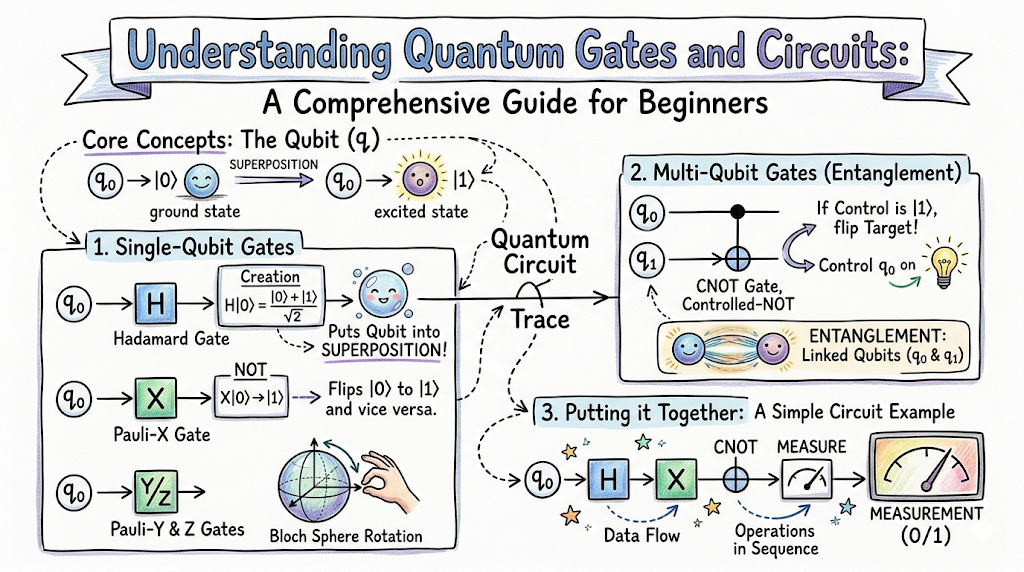
Quantum gates are the operational tools used to change these quantum states. They are mathematically represented as unitary matrices. When a gate acts on a qubit, it performs a matrix multiplication against the qubit’s state vector, effectively rotating its position on the Bloch Sphere.
   [ Single-Qubit Gates ]              [ Multi-Qubit Gates ]
  +----------------------+           +------------------------+
  |  Hadamard (H) Gate   |           |    Controlled-NOT      |
  |  Creates Superposition|           |      (CNOT) Gate       |
  +----------------------+           +------------------------+
             |                                    |
             v                                    v
   Alters Single Qubits                Entangles Multiple Qubits
Common single-qubit gates include the Pauli-X gate (which acts like a classical NOT gate by flipping $\lvert0\rangle$ to $\lvert1\rangle$), the Pauli-Z gate (which flips the phase of the state), and the critical Hadamard (H) gate, which transitions a qubit from a definite state into a perfect equal superposition. Multi-qubit gates, such as the Controlled-NOT (CNOT) gate, allow qubits to interact with one another, forming the basis for generating entanglement across the system.
Quantum Measurements
Measurement is the act of observing a qubit’s state, forcing it to choose a definitive classical output. Before measurement, a qubit retains its complex quantum characteristics, existing in a blend of probabilities. The moment a measurement operation is applied, the quantum state collapses instantly into a standard classical bit ($0$ or $1$).
Once a qubit is measured, its quantum properties are erased, and any subsequent measurements will yield the exact same classical result. Therefore, quantum algorithms are designed to manipulate probabilities so that the correct answer has the highest likelihood of appearing at the exact moment of measurement.
Circuit Design
Circuit design is the process of arranging quantum gates in a specific sequence over a timeline to perform a purposeful calculation. Designers use specialized visual notation where horizontal lines represent the timeline of individual qubits, and symbols placed along those lines represent the gates being applied.
Designing an efficient quantum circuit requires minimizing the total number of gates—especially multi-qubit gates—to prevent environmental noise from corrupting the delicate quantum states before the final measurement can occur.
Quantum Algorithms
A quantum algorithm is a step-by-step procedure designed to run on a quantum computer to solve a specific problem. Instead of standard logic paths, quantum algorithms rely on quantum phenomena like interference and entanglement.
For instance, Shor’s Algorithm uses quantum principles to find the prime factors of large numbers exceptionally fast, while Grover’s Algorithm searches unstructured databases with a significant mathematical speedup over classical search routines.
Error Correction
Quantum hardware is highly sensitive to external environmental factors, such as temperature fluctuations, electromagnetic interference, and magnetic fields. These disruptions cause quantum decoherence, where qubits lose their quantum properties and introduce calculation errors.
Quantum error correction is a specialized domain that distributes the information of a single “logical qubit” across multiple physical qubits. By continuously monitoring these physical qubits without directly measuring them, the system can detect and correct errors in real-time, preserving the integrity of the computation.
Quantum Parallelism
Quantum parallelism is the ability of a quantum computer to evaluate a massive number of possibilities simultaneously. While a classical register with $n$ bits can store exactly one number at a time, a quantum register with $n$ qubits can exist in a simultaneous superposition of $2^n$ states.
When a sequence of quantum gates is applied to this register, the operation acts on all $2^n$ states at once. This allow a 30-qubit system to process over one billion states simultaneously, providing a massive computational leap for complex problem solving.
Quantum Circuit Architecture & Workflow
Executing a program on a quantum computer requires a structured workflow that bridges the gap between classical instructions and quantum physical hardware. The architectural lifecycle of a quantum circuit follows a clear end-to-end trajectory:
+--------------------+      +-----------------------+      +---------------------+
| 1. Initialization  | ---> |  2. Gate Operations   | ---> |3. Circuit Execution |
| Set qubits to |0>  |      | Apply H, CNOT, etc.   |      | Physical or Simulated|
+--------------------+      +-----------------------+      +---------------------+
                                                                      |
                                                                      v
+--------------------+      +-----------------------+      +---------------------+
| 6. Interpretation  | <--- |   5. Error Handling   | <--- |   4. Measurement    |
| Statistical analysis|      | Mitigate noise drift  |      | Collapse to 0 or 1  |
+--------------------+      +-----------------------+      +---------------------+
1. Qubit Initialization
The workflow begins by preparing the physical system. Before any calculation can take place, all qubits must be set to a well-defined baseline state, typically the ground state, denoted as $\lvert0\rangle$. This ensures that there is no residual data or environmental noise left over from previous operations, giving the algorithm a clean, predictable starting point.
2. Gate Operations
Once initialized, the system applies a sequence of quantum gates according to the algorithm’s design. This stage is where the heavy computational lifting happens. Single-qubit gates like the Hadamard gate are used to create superpositions, while multi-qubit gates like the CNOT are applied to entangle qubits. This step shapes the probability distribution across the entire quantum system.
3. Circuit Execution
The compiled sequence of gates is translated into physical control signals. In superconducting architectures, these signals are precise microwave pulses sent down coaxial cables into a dilution refrigerator. In trapped ion systems, they are carefully targeted laser pulses. These pulses manipulate the physical properties of the qubits, implementing the mathematical gates specified in the circuit design.
4. Measurement Systems
After the final gate operation is completed, a measurement signal is sent to the qubits. This causes their quantum states to collapse into definitive classical bits. The measurement hardware records these outputs as standard 0s and 1s. Because quantum mechanics is inherently probabilistic, the entire circuit is typically executed thousands of times (referred to as “shots”) to gather a reliable sample size of output data.
5. Error Handling and Mitigation
Because modern quantum hardware is prone to environmental noise, the raw data collected from measurements often contains errors. During this phase, post-processing software applies error mitigation techniques to filter out system noise and calibration drift. This refines the raw data, ensuring the final output reflects the intended mathematical logic of the circuit rather than hardware imperfections.
6. Quantum Simulation and Result Interpretation
Before running a circuit on real quantum hardware, developers often run it on classical quantum simulators to verify its correctness. Once the verified data is returned from the physical hardware, it is interpreted statistically. The distribution of 0s and 1s is analyzed to extract the final answer to the problem, whether it is a molecular energy configuration, an optimized logistical route, or a decoded cryptographic key.
Quantum Computing Lifecycle
Developing and deploying solutions using quantum gates and circuits requires a structured methodology. The table below outlines the core stages of the quantum computing lifecycle, highlighting the specific technologies used and their real-world outcomes.
| Stage | Purpose | Technologies Used | Real-World Outcome |
| Problem Definition | Isolating complex mathematical or computational challenges that fit quantum advantages. | Mathematical modeling tools, enterprise domain analysis frameworks. | A well-defined computational problem mapped to a specific quantum benefit. |
| Quantum Modeling | Converting the real-world problem into a formal quantum formulation or Hamiltonian equation. | NumPy, SciPy, custom physics simulation libraries. | A clear mathematical translation of the problem into quantum terms. |
| Circuit Design | Constructing the logical sequence of single and multi-qubit gates to execute the algorithm. | Qiskit, Cirq, PennyLane, visual circuit editors. | A compiled quantum circuit diagram ready for compilation. |
| Gate Operations | Mapping logical gates to the specific native gate sets supported by the target hardware. | Quantum compilers, open pulse control software, transpiler tools. | An optimized instruction set tailored to minimize physical error rates. |
| Simulation | Testing and debugging the circuit behavior on classical computers to verify logical correctness. | Qiskit Aer, state-vector simulators, high-performance computing clusters. | Validated circuit logic free from algorithmic errors before hardware deployment. |
| Execution | Running the compiled instructions on physical quantum systems using precise control signals. | Superconducting qubits, trapped ion processors, photonic quantum hardware. | Raw binary data collected from physical quantum measurements. |
| Measurement | Acquiring data over thousands of execution shots to build a statistical distribution. | Readout resonators, laser measurement arrays, data collection buses. | A clear probability distribution showing the most likely solutions. |
| Optimization | Applying noise mitigation and refining circuit depth to improve overall solution fidelity. | Error mitigation software, iterative variational solvers (VQE). | A highly accurate, finalized solution delivered back to the primary enterprise application. |
Popular Quantum Computing Platforms & Tools
The quantum computing ecosystem has evolved to include an array of software development kits, cloud platforms, and simulators that allow anyone to design, test, and run quantum circuits.
Quantum Programming Frameworks
Modern quantum programming relies on high-level Python-based frameworks that abstract away the underlying physics. Qiskit, developed by IBM, is the most widely adopted open-source framework, offering comprehensive tools for circuit design, optimization, and hardware execution. Google’s Cirq is tailored specifically for writing and compiling circuits optimized for Noisy Intermediate-Scale Quantum (NISQ) processors. For those focused on quantum machine learning and variational algorithms, Xanadu’s PennyLane offers seamless integration with popular classical machine learning libraries like PyTorch and TensorFlow.
Quantum Simulators and Cloud Platforms
Before running code on expensive quantum hardware, developers rely on software simulators to test their circuits. Tools like Qiskit Aer run on local classical machines to simulate ideal or noisy quantum environments. For larger configurations, cloud platforms provide direct access to both advanced simulators and physical quantum hardware. IBM Quantum Platform, Amazon Braket, and Microsoft Azure Quantum allow developers to write code in their local environments and send it to physical quantum systems located around the world.
Tool Comparison
The table below provides a quick reference for the most popular tools used across the industry:
| Tool | Purpose | Difficulty | Industry Usage |
| Qiskit | Full-stack quantum circuit design, optimization, and hardware execution. | Beginner to Intermediate | Broadly adopted across enterprise, research, and educational sectors. |
| Cirq | Designing and executing optimized circuits specifically for Google’s hardware. | Intermediate to Advanced | Primarily used in research labs and specialized algorithm development teams. |
| PennyLane | Specialised framework for quantum machine learning and differentiable programming. | Intermediate | Used by AI researchers, data science teams, and academic labs. |
| Amazon Braket | Unified cloud interface to access hardware from multiple quantum providers. | Intermediate | Enterprise development teams looking for multi-platform hardware flexibility. |
| Qiskit Aer | High-performance classical simulation of quantum circuit workflows. | Beginner | Universal tool used by developers for initial circuit debugging and testing. |
Real-World Applications of Quantum Computing
As quantum gates and circuits become more resilient and scalable, their practical application across global industries is transforming commercial operations.
Medicine and Advanced Material Science
The pharmaceutical industry faces high costs and lengthy timelines when discovering new medications, largely due to the difficulty of predicting how molecules will interact. Quantum circuits can accurately simulate molecular structures and electronic configurations at an atomic level. This helps researchers quickly identify effective drug candidates, accelerating the development of targeted therapies.
In material science, this capability allows engineers to discover novel molecular combinations, leading to the creation of ultra-efficient solar panels, lightweight materials for aerospace engineering, and high-density grid batteries.
Financial Services and Logistics Optimization
Modern financial institutions manage risk by running complex simulations to predict market movements and asset interactions. Quantum algorithms can evaluate vast portfolios, optimize asset allocation, and run complex risk assessments far more efficiently than classical forecasting models.
In logistics, global supply chains utilize quantum computing to solve routing challenges. By processing thousands of variables simultaneously—such as shipping lanes, weather changes, fuel costs, and port delays—quantum circuits help shipping conglomerates minimize fuel consumption and streamline delivery schedules.
       [ Core Industry Transformations ]
                     |
     +---------------+---------------+
     |                               |
     v                               v
[ Life Sciences ]            [ Global Logistics ]
- Molecular Modeling         - Route Optimization
- Accelerated Pharma         - Fleet Consolidation
- Advanced Polymers          - Supply Chain Resilience
Cryptography and Artificial Intelligence
As mentioned earlier, quantum computing will significantly impact cybersecurity. While fault-tolerant systems pose a threat to traditional RSA encryption, they also enable the development of post-quantum cryptography—new, highly secure encryption methods designed to withstand quantum attacks.
In artificial intelligence, quantum systems can process massive, multi-dimensional datasets much faster than classical computers. This capability speeds up the training of large language models, enhances pattern recognition in autonomous vehicles, and improves anomaly detection for fraud prevention.
Benefits of Quantum Gates and Circuits
Building systems around quantum gates and circuits offers distinct advantages for advanced computing applications:
- Exponential Information Scaling: Every qubit added to a quantum register doubles the system’s total processing capacity ($2^n$), allowing it to manage incredibly complex datasets.
- True Parallel Problem Solving: Instead of testing solutions sequentially, quantum superposition allows a circuit to evaluate vast combinations of data simultaneously.
- Accurate Nature Simulations: Because molecular structures operate on the laws of quantum mechanics, quantum circuits are naturally suited to simulate physical chemistry and material behaviors without approximation errors.
- Enhanced Mathematical Efficiency: Specialized quantum algorithms provide significant speedups for complex calculations, transforming tasks like large-integer factorization and unstructured database searches.
- Advanced Optimization: Quantum circuits can navigate complex multi-variable optimization landscapes, helping industries identify highly efficient solutions that classical search methods might miss.
Challenges & Limitations
Despite its immense potential, the quantum computing industry faces significant engineering and physical hurdles before achieving widespread commercial adoption.
Hardware Instability and High Error Rates
The most pressing challenge in contemporary quantum hardware development is maintaining qubit stability. Qubits are highly sensitive to their surrounding environment; even minor temperature variations, electromagnetic waves, or physical vibrations can cause quantum decoherence. When decoherence occurs, the qubits fall out of superposition or lose their entangled states, introducing errors that corrupt the entire computation. Consequently, current systems require considerable error-handling overhead just to manage these faults.
Infrastructure Complexity and Cooling Demands
Most leading physical quantum architectures—such as superconducting systems—require extreme operational environments to function. These processors must be cooled inside specialized dilution refrigerators to temperatures just above absolute zero (approximately 15 millikelvin, which is colder than deep space). Maintaining this infrastructure requires specialized equipment, substantial electrical power, and deep technical expertise. These demanding requirements make local enterprise deployment unfeasible, confining current physical hardware access to specialized cloud data centers.
+-----------------------------------------------------------------+
|                    Operational Challenges                       |
+-----------------------------------------------------------------+
|  [Decoherence]  --> Qubits lose quantum states due to noise     |
|  [Cryogenics]   --> Systems require cooling near absolute zero  |
|  [Scalability]  --> Adding physical qubits increases error rates |
+-----------------------------------------------------------------+
Scalability and the Talent Gap
Building a truly useful quantum computer requires scaling the hardware to thousands, or even millions, of high-fidelity physical qubits. As you add more qubits to a processor, controlling their interactions and minimizing cross-talk becomes exponentially more difficult. This physical engineering challenge is compounded by a global shortage of qualified talent. Designing quantum circuits requires a deep understanding of quantum mechanics, linear algebra, and computer science—a interdisciplinary skill set that creates a steep learning curve for incoming developers.
Career Opportunities in Quantum Computing
The rapid growth of the quantum ecosystem has created a strong demand for specialized professionals across research labs, hardware manufacturers, and enterprise technology corporations.
Key Professional Roles
- Quantum Software Engineer: These professionals write the code that controls quantum systems, build software development kits, and develop the tools needed to compile and run quantum circuits on cloud infrastructure.
- Quantum Algorithm Developer: Researchers who focus on designing new quantum algorithms or adapting existing ones to solve specific enterprise challenges, such as optimization or machine learning tasks.
- Quantum Systems Engineer: Hardware-focused engineers who design, assemble, and maintain the physical quantum processors, control lines, and cryogenic refrigeration systems.
- Scientific Computing Specialist: Experts who bridge the gap between domain-specific sciences (like chemistry or biology) and quantum systems, helping research teams map complex physical problems to quantum circuits.
Educational Prerequisites and Skills
Entering this field requires a strong academic and technical foundation. Most advanced roles require a background in physics, mathematics, computer science, or electrical engineering. Essential technical skills include:
- Programming: Proficiency in Python and familiarity with quantum frameworks like Qiskit, Cirq, or PennyLane.
- Mathematics: A deep understanding of linear algebra (matrices, vectors, and eigenvalues), complex numbers, and probability theory.
- Quantum Foundations: A clear understanding of core quantum principles, including superposition, entanglement, and unitary gate operations.
Industry Demand and Career Roadmap
While historically limited to academic research institutions, quantum career paths have expanded rapidly into commercial industries like aerospace, finance, cybersecurity, and pharmaceuticals. The long-term career outlook is highly promising. Aspiring professionals can build a competitive portfolio by contributing to open-source quantum frameworks, publishing verified circuit simulations on GitHub, and completing structured educational programs.
Beginner Roadmap for Learning Quantum Computing
Mastering quantum computing requires a structured learning path that balances theoretical mathematics with hands-on programming experience. Below is a step-by-step roadmap designed to guide beginners from foundational concepts to advanced simulations.
[Phase 1: Foundations]   --->   [Phase 2: Core Quantum]  --->   [Phase 3: Coding & Projects]
- Linear Algebra                 - Superposition                 - Master Qiskit/Cirq
- Probability Theory             - Entanglement                  - Build Circuit Simulations
- Basic Python                   - Quantum Gates                 - Open-Source Contributions
Step 1: Establish Mathematical and Programming Basics
Before diving into quantum physics, focus on the core mathematical tools used to describe quantum systems. Prioritize linear algebra—specifically matrix multiplication, vectors, complex numbers, and eigenvalues—as quantum gates are mathematically represented as matrices. Concurrently, learn foundational Python programming, which is the standard language for all major quantum development frameworks.
Step 2: Understand Fundamental Physics and Computing Concepts
Familiarize yourself with basic classical computing concepts, such as binary logic gates and state machines, to understand how quantum systems differ. From there, study introductory quantum mechanics concepts from a conceptual standpoint, focusing on wave-particle duality, quantum states, and the probabilistic nature of atomic measurements.
Step 3: Master Core Quantum Computing Concepts
Begin exploring specialized quantum concepts. Learn how qubits are represented on the Bloch Sphere and study the mathematical mechanics of superposition and entanglement. Practice writing out quantum states using Dirac notation to build comfort with the standard language of the field.
Step 4: Dive into Quantum Gates and Circuit Workflows
Study individual single-qubit gates (X, Y, Z, H) and multi-qubit gates (CNOT, CZ). Learn how these gates are visualized in circuit diagrams and trace how quantum states change as they move through a sequence of gates. Focus on understanding how the Hadamard gate generates superposition and how controlled operations create entanglement.
Step 5: Get Hands-on with Programming Frameworks
Install open-source frameworks like Qiskit or Cirq and begin writing code. Start with simple exercises, such as building a two-qubit circuit to generate a Bell State (a fundamental entangled state). Run your code on classical software simulators to verify that your output probabilities match your theoretical expectations.
Step 6: Explore Quantum Algorithms and Research Projects
Once comfortable with basic circuit design, study foundational algorithms like Deutsche-Jozsa, Grover’s Search, and Shor’s Algorithm. To solidify your skills, build a portfolio of simulation projects—such as simulating a simple chemical molecule or solving a basic optimization problem—and share your work within open-source quantum development communities.
Certifications & Training
Structured certification programs offer a clear, verified way to validate your skills, whether you are a student preparing for the job market or a technology professional transitioning into advanced computing.
| Certification | Level | Best For | Skills Covered |
| IBM Quantum Developer Certification | Intermediate | Developers and software engineers seeking industry-recognized credentials. | Quantum circuit design, Qiskit framework utilization, gate sequencing, and hardware execution. |
| Cloud-Based Quantum Platform Training | Beginner to Intermediate | Solutions architects and IT professionals working with cloud integrations. | Managing multi-platform hardware instances, executing remote jobs via Amazon Braket or Azure Quantum. |
| Academic Scientific Computing Certifications | Advanced | Researchers, data scientists, and specialized physics students. | Quantum algorithms, advanced error mitigation, variational quantum solvers, and quantum chemistry. |
| Foundational Quantum Technology Education | Beginner | Students, tech generalists, and enterprise decision-makers. | Structural understanding of qubits, conceptual gate workflows, industry use cases, and technology paths. |
Common Beginner Mistakes
- Skipping Mathematical Foundations: Many beginners jump straight into writing quantum code without mastering linear algebra. Without understanding vector transformations and matrix multiplication, it is difficult to grasp how quantum gates manipulate data, leading to confusion when debugging complex circuits.
- Expecting Instant Supercomputer Performance: A common misconception is that quantum computers speed up every type of software application. In reality, quantum systems excel at specific, highly complex mathematical tasks. For standard tasks like word processing or web browsing, classical architectures remain far more efficient.
- Learning Frameworks Without the Core Concepts: Memorizing Qiskit syntax without understanding the underlying quantum principles—such as superposition, phase, and entanglement—limits your ability to design original algorithms or optimize circuits for real hardware.
- Believing Overstated Industry Hype: Beginners can easily be misled by sensationalized media claims about quantum computing. It is important to maintain realistic expectations, recognizing that fault-tolerant, large-scale quantum systems are still developing and require significant engineering effort to mature.
- Ignoring Hardware Constraints and Error Rates: Writing theoretical circuits without considering physical limitations often leads to poor results on real hardware. Ideal simulations do not account for environmental noise and gate decoherence, which developers must learn to mitigate to write effective real-world applications.
Best Practices for Learning Quantum Computing
To get the most out of your quantum computing education, follow these practical guidelines:
- Build a Strong Mathematical Core: Spend time mastering the basics of vectors, matrices, and probability amplitudes before diving into complex programming frameworks.
- Use Simulators for Early Practice: Use local software simulators to test, debug, and refine your circuits. Simulators provide a clean, noise-free environment, making it much easier to verify your program’s core logic.
- Balance Theory with Hands-On Coding: Match every theoretical concept you learn with a practical programming exercise. If you read about quantum entanglement, write a quick script to build and measure an entangled Bell State.
- Focus on Minimizing Circuit Depth: When designing circuits, aim to use as few gates as possible—especially multi-qubit gates. Keeping your circuits shallow helps prevent environmental noise from corrupting your calculations on physical hardware.
- Engage with the Quantum Community: Join open-source developer channels, participate in hackathons, and contribute to public code repositories. Learning alongside other developers is an excellent way to solve problems and stay updated on the latest industry tools.
Future of Quantum Computing
The trajectory of quantum computing points toward a hybrid future where quantum processors work alongside classical high-performance computing clusters. As systems evolve past the current Noisy Intermediate-Scale Quantum (NISQ) era, researchers are focused on achieving fault-tolerant quantum computing through advanced error correction. This transition will allow processors to run deep, complex circuits with millions of gate operations without losing data integrity due to environmental noise.
 [ NISQ Era ]               [ Hybrid Computing ]             [ Fault-Tolerant Systems ]
- Noise-prone qubits       - CPU + GPU + QPU integration    - Logical error correction
- Shallow circuits         - Cloud-based quantum scaling    - Deep, complex algorithms
In the corporate world, cloud-based quantum computing will become a standard utility for enterprise tech teams. Companies will access specialized Quantum Processing Units (QPUs) remotely, seamlessly routing complex optimization, cryptography, and machine learning tasks to quantum hardware while using classical systems for standard computing needs. As hardware stability and gate precision improve, this hybrid architecture will drive major scientific breakthroughs, fundamentally reshaping global industries, digital security, and scientific research.
FAQs
1. What are quantum gates?
Quantum gates are the foundational building blocks of quantum algorithms, represented mathematically as unitary matrices. They act on a small number of qubits to rotate their state vectors on the Bloch Sphere, altering their underlying probability amplitudes. Unlike many classical logic gates, quantum gates are always reversible, ensuring no information is lost during the calculation.
2. What is a quantum circuit?
A quantum circuit is a step-by-step sequence of quantum gates, measurements, and qubit initializations arranged along a timeline to execute a specific algorithm. In a circuit diagram, horizontal lines represent the qubits over time, while the symbols placed along those lines represent the gates applied to manipulate the quantum information before final measurement.
3. How is quantum computing different from classical computing?
Classical computing processes information using binary bits that exist strictly as a 0 or a 1. Quantum computing utilizes qubits, which can exist in a simultaneous blend of states through superposition and interact via entanglement. This allows quantum systems to process vast combinations of data in parallel, solving specific complex problems much faster than classical supercomputers.
4. What is a qubit?
A qubit, or quantum bit, is the physical and mathematical unit of quantum information. Realized through physical systems like electron spin or photon polarization, a qubit is not restricted to binary states. It can hold a continuous range of states across a two-dimensional complex vector space until a measurement forces it to collapse into a classical 0 or 1.
5. Is quantum computing difficult to learn?
Quantum computing has a steep learning curve because it combines elements of computer science, linear algebra, and quantum physics. However, with a structured approach that prioritizes foundational mathematics before moving into hands-on programming frameworks, beginners can steadily build proficiency without needing an advanced physics degree.
6. Does quantum computing require advanced mathematics?
Yes, a solid understanding of foundational mathematics is necessary to grasp how quantum circuits operate. The most critical field to master is linear algebra, including vector addition, matrix multiplication, complex numbers, and eigenvalues. These mathematical tools are used daily to describe quantum states and gate transformations.
7. Can beginners learn quantum computing?
Absolutely. With modern high-level, open-source programming frameworks like Qiskit and Cirq, anyone with a basic understanding of Python and linear algebra can start building and simulating quantum circuits. Beginners can learn the core concepts through accessible online resources, developer communities, and structured learning paths.
8. What industries use quantum computing?
Quantum computing is actively utilized and researched across several sectors, including pharmaceuticals for drug discovery, logistics for route optimization, financial services for risk modeling, material science for developing advanced polymers, and cybersecurity for creating post-quantum encryption protocols.
9. What is the purpose of the Hadamard gate?
The Hadamard (H) gate is a fundamental single-qubit gate used to create superposition. When applied to a qubit in the definite ground state $\lvert0\rangle$, it transforms it into an equal combination of both $\lvert0\rangle$ and $\lvert1\rangle$, meaning a subsequent measurement has an equal 50% chance of yielding either classical result.
10. What happens when you measure a qubit?
When a measurement is applied, a qubit’s fluid quantum state collapses instantly into a definitive classical bit, either a 0 or a 1, based on its probability amplitudes. This observation erases its quantum properties, meaning any immediate subsequent measurements will yield the exact same classical output.
11. Why are quantum gates required to be reversible?
Quantum gates must be reversible because they are governed by the laws of quantum mechanics, which preserve total probability amplitudes through unitary operations. Reversibility ensures that the physical system does not lose or destroy information during computation, allowing the circuit to run backward mathematically to retrieve its initial inputs.
12. What is quantum decoherence?
Quantum decoherence is the process where a quantum system loses its unique properties—such as superposition and entanglement—due to interactions with the surrounding environment. Noise from temperature changes, electromagnetic waves, or vibrations causes calculation errors, presenting a major hardware engineering challenge.
13. What is a simulator in quantum computing?
A quantum simulator is a classical software application running on standard computers or high-performance clusters that mimics the mathematical behavior of an ideal or noisy quantum computer. Simulators allow developers to test, debug, and verify the logic of their quantum circuits before deploying them to physical quantum hardware.
14. How do multi-qubit gates work?
Multi-qubit gates, such as the Controlled-NOT (CNOT) gate, perform an operation on a target qubit only if the state of a control qubit meets specific criteria. These gates allow qubits to interact with one another, serving as the essential tool for generating quantum entanglement across a circuit.
15. What are the main physical types of qubits used today?
Modern quantum computers use several different hardware approaches to create qubits. The most common types include superconducting qubits (used by IBM and Google), trapped ion systems, photonic circuits that manipulate light particles, and topological qubits designed to inherently resist environmental noise.
Final Thoughts
The development of quantum gates and circuits marks a fundamental shift in how we approach computation. Moving beyond classical binary systems introduces challenges but also opens up remarkable opportunities. For students, engineers, and tech innovators, mastering these core principles is an investment in the future of advanced technology.
When entering this field, it is important to focus on building a strong foundation. Developing a clear understanding of linear algebra and core quantum concepts provides a significant advantage when writing code or designing algorithms. Rather than getting distracted by industry hype, approach the field with a practical, engineering-focused mindset, recognizing both the current hardware limitations and the significant long-term potential.
