Introduction
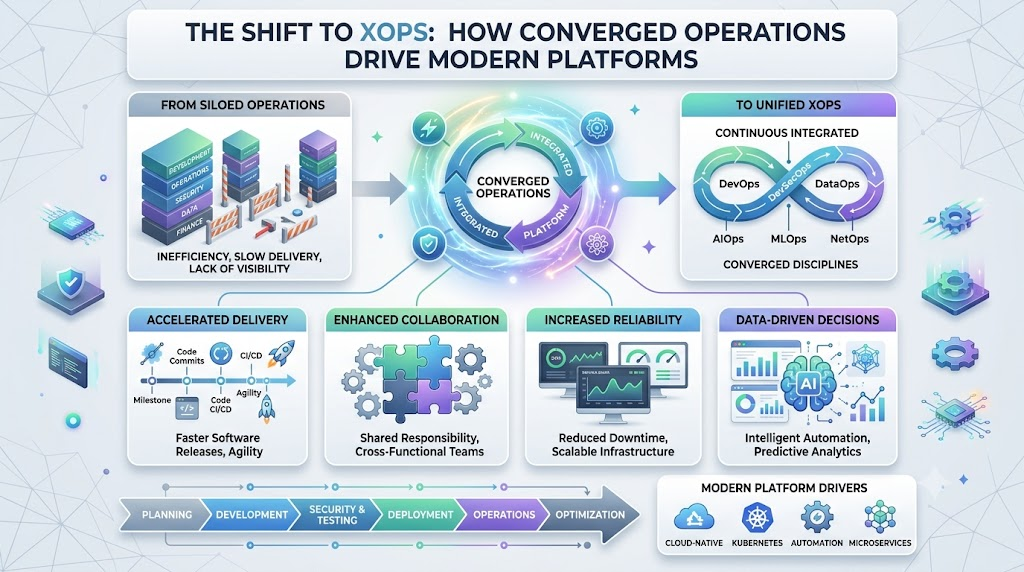
Modern engineering organizations frequently encounter an operational bottleneck when scaling systems beyond traditional web applications. While DevOps established standard patterns for continuous integration and delivery of application code, the rapid rise of machine learning, automated data pipelines, and infrastructure governance created isolated operational silos. Data scientists build models independently, data engineers deploy analytical pipelines on disconnected schedules, and platform teams struggle to maintain unified visibility across environments. XOps—shorthand for cross-functional or “everything” operations—serves as the unifying framework designed to address this fragmentation. It aligns diverse operational specializations, including DevOps, DataOps, MLOps, DevSecOps, FinOps, and AIOps, under shared engineering disciplines, automated feedback loops, and standardized governance. Educational platforms like XOpsSchool focus on this operational convergence, helping teams understand how these specialized disciplines integrate to deliver scalable, reliable, and observable technical workflows.
What Is XOps?
XOps is an umbrella framework that applies the continuous delivery, automation, and feedback principles of DevOps across all operational disciplines within an enterprise. Rather than treating software engineering, data analytics, artificial intelligence, security, and cloud cost management as isolated functions, XOps creates shared operational baselines across them.
In an XOps model, the letter X functions as a variable representing any specialized operational domain:
- Development (DevOps): Continuous code integration, testing, and application deployment.
- Data Engineering (DataOps): Automated ingestion, cleaning, transformation, and validation of data pipelines.
- Machine Learning (MLOps): Model training, versioning, validation, registry storage, and inferencing.
- Artificial Intelligence Operations (AIOps): Using algorithmic analysis and machine learning to parse logs, metrics, and traces for automated incident remediation.
- Security (DevSecOps): Automated vulnerability scanning, policy enforcement, and static/dynamic security testing integrated into delivery pipelines.
- Financial Operations (FinOps): Continuous cloud cost visibility, unit economics tracking, and automated resource rightsizing.
The core premise of XOps is simple: operational maturity should not depend on whether a team is writing microservices, managing vector databases, or tuning neural networks. Continuous validation, infrastructure-as-code, pipeline automation, and unified observability apply across all technical domains.
Why XOps Matters in Modern IT Operations
When organizations adopt specialized practices without a shared framework, operational friction compounds rapidly:
- Siloed Toolchains: A software team uses GitHub Actions and Kubernetes, while the data team manually triggers Airflow DAGs, and the data science team deploys notebooks to ad-hoc compute instances without revision tracking.
- Fragmented Observability: Application errors show up in APM tooling, but data pipeline failures remain hidden until a downstream dashboard breaks, and model accuracy degradation is detected only after customer churn increases.
- Inconsistent Governance: Security checks occur automatically in application code builds, while training datasets and data lakes bypass automated compliance and access controls.
XOps eliminates these disjointed practices by establishing uniform pipelines, shared platform interfaces, and automated guardrails that span all functional boundaries.
Core Components of the XOps Framework
A functional XOps implementation rests on five foundational pillars:
+-------------------------------------------------------------+
|                     Unified Governance                      |
|          (Security Policies, FinOps Cost Budgets)           |
+-------------------------------------------------------------+
|                      Shared Platforms                       |
|           (Internal Developer Platforms, API-Driven)        |
+-------------------------------------------------------------+
|                    Continuous Validation                    |
|             (CI/CD, Model Evaluation, Data Drift)           |
+-------------------------------------------------------------+
|                    Unified Observability                    |
|             (Logs, Metrics, Traces, Model Health)           |
+-------------------------------------------------------------+
1. Unified Versioning and Configuration Management
In traditional software, code versioning lives in Git. In XOps, versioning extends beyond code:
- Data Versioning: Tracking schema changes, dataset snapshots, and lineage.
- Model Versioning: Documenting model weights, hyperparameters, training datasets, and inference runtime dependencies.
- Infrastructure Versioning: Capturing compute, network, and storage configurations declaratively via Infrastructure as Code (IaC).
2. Continuous Delivery and Automation Pipelines
Continuous delivery principles govern every asset. Code commits trigger automated builds and unit tests; new training data runs automated quality and schema checks; and model updates undergo automated evaluation against baseline performance metrics before serving live traffic.
3. Shared Internal Developer Platforms (IDPs)
Rather than requiring every data engineer or scientist to master underlying cloud primitives, platform engineering teams build standardized, self-service interfaces. These platforms allow engineers to provision compliant databases, compute nodes, and runtime environments through clear service catalogs.
4. Telemetry and Cross-Domain Observability
Telemetry collection must incorporate application logs, data pipeline completion latencies, infrastructure saturation, model inference latencies, and prediction drift into a centralized monitoring plane.
5. Automated Policy and Cost Controls
Security policies and cost allocations run continuously within the pipeline rather than as post-deployment audits. Compute instances shut down automatically when idle, and artifacts failing security baselines are prevented from deploying.
Comparing Core XOps Disciplines
To understand how XOps functions as a whole, it helps to examine how individual operational tracks operate within it.
| Discipline | Primary Focus | Primary Artifacts | Key Metrics | Common Tooling |
| DevOps | Application lifecycle & delivery | Application code, containers, configuration files | Deployment frequency, Lead time for changes, MTTR | Git, GitHub Actions, Docker, Kubernetes, Terraform |
| DataOps | Data lifecycle & analytical pipelines | Data schemas, pipelines, transformation models | Pipeline latency, schema error rates, data freshness | Apache Airflow, dbt, Apache Kafka, Great Expectations |
| MLOps | Machine learning lifecycle | Trained models, feature stores, training data | Inference latency, prediction drift, model accuracy | MLflow, Kubeflow, Feast, Triton Inference Server |
| AIOps | IT operations automation | Telemetry data, alerts, automated remediation runbooks | Mean time to detect (MTTD), noise reduction, alert correlation | Prometheus, OpenTelemetry, Grafana, PagerDuty |
| DevSecOps | Security automation & compliance | Policies as code, SBOMs, scan reports | Vulnerability fix rate, pipeline scan duration | Trivy, SonarQube, Open Policy Agent (OPA) |
| FinOps | Cloud financial management | Cost allocation tags, usage metrics, billing models | Unit economic cost, idle resource ratio, budget variance | Infracost, Kubecost, CloudHealth |
How an Integrated XOps Workflow Functions in Practice
Consider an enterprise customer churn prediction system. In an organization operating without an integrated XOps model, the engineering lifecycle moves in disjointed stages:
- Data engineers run scheduled scripts to pull transactional records.
- Data scientists extract an unversioned CSV to train a churn classification model on their local instances.
- Software engineers rewrite the model logic into a web microservice to deploy it.
- Infrastructure engineers manually allocate virtual machines.
When the service encounters unexpected payloads in production, triage requires meetings across all four teams because no single system links the data state, model version, application code, and infrastructure metrics.
The Unified XOps Approach
In contrast, an integrated XOps workflow connects these actions into a repeatable pipeline:
[Raw Event Data]
       │
       ▼
(DataOps Pipeline) ─── Schema Validation & Transformation (dbt/Airflow)
       │
       ▼
(MLOps Pipeline)   ─── Automated Retraining & Drift Check (MLflow/Kubeflow)
       │
       ▼
(DevOps Pipeline)  ─── Containerization & Canary Deployment (Docker/ArgoCD)
       │
       ▼
(AIOps / Observability) ─── Production Inference Latency & Drift Monitoring
- Data Ingestion (DataOps): Raw records enter the system through event streams. Transformation pipelines validate data quality against strict schema definitions. If null values spike, the pipeline halts automatically and alerts the team before polluted data reaches downstream consumers.
- Model Training and Packaging (MLOps): Cleaned feature sets trigger automated training workflows. Hyperparameters and evaluation scores register in a central catalog. If the candidate model outperforms the active production baseline without showing statistical bias, the model artifact is approved.
- Deployment and Delivery (DevOps & DevSecOps): The model artifact packages into an immutable container image. Automated scanners verify dependency integrity. GitOps controllers deploy the updated container to a Kubernetes cluster using a canary rollout pattern, shifting a small fraction of live user traffic to monitor performance.
- Telemetry and Cost Verification (AIOps & FinOps): Observability collectors monitor memory utilization, inference latency, and data drift. Automated cost monitors verify that the auto-scaling parameters stay within allocated team budgets.
Practical Benefits of Adopting XOps
- Reduced Hand-Off Latency: Automating the transitions between data pipelines, model registries, and application deployments eliminates communication lag between distinct functional teams.
- High System Reliability: Standardized testing catches schema mismatches, infrastructure misconfigurations, and software bugs before deployment to production environments.
- Auditability and Compliance: Because every artifact—code, training data lineage, infrastructure definition, and model weight—is versioned declaratively, reconstructing the exact state of any deployment is deterministic.
- Elimination of Duplicated Tooling: Standardizing infrastructure access on platform engineering patterns keeps individual teams from buying and configuring separate, overlapping platforms for CI/CD, secrets management, and observability.
Challenges and Implementation Hurdles
While the strategic value of XOps is high, adoption introduces specific organizational and technical friction points:
- Organizational Silos: Teams accustomed to working in isolation often resist shared standards. Data scientists may view CI/CD workflows as unnecessary overhead, while infrastructure teams may find data lineage requirements complex.
- Toolchain Proliferation: Integrating systems built for different functions—such as orchestrating an Airflow data pipeline from an ArgoCD GitOps release—requires robust API design and deliberate architectural patterns.
- Cross-Disciplinary Skill Gaps: Finding or training engineers who understand the nuances of distributed systems, machine learning lifecycles, and data governance is challenging.
- Unclear Ownership: When a predictive feature fails in production, determining whether the root cause is a bad dataset (DataOps), model drift (MLOps), container network timeouts (DevOps), or cloud resource throttling (FinOps) requires clear ownership boundaries.
Implementation Best Practices
Adopting XOps does not require refactoring an entire operational organization at once. Successful implementations follow a phased approach:
- Establish Version Control as the Source of Truth: Ensure that application code, infrastructure definitions (IaC), data transformation logic, and machine learning configs live in declarative, versioned repositories.
- Build an Internal Developer Platform: Platform teams should supply pre-configured templates for common workflows—such as spinning up a compliant data pipeline or deploying an inference endpoint—rather than requiring individual contributors to build operational scaffolding from scratch.
- Standardize on Unified Observability: Adopt open standards such as OpenTelemetry to collect distributed traces, logs, and performance metrics into shared analytics dashboards.
- Automate Quality Gates at Every Boundary: Implement automated linting, unit testing, schema validation, and security scanning directly inside pull requests across all code repositories.
- Define Clear RACI Matrices: Clearly specify which team is responsible, accountable, consulted, and informed for each operational artifact across the software, data, and machine learning lifecycles.
Frequently Asked Questions
What does the “X” in XOps stand for?
The “X” represents a variable for any operational discipline within technology systems, including DevOps, DataOps, MLOps, DevSecOps, FinOps, and AIOps.
Is XOps a replacement for DevOps?
No. XOps is an extension of DevOps principles applied to specialized fields like data analytics, artificial intelligence, security, and cloud cost management.
What is the core difference between DevOps and DataOps?
DevOps focuses on the continuous integration and delivery of software code and infrastructure, while DataOps focuses on orchestrating, validating, and monitoring data pipelines and schemas.
Where does MLOps fit into the XOps framework?
MLOps manages the machine learning lifecycle within XOps, handling model experimentation, training data versioning, validation, deployment, and drift monitoring.
How does AIOps differ from MLOps?
MLOps is the process of operationalizing machine learning models for business applications, whereas AIOps uses artificial intelligence and machine learning to automate IT operations and incident management.
What skills do engineers need to work effectively in an XOps environment?
Engineers benefit from a solid understanding of Git version control, continuous delivery pipelines, container orchestration, infrastructure as code, and distributed system observability.
Can small engineering teams benefit from XOps?
Yes. Small teams benefit from XOps principles by keeping operational tooling standardized, preventing fragmented workflows as their technical systems grow.
What is the role of platform engineering in XOps?
Platform engineering teams build and maintain the self-service internal developer platforms that allow data, ML, and software teams to deploy and manage workloads using shared operational standards.
What are the most common tools used across XOps disciplines?
Common technologies include Git, Kubernetes, Docker, Terraform, GitHub Actions, Apache Airflow, MLflow, Prometheus, and Grafana.
How does FinOps integrate into an XOps pipeline?
FinOps brings financial accountability to XOps by embedding automated cost checks into code reviews, tracking unit economics, and identifying idle cloud resources.
Conclusion
XOps represents the natural evolution of modern technical operations. As modern organizations move beyond basic web applications into data-driven platforms and production machine learning, the operational boundaries that once separated development, infrastructure, data engineering, and security become untenable. By taking the core tenets of DevOps—automation, continuous validation, rapid feedback loops, and declarative infrastructure—and applying them uniformly across data, AI, security, and finance, XOps provides a scalable blueprint for modern engineering. Organizations that build shared platforms, cultivate cross-disciplinary skills, and enforce automated quality gates across every stage of the lifecycle eliminate systemic friction and establish predictable, high-performing technical operations.
