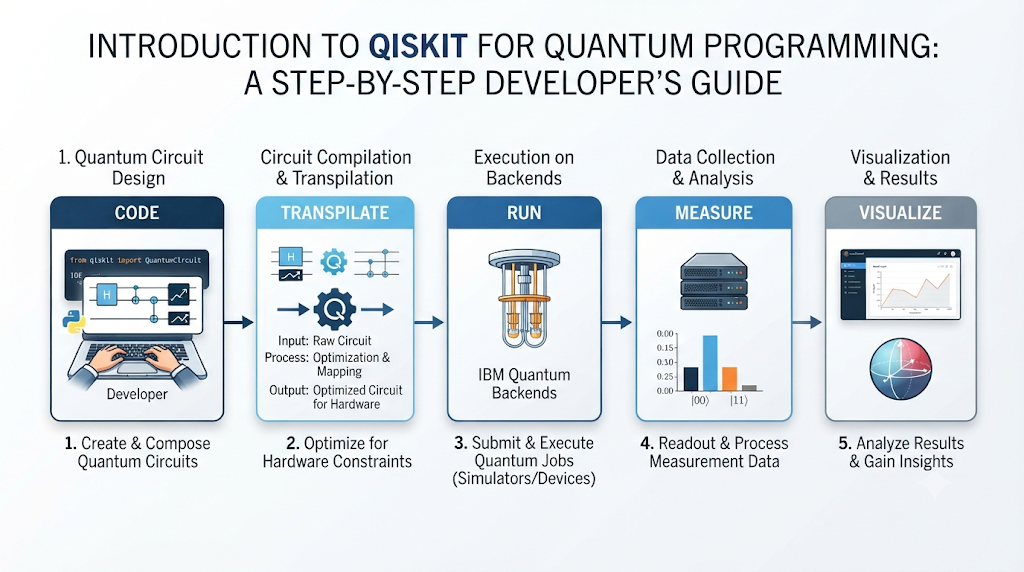
Quantum computing is no longer a theoretical domain confined to physics research laboratories. High-performance quantum processors, cloud-accessible quantum hardware, and advanced software tools have transformed quantum software development into a rapidly growing discipline. Whether you are a software developer, Python programmer, AI scientist, or student, understanding how to write programs for quantum devices is one of the most future-proof skills you can cultivate today. In this guide hosted on QuantumUting.com, we will break down the fundamentals of Qiskit, walk through its architecture, set up a modern development environment, write a complete quantum program from scratch, and explore the global quantum software ecosystem.
What is Qiskit?
Qiskit (pronounced kiss-kit) is an open-source framework for quantum computing built directly on Python. It provides tools for creating, manipulating, and executing quantum programs at the level of quantum circuits, pulses, and domain-specific application modules.
+-------------------------------------------------------------------+
|                        PYTHON APPLICATION LAYER                   |
|         (Quantum Machine Learning, Chemistry, Optimization)       |
+-------------------------------------------------------------------+
                                  |
                                  v
+-------------------------------------------------------------------+
|                            QISKIT SDK                             |
|   (QuantumCircuit, Circuit Library, Transpiler, Pass Managers)    |
+-------------------------------------------------------------------+
                                  |
                                  v
+-------------------------------------------------------------------+
|                     EXECUTION ENGINE / RUNTIME                    |
|                (Sampler & Estimator Execution Primitives)         |
+-------------------------------------------------------------------+
                 /                                 \
                v                                   v
+-------------------------------+   +-------------------------------+
|     LOCAL / CLOUD SIMULATOR   |   |     IBM QUANTUM HARDWARE      |
|    (AerSimulator / Statevector) |   |    (Physical QPU Backend)    |
+-------------------------------+   +-------------------------------+
Unlike classical software, which operates on binary bits ($0$ and $1$), Qiskit enables developers to manipulate qubits—the fundamental units of quantum information capable of existing in states of $0$, $1$, or a continuous quantum linear combination of both (superposition).
Qiskit abstracts the underlying quantum physics, enabling software engineers to construct circuits using familiar object-oriented Python code. It handles low-level tasks, such as translating abstract mathematical gates into physical microwave pulses sent to superconducting quantum processors.
Why Qiskit is Popular in Quantum Computing
Qiskit has become the industry-standard framework for quantum programming due to several key advantages:
- Pythonic Native Experience: Qiskit seamlessly integrates with standard Python libraries like NumPy, SciPy, and Matplotlib. Python developers can learn quantum programming without mastering C++ or low-level assembly languages.
- Hardware and Backend Agnostic: While developed by IBM, Qiskit is designed to target multiple execution targets—including local simulators, HPC GPU-accelerated clusters, and real superconducting or ion-trap quantum hardware.
- Performance via Rust Core: Modern releases of Qiskit integrate high-performance Rust kernels under the hood, delivering fast circuit generation, low memory overhead, and accelerated transpilation times.
- Massive Global Community: Backed by extensive documentation, open-source contributors, textbook materials, and IBM Quantum credentials, Qiskit boasts the largest active community of quantum developers worldwide.
- Enterprise-Grade Tooling: Qiskit includes built-in transpilation pipelines, error mitigation workflows, and optimized cloud execution primitives.
History and Evolution of Qiskit
Qiskit was launched by IBM in 2017 to provide an accessible interface for the IBM Quantum Experience platform. Over time, its architecture has evolved to match the needs of growing quantum processors:
- 2017–2019 (Foundational Release): Introduced early modules (Terra, Aer, Ignis, Aqua) representing core logic, simulation, noise mitigation, and high-level applications.
- 2020–2023 (Pruned Architecture & Cloud Scale): Consolidated legacy modules into a unified, high-performance SDK to reduce package overhead and streamline quantum cloud workflows.
- 2024 (Qiskit 1.0 Milestone): Delivered API stability, standardized execution primitives (Sampler and Estimator), and introduced a high-performance C/Rust underlying engine.
- Modern Releases (Qiskit 2.x Ecosystem): Features enhanced Rust integration, expanded C APIs for HPC co-processing, advanced multi-representation compilation passes, and direct dynamic execution control for utility-scale quantum experiments.
Core Components of the Qiskit Framework
To write effective Qiskit code, it helps to understand its modern architectural pillars:
+-----------------------------------------------------------------+
|                    QISKIT CORE ARCHITECTURE                     |
+-----------------------------------------------------------------+
|  1. QuantumCircuit & Gate Operations                            |
|     (Defines register layout, state prep, and gate sequencing)  |
+-----------------------------------------------------------------+
|  2. Transpiler & Pass Managers                                  |
|     (Maps abstract circuits to target QPU topology and gates)   |
+-----------------------------------------------------------------+
|  3. Execution Primitives                                        |
|     - Sampler (Measures quasiprobabilities and bitstrings)      |
|     - Estimator (Calculates expectation values of observables)   |
+-----------------------------------------------------------------+
|  4. Hardware & Simulation Backends                              |
|     (AerSimulator, Fake Backends, IBM Quantum Hardware)         |
+-----------------------------------------------------------------+
1. QuantumCircuit Interface
The foundational layer where programmers define quantum registers, classical registers, and gate sequences.
2. Transpiler
The optimization engine that converts abstract, ideal quantum circuits into target-native gate sets (e.g., $CZ$, $ECR$, $RZ$, $X$) mapped specifically to the physical coupling graph of a target QPU.
3. Execution Primitives
- Sampler: Evaluates full output probability distributions and bitstrings from quantum circuit measurements.
- Estimator: Computes mathematical expectation values of physical operators (observables)—essential for Quantum Machine Learning and Quantum Chemistry algorithms.
Understanding Qubits and Quantum Circuits
Before writing code, let’s clarify the core concepts of quantum information:
- Classical Bit vs. Qubit: A classical bit exists rigidly as either $0$ or $1$. A qubit is a two-state quantum mechanical system whose state $\vert{}\psi\rangle$ can be expressed in Dirac notation as:
$$\psi = \alpha \vert{}0\rangle + \beta \vert{}1\rangle$$
Here, $\alpha$ and $\beta$ are complex numbers representing probability amplitudes such that $\vert{}\alpha\vert{}^2 + \vert{}\beta\vert{}^2 = 1$.
- Superposition: Allows a qubit to maintain a linear combination of states until measured, enabling parallel processing of complex search spaces.
- Entanglement: A uniquely quantum phenomenon where two or more qubits become correlated such that the quantum state of one cannot be described independently of the others—even when physically separated.
- Quantum Circuit: A chronological sequence of quantum operations (gates), measurements, and reset operations acting on qubits over time, read left-to-right.
Installing Qiskit (Step-by-Step)
Setting up Qiskit requires a modern Python environment (Python 3.10 or newer recommended).
Step 1: Create a Virtual Environment
It is best practice to isolate your quantum project dependencies inside a clean virtual environment using venv or conda:
Bash
# Create virtual environment
python -m venv qiskit_env

# Activate on Linux/macOS
source qiskit_env/bin/activate

# Activate on Windows
qiskit_env\Scripts\activate
Step 2: Install Qiskit SDK and Aer Simulator
Install the core Qiskit SDK alongside qiskit-aer (for high-performance local simulation) and matplotlib (for visual rendering):
Bash
pip install qiskit qiskit-aer matplotlib
Step 3: Verify Installation
Verify that Qiskit installs properly by running a quick terminal command:
Bash
python -c "import qiskit; print(qiskit.__version__)"
Setting Up the Development Environment
While you can write Qiskit scripts in any standard text editor or IDE (such as VS Code or PyCharm), Jupyter Notebooks or JupyterLab offer the best experience for quantum software engineering. They allow you to inline-render quantum circuit diagrams, histogram outputs, and Bloch sphere visualizers.
To install and launch JupyterLab in your active virtual environment:
Bash
pip install jupyterlab
jupyter lab
Writing Your First Quantum Program in Qiskit
Let’s write a simple program: generating a 2-qubit Bell State (specifically, the maximally entangled state $\vert{}\Phi^+\rangle = \frac{\vert{}00\rangle + \vert{}11\rangle}{\sqrt{2}}$).
Python
# Import core Qiskit objects
from qiskit import QuantumCircuit
from qiskit_aer import AerSimulator
import matplotlib.pyplot as plt

# 1. Create a circuit with 2 qubits and 2 classical bits
qc = QuantumCircuit(2, 2)

# 2. Put Qubit 0 into Superposition using a Hadamard Gate
qc.h(0)

# 3. Entangle Qubit 0 and Qubit 1 using a Controlled-NOT (CNOT) Gate
qc.cx(0, 1)

# 4. Measure both qubits into corresponding classical bits
qc.measure([0, 1], [0, 1])

# 5. Initialize the local simulator
simulator = AerSimulator()

# 6. Run the quantum circuit and fetch counts
job = simulator.run(qc, shots=1000)
result = job.result()
counts = result.get_counts()

print("Measurement Counts:", counts)
Output Explanation
When you run this code, you will observe measurement outcomes that look like this:
Plaintext
Measurement Counts: {'00': 498, '11': 502}
Notice that states '01' and '10' never appear (outside of physical hardware noise). Measuring Qubit 0 as $0$ instantly collapses Qubit 1 to $0$; measuring Qubit 0 as $1$ instantly collapses Qubit 1 to $1$. This confirms successful quantum entanglement!
Understanding Quantum Gates
Quantum gates are linear transformations applied to qubit vectors. Below are fundamental single- and multi-qubit gates used in Qiskit:
- Hadamard Gate (
qc.h(i)): Creates an equal superposition state on qubiti. Transforms $\vert{}0\rangle \rightarrow \frac{\vert{}0\rangle + \vert{}1\rangle}{\sqrt{2}}$. - Pauli-X Gate (
qc.x(i)): The quantum equivalent of a classical NOT gate. Flips $\vert{}0\rangle \rightarrow \vert{}1\rangle$ and $\vert{}1\rangle \rightarrow \vert{}0\rangle$. - Pauli-Z Gate (
qc.z(i)): Flips the quantum phase of the $\vert{}1\rangle$ component without altering state probabilities. - Controlled-NOT Gate (
qc.cx(control, target)): A 2-qubit conditional operation. Flips the target qubit if and only if the control qubit is in state $\vert{}1\rangle$. - Parameterized Rotation Gates (
qc.rx,qc.ry,qc.rz): Rotates a qubit state around specific axes on the Bloch sphere by an angle $\theta$. These gates form the foundation of Quantum Neural Networks and Variational Quantum Algorithms.
Creating and Executing Quantum Circuits
Building scalable quantum applications involves more than appending single gates. In Qiskit, you can construct sub-circuits, apply control-flow structures, and use preset compilation passes.
Python
from qiskit import QuantumCircuit
from qiskit.circuit import Parameter

# Create a parameterized gate circuit
theta = Parameter('θ')
param_qc = QuantumCircuit(1)
param_qc.ry(theta, 0)

# Assign a concrete value for execution
bound_qc = param_qc.assign_parameters({theta: 3.14159 / 2})
Parameterization allows variational algorithms (like VQE or QAOA) to adjust parameter values iteratively via classical optimization loops without re-compiling the circuit structure from scratch every time.
Quantum Simulator vs. IBM Quantum Hardware
When executing quantum programs, developers choose between local classical simulation and actual quantum hardware:
| Feature / Metric | Local Quantum Simulator (e.g., AerSimulator) | Physical IBM Quantum Hardware (QPU) |
| Execution Environment | Local CPU/GPU | Cloud-based Superconducting Quantum Processor |
| Qubit Limit | ~20–30 qubits (memory bound) | 100+ to 1000+ physical qubits |
| Noise & Decoherence | Ideal (Noise-free) or simulated noise | Real environmental decoherence & gate errors |
| Execution Cost | Completely Free | Free tier available / Enterprise usage tiers |
| Speed / Queue | Instant execution | Subject to cloud job queues |
| Primary Use Case | Algorithm debugging, testing, & unit verification | Utility-scale experiments, research, & benchmarking |
Measuring Quantum States
In quantum mechanics, measurement forces a system to collapse from a superposition state into a definite classical state ($0$ or $1$).
Python
# Measure specific qubits selectively
qc = QuantumCircuit(3, 3)
qc.h([0, 1, 2])
qc.measure([0, 2], [0, 2])  # Qubit 1 remains unmeasured in superposition
When writing advanced dynamic circuits, you can use classical conditional logic (if_test) based on immediate mid-circuit measurement outcomes to apply dynamic phase corrections or perform real-time error detection.
Visualizing Quantum Circuits
Qiskit provides built-in visualization utilities powered by Matplotlib:
1. Drawing the Circuit Diagram
Python
# Visualizing circuit structure inline
qc.draw(output='mpl')
plt.show()
2. Plotting Output Histograms
Python
from qiskit.visualization import plot_histogram

# Visualizing measurement results
plot_histogram(counts)
plt.show()
3. Visualizing State Vectors on the Bloch Sphere
Python
from qiskit.quantum_info import Statevector
from qiskit.visualization import plot_bloch_multivector

# Calculate statevector and plot on Bloch Spheres
state = Statevector.from_instruction(qc)
plot_bloch_multivector(state)
plt.show()
Common Qiskit Modules and Libraries
While the core Qiskit SDK handles circuit construction and transpilation, specialized open-source domain libraries build on top of Qiskit:
qiskit-aer: High-performance simulator framework written in C++ with GPU support.qiskit-ibm-runtime: Cloud client providing access to IBM Quantum hardware using managed primitives (Sampler and Estimator).qiskit-algorithms: Collection of standard algorithms like Grover’s Search, VQE, QAOA, and Quantum Phase Estimation.qiskit-machine-learning: Integrates quantum kernel estimators and neural network layers directly into PyTorch and Scikit-Learn workflows.qiskit-nature: Quantum chemistry tools that translate electronic structure problems into qubit Hamiltonians.
Practical Examples Using Qiskit
Let’s build a practical application: creating a Quantum Random Number Generator (QRNG). Unlike classical pseudorandom generators (which rely on deterministic algorithms), a quantum random number generator leverages the intrinsic fundamental randomness of quantum measurement.
Python
from qiskit import QuantumCircuit
from qiskit_aer import AerSimulator

def generate_quantum_random_bit():
    # Single qubit circuit
    qc = QuantumCircuit(1, 1)

    # Put qubit into equal superposition (50% 0, 50% 1)
    qc.h(0)
    qc.measure(0, 0)

    # Run on simulator
    sim = AerSimulator()
    job = sim.run(qc, shots=1)
    result = job.result().get_counts()

    # Return measured classical bit
    return list(result.keys())[0]

# Generate an 8-bit true random byte
random_byte = "".join([generate_quantum_random_bit() for _ in range(8)])
print("Quantum Random Byte Generated:", random_byte)
Popular Quantum Algorithms Supported by Qiskit
Qiskit allows you to write and explore foundational quantum algorithms:
- Grover’s Search Algorithm: Achieves quadratic speedup ($\mathcal{O}(\sqrt{N})$) over classical brute-force searching through unstructured databases ($\mathcal{O}(N)$).
- Shor’s Algorithm: Solves prime factorization in polynomial time ($\mathcal{O}((\log N)^3)$), posing a theoretical challenge to RSA encryption systems.
- Variational Quantum Eigensolver (VQE): A hybrid quantum-classical algorithm used to calculate molecular ground-state energies in quantum chemistry.
- Quantum Approximate Optimization Algorithm (QAOA): Designed to solve complex combinatorial optimization problems on near-term noisy quantum hardware.
Qiskit vs. Other Quantum Programming Frameworks
How does Qiskit compare against other leading frameworks in the software development ecosystem?
| Feature / Criteria | Qiskit (IBM) | Cirq (Google) | PennyLane (Xanadu) | Q# / Azure Quantum (Microsoft) |
| Primary Language | Python (Rust engine) | Python | Python | Q# (C# / Python wrapper) |
| Primary Target Hardware | IBM Quantum (Superconducting) | Google Sycamore / Ion-trap backends | Optical, Superconducting, Neutral Atoms | Quantinuum, IonQ, Rigetti |
| Key Focus Area | General-purpose quantum computing & hardware execution | Noisy Intermediate-Scale Quantum (NISQ) algorithms | Quantum Machine Learning & Automatic Differentiable Circuits | Enterprise integration, resource estimation, fault-tolerance |
| Differentiability | Via PyTorch / Aer extensions | Via TensorFlow Quantum | Native automatic differentiation | Via Azure Quantum hybrid stack |
| Learning Curve | Gentle / Beginner-Friendly | Moderate | Beginner-Friendly (for ML engineers) | Steeper (requires new language paradigm) |
Real-World Applications of Qiskit
Industries are actively exploring Qiskit for practical quantum applications:
+-----------------------------------------------------------------+
|                    REAL-WORLD QISKIT APPLICATIONS               |
+-----------------------------------------------------------------+
|  1. Financial Portfolio Optimization & Risk Analysis            |
|     (QAOA algorithms for asset pricing & Monte Carlo simulations) |
+-----------------------------------------------------------------+
|  2. Drug Discovery & Molecular Materials Modeling               |
|     (VQE simulation of chemical bonds and catalyst synthesis)   |
+-----------------------------------------------------------------+
|  3. Logistics & Supply Chain Optimization                       |
|     (Solving routing, scheduling, & fleet distribution challenges)|
+-----------------------------------------------------------------+
|  4. Cyber Security & Quantum Key Distribution                   |
|     (Simulating quantum-safe cryptographic protocols)           |
+-----------------------------------------------------------------+
Common Beginner Mistakes and How to Avoid Them
- Forgetting to Transpile for Physical Hardware: Running uncompiled circuits directly on QPUs causes errors. Always run your circuit through
transpile()or use preset pass managers to match the target device’s physical topology. - Confusing Qubit Indexing Order: Qiskit uses little-endian bit ordering by default. In a register output string
'01', bit 0 is written on the rightmost side ($q_0 = 1, q_1 = 0$). - Assuming Quantum Speedup for All Tasks: Quantum computers are specialized co-processors designed for specific problem domains, not replacements for classical CPUs or GPUs.
- Neglecting Hardware Decoherence & Gate Noise: Expecting 100% pure theoretical measurement outcomes on physical QPUs leads to unexpected results. Modern NISQ systems require error mitigation strategies.
Best Practices for Learning Quantum Programming
To maximize your learning velocity with Qiskit, adopt these developer practices:
- Master Dirac Notation & Linear Algebra Basics: Learn matrix multiplication, complex vector spaces, and tensor products—these mathematical concepts directly govern quantum gate behaviors.
- Build Up From Small Qubit Counts: Debug your algorithm logic on a 2- to 4-qubit circuit before attempting 50+ qubit simulations.
- Leverage Local Aer Simulators First: Test circuit flow, logic, and statevector assertions locally before submitting remote jobs to IBM Quantum hardware queues.
- Write Clean Modular Code: Wrap quantum circuit generation routines inside reusable Python functions to streamline hybrid classical-quantum optimization loops.
Learning Roadmap for Becoming a Quantum Developer
+-----------------------------------------------------------------+
|                   QUANTUM DEVELOPER LEARNING ROADMAP            |
+-----------------------------------------------------------------+
| PHASE 1: FOUNDATIONS                                            |
|   - Master Python Programming & NumPy                           |
|   - Learn Complex Linear Algebra & Dirac Notation               |
+-----------------------------------------------------------------+
                                  |
                                  v
+-----------------------------------------------------------------+
| PHASE 2: CORE QISKIT & QUANTUM MECHANICS                        |
|   - Install Qiskit SDK & AerSimulator                           |
|   - Learn Superposition, Entanglement, and Single/Multi Gates   |
+-----------------------------------------------------------------+
                                  |
                                  v
+-----------------------------------------------------------------+
| PHASE 3: ALGORITHMS & HARDWARE                                  |
|   - Study Grover's Search, VQE, and QAOA                        |
|   - Execute jobs via IBM Cloud & Master Transpilation Passes    |
+-----------------------------------------------------------------+
                                  |
                                  v
+-----------------------------------------------------------------+
| PHASE 4: SPECIALIZATION & INDUSTRY                              |
|   - Pick a field: Quantum AI, Quantum Chemistry, or Cryptography|
|   - Contribute to open-source Qiskit projects & publish notebooks|
+-----------------------------------------------------------------+
Career Opportunities in Quantum Computing
As enterprise investment in quantum technology continues to grow, organizations are seeking professionals across several specialized roles:
- Quantum Software Engineer: Builds software SDKs, transpiler compilation pipelines, and hybrid execution frameworks.
- Quantum Algorithm Researcher: Designs novel algorithms that leverage quantum advantage for complex math and computing problems.
- Quantum AI / Machine Learning Scientist: Integrates parameterized quantum circuits into deep learning architectures for optimization and generative modeling.
- Quantum Solution Architect: Bridges enterprise business needs with technical quantum hardware platforms.
Future of Qiskit and Quantum Software Development
The future of Qiskit centers on fault-tolerant quantum computing (FTQC) and high-performance hybrid systems. Key developments shaping the ecosystem include:
- Tighter HPC & C-API Integration: Broader C APIs allow high-performance classical supercomputers to interact directly with quantum processing workflows at near-zero latency.
- Advanced Transpilation & Compiler Frameworks: Multi-representation compilation pipelines seamlessly lower abstract applications down to logical, error-corrected qubits.
- Scale-Out Hybrid Workflows: Cloud services coordinate classical CPU/GPU clusters alongsideQPUs to process enterprise-scale workloads.
Frequently Asked Questions
FAQ 1: Do I need a Ph.D. in Physics to learn Qiskit and write quantum programs?
No. While a physics background helps with advanced hardware research, software developers and Python programmers can successfully build quantum circuits and algorithms by understanding linear algebra basics and quantum logic gates.
FAQ 2: Is Qiskit completely free to use?
Yes. Qiskit is a 100% open-source software framework released under the Apache 2.0 license. You can download, modify, and run Qiskit locally on your machine at zero cost.
FAQ 3: Can I run Qiskit code without a real quantum computer?
Yes. Qiskit includes local high-performance simulators like AerSimulator that simulate ideal or noisy quantum processors directly on your local CPU or GPU.
FAQ 4: How do I access real IBM Quantum computers using Qiskit?
You can create a free account on the IBM Quantum Platform, retrieve your API access token, and connect your Qiskit code to real cloud-based quantum processing units via the qiskit-ibm-runtime package.
FAQ 5: What programming language is Qiskit built on?
Qiskit is primarily written in Python for developer accessibility, with performance-critical compiler paths, core data structures, and transpiler routines engineered in Rust and C++ for speed.
FAQ 6: What is the difference between Qiskit SDK and IBM Quantum Compute Service?
Qiskit SDK is the open-source software development toolkit used to design and compile circuits. IBM Quantum Compute Service (formerly Qiskit Runtime Service) is the managed cloud service that runs those compiled circuits on IBM physical hardware.
FAQ 7: Can Qiskit be used for Quantum Machine Learning (QML)?
Yes. Qiskit features specialized domain tools like qiskit-machine-learning that allow developers to construct quantum neural networks and integrate parameterized circuits directly into PyTorch frameworks.
FAQ 8: How many qubits can I simulate locally on my laptop?
Most modern developer laptops can simulate up to 20–25 qubits using statevector simulators. Because memory requirements scale exponentially ($2^N$ complex numbers for $N$ qubits), simulating 30+ qubits typically requires distributed high-performance computing memory.
FAQ 9: How does Qiskit handle error mitigation on real hardware?
Qiskit features error mitigation tools via runtime primitives that use methods like Zero Noise Extrapolation (ZNE) and Probabilistic Error Cancellation (PEC) to suppress physical hardware noise.
FAQ 10: Where can I get officially certified in Qiskit?
IBM offers the IBM Certified Associate Developer – Qiskit credential. Preparing for this certification involves mastering quantum circuit construction, transpilation, measurement operations, and execution primitive workflows.
Conclusion
Quantum computing represents a paradigm shift in processing power and computational capabilities. Qiskit provides an accessible pathway for developers to explore quantum software engineering, run real quantum experiments, and build next-generation applications today. By mastering fundamental concepts like superposition, entanglement, quantum gates, and circuit transpilation, you position yourself at the forefront of modern computing technology.
