Introduction
Human intuition is fundamentally calibrated by the classical laws of physics. In our everyday macroscopic world, an object can only occupy a single, well-defined location at any given point in time. A door is either open or shut, a traffic light is either green or red, and a standard coin resting on a tabletop faces either heads up or tails up. These definitive, binary states form the logical foundation of our physical realities and classical computing frameworks. Transitioning from a classical understanding of physics to a quantum perspective requires letting go of binary assumptions and looking at the world through probabilities. By exploring these principles on platforms like QuantumUting, students and tech professionals can unlock the foundational concepts that turn theoretical physics into practical computing power. This comprehensive guide will break down quantum superposition and interference, tracing their journey from laboratory oddities to structural components of next-generation machines.
Core Highlights: Key Takeaways
- Beyond Binary: Quantum superposition allows a subatomic system to exist in multiple potential configurations simultaneously until a formal measurement forces a choice.
- Wave Interactions: Quantum interference governs how these overlapping possibilities combine, using constructive methods to boost valid answers or destructive methods to cancel out false paths.
- The Measurement Effect: Looking at a quantum system triggers a wavefunction collapse, instantly freezing a fluid cloud of probabilities into a single, concrete classical reality.
- Computing Revolution: Harnessing these principles enables quantum hardware to evaluate vast numbers of operational paths at once, unlocking exponential processing advantages.
What Is Quantum Superposition?
At its simplest, quantum superposition is the principle that a physical system can exist in multiple distinct states or configurations at the same time. In the classical world, a system must choose an absolute identity; it can only occupy one point along a spectrum at a single moment. Quantum particles, however, are not bound by this strict rule, maintaining a combination of all possible arrangements simultaneously.
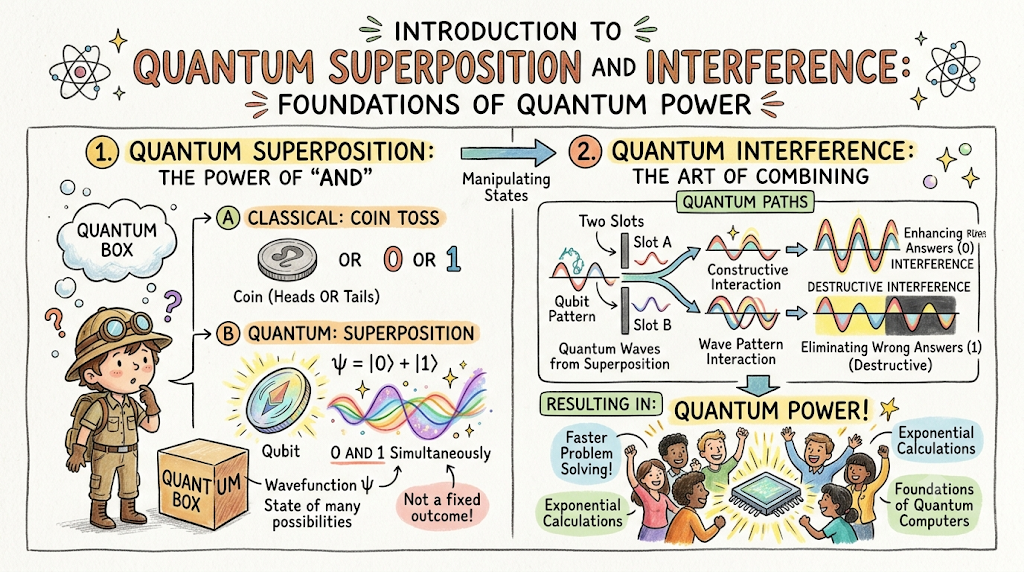
To make this concept intuitive, consider a classic coin flip analogy. If a coin rests flat on a desk, it displays a single state: heads or tails. This represents a classical binary system. But if you spin that coin rapidly on its edge, it becomes a blur of both possibilities at once. It is only when you slap your hand down to stop the spin that the coin is forced to settle into a single classical outcome.
Classical Bit:  [ Heads ] OR [ Tails ] (Static on table)
Quantum Qubit:  [ Heads ] AND [ Tails ] (Spinning blur)
In the realm of advanced computing, this fluid behavior is harnessed through qubits and superposition. While a standard computer architecture processes data using individual classical bits that must represent either a $0$ or a $1$, a quantum system utilizes quantum bits, or qubits. Because a qubit can enter a state of superposition, it can hold the value of $0$ and $1$ simultaneously, multiplying the machine’s processing capacity.
This dual existence is a real, physical state, not merely a limitation of our measuring instruments. A particle in superposition is genuinely exploring various physical paths, energy levels, or spin orientations at once. It maintains this fluid identity as long as it remains isolated from the external environment, acting as a rich wave of potential answers.
Classical vs Quantum States
To understand how quantum systems operate, it helps to directly compare the differences between classical bits and qubits and superposition mechanics. A classical bit relies on physical micro-components, such as an electric voltage level in a transistor or a magnetic alignment on a hard drive platter. These mechanisms are deterministic, meaning if you know the initial settings, you can predict the system’s exact state with complete certainty.
Classical Bit  ──> Transistor Voltage  ──> Deterministic (Always 0 or 1)
Quantum Qubit  ──> Subatomic Particle  ──> Probabilistic (0 and 1 Combined)
Qubits, by contrast, utilize the inherent probabilistic qualities of subatomic particles, such as the polarization state of a photon or the spin direction of an isolated electron. When placed into a superposition state, a qubit does not carry a secret, hidden value waiting to be revealed. Instead, its identity remains truly undecided, existing as a mathematical distribution of potential outcomes until an interaction occurs.
This structural difference fundamentally redefines the role of measurement within the two systems:
- Classical Measurement: Reading the state of a standard computer transistor is completely passive. You simply check the existing voltage value without changing the system’s trajectory.
- Quantum Measurement: Interacting with a qubit in superposition is an active event. The moment a measurement tool touches the particle, the delicate balancing act is shattered, forcing the system to collapse into a single, static classical value.
Mathematical Intuition of Superposition
You do not need to dive into complex advanced equations to understand the simple mathematical intuition behind quantum states. In quantum computing fundamentals, scientists describe the overall condition of a qubit using a tool called a state vector. Think of a state vector as a pointer on a specialized compass dial, where pointing straight up represents a definitive $0$ and pointing straight down represents a definitive $1$.
When a qubit enters a state of superposition, its vector pointer tilts away from those absolute vertical lines, aiming along an angled coordinate point on the dial. This angled position indicates that the qubit contains elements of both options simultaneously. The specific position of the pointer along this mathematical coordinate space dictates the odds of what the particle will choose when it is eventually measured.
         |0> (Straight Up: Definitive Zero)
          ▲
          │  ↗ State Vector (Tilted: Superposition of 0 and 1)
          │ /
          └───────────> |1> (Straight Right: Definitive One)
These mathematical coordinate positions are called probability amplitudes. While a standard probability calculation uses basic percentages that always sum directly to 100%, quantum amplitudes use complex values that can interact like physical waves. These amplitudes can enhance or cancel each other out, providing the mathematical foundation for quantum computing systems to guide particles toward correct computational paths.
What Is Quantum Interference?
Quantum interference is the physical mechanism that governs how the overlapping states within a superposition combine, interact, and shape the final observable probabilities of a system. This behavior stems directly from the dual wave-particle nature of quantum entities. Because subatomic particles behave like waves, their individual probability amplitudes travel through space like ripples moving across a pool of water.
When two or more quantum wave paths cross paths, they interact via two primary methods:
- Constructive Interference: This happens when the peaks of two waves line up perfectly, combining their energies to create a taller wave. In a quantum environment, constructive interference boosts the probability amplitude of a specific outcome, making that particular result much more likely to happen during a measurement.
- Destructive Interference: This occurs when the peak of one wave meets the valley of another, causing them to cancel each other out completely. In a quantum system, this interaction shrinks the probability amplitude of an outcome down to zero, ensuring that particular path becomes impossible to observe.
Constructive:  [Wave Peak] + [Wave Peak]   ──> Amplified Crest (High Probability)
Destructive:   [Wave Peak] + [Wave Valley] ──> Flattened Line  (Zero Probability)
This wave-like interaction changes how probabilities combine in a quantum system. In our everyday world, if you add more pathways to a destination, you always increase the odds of a traveler arriving there. In a quantum setup, however, adding a second path can introduce destructive interference, canceling out a particle’s probability amplitude and making it impossible for the entity to reach the destination at all.
Relationship Between Superposition and Interference
Superposition and quantum interference are not separate, isolated events; they are two sides of the same coin, structurally dependent on one another to exist. Superposition serves as the initial physical foundation, creating the multiple concurrent states and wave paths that a particle can explore. Without superposition, a system is locked into a single binary value, leaving no room for wave patterns to form.
Interference acts as the dynamic behavior that shapes those overlapping wave paths over time. Once superposition opens up multiple possibilities, interference guides how those paths interact and evolve. It is the mechanism that allows a quantum machine to sort through all the available overlapping data channels and arrange them into a useful structure.
[Superposition Foundational Layer] ──> Opens Multiple Coexisting Wave Paths
                                              │
[Interference Behavioral Layer]     ──> Shapes and Controls Final Path Probabilities
Because of this deep connection, both mechanics are inseparable within any functioning quantum system. Superposition allows a particle to explore multiple paths at once, while interference uses wave mechanics to control the probabilities of those paths. Together, they form the core engine that drives all quantum information systems.
Double-Slit Experiment Explanation
To truly appreciate how quantum superposition and interference function in a laboratory setting, one must examine the classic double slit experiment. This historic test provides clear, visual proof of wave-particle duality and demonstrates how subatomic entities behave when left unobserved.
[Particle Source] ──> [ Barrier with Slit A & Slit B ] ──> [ Detector Screen ]
                              │                                   │
                     Creates Superposition              Interference Pattern
The Experimental Setup
The experiment utilizes a simple architecture consisting of three primary components:
- A particle source capable of emitting individual quantum entities, such as photons or electrons, one at a time.
- A physical barrier positioned in the middle of the track containing two parallel openings, labeled Slit A and Slit B.
- A sensitive detector screen placed at the back of the bay to record the exact landing position of each arriving particle.
The Behavioral Outcome
If you fire macro-objects like tiny marbles through this setup, they behave deterministically. Each marble passes through either the left slit or the right slit, forming two simple, vertical columns of impacts on the back wall.
However, when you fire individual electrons through the barrier one by one, a completely different pattern emerges. Even though the particles travel through the apparatus isolated from one another, they do not form two straight lines. Instead, over time, the impacts across the back screen build a highly detailed pattern of alternating light and dark bands—a classic interference pattern.
This visual proof reveals that each individual electron enters a state of superposition at the barrier, passing through both Slit A and Slit B at the same time. The wave from Slit A then interacts with the wave from Slit B, creating constructive and destructive interference regions that dictate where the electron can and cannot land on the detector screen.
The Observation Effect
The most astonishing part of the experiment happens when researchers place a small monitoring camera next to the barrier to watch exactly which slit each electron passes through. The moment this measurement device is turned on, the system’s behavior changes instantly.
The electrons stop acting like waves and begin behaving like solid, classical marbles. They pass cleanly through one slit or the other, and the alternating interference pattern on the back screen vanishes, replaced by two standard vertical rows. The act of observation destroys the superposition, proving that measuring a quantum system fundamentally alters its physical behavior.
Measurement and Wavefunction Collapse
The sudden shift from a fluid cloud of quantum possibilities to a single, concrete outcome is known as wavefunction collapse. In quantum mechanics, a particle’s potential states are described by a fluid mathematical equation called a wavefunction. This wave equation tracks all the paths open to the particle, along with their respective probability amplitudes.
When a measurement device interacts with that particle, it forces the system to make a definitive choice. The fluid wavefunction collapses instantly, dropping the probability amplitudes for all other paths down to zero while locking the chosen path at 100%. This interaction marks the exact point where a system crosses over from a fluid quantum state to a fixed classical reality.
Fluid Wavefunction ──> [Measurement Interaction] ──> Instant Collapse to Single Fixed Value
What triggers this sudden transition is decoherence—the unwanted interaction between a delicate quantum particle and the large macroscopic environment. When a qubit bumps into surrounding atoms or encounters stray electrical signals, it shares its quantum information with the outside world. This environmental noise breaks the particle’s superposition, washing away its wave patterns and freezing it into a standard classical state.
Real-World Meaning of Superposition
In the tech sector, quantum superposition is transitioning from a theoretical physics concept into a structural tool for next-generation data processing. By using qubits that can process $0$ and $1$ values at the same time, quantum computers can handle complex information arrays that would lock up a standard silicon supercomputer.
To understand this processing power, compare how both architectures navigate a complex maze. A classical computer searches for the exit by testing one path at a time, moving sequentially down a track, hitting a dead end, backing up, and trying the next lane. If the maze contains millions of possible routes, this step-by-step search can take years to complete.
Sequential Classical Search:  [Path 1] ──> [Path 2] ──> [Path 3] (One by One)
Parallel Quantum Search:      [Path 1, Path 2, Path 3 Combined]   (All Paths at Once)
A quantum computer solves the maze by utilizing qubits in a state of superposition. This allows the machine to explore every single available pathway through the maze simultaneously. Instead of running millions of separate searches one after the other, the computer evaluates the entire network of options in a single operational step, delivering an exponential leap in speed.
This parallel computing capability provides a massive quantum advantage for specific, highly complex mathematical problems. Tasks like analyzing intricate corporate logistics, simulating complex chemical reactions, or optimizing global financial portfolios require processing billions of variables at once. Superposition gives quantum hardware the structural foundation needed to solve these problems in minutes.
Real-World Applications of Interference
While superposition allows a quantum machine to hold millions of values at once, it is quantum interference that allows engineers to extract the correct answer from that sea of data. Without interference, measuring a computer’s qubits would simply yield a random selection of data fragments, rendering the parallel processing power useless.
Raw Superposition Data ──> [Interference Optimization Engine] ──> Valid Answer Highlighted
Advanced Quantum Algorithms
Engineers use interference patterns to design advanced quantum algorithms, such as Grover’s search algorithm and Shor’s factoring method. These frameworks are built so that the wrong paths through a calculation cause destructive interference, canceling each other out and dropping their probabilities to zero. At the same time, the valid computational paths cause constructive interference, boosting the correct answer so it stands out clearly when the qubits are measured.
Quantum Sensing and Metrology
Beyond computing, interference principles are driving major advancements in quantum sensing and ultra-precise measurement tools. Devices like quantum gravimeters and atomic interferometers track how ambient fields alter the phase of a particle’s wave pattern. By watching these fine adjustments, these sensors can map underground mineral reserves or detect tiny gravitational shifts with accuracy far beyond classical tools.
Secure Cryptography
Interference also serves as a foundational component in quantum key distribution networks, enabling ultra-secure communication channels. These cryptographic systems transmit data using individual, entangled photons put into delicate superposition states. If an outside eavesdropper attempts to intercept or view the data stream, their measurement collapse instantly alerts the main administrators and renders the stolen key useless.
Molecular Simulation Systems
Finally, interference mechanics allow quantum hardware to accurately simulate the complex wave behaviors of atoms and molecular bonds. Standard supercomputers struggle to model these fine quantum interactions because the math scales out too quickly. By using physical qubits that naturally mirror these subatomic wave patterns, quantum systems can model complex chemical reactions, accelerating the discovery of life-saving medicines and new clean energy materials.
Challenges in Maintaining Superposition
The primary bottleneck preventing engineers from building large-scale quantum computers is the extreme difficulty of protecting a qubit’s delicate superposition state. Because these subatomic wave patterns are highly fragile, they require total isolation from the outside world to keep their probabilities stable.
The greatest threat to this stability is quantum decoherence, which happens when a qubit accidentally interacts with the surrounding environment. Even a tiny bump from a nearby atom, a stray electromagnetic wave, or a minor vibration from a cooling fan can disrupt the system’s alignment. This environmental leak breaks the superposition, destroying your data wave patterns and causing the qubit to drop back into a simple classical state.
Stable Superposition Wave ──> [Stray Heat / Vibration] ──> Decoherence Collapse to Classical State
To fight decoherence, modern quantum processors must run inside highly controlled environments. System engineers isolate quantum chips inside multi-layered dilution refrigerators that cool the hardware down to temperatures below $0.01\text{ Kelvin}$—colder than deep outer space. This extreme cooling stops atomic movement and minimizes thermal noise, giving qubits the quiet environment they need to finish complex calculations before their wave states break down.
Why Interference Is Critical in Quantum Computing
It is common to hear people say that a quantum computer’s power comes entirely from its ability to hold millions of data values at once using superposition. However, this tells only half the story. The real secret to quantum computing lies in how engineers use quantum interference to isolate the exact answer you need from that massive pool of possibilities.
When a quantum computer finishes a calculation, its qubits exist in a wide superposition of all possible answers—both right and wrong. If you simply measured the system at that point, the wave state would collapse randomly, returning a useless jumble of data. To avoid this, quantum algorithms use interference to actively reshape those probabilities before any measurement occurs.
[Vast Superposition Blur] ──> Destructive Interference (Cancels Wrong Paths)
                          └──> Constructive Interference (Boosts Correct Answer) ──> Measured Output
The algorithm guides the qubits through a sequence of logic gates designed to manipulate their wave phases. It forces the incorrect computational paths to collide and experience destructive interference, canceling out their wave heights. Simultaneously, it aligns the valid paths to cause constructive interference, amplifying the correct solution so it can be read with near-perfect certainty during final measurement.
Quantum Technologies Using These Principles
Quantum Computers
These next-generation computing systems use interconnected arrays of superconducting loops, trapped ions, or silicon quantum dots to run advanced algorithms. By manipulating qubits in states of superposition, these processors can solve complex data problems that would take a standard supercomputer thousands of years to complete.
Quantum Communication Systems
These specialized networks secure long-distance data transfers using the unhackable laws of physics. By transmitting encryption keys via single photons in superposition, these channels ensure total privacy; any attempt by an outside hacker to spy on the stream instantly breaks the wave state, alerting the network operators.
Quantum Sensors
These high-precision measurement tools track fine structural anomalies across magnetic, electrical, and gravitational fields. By measuring how outside forces alter the phase of a controlled particle wave, these instruments enable next-generation medical imaging, autonomous navigation without GPS, and advanced geological mapping.
Quantum Simulators
These specialized systems are tuned to accurately model the quantum behaviors of molecules, materials, and complex subatomic systems. They allow research scientists to test new chemical combinations, discover advanced materials, and study high-temperature superconductors without running slow, expensive laboratory experiments.
Future of Superposition-Based Systems
The next major milestone for quantum technology is building scalable qubit architectures that can grow without increasing system errors. Modern quantum chips contain only a few hundred physical qubits because keeping large arrays stable is incredibly difficult. Overcoming this hurdle requires moving toward fault-tolerant quantum computing, which groups thousands of fragile physical qubits together into highly stable logical qubits protected by automated error-correction software.
Fragile Physical Qubits (Thousands) ──> [Error-Correction Software] ──> 1 Stable Logical Qubit
As these architectures stabilize, we will see a major expansion of hybrid quantum-classical computing frameworks. Instead of replacing standard computers entirely, quantum processors will function as specialized accelerators connected to traditional data centers. High-performance classical systems will handle standard data tasks and hand off complex mathematical problems—like logistics routing or molecular modeling—to quantum hardware.
Ultimately, this computing revolution will unlock advanced Quantum AI systems. Modern machine learning models require massive amounts of data and computing power to train their neural networks. By processing data variables using qubits in superposition and optimizing neural paths via automated interference algorithms, next-generation AI platforms can train in fractions of the time, driving breakthroughs across every industry.
Key Takeaways
- Simultaneous Realities: Quantum superposition allows a subatomic system to exist in multiple potential configurations at once, breaking past classical binary limits.
- Probability Manipulation: Quantum interference shapes system outcomes by using wave mechanics to boost valid data paths and cancel out incorrect ones.
- The Observation Rule: Any physical interaction or measurement triggers a wavefunction collapse, freezing fluid quantum waves into a single classical state.
- The Innovation Engine: Combining superposition and interference provides the core processing engine that allows quantum hardware to tackle complex data challenges.
FAQ Section
1.What is quantum superposition in simple words?
Quantum superposition is the ability of a subatomic particle, like an electron or photon, to exist in multiple states or configurations at the same time. Think of it like a spinning coin: while it is spinning, it exists as a blur of both heads and tails simultaneously, only settling into a single state when you stop the spin.
2.What is quantum interference?
Quantum interference is the behavior where the overlapping possibilities of a particle in superposition interact like waves. In constructive interference, the wave heights combine to make a specific outcome much more likely to happen; in destructive interference, the waves cancel each other out, making that path impossible.
3.How are superposition and interference related?
Superposition serves as the initial foundation, opening up multiple concurrent states and wave paths for a particle to explore. Interference acts as the steering mechanism, using wave interactions to shape, shift, and control the final probabilities of those paths. You cannot run a functioning quantum algorithm without both principles working together.
4.What happens in the double-slit experiment?
In the double-slit experiment, individual particles fired at a barrier with two openings pass through both slots at the same time, entering a state of superposition. The paths interact to create an alternating wave pattern on a back screen. However, if you place a camera to watch the slits, the superposition breaks down instantly, and the wave pattern vanishes.
5.Can we observe a quantum state directly?
No, you cannot directly observe a quantum state while it is in a superposition. The moment a measurement tool interacts with a delicate quantum particle, the wavefunction collapses, forcing the system to instantly freeze into a standard binary state ($0$ or $1$). We can only observe the final classical result of the collapse.
6.Why does measurement change quantum systems?
Measurement changes a quantum system because it introduces physical interaction and environmental noise, a process known as decoherence. When a delicate qubit bumps into an outside camera sensor or light photon, it shares its data with the environment, breaking its superposition wave state and dropping it into a classical state.
7.What is a qubit in superposition?
A qubit in superposition is a quantum computing bit that holds the values of $0$ and $1$ at the same time. This capability allows a quantum computer to evaluate vast numbers of operational paths simultaneously, delivering an exponential leap in processing speed compared to standard silicon computers.
8.How is interference used in quantum computing?
Quantum computing algorithms use interference to isolate the correct answer to a problem from a sea of data possibilities. Engineers configure the software steps so that wrong paths experience destructive interference and cancel each other out, while the correct computational paths cause constructive interference, amplifying the right answer.
9.What causes loss of superposition?
The loss of superposition is caused by quantum decoherence, which happens when a particle interacts with outside environmental noise, such as stray magnetic fields, air molecules, or temperature shifts. To protect qubits against this breakdown, quantum chips must run inside heavily shielded refrigerators cooled near absolute zero.
10.How can beginners learn quantum concepts easily?
Beginners can master quantum principles by focusing on intuitive visual analogies, studying wave mechanics, and exploring introductory educational resources. Following structured tutorials and real-world examples on specialized quantum platforms like QuantumUting provides an excellent, math-free foundation for mastering these advanced concepts.
Conclusion
Mastering the core principles of quantum superposition and interference requires moving past the rigid, binary logic of our everyday classical world. At the subatomic scale, nature reveals a fluid landscape where particles can explore multiple physical realities at the same time and use wave mechanics to shape their own probabilities. Trying to understand next-generation technologies using only classical intuition creates blind spots, as these advanced systems depend entirely on properties that do not exist in traditional physics.
Bringing these subatomic principles into the technology sector marks a major shift in how we process information. Superposition gives quantum systems the raw power to explore millions of calculations at once, while interference provides the precise control needed to find the correct answer amidst that data. Together, these principles form the core processing engine that allows quantum hardware to solve complex, global challenges that would lock up the world’s fastest silicon supercomputers.
