Introduction
The world of technology is undergoing a foundational shift. For decades, classical computers have relied on binary pieces of information called bits, which exist as either a 0 or a 1. While this framework has driven the digital age, modern computational challenges demand a fundamentally different approach. This is where quantum computing steps in, capturing the attention of scientists, enterprise leaders, and developers globally.
Understanding quantum entanglement is no longer just an academic exercise for theoretical physicists. For beginners, students, and IT professionals, learning these quantum fundamentals is the key to entering the next era of engineering and software development. As quantum networks, secure communication channels, and advanced algorithms move out of laboratory testing and into industrial applications, professionals who grasp these concepts early will be at the forefront of the industry.
To help bridge the gap between complex physics and practical application, educational platforms like QuantumUting provide accessible resources, structured insights, and clear guides designed to transform curious learners into capable quantum thinkers. By mastering how entanglement drives the quantum revolution, you prepare yourself to work with technologies that will redefine cybersecurity, medicine, and global infrastructure.
What Is Quantum Entanglement?
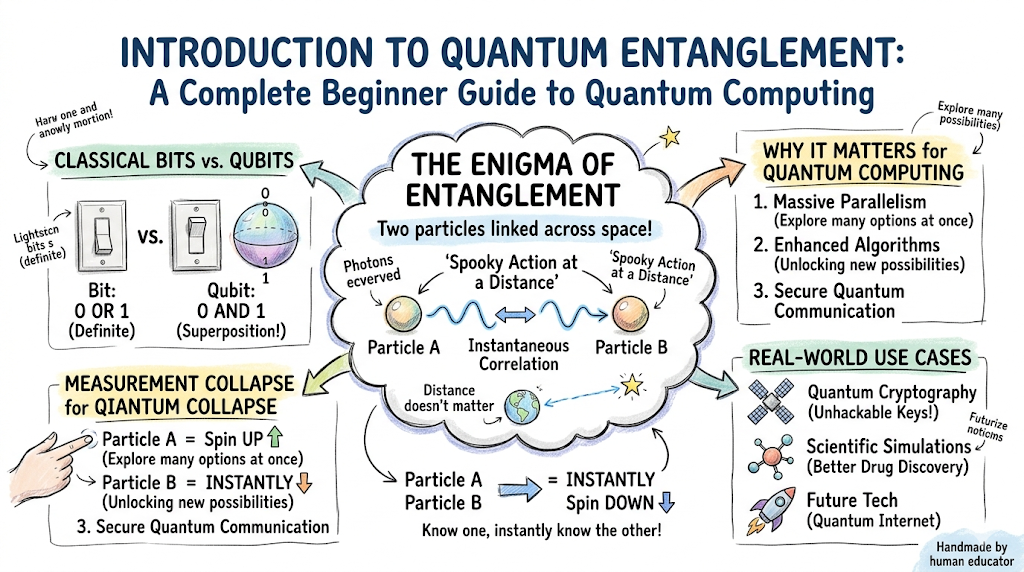
To understand quantum entanglement, one must first look at the basics of quantum mechanics, the branch of physics that governs the behavior of matter and light at the atomic and subatomic scales. In our everyday macroscopic world, an object has definite properties; a coin sitting on a table is either heads or tails. However, in the quantum realm, particles can exist in multiple states simultaneously until they are observed or measured.
When two particles, such as electrons or photons, interact in a specific manner, they can become entangled. Once entangled, their individual physical properties (such as spin, position, or polarization) become inherently linked. If you measure the state of one particle, you instantly know the state of its entangled partner, even if one particle remains on Earth and the other is placed on the edge of the galaxy.
The Historical Context and “Spooky Action”
The concept of entanglement was so radical that it deeply troubled some of the greatest minds in physics. In 1935, Albert Einstein, Boris Podolsky, and Nathan Rosen published the EPR paper, arguing that quantum mechanics was incomplete. Einstein could not accept that an action performed on one particle could instantly affect another distant particle, as this seemed to violate the speed-of-light limit set by his own theory of relativity. He famously dismissed the phenomenon as “spooky action at a distance.”
Decades later, physicist John Bell formulated a mathematical framework known as Bell’s Theorem, which allowed scientists to test this phenomenon experimentally. Subsequent experiments have consistently proven that quantum entanglement is real, reproducible, and does not violate relativity, because no actual usable information is traveling through classical space faster than light. Instead, the correlation is an intrinsic property of the quantum system itself.
Why Entanglement Matters in Computing
In classical computing, a system with two bits can exist in one of four definite configurations at any given moment:
- 00
- 01
- 10
- 11
In quantum computing, we use quantum bits, or qubits. When these qubits are entangled, they do not exist as isolated components. Instead, a system of entangled qubits holds all four combinations simultaneously. As you add more entangled qubits, the information-carrying capacity of the system grows exponentially, allowing a quantum computer to evaluate a vast number of possibilities at the same time.
Why Quantum Entanglement Matters in Modern Technology
Quantum entanglement is not just a fascinating physics concept; it is the fundamental fuel for advanced technology. By leveraging the instantaneous correlation between entangled particles, engineers can build systems that outperform classical infrastructure across several key domains.
Faster Computation Potential
While a classical computer processes calculations sequentially, an array of entangled qubits processes a massive solution space all at once. For specific, highly complex mathematical problems—such as factoring large numbers or searching unindexed databases—entangled quantum systems can find answers in minutes where classical supercomputers would stall.
Quantum Communication and Cryptography
The instant correlation of entanglement enables entirely secure methods of transmitting data. Through a process called Quantum Key Distribution (QKD), cryptographic keys can be shared using entangled photons. Because observing a quantum system alters its state, any attempt by an eavesdropper to intercept the key instantly breaks the entanglement. This Alerts the communicating parties immediately, making the hack detectable by the laws of physics.
Parallel Information Processing and Networking
Entanglement allows for the creation of quantum networks, where quantum information can be routed between distant quantum processors. This forms the foundation of the conceptual “quantum internet.” By linking smaller quantum computers together via entangled channels, we can create a distributed quantum computing network capable of solving enterprise-level optimization problems.
Advanced Scientific Simulations
Simulating the behavior of molecules, chemical bonds, and subatomic structures is incredibly difficult for classical computers because the interactions are governed by quantum mechanics. A quantum computer utilizing entangled qubits natively speaks the language of molecular physics, allowing researchers to accurately simulate new materials, optimize renewable energy cells, and model biological processes with unprecedented precision.
Core Concepts of Quantum Entanglement
To build a complete understanding of quantum technology, it is necessary to break down the core scientific concepts that govern these systems.
Qubits
The qubit is the fundamental unit of quantum information. Unlike a classical bit made of silicon that switches between 0 and 1 using electrical voltage, a qubit can be built from physical systems like a trapped ion, a superconducting circuit, or the spin of an electron.
Superposition
Superposition is the ability of a quantum system to be in multiple states at the same time. Think of a spinning coin: while it is spinning on the table, it is not definitively heads or tails; it is a blend of both states until you catch it and force it to land. Superposition allows a qubit to represent a 0, a 1, or any quantum combination of both simultaneously.
Quantum States
A quantum state is a mathematical description of a quantum system. It provides the probabilities for each possible outcome when a measurement is performed on the system. Engineers manipulate these states using precise microwave pulses or lasers to perform calculations.
Entangled Qubits
When two qubits are placed into an entangled state, their individual identities merge into a single shared quantum state. The state of qubit A cannot be described independently of the state of qubit B. This creates a deeply coordinated system where changes to one qubit instantly adjust the probability distribution of its partner.
Quantum Measurement
Measurement is the act of observing a quantum system. Before measurement, qubits exist in a delicate cloud of probabilities (superposition). The moment a measurement occurs, the quantum state collapses into a definite classical state of either 0 or 1. In an entangled pair, measuring the first qubit collapses the state of the second qubit instantly.
Quantum Gates
Similar to how classical computers use logic gates (AND, OR, NOT) to manipulate bits, quantum computers use quantum gates to manipulate qubits. Quantum gates alter the probabilities of superposition and can actively entangle multiple qubits together. An example is the Controlled-NOT (CNOT) gate, which is frequently used to generate entanglement between two qubits.
Quantum Teleportation
Quantum teleportation is the transfer of an exact quantum state from one location to another using an entangled pair of particles and classical communication channels. It does not physically move matter across space; instead, it moves the exact informational state of a particle, destroying the original state and recreating it perfectly on the distant entangled particle.
Quantum Communication
Quantum communication involves the transmission of quantum information (qubits) over long distances. This is typically achieved by firing entangled photons through specialized fiber-optic cables or transmitting them via satellite links to ground stations.
Quantum Algorithms
A quantum algorithm is a step-by-step procedure designed to run on a quantum computer. These algorithms, such as Shor’s Algorithm for factoring integers or Grover’s Algorithm for database searching, are specifically written to utilize superposition and entanglement to solve problems faster than classical software.
Quantum Decoherence
The greatest obstacle in quantum computing is quantum decoherence. Qubits are highly sensitive to their surrounding environment. Any interference from heat, electromagnetic waves, or physical vibration can cause the qubits to lose their quantum properties and fall out of entanglement. This destroys the computation, resulting in processing errors.
Quantum Computing Architecture & Workflow
Operating a quantum computer requires a careful integration of classical computing controls and quantum physics environments. Below is a conceptual breakdown of how a quantum computing workflow operates from start to finish.
1. Quantum State Preparation
The workflow begins with qubit initialization. The qubits inside the processor must be cooled to near absolute zero (in superconducting systems) or trapped in a vacuum to eliminate environmental noise. They are then set to a pristine ground state, typically representing a clean classical 0.
2. Superposition and Entanglement Generation
The quantum computer applies a series of initialization gates (such as the Hadamard gate) to place the qubits into a state of superposition. Following this, multi-qubit gates are applied to link specific qubits together, generating the quantum entanglement required for complex parallel processing.
3. Quantum Operations and Processing
The quantum algorithm executes by applying a choreographed sequence of quantum gates. These gates shift the mathematical phases of the qubits, causing the correct answers to constructively interfere (strengthen) and the incorrect answers to destructively interfere (cancel each other out).
4. Measurement Systems
Once the processing steps are complete, the system triggers a readout sequence. The measurement sensors capture the final state of the qubits, collapsing the quantum data into standard classical bits (0s and 1s) that a human engineer can read.
5. Classical + Quantum Integration
Because quantum computers output probabilistic data, the workflow often requires running the quantum circuit multiple times (known as “shots”). A classical computer works in tandem with the quantum processor, collecting the readouts, running error mitigation software, and presenting the final stabilized data to the user.
Quantum Entanglement Lifecycle
The journey of an entangled state from creation to measurement follows a strict lifecycle within a quantum processor. The table below outlines each phase of this process.
| Stage | Purpose | Technologies Used | Real-World Outcome |
| Qubit Initialization | Resets qubits to a known baseline state to prevent initial calculation errors. | Cryogenic dilution refrigerators, laser cooling, trapped ion traps. | A stable group of qubits resting at their lowest energy state (0). |
| Superposition Creation | Prepares the qubits to hold multiple data possibilities at the same time. | Hadamard gates, precise radiofrequency or microwave pulses. | Qubits transition from single values to active probabilistic states. |
| Entanglement Generation | Links individual qubits together into a unified, highly cooperative system. | Controlled-NOT (CNOT) gates, entangling laser pulses. | A combined quantum state where qubits share processing pathways. |
| Quantum Processing | Manipulates the entangled states to run specific calculations and algorithms. | Quantum logic gate arrays, phase-shifting operations. | Amplification of correct computational paths while dampening errors. |
| Measurement | Collapses the quantum states into definitive values for analysis. | Superconducting quantum interference devices (SQUIDs), optical detectors. | Quantum information is translated into standard classical bits (0 and 1). |
| Error Correction | Identifies and fixes bit-flips or phase-flips caused by environmental noise. | Quantum Error Correction (QEC) codes, surface codes. | High-fidelity data retention despite minor environmental disruptions. |
| Classical Interpretation | Formats the raw measurement numbers into useful structural answers. | Classical software libraries, CPU/GPU processing units. | Readable data sets, solved optimization problems, or clean crypto keys. |
| Continuous Optimization | Calibrates the control systems for subsequent computational cycles. | Automated machine learning control loops, feedback electronics. | Improved gate fidelity and longer coherence times for future runs. |
Popular Quantum Computing Platforms & Tools
The quantum ecosystem has expanded rapidly, providing developers, researchers, and enterprises with real cloud access to quantum hardware and advanced simulators.
Quantum Programming Frameworks
You do not need a physics lab to write quantum code. Modern open-source programming frameworks allow developers to build quantum circuits using familiar languages like Python.
- Qiskit: Developed by IBM, this is the most widely used open-source SDK for working with quantum circuits, pulses, and algorithms.
- Cirq: Created by Google, this framework is specifically optimized for writing and deploying algorithms on Noisy Intermediate-Scale Quantum (NISQ) processors.
- Pennylane: Built by Xanadu, this library bridges the gap between quantum computing and machine learning, allowing for differentiable quantum circuits.
Quantum Hardware and Cloud Services
Major technology providers host real quantum computers in specialized data centers and open access to them over the internet via cloud platforms.
- IBM Quantum: Offers direct access to a fleet of real superconducting quantum processors alongside comprehensive educational tools.
- Amazon Braket: A fully managed AWS service that allows users to test algorithms on hardware from different providers, including trapped-ion, superconducting, and neutral-atom technologies.
- Microsoft Azure Quantum: Provides a cloud ecosystem featuring diverse quantum hardware partners and integrated development environments.
Tool Comparison Matrix
| Tool / Platform | Primary Purpose | Difficulty | Enterprise Usage |
| Qiskit (IBM) | Developing and testing general quantum circuits and algorithms. | Beginner to Intermediate | High; widely adopted across banking, research, and academia. |
| Cirq (Google) | Designing algorithms for near-term quantum hardware systems. | Intermediate to Advanced | Moderate; heavily utilized in hardware-specific research labs. |
| Amazon Braket | Multi-hardware cloud testing and quantum hardware comparison. | Intermediate | High; popular for corporate R&D teams leveraging cloud infrastructure. |
| PennyLane | Quantum machine learning and molecular simulation tasks. | Advanced | Growing; popular among data scientists and chemical researchers. |
Real-World Use Cases of Quantum Entanglement
While early quantum systems are still scaling up, the practical applications of quantum entanglement span across many global industries.
Quantum Cryptography and Secure Networks
As classical supercomputers grow more powerful, traditional encryption methods (like RSA) face long-term vulnerabilities. Quantum Key Distribution (QKD) systems utilize entangled photons to build completely secure communication links. Financial institutions and government agencies are actively building these networks to safeguard national security data against future decryption methods.
Drug Discovery and Molecular Science
Traditional chemistry software relies on approximations when modeling molecular structures because calculating exact electron interactions is too complex. Quantum computers use entangled states to perfectly simulate molecular bonds. This enables pharmaceutical companies to discover targeted therapies, predict drug interactions, and bring lifesaving medications to market faster.
Financial Modeling and Portfolio Optimization
The financial world relies heavily on risk analysis, asset pricing, and portfolio diversification. Quantum algorithms can evaluate millions of correlated market factors simultaneously. By analyzing complex market dependencies through entangled states, investment firms can optimize portfolios and assess risk profiles with unparalleled accuracy.
Logistics and Supply Chain Optimization
From routing global shipping container fleets to optimizing electrical grids, logistics challenges often involve thousands of moving parts. Quantum optimization algorithms navigate these complex combinatorial options efficiently, helping transportation enterprises reduce fuel usage, cut delivery times, and maximize supply chain output.
Benefits of Quantum Entanglement in Computing
Integrating quantum entanglement into enterprise architecture unlocks capabilities that are fundamentally impossible with classical setups.
- Massive Information Processing Scaling: Every entangled qubit added to a processor doubles the system’s simultaneous state capacity. A system with 300 perfectly entangled qubits can hold more states than there are atoms in the observable universe.
- Tamper-Evident Cyber Defenses: Because measuring an entangled system permanently changes its state, unauthorized data interception is exposed instantly, bringing an entirely new level of trust to communication channels.
- High-Dimensional Problem Solving: Many industrial challenges involve complex, interconnected variables. Entanglement allows a quantum computer to map out these dependencies naturally, leading to cleaner solutions in machine learning and material science.
- Energy-Efficient Complex Computation: For massive scientific calculations, quantum computers can find solutions using significantly less time and power than a traditional server farm running for weeks on end.
Challenges & Limitations
Despite its immense potential, engineering stable quantum systems presents significant technical hurdles that the scientific community is working hard to solve.
Hardware Instability and Decoherence
Qubits are fragile. Small changes in room temperature, stray magnetic fields, or minor vibrations can destroy their entangled state in a fraction of a second. Keeping quantum processors isolated from these environmental disruptions requires heavy engineering and advanced isolation systems.
The Need for Extreme Cryogenics
Most modern superconducting quantum processors must be kept at temperatures colder than deep space—around 0.015 Kelvin. Operating these dilution refrigerators requires significant infrastructure, high electrical power, and specialized maintenance facilities, limiting widespread on-premise installation.
The Scale of Quantum Error Correction
Because qubits are prone to decoherence, a large portion of a quantum computer’s processing power must be dedicated to tracking and correcting internal errors. To run a complex algorithm reliably, a machine might need millions of physical qubits just to maintain a few thousand stable, error-corrected “logical” qubits.
A Critical Global Skill Shortage
The quantum industry is growing faster than universities can train professionals. There is a profound shortage of software engineers, systems architects, and developers who understand both the underlying physics and modern enterprise software practices. This makes educational access an urgent priority.
Quantum Computing Career Opportunities
The quantum economy is expanding from pure research labs into global enterprise offices. This transition is opening up diverse career paths for technical professionals.
In-Demand Industry Roles
- Quantum Software Engineer: Designs, optimizes, and maintains the software development kits (SDKs) and execution layers that connect classical programming interfaces to quantum systems.
- Quantum Algorithm Developer: invents new mathematical workflows and routines to solve specific problems in optimization, machine learning, and cryptography.
- Quantum Systems Architect: Oversees the integration of quantum processing units (QPUs) with classical server infrastructure in enterprise environments.
- Quantum Security Specialist: Assists enterprises in transitioning their traditional data encryption systems over to quantum-resistant standards and QKD setups.
Educational Background and Requirements
While advanced research roles still require a Ph.D. in Quantum Physics or Electrical Engineering, application-level roles are increasingly open to individuals with strong backgrounds in Computer Science, Applied Mathematics, or Data Science. If you are proficient in Python, linear algebra, and data structures, you can build up the necessary quantum knowledge through focused study.
Beginner Roadmap for Learning Quantum Computing
If you want to transition into quantum technology, following a structured learning path will help you avoid getting overwhelmed by the mathematics and theory.
Step 1: Secure Your Foundational Mathematics
Before writing code, make sure you understand the core concepts of linear algebra. You should be comfortable with:
- Vectors and matrices
- Matrix multiplication
- Complex numbers
- Probability distributions
Step 2: Master Python Programming
Python is the standard language of the quantum development world. Focus on learning core programming logic, object-oriented principles, and data scientific libraries like NumPy and SciPy.
Step 3: Study Basic Quantum Concepts
Learn the core vocabulary of quantum mechanics without getting bogged down in advanced physics equations. Focus entirely on understanding what superposition, measurement, and quantum entanglement mean conceptually.
Step 4: Start Writing Code with Quantum Simulators
Install an open-source framework like Qiskit. Begin by building simple two-qubit circuits on your local computer using a quantum simulator. A simulator mimics a quantum processor on your classical machine, allowing you to learn how gates alter qubit states without needing real hardware access right away.
Step 5: Engage with Open-Source Projects and Communities
Join online communities, read educational blogs, and participate in quantum hackathons. Working on small open-source projects, such as building a basic quantum random number generator, helps cement your conceptual knowledge through hands-on experience.
Certifications & Training
Structured certifications and training pathways help validate your skills to employers while providing a methodical way to measure your personal progress.
| Certification / Program | Target Level | Best For | Skills Covered |
| IBM Quantum Developer Certification | Intermediate | Programmers wanting to prove practical Qiskit proficiency. | Circuit building, quantum gate applications, SDK execution. |
| Enterprise Quantum Training (QuantumUting) | Beginner | Professionals looking to apply quantum concepts to business workflows. | Quantum foundations, cryptography basics, industrial use cases. |
| EdX / Coursera University Programs | Beginner to Intermediate | Students seeking structured academic theory. | Linear algebra, quantum mechanics history, algorithms. |
When planning your education, look for programs that balance theoretical lectures with hands-on coding exercises. Utilizing structured training pathways, such as those provided by QuantumUting, ensures you spend your time on practical skills that align with current industry demands.
Common Beginner Mistakes
- Ignoring the Mathematics Fundamentals: Attempting to build quantum algorithms without understanding basic vector multiplication makes it incredibly difficult to debug why a circuit is behaving unexpectedly.
- Learning Theory Without Practical Application: Spending months reading pure physics textbooks without writing any code can lead to conceptual burnout. Balance your reading by building actual circuits on a simulator.
- Expecting Instant Computational Mastery: Quantum computers will not make everyday web browsing or video gaming faster. Believing that quantum tech completely replaces classical computers leads to unrealistic expectations.
- Chasing Buzzwords Instead of Concepts: Focus on mastering foundational mechanics like state preparation and entanglement before trying to tackle abstract, advanced topics like “quantum machine learning.”
Best Practices for Learning Quantum Computing
- Start with the Absolute Basics: Ensure you can confidently explain the difference between a classical bit and a qubit before moving into multi-qubit systems.
- Work Progressively with Simulators: Run your code on local classical simulators first. Once your circuit works perfectly without errors, deploy it to real quantum hardware via the cloud to see how real-world noise affects your results.
- Deconstruct Algorithms Slowly: When studying complex algorithms like Shor’s or Grover’s, break them down into smaller pieces. Study how each individual quantum gate alters the probability distribution.
- Maintain Scientific Curiosity: Approach the subject with patience. Quantum computing requires a mindset shift from traditional programming, so give your brain time to adapt to these new concepts.
Future of Quantum Entanglement
The long-term trajectory of quantum technology is set to transform the global digital ecosystem over the next several decades.
The Quantum Internet
Researchers are actively working on scaling up quantum repeaters, which preserve entanglement over long distances. This infrastructure will eventually lead to a global quantum internet, allowing unconditionally secure data transmission and real-time collaboration between quantum data centers worldwide.
Hybrid Classical-Quantum Systems
The immediate future of enterprise computing does not involve standalone quantum machines. Instead, we are entering an era of hybrid data centers. High-performance classical supercomputers will handle traditional data management, offloading specific, highly complex mathematical tasks to an attached quantum coprocessor. This collaborative approach will maximize the strengths of both architectural frameworks.
FAQs
1. What is quantum entanglement in simple words?
Quantum entanglement is a phenomenon where two subatomic particles become deeply connected, causing the physical state of one particle to instantly match the state of the other, regardless of the distance separating them.
2. What are qubits?
Qubits, or quantum bits, are the foundational units of information in a quantum computer. Unlike classical bits that can only be a 0 or a 1, qubits can exist in a state of superposition, representing both values at the same time.
3. Why did Einstein call it spooky action at a distance?
Einstein called it “spooky action” because the instantaneous correlation between entangled particles seemed to challenge his theory of relativity, which states that nothing can travel faster than the speed of light.
4. Is quantum computing difficult to learn?
It requires a new mental approach because it relies on quantum mechanics rather than traditional binary logic. However, anyone with a solid grasp of basic linear algebra and Python programming can learn to write quantum code.
5. Does quantum computing replace classical computers?
No. Quantum computers are specialized accelerators. They are designed to solve specific, highly complex mathematical and scientific problems, while classical computers will remain the ideal choice for everyday tasks like word processing, web browsing, and video streaming.
6. Which programming language is used in quantum computing?
Python is the dominant programming language used in the quantum industry. Most major development frameworks, including Qiskit and Cirq, are built as Python libraries.
7. Can beginners learn quantum computing?
Yes. With the wealth of open-source frameworks, interactive simulators, and structured educational resources available today, beginners can start building real quantum circuits without needing a laboratory.
8. What industries use quantum technology?
The primary industries investing in quantum systems include cybersecurity, banking and finance, pharmaceuticals, logistics, aerospace, and advanced materials engineering.
9. What is quantum decoherence?
Quantum decoherence is the process where qubits lose their quantum properties (like superposition and entanglement) due to interference from their surrounding environment, such as temperature fluctuations or electromagnetic noise.
10. What is a quantum gate?
A quantum gate is a fundamental building block of a quantum circuit. It operates on physical qubits to alter their state, shift their phases, or entangle them with other qubits to perform calculations.
11. How do you create an entangled qubit pair?
In a quantum computer, entanglement is typically generated by applying a multi-qubit logic gate, such as a Controlled-NOT (CNOT) gate, which links the state of a target qubit to the state of a control qubit.
12. What is Quantum Key Distribution?
Quantum Key Distribution (QKD) is a secure communication method that uses the principles of quantum mechanics to share cryptographic keys. Any attempt to intercept the key breaks the entanglement, instantly alerting the users.
13. Do I need a quantum physics degree to work in this industry?
While hardware design and foundational research often require a Ph.D. in physics, there is an increasing demand for software developers, educators, and systems analysts who come from general computer science backgrounds.
14. What is a quantum simulator?
A quantum simulator is a classical software program running on a standard computer or supercomputer that mimics the behavior of a quantum processor, allowing developers to test circuits without needing access to real quantum hardware.
15. How can I practice quantum programming for free?
You can access real quantum hardware and simulators for free through platforms like IBM Quantum, or by installing open-source Python toolkits like Qiskit directly onto your local machine.
Final Thoughts
Stepping into the world of quantum computing can feel like entering a completely different reality—one where the familiar rules of everyday logic no longer apply. Phenomena like quantum entanglement challenge our classical understanding of distance and data processing, but they also open up some of the most exciting technological opportunities of our generation.
As you embark on this learning journey, remember that patience and strong fundamentals are your greatest assets. Do not feel discouraged if concepts like superposition or phase-shifting take time to click. Every researcher, engineer, and systems architect in this field started exactly where you are today: looking at a complex system and asking how it works.
