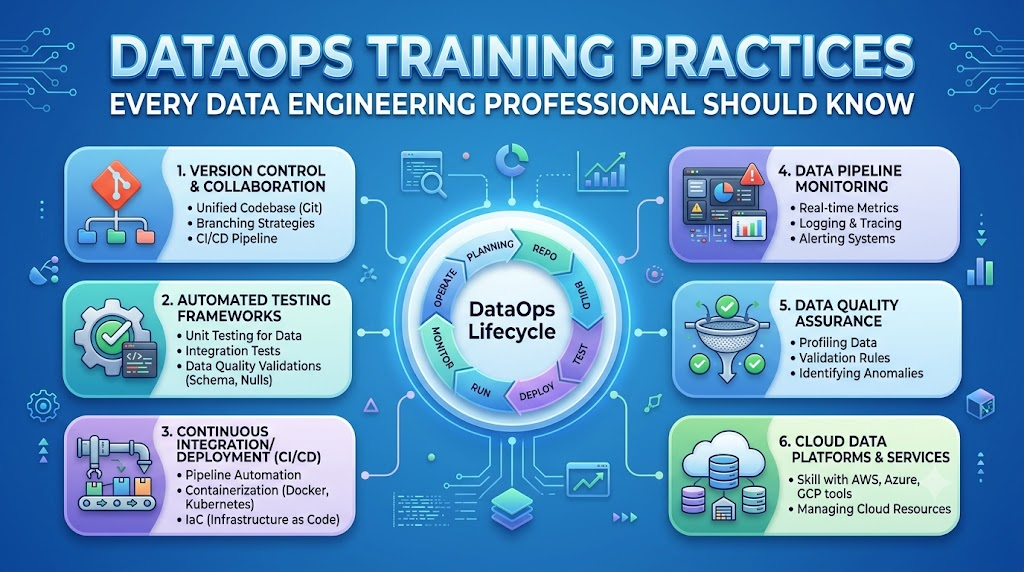
Introduction
As organizations expand, centralized data engineering teams inevitably transform into delivery bottlenecks. Domain teams—such as marketing, risk, logistics, and finance—wait months for centralized engineers to provision cloud storage, build extraction scripts, and update analytical models. When companies attempt to solve this by adopting decentralized models like Data Mesh, they often trade a central bottleneck for uncoordinated chaos, leading to fragmented tools, divergent data standards, and zero global observability.Understanding what is DataOps from a platform engineering perspective provides the foundation needed to resolve this tension. DataOps equips central platform teams to transition from building individual queries to delivering automated, self-service platform infrastructure. Domain engineers gain the autonomy to build, test, and deploy their own data assets safely within standardized operational guardrails. This guide examines how modern platform teams use DataOps to support distributed delivery. You will explore self-service orchestration, automated testing templates, federated observability, and infrastructure automation. Whether you are standardizing enterprise operations or exploring structured technical education through DataOpsSchool.com, these architectural patterns provide a roadmap for scalable, reliable data platforms.
The Operating Model Evolution: What Is DataOps to a Platform Team?
When viewed through platform engineering, what is DataOps? It is the foundational operating framework that enables decentralized domain teams to build, deploy, and monitor their own data products autonomously, reliably, and securely.
Historically, data organizations operated as monolithic service bureaus. Business units submitted tickets requesting pipeline adjustments, and a centralized data engineering group manually implemented the SQL transformations, scheduled the jobs, and monitored daily runs. This organizational structure collapses under enterprise scale. Central engineers lack the domain context to understand business anomalies, while domain analysts lack the operational tooling to deploy changes safely.
DataOps bridges this organizational divide by separating platform capabilities from business logic. The central platform team acts as an internal software vendor, providing standardized CI/CD pipelines, automated testing harnesses, ephemeral environments, and observability tooling as reusable code templates. Domain teams leverage this self-service foundation to author their own transformations with complete autonomy, protected by automated platform guardrails.
Failure Modes in Decentralized Data Architectures
Distributing data ownership without standardized DataOps automation exposes platforms to distinct operational vulnerabilities:
- Tooling Sprawl and Redundant Infrastructure: Independent domain teams procure conflicting orchestrators, distinct transformation libraries, and redundant warehouse instances, inflating cloud spend and complicating cross-functional joins.
- Inconsistent Quality Standards: Without automated verification templates, one domain applies strict uniqueness and schema tests while another pushes raw, unvalidated CSV extractions directly to executive dashboards.
- Siloed Lineage Graphs: When domain pipelines run independently without unified metadata standards, central teams cannot map end-to-end lineage across business units, making root-cause diagnosis nearly impossible.
- Configuration Drift Across Environments: Developers manually configure staging schemas, IAM privileges, and database roles through cloud provider consoles, creating unrepeatable, undocumented production dependencies.
- Federated Security and Access Gaps: Decentralized teams accidentally bypass compliance rules, leaving sensitive customer attributes unmasked or granting overly permissive access rights to raw warehouse layers.
The Federated DataOps Lifecycle: Core Architectural Layers
In an enterprise platform model, the DataOps lifecycle provides domain engineers with a standardized path from local feature development to production monitoring.
Domain Workspaces → Self-Service Ingestion → Central Storage Plane → Declarative Transformation → Automated Platform Gates → Atomic Promotion → Federated Observability
1. Domain Workspaces and Ingestion Templates
Domain teams ingest operational data using standardized, reusable extraction templates. Central platform engineering supplies infrastructure modules that enforce automated connection retries, error quarantine logic, and schema registry validation by default.
2. The Unified Storage Plane
Data lands within shared cloud data lakes or analytical warehouses governed by centralized Infrastructure as Code (IaC). Decoupled compute and storage allow domain units to scale compute independently without physically siloing organizational datasets.
3. Declarative Transformations
Domain engineers write business transformations using modular SQL and version-controlled repositories. Transformations follow centralized repository templates that provide pre-configured linters, unit-testing scaffolds, and documentation generators.
4. Automated Platform Gates
When a domain team submits code changes, the platform’s continuous integration runner validates syntax, runs automated assertions, evaluates schema contracts, and checks security policies without requiring human approval from central engineers.
5. Atomic Promotion
Continuous delivery workflows build updated analytical tables in isolated namespaces before atomically shifting production pointers. Downstream analytical consumers across domains experience uninterrupted availability.
6. Federated Observability
Execution metrics, table freshness statuses, and data quality scores are published to a centralized telemetry catalog. Central operations monitors system-wide platform health, while domain teams receive targeted alerts for issues within their specific domains.
Architectural Pillars of Self-Service DataOps
Continuous Integration and Deployment (CI/CD) as a Platform Service
The primary mission of a modern DataOps platform team is turning CI/CD into a self-service utility. Domain teams should never write custom deployment scripts or perform manual warehouse deployments.
[Domain Developer Branch]
             │
             ▼
[Standardized Static Analysis & Linting]
             │
             ▼
[Automated Ephemeral Workspace Creation (Metadata Clone)]
             │
             ▼
[Execution of Domain Transformation Tests]
             │
             ▼
[Federated Contract & Security Verification]
             │
             ▼
[Automated Peer Approval & Production Swap]
Modern platform engineering provides automated ephemeral environments using zero-copy database cloning. When an analytics engineer opens a pull request, the CI pipeline provisions an isolated test schema linked to production metadata. Domain transformations execute within this temporary sandbox, run assertion tests, and teardown scripts automatically destroy the namespace after validation.
Multi-Tiered Federated Quality Gates
Quality cannot be enforced manually by central platform gatekeepers. Instead, platform teams supply testing frameworks that run automatically at pipeline boundaries:
- Platform Baseline Tests: Standardized checks applied to all models across the enterprise, verifying non-null primary keys, valid date formats, and correct environment parameters.
- Domain Semantic Tests: Assertions defined directly by domain business analysts, evaluating business logic such as confirming transaction totals balance against payment ledger lines.
- Cross-Domain Contract Tests: Programmatic boundaries between domains ensuring that when the logistics team alters a shipping table, dependent marketing pipelines do not experience unhandled schema breaks.
- Dynamic Privacy Checks: Automated scans ensuring that columns containing PII are tagged and masked before promotion to consumption layers.
SQL
-- Platform contract assertion: Halting deployment if downstream interface standards fail
SELECT
    customer_id,
    subscription_status,
    monthly_recurring_revenue
FROM {{ ref('fct_domain_subscriptions') }}
WHERE monthly_recurring_revenue < 0
   OR subscription_status NOT IN ('ACTIVE', 'TRIAL', 'CANCELED', 'PAUSED');
-- In an automated DataOps platform gate, records returned here block the release
Federated Observability vs. Traditional Monitoring
Platform operations monitors global infrastructure capacity, while domain teams need visibility into data health:
- Cross-Domain Lineage: Mapping dependencies between domain products, allowing teams to determine instantly which downstream reports break when an upstream table changes.
- Domain Freshness Telemetry: Tracking delivery SLAs across individual business units, alerting specific domain on-call engineers when batch runs miss delivery schedules.
- Volume Variance: Flagging unexpected row count drops or surges, distinguishing between infrastructure ingestion failures and genuine business volume shifts.
- Schema Evolution Tracking: Detecting added, dropped, or altered fields across domains, ensuring dependencies adapt before production transformations run.
Systems Trade-Offs: Centralized Silos vs. Self-Service DataOps
| Operational Domain | Monolithic Centralized Operations | Self-Service DataOps Platform | Architectural Trade-Off |
|---|---|---|---|
| Pipeline Ownership | Central engineering team writes all models | Domain teams author models via platform templates | Requires domain upskilling; eliminates delivery bottlenecks and ticket backlogs. |
| Change Deployment | Manual, batched production releases | Automated self-service CI/CD pipelines | Demands initial investment in platform tooling; unlocks rapid, fearless releases. |
| Testing Regimes | Ad-hoc manual spot-checks | Automated assertions embedded in CI templates | Adds minor CI compute overhead; catches data defects prior to production consumption. |
| Environment Strategy | Static shared development schemas | Ephemeral schemas via automated cloning | Requires advanced CI/CD automation; prevents developer collisions. |
| Infrastructure | Manual console configuration | Declarative Infrastructure as Code (Terraform) | Requires cloud infrastructure expertise; provides reproducible, auditable disaster recovery. |
Practical Architectural Scenario: Self-Service Pipeline Modernization
Consider a product analytics team introducing a new user churn prediction model. In a traditional centralized setup, they wait three weeks for central data engineers to configure storage, write ingestion DAGs, and provision database roles.
Under a modern self-service DataOps platform model:
- Workspace Generation: The product analytics engineer leverages an internal developer portal to instantiate a standardized repository from a centralized template containing pre-configured CI/CD workflows and linters.
- Local Transformation Authoring: The engineer writes transformation models in modular SQL and defines domain-specific assertions within YAML configuration files.
- Automated Ephemeral Validation: Opening a pull request triggers the central CI runner, which creates a temporary schema via zero-copy database cloning and executes the transformation logic against realistic schemas.
- Contract and Security Verification: Platform checks verify that user identifiers are properly pseudonymized and table properties align with global governance guidelines.
- Autonomous Production Promotion: Following peer review and automated build clearance, the CI/CD platform automatically merges the code and deploys models to production, scheduling DAG tasks within the shared orchestrator.
Tooling Landscape in a Modern DataOps Platform
A modern DataOps architecture incorporates best-of-breed tooling across distinct functional roles:
Orchestration and Federated Workflows
- Apache Airflow: A widely utilized programmatic orchestrator using Python Directed Acyclic Graphs (DAGs) to define complex cross-system task dependencies, retry logic, and monitoring hooks.
- Dagster: An orchestrator designed around data assets and software-defined abstractions, providing native support for testing, environment parameterization, and federated ownership.
- Prefect: A flexible workflow engine prioritizing dynamic execution, fine-grained state management, and clear developer ergonomics.
Transformation and Modeling Layer
- dbt (data build tool): Transforms raw data inside cloud warehouses using modular SQL, turning transformations into version-controlled software packages complete with integrated testing, dependency tracking, and documentation compilation.
Automated Testing and Contract Validation
- Great Expectations: An open-source Python framework providing expressive, declarative assertions to validate, document, and profile data payloads.
- Soda: A lightweight data validation engine using human-readable assertion syntax to enforce data reliability standards across ingestion jobs.
Cloud Data Warehouses and Lakehouses
- Snowflake, Databricks, BigQuery, and AWS Redshift: High-performance analytical platforms that serve as the compute and storage backbone, offering isolation, autoscaling, and zero-copy cloning capabilities.
Infrastructure as Code (IaC)
- Terraform: Automates the provisioning of warehouse roles, analytical schemas, storage buckets, and access control policies across cloud providers to prevent manual configuration divergence.
Implementation Challenges and Practical Solutions
Transitioning to a self-service DataOps architecture introduces technical and organizational hurdles:
- Controlling Decentralized Cloud Costs: Giving multiple domain teams independent access to warehouse compute without governance can result in unchecked query costs and runaway billing.
- Solution: Implement resource monitors, auto-suspending virtual warehouses, and execution timeouts via Infrastructure as Code. Allocate distinct cost centers to domain teams to maintain financial accountability.
- Balancing Platform Rigor with Developer Speed: Imposing dozens of mandatory testing and security checks can cause domain engineers to circumvent platform standards.
- Solution: Modularize CI validation pipelines. Separate mandatory platform blockers (such as security masking and structural syntax) from recommended domain warnings (such as documentation coverage).
- Mitigating Cross-Domain Breaking Changes: Independent domain releases risk breaking shared dimensional tables consumed across the enterprise.
- Solution: Enforce programmatic data contracts. Implement schema compatibility tests within CI pipelines that flag breaking column changes before merges take place.
Common Anti-Patterns That Undermine Self-Service DataOps
- Platform Teams Acting as Project Gatekeepers: If central engineers must manually review and approve every domain pull request, the platform is not truly self-service, and delivery backlogs persist.
- Abandoning Global Governance for Complete Autonomy: Permitting domain teams to adopt arbitrary database technologies and ad-hoc testing standards creates fragmented data silos that undermine enterprise analytics.
- Treating Data Testing as an Initial Milestone Only: Testing incoming data at ingestion is valuable, but failing to validate intermediate transformations allows joined or aggregated data to degrade unnoticed.
- Overlooking Pipeline Idempotency: Designing pipelines that append records without verifying deduplication logic causes accidental duplicate processing whenever a pipeline fails midway and retries.
Delivering Business Value and Operational Return
Adopting a self-service DataOps platform model delivers measurable operational returns:
- Eliminated Delivery Bottlenecks: Domain teams build, test, and ship analytical products independently, reducing cycle times from months to hours.
- Shorter Incident Remediation Times: Standardized observability and end-to-end lineage graphs allow engineers to diagnose pipeline failures and evaluate downstream impact within minutes.
- Scalable Engineering Capacity: Central platform engineers step away from manual firefighting and ad-hoc scripting, focusing on core infrastructure capabilities, cost governance, and platform reliability.
- Trustworthy Enterprise Data: Automating quality assertions across domain boundaries ensures that business intelligence layers remain accurate, consistent, and audit-ready.
Skills and Career Relevance
The rise of self-service DataOps has transformed data engineering from writing routine transformations into designing scalable platform systems. Key competencies in this discipline include:
- Platform Automation and Scripting: Proficiency in Python and modern SQL, including test harness construction and package management.
- CI/CD Pipeline Engineering: Understanding automation platforms like GitHub Actions or GitLab CI, containerized workflows (Docker), and automated artifact deployment.
- Cloud Architecture and IaC: Familiarity with AWS, Azure, or GCP infrastructure, paired with declarative tools like Terraform.
- Orchestration and Observability: Deep understanding of DAG design patterns, task dependencies, state handling, and metric telemetry collection.
For professionals evaluating formal career development, pursuing a Certified DataOps Engineer or Certified DataOps Architect path provides structured validation of these competencies. Structured DataOps training curricula, tutorials, and certification courses help bridge the gap between traditional data warehousing and modern, automated platform engineering. When internal teams face significant modernization hurdles, organizations also frequently rely on specialized DataOps consulting and professional services to architect resilient deployment workflows.
Practical Tips
- Decouple Platform from Business Logic: Centralize infrastructure, deployment pipelines, and observability standards while delegating data transformation models to domain teams.
- Enforce Upstream Contracts: Implement schema checks at the ingestion boundary to catch and quarantine malformed records before they corrupt analytical models.
- Ensure Pipeline Idempotency: Design pipelines so that multiple executions over the same input data produce identical end states, ensuring safe automated retries.
- Use Ephemeral Environments for CI: Leverage database metadata cloning to test code modifications against production structures in isolated test schemas.
- Maintain Transparent Lineage: Automatically compile end-to-end dependency graphs to trace root causes quickly and satisfy regulatory audit requirements.
FAQs
What is DataOps?
DataOps is an operational discipline that applies software engineering best practices, CI/CD automation, agile workflows, and continuous monitoring to data platforms. It ensures data pipelines deliver reliable, high-quality, and compliant data products to downstream business consumers with minimal manual intervention.
How does DataOps support a Data Mesh or decentralized architecture?
DataOps provides the self-service platform infrastructure that makes decentralized data ownership viable. Instead of central data engineers writing all transformations, the platform team provides automated CI/CD templates, testing harnesses, and observability tools that allow domain teams to build and deploy their own data products safely.
Why does DataOps treat data environments differently than traditional application software?
Standard application systems are primarily stateless, meaning bugs can be resolved by rolling back application container versions. Data platforms are stateful systems; an erroneous transformation query permanently alters warehouse tables, requiring complex, manual backfills to restore historical accuracy.
How does DataOps improve data quality across distributed teams?
DataOps integrates automated testing directly into the pipeline lifecycle. It validates data structures at ingestion, checks business rules during transformation, and evaluates output metrics against predefined statistical thresholds before downstream dashboards or machine learning models consume the final output.
What role does CI/CD play in data engineering?
CI/CD automates the validation and deployment of pipeline code. When engineers commit updates, automated systems run linters, execute unit tests, build ephemeral environments to test transformations against sample datasets, and safely deploy approved changes to production warehouses without manual intervention.
What does a DataOps Engineer do?
A DataOps Engineer focuses on building, maintaining, and automating the infrastructure and delivery pipelines for data teams. They create CI/CD pipelines, configure workflow orchestrators, implement data observability tools, establish automated testing frameworks, and ensure data platforms operate reliably without manual maintenance.
What is the difference between pipeline monitoring and data observability?
Pipeline monitoring tracks binary infrastructure metrics, such as whether a job succeeded, its execution duration, and CPU memory utilization. Data observability evaluates the internal health of the data payload flowing through those pipelines, monitoring data freshness, volume variations, schema drift, and lineage dependencies.
How can engineering teams handle breaking upstream schema drift?
Teams enforce explicit data contracts and automated schema checks at the ingestion boundary. When an upstream application service alters or drops a column without warning, the ingestion layer quarantines breaking records into isolated dead-letter tables rather than allowing corrupt data to propagate downstream.
What is covered in DataOps training and certification?
Comprehensive training covers data pipeline automation, CI/CD design patterns, automated testing frameworks, workflow orchestration, data observability, and declarative infrastructure management. Professional pathways like Certified DataOps Engineer and Certified DataOps Architect validate an engineer’s ability to design scalable, production-grade data architectures.
When should an enterprise engage DataOps consulting services?
Organizations typically seek specialized consulting when modernizing legacy data warehouses, untangling brittle data pipelines, dealing with persistent data quality incidents, or migrating toward cloud lakehouses. External DataOps architects help design standardized CI/CD patterns, governance models, and robust testing architectures efficiently.
Conclusion
Understanding what is DataOps requires an operational transition from treating data engineering as a centralized ticketing service to running it as an internal platform product. As enterprises adopt decentralized data models, stability cannot rely on manual reviews or centralized bottlenecks. Reliability requires embedding automated testing, isolated development environments, version-controlled transformations, and comprehensive observability directly into reusable platform templates. When platform teams establish standardized CI/CD frameworks, enforce clear data contracts, and automate infrastructure provisioning, domain teams can innovate autonomously without risking enterprise stability. As data complexity expands and organizations scale their analytical initiatives, adopting disciplined DataOps practices ensures that delivery remains resilient, scalable, and secure. To advance your technical expertise or guide your organization through modern platform adoption, explore the specialized resources, tutorials, and certification pathways available at DataOpsSchool.com.
