Introduction
You run a big delivery company. Every single morning, your team faces a massive puzzle. You have fifty trucks, hundreds of delivery stops, and tight time windows. You need to find the absolute best route for every truck to save fuel and time.
Traditional computers struggle with this task. They test every single route one by one. As your delivery list grows, the time it takes to check all options explodes. Your standard computer might freeze or take days to finish the math.
By the time you get an answer, your trucks have already left. You need a better way to solve these giant puzzles before the day even begins. That is where new computing tools come into play. To explore advanced computing solutions and see how modern tools handle tough math problems, visit QuantumUting. This platform helps teams understand how modern tech handles hard choices.
Why Old Computers Fail at Hard Math
Normal computers think in bits. A bit is like a light switch. It is either on, which means one, or off, which means zero. Every video you watch and every email you send relies on these simple switches.
When you ask a normal computer to solve a massive puzzle, it has to flip those switches over and over. It tries one path. If that path fails, it backs up and tries another. This step-by-step method works fine for small tasks.
But modern business problems are huge. If you want to place cell phone towers across a whole country to give everyone strong service, the number of choices is staggering. A normal computer will run out of time and power trying to test every single spot. You need a machine that can test many ideas at the same time.
Enter the World of Quantum Logic
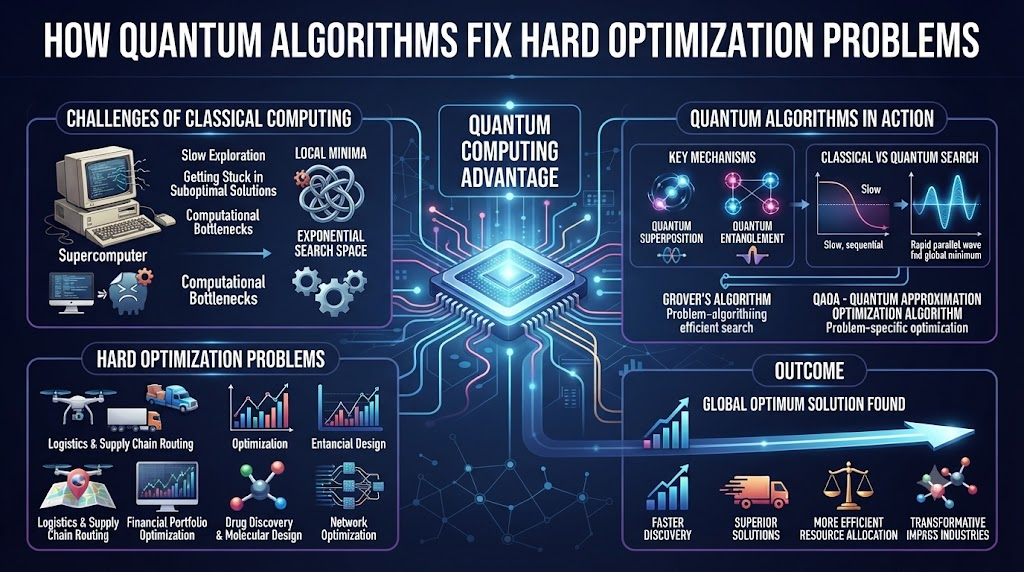
Quantum computers do not use normal bits. They use qubits. A qubit can be both a one and a zero at the same time. This strange rule of physics is called superposition.
Imagine spinning a coin on a table. While it spins, is it heads or tails? It is kind of both until it lands. Qubits work like that spinning coin. Because they hold multiple states at once, a quantum machine can test thousands of options in a single blink.
This ability changes everything for math problems. Instead of testing routes one by one, a quantum algorithm looks at a landscape of choices all at once. It drops straight into the valley of the best possible answer.
How Quantum Algorithms Find the Best Choice
Quantum algorithms use special tricks to guide the math. One famous trick is called quantum superposition. Another is entanglement, where two qubits link together so that changing one instantly affects the other.
When you write a quantum program, you set up your puzzle as an energy landscape. The highest peaks are bad choices, like a delivery route that takes ten hours. The deepest valleys are the best choices, like a quick thirty-minute route.
The quantum algorithm uses wave interference. It boosts the good waves and cancels out the bad waves. When the machine finishes running, the bad answers fade away like static noise. Only the best answer remains on the screen for you to read.
Real-World Story About Server Crashes And Tough Choices
- Your team built a new cloud server network to handle online orders for a huge holiday sale.
- Traffic spiked by ten times normal levels within ten minutes of the sale starting.
- Traditional load balancers tried to sort the web traffic one user request at a time.
- The queue grew so fast that the main database ran out of memory and crashed completely.
- Customers stared at blank error screens and left your store for your main competitor.
- Your engineers spent four hours manually shifting traffic streams to bring systems back online.
- You lost thousands of dollars in sales during those four offline hours alone.
- You realized that old software cannot keep up with sudden, massive data spikes.
- You started looking at advanced optimization tools to predict and balance server loads instantly.
- Proper quantum-inspired routing models now help your system handle traffic spikes without a single glitch.
Comparing Old Tech and New Tech
| Feature | Standard Computers | Quantum Computers |
| Basic Unit | Bits (Zero or One) | Qubits (Zero and One together) |
| Search Method | One choice at a time | Many choices at once |
| Best Use Case | Everyday web browsing and typing | Massive logistics and drug research |
| Speed on Big Data | Slows down fast as data grows | Stays fast even with huge datasets |
| Hardware Need | Standard silicon chips | Super-cooled lab freezers |
Where Quantum Optimization Helps Right Now
You might think quantum computers only exist in sci-fi movies. But real companies use them today to solve expensive problems. Supply chain management is a huge winner. Cargo ships need to pack thousands of containers safely without tipping over or wasting space.
Finance companies also use these tools. When you invest money, you want to pick stocks that make money while keeping risks low. Finding the right mix of stocks is a giant math puzzle with millions of combinations.
Energy companies use quantum tools to manage power grids. When wind and solar farms pump power into the city lines, operators must balance supply and demand second by second. Quantum algorithms help keep the lights on without wasting fuel.
Common Mistakes and Pitfalls
- Mistake: Assuming quantum computers will replace your normal laptop for writing emails. Fix: Keep your normal computer for daily tasks and use quantum tools only for massive math puzzles.
- Mistake: Writing code without understanding how qubits handle data errors. Fix: Use error-correction layers and test your logic on small simulators first.
- Mistake: Expecting instant magic results without cleaning your input data. Fix: Clean and organize your dataset carefully before feeding it into any optimization model.
- Mistake: Ignoring hardware temperature limits when running hybrid cloud models. Fix: Work with cloud providers who manage the cooling systems for you.
- Mistake: Treating quantum algorithms like faster versions of normal loops. Fix: Learn how probability waves work so you write code that fits the hardware.
- Mistake: Forgetting to test your old algorithms side-by-side with your new ones. Fix: Run benchmarks to prove the quantum approach actually saves time and money.
- Mistake: Buying expensive hardware instead of using cloud-based quantum services. Fix: Rent quantum time through secure cloud platforms to save upfront costs.
- Mistake: Skipping security steps when sending sensitive company data to external quantum processors. Fix: Encrypt all data packets before they leave your local firewall.
- Mistake: Failing to train your software team on basic quantum logic gates. Fix: Run weekly workshops to help your engineers feel comfortable with the new math.
- Mistake: Giving up after your first simulation gives a weird or random result. Fix: Run multiple trials and average the output values to find the true best path.
Step-by-Step Implementation Roadmap
- Audit Your Current Problems: Look at your business operations and find the one process that takes the longest time to calculate.
- Define Your Goals: Write down what success looks like, such as cutting delivery fuel costs by fifteen percent this quarter.
- Choose Your Cloud Partner: Pick a reliable cloud platform that offers access to quantum simulators and processors.
- Clean Your Input Data: Gather your operational numbers, remove bad records, and format the data into clean spreadsheets.
- Build a Small Prototype: Write a simple test program using a quantum simulator to solve a tiny piece of your puzzle.
- Test Against Old Methods: Compare the speed and accuracy of your new quantum script against your old software script.
- Scale Up the Dataset: Slowly feed larger batches of data into your model to see how well the algorithm scales.
- Train Your Team: Teach your system operators how to read output reports and spot unusual spikes or behavior.
- Deploy to Production: Move your tested quantum algorithm into your live daily workflow system.
- Monitor and Refine: Check your system metrics weekly and tweak your code variables to make your results even sharper.
Frequently Asked Questions
1. What is a quantum algorithm in simple words?
It is a step-by-step rule designed for quantum computers that tests many different possible answers at the same time instead of checking them one by one.
2. Do I need to buy a quantum computer to use these algorithms?
No, you can run quantum algorithms using cloud services that connect you to real quantum processors over the internet.
3. How do quantum algorithms help supply chains?
They instantly test millions of delivery routes and warehouse layouts to find the cheapest and fastest way to move goods.
4. Are quantum algorithms better at every type of task?
No, normal computers are still faster and cheaper for basic tasks like sending emails, browsing the web, or editing text documents.
5. What makes qubits different from normal bits?
Normal bits can only be a zero or a one, while qubits can hold both values at the same time thanks to a physics rule called superposition.
6. How hard is it to learn quantum programming?
If you already know basic programming languages like Python, you can learn the basics of quantum coding in a few weeks using online tutorials.
7. Can small businesses use quantum optimization?
Yes, because cloud platforms let you rent quantum computing time by the minute, making it affordable for companies of any size.
8. What is the biggest challenge in quantum computing right now?
Keeping the hardware cold and stable so the delicate qubits do not lose their data state due to outside heat or noise.
9. How do I know if my problem needs a quantum algorithm?
If your computer takes hours or days to test all options for a scheduling or routing task, your problem is a good match for quantum tools.
10. Where can I learn more about modern optimization tools?
You can read guides and explore advanced computing concepts by visiting platforms like QuantumUting.com.
Final Recommendation and Next Steps
Quantum optimization is no longer just a theory for physics labs. It is a practical tool that helps modern businesses solve impossible math puzzles in seconds. You do not need a physics degree to start benefiting from these tools today.
Begin by picking one slow calculation in your current workflow. Look for cloud services that let you test quantum algorithms without buying expensive hardware. Take things one small step at a time, test your results carefully, and watch your operational speed climb.
