In the ever-evolving tech landscape, DevOps has emerged as a crucial framework for efficient software development and deployment. Companies worldwide are investing in DevOps practices to streamline processes, enhance collaboration, and foster innovation. To meet this rising demand, BestDevOps Training offers tailored programs that empower professionals to excel in this transformative domain.
What is DevOps?
DevOps, short for Development and Operations, is a cultural and professional movement that emphasizes collaboration between software developers and IT operations teams. The goal is to shorten the systems development lifecycle while delivering high-quality software reliably. By integrating automation, continuous delivery, and agile practices, DevOps enables faster and more efficient project execution.
DevOps Lifecycle Phases
DevOps involves several key phases, each supported by specialized tools and practices to ensure efficiency:
- Plan
- Tools: Jira, Trello, Asana
- Practices: Agile planning, backlog management, and sprint planning.
- Develop
- Tools: Git, Bitbucket, GitHub
- Practices: Version control, branching strategies, and code reviews.
- Build
- Tools: Maven, Gradle, Bazel
- Practices: Automating the build process, managing dependencies, and ensuring code integrity.
- Test
- Tools: Selenium, JUnit, TestNG, Postman
- Practices: Automated testing (unit, integration, performance).
- Release
- Tools: Jenkins, GitLab CI/CD, CircleCI
- Practices: Managing pipelines for smooth and automated releases.
- Deploy
- Tools: Kubernetes, Docker Swarm, AWS Elastic Beanstalk
- Practices: Deployment strategies (Blue-Green, Rolling, Canary).
- Operate
- Tools: Prometheus, Grafana, Splunk
- Practices: Monitoring and logging, incident response.
- Monitor
- Tools: ELK Stack, Datadog, Nagios
- Practices: Proactive monitoring and improving application reliability.
Key DevOps Practices
To achieve DevOps excellence, professionals must embrace these critical practices:
- Continuous Integration (CI): Frequently merging code changes into a shared repository to detect issues early.
- Tools: Jenkins, Travis CI, GitHub Actions
- Benefits: Early bug detection, faster feedback.
- Continuous Delivery (CD): Ensuring code is always in a deployable state.
- Tools: Bamboo, CircleCI, Spinnaker
- Benefits: Faster time-to-market.
- Infrastructure as Code (IaC): Managing infrastructure through code for consistency and scalability.
- Tools: Terraform, CloudFormation, Pulumi
- Configuration Management: Automating system configurations to reduce manual errors.
- Tools: Ansible, Puppet, Chef
- Containerization: Packaging applications with dependencies in isolated environments.
- Tools: Docker, Podman
- Orchestration: Automating container deployment, scaling, and networking.
- Tools: Kubernetes, Docker Swarm
- Monitoring and Logging: Tracking system performance and detecting issues proactively.
- Tools: Prometheus, Grafana, ELK Stack
- DevSecOps: Integrating security into every phase of the DevOps lifecycle.
- Tools: Snyk, SonarQube, OWASP ZAP
- Benefits: Proactive risk mitigation.
Why Choose BestDevOps Training?
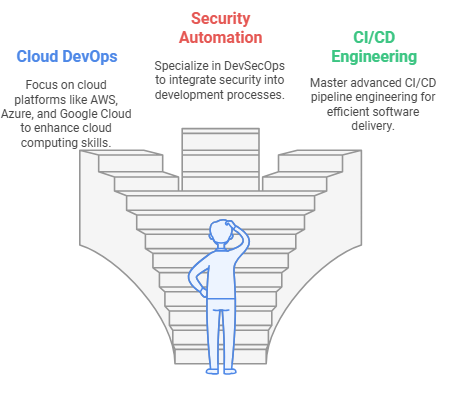
Here’s why BestDevOps is the preferred choice for aspiring DevOps professionals:
- Expert-Led Sessions: Learn from seasoned professionals with real-world experience.
- Custom Learning Tracks: Tailored courses for beginners and experienced professionals.
- Hands-On Labs: Access practical environments to build real-world skills.
- Career Guidance: Resume-building sessions, interview preparation, and networking.
Success Stories
Hear from our alumni:
“BestDevOps Training was a game-changer for my career. The hands-on projects and expert guidance helped me land my dream role as a DevOps engineer.” – Jane Doe, Certified DevOps Engineer
“The program’s structured learning path and real-world labs gave me the confidence to transition into a DevOps role seamlessly.” – John Smith, IT Specialist
Advanced Topics in DevOps
- GitOps: Managing infrastructure and deployments via Git.
- Tools: ArgoCD, Flux
- Site Reliability Engineering (SRE): Applying software engineering principles to operations.
- Focus: Reliability, scalability, incident management.
- Chaos Engineering: Testing system resilience by injecting faults.
- Tools: Gremlin, Chaos Monkey
- Serverless Computing: Building and running applications without managing servers.
- Tools: AWS Lambda, Azure Functions
Take the Next Step in Your DevOps Journey
DevOps is transforming how organizations operate, and professionals with the right skills are leading the charge. Enroll in BestDevOps Training today to gain the knowledge, tools, and certifications needed to excel in this field. With our comprehensive programs, you’ll be equipped to drive innovation and efficiency in your organization—and achieve your career goals.
