Introduction
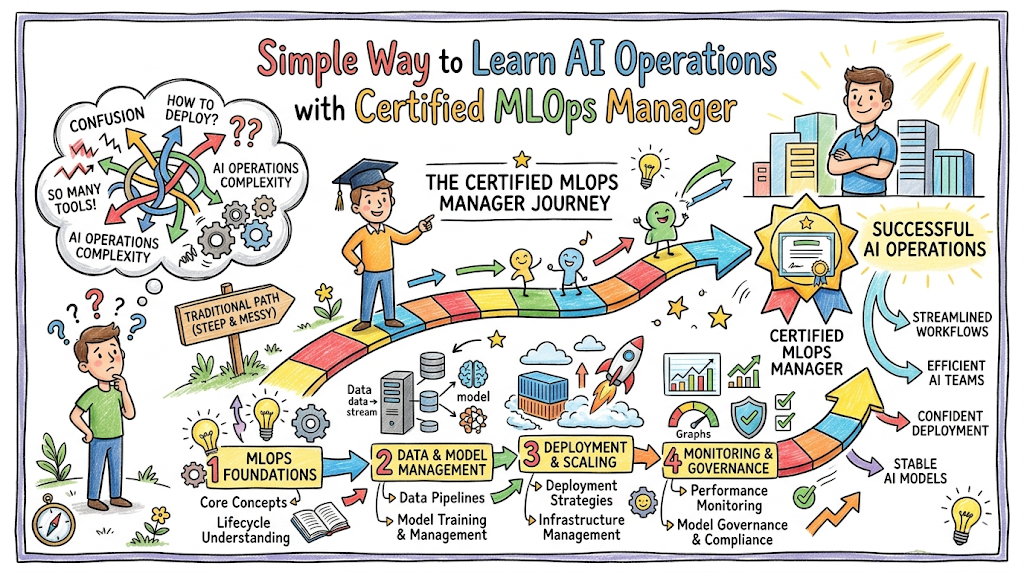
Machine Learning Operations is no longer a niche experimental phase but a core requirement for any enterprise looking to scale artificial intelligence. The Certified MLOps Manager program offered by aiopsschool.com serves as a bridge between data science and production engineering. This guide is designed for professionals who want to move beyond building models and start managing the entire lifecycle of machine learning in a production environment.
In the modern landscape of DevOps, cloud-native architecture, and platform engineering, managing ML workloads requires a unique set of skills that traditional software engineering often overlooks. This guide helps engineers and managers understand how to navigate this evolving field and make informed career decisions. By focusing on operationalizing AI, professionals can ensure that their models provide consistent business value while maintaining high reliability and performance.
What is the Certified MLOps Manager?
The Certified MLOps Manager represents a professional standard for individuals who oversee the deployment, monitoring, and management of machine learning models. It exists to solve the “last mile” problem in AI, where many high-quality models fail to reach production due to operational friction. Unlike theoretical courses that focus on math and algorithms, this certification emphasizes real-world, production-focused learning.
It aligns perfectly with modern engineering workflows by treating ML models as software artifacts that require versioning, automated testing, and CI/CD pipelines. Enterprise practices today demand that ML systems be as robust as any other microservice. This program prepares professionals to lead teams that can handle data drift, model decay, and complex infrastructure scaling without compromising the integrity of the data science process.
Who Should Pursue Certified MLOps Manager?
This certification is highly beneficial for a variety of roles across the technical spectrum. DevOps engineers and SREs looking to specialize in data-heavy environments will find the curriculum particularly relevant. Cloud professionals and security experts who need to understand the unique vulnerabilities and scaling requirements of ML clusters should also consider this path. Data engineers and data scientists who want to take ownership of their models in production will gain the operational discipline needed to succeed.
The program is structured to support beginners who are just entering the operations space, as well as experienced engineers and technical managers who need to lead AI initiatives. Globally, the demand for MLOps expertise is surging as companies realize that building a model is only 10% of the work. In India, where the IT sector is rapidly shifting toward high-value AI services, holding this certification provides a significant competitive advantage for those aiming for senior and leadership positions.
Why Certified MLOps Manager is Valuable and Beyond
The demand for MLOps professionals is built on the massive enterprise adoption of AI across every vertical from finance to healthcare. This is not a passing trend but a fundamental shift in how software is built and maintained. By gaining this certification, professionals ensure their longevity in the market, as they possess the skills to manage the infrastructure that powers the future of automation.
It helps individuals stay relevant even as specific tools and frameworks change, because the core principles of MLOps—automation, monitoring, and governance—are universal. The return on time and career investment is substantial, as organizations are willing to pay a premium for leaders who can reduce the time-to-market for AI products. Ultimately, it transforms a technical contributor into a strategic asset who can manage the complex intersection of data, code, and infrastructure.
Certified MLOps Manager Certification Overview
The program is delivered via the official platform and is hosted on the provider website. It explains certification levels, assessment approaches, ownership, and structure in practical terms that align with industry needs. The curriculum is designed to be rigorous, ensuring that those who pass have a deep understanding of how to manage the lifecycle of machine learning models in a production environment.
The assessment approach is focused on practical application rather than just theoretical knowledge, requiring candidates to demonstrate their ability to handle real-world scenarios. Ownership of the certification resides with a body of experts who continuously update the content to reflect the latest tools and practices in the field. This ensures the program remains the gold standard for MLOps managers worldwide.
Certified MLOps Manager Certification Tracks & Levels
The program is organized into distinct levels to support career progression from entry-level to leadership. The Foundation level focuses on the core concepts of MLOps, including the differences between DevOps and MLOps, basic pipeline construction, and the importance of data versioning. This level is ideal for those new to the field or coming from a pure data science background.
The Professional level dives deep into the technical implementation of MLOps. It covers specialization tracks such as SRE for ML, security in ML pipelines, and cloud-specific ML operations. Finally, the Advanced or Leadership level is designed for managers and architects who need to design enterprise-wide ML strategies, manage budgets, and ensure compliance and governance across multiple teams. This tiered approach allows professionals to grow their skills incrementally alongside their career advancements.
Complete Certified MLOps Manager Certification Table
| Track | Level | Who it’s for | Prerequisites | Skills Covered | Recommended Order |
| MLOps Foundation | Foundation | Beginners, Data Scientists | Basic Linux & Python | CI/CD, Git, Data Versioning | 1 |
| MLOps Engineering | Professional | DevOps & Data Engineers | Foundation Level | Kubeflow, Terraform, Monitoring | 2 |
| MLOps SRE | Professional | SREs, Platform Engineers | Cloud Fundamentals | Latency, Drift Detection, Scaling | 3 |
| MLOps Security | Professional | Security Engineers | DevSecOps Basics | Model Poisoning, IAM, Encryption | 4 |
| MLOps Management | Advanced | Managers, Architects | 5+ Years Industry Exp | Governance, ROI, Team Leadership | 5 |
Detailed Guide for Each Certified MLOps Manager Certification
Certified MLOps Manager – Foundation Level
What it is
This certification validates a professional’s understanding of the fundamental principles of MLOps. It ensures the candidate knows how to bridge the gap between static data science models and automated deployment cycles.
Who should take it
Aspiring MLOps engineers, data scientists, and traditional DevOps engineers who want to understand the unique requirements of machine learning workloads. It is ideal for those with limited experience in the field.
Skills you’ll gain
- Understanding the MLOps lifecycle
- Version control for data and models
- Basic CI/CD pipeline construction for ML
- Concepts of reproducibility and experiment tracking
Real-world projects you should be able to do
- Setting up a basic automated pipeline for a regression model
- Implementing Data Version Control in a small team environment
- Creating a model registry to track different versions of an AI model
Preparation plan
- 7-14 Days: Focus on core terminology and the differences between ML and traditional software lifecycles.
- 30 Days: Complete hands-on labs involving Git and basic automation tools.
- 60 Days: Build and document a complete end-to-end basic ML pipeline from scratch.
Common mistakes
- Focusing too much on the math of the models rather than the infrastructure.
- Ignoring data versioning and only focusing on code versioning.
- Underestimating the importance of environment consistency.
Best next certification after this
- Same-track option: Certified MLOps Manager – Professional Engineering
- Cross-track option: SRE Fundamentals
- Leadership option: Technical Team Lead Certification
Certified MLOps Manager – Professional Level
What it is
This level validates advanced technical proficiency in automating and scaling ML workloads in production. It focuses on orchestration, monitoring, and infrastructure as code specifically for AI applications.
Who should take it
Experienced DevOps engineers, data engineers, and cloud architects who are responsible for maintaining large-scale ML environments. Usually requires several years of technical experience.
Skills you’ll gain
- Orchestration with Kubernetes and Kubeflow
- Infrastructure as Code for ML clusters
- Real-time monitoring and alerting for model performance
- Automated scaling of GPU and CPU resources
Real-world projects you should be able to do
- Deploying a multi-stage ML pipeline on a Kubernetes cluster
- Setting up monitoring for model drift detection
- Automating the retraining of models based on performance triggers
Preparation plan
- 7-14 Days: Deep dive into container orchestration and cloud-native ML tools.
- 30 Days: Implement complex monitoring and logging solutions in a lab environment.
- 60 Days: Design a high-availability infrastructure for a production ML service.
Common mistakes
- Over-engineering the pipeline for small-scale projects.
- Failing to monitor data drift, leading to silent model failures.
- Not considering the cost implications of high-performance computing resources.
Best next certification after this
- Same-track option: Certified MLOps Manager – Advanced Strategy
- Cross-track option: DevSecOps Professional
- Leadership option: Certified MLOps Manager – Leadership Track
Choose Your Learning Path
DevOps Path
Professionals coming from a DevOps background should focus on how ML artifacts differ from standard binaries. The path involves learning about data pipelines and how to integrate ML testing into existing CI/CD workflows. It emphasizes the use of familiar tools to manage the lifecycle of models. This path is perfect for those who want to apply their automation skills to the fastest-growing sector of IT.
DevSecOps Path
Security professionals in the MLOps space must address unique challenges such as model poisoning and data privacy. This path covers secure supply chains for ML, ensuring that the training data and the models themselves are protected. It involves integrating security scanning into the ML pipeline and managing complex IAM roles for data access. This ensures that AI initiatives remain compliant with global regulations.
SRE Path
Site Reliability Engineers focusing on MLOps look at the performance of ML systems. This path teaches how to manage error budgets for AI services and how to handle the high latency often associated with deep learning inference. It focuses on building resilient systems that can gracefully handle infrastructure failures without losing state. Professionals on this path ensure that ML services meet their reliability targets.
AIOps Path
The AIOps path focuses on using artificial intelligence to improve traditional IT operations. Professionals learn how to implement ML models that can predict outages and automate root cause analysis. This path is about turning the lens of AI inward to make the entire infrastructure smarter and more self-healing. It bridges the gap between raw data and actionable operational insights.
MLOps Path
This is the core path for those dedicated to the lifecycle of machine learning. It covers the entire journey from data ingestion and feature engineering to model deployment and monitoring. This path is ideal for those who want to be the primary architects of ML platforms. It focuses on creating a seamless experience for data scientists while maintaining the rigor of production engineering.
DataOps Path
DataOps focuses on the reliability and quality of the data that feeds the ML models. This path involves building automated data pipelines that ensure data is clean, labeled correctly, and delivered on time. It emphasizes collaboration between data engineers and data scientists to reduce the cycle time of data delivery. Without strong DataOps, MLOps cannot succeed in an enterprise environment.
FinOps Path
Managing the costs of ML infrastructure is a major challenge due to the high cost of specialized hardware. The FinOps path for MLOps focuses on cloud cost optimization and identifying underutilized resources. Professionals learn how to provide transparency into the spending of AI teams and ensure that the business value of models outweighs their costs. This is critical for long-term project sustainability.
Role → Recommended Certified MLOps Manager Certifications
| Role | Recommended Certifications |
| DevOps Engineer | MLOps Foundation, MLOps Engineering |
| SRE | MLOps Foundation, MLOps SRE |
| Platform Engineer | MLOps Engineering, MLOps Management |
| Cloud Engineer | MLOps Foundation, MLOps Engineering |
| Security Engineer | MLOps Security, MLOps Foundation |
| Data Engineer | DataOps Specialist, MLOps Foundation |
| FinOps Practitioner | MLOps Foundation, MLOps FinOps |
| Engineering Manager | MLOps Foundation, MLOps Management |
Next Certifications to Take After Certified MLOps Manager
Same Track Progression
Once the professional level is reached, the logical next step is to pursue the Advanced MLOps Management track. This involves mastering the strategic side of AI, including choosing the right vendor stacks and designing long-term roadmaps. Deep specialization in specific areas like observability for ML can also help in becoming a principal engineer in this domain.
Cross-Track Expansion
Broadening your skills is essential for a well-rounded career. After MLOps, many professionals move into DevSecOps to ensure their pipelines are secure, or SRE to ensure their systems are reliable. Understanding the broader ecosystem of Cloud-Native technologies via Kubernetes certifications can also complement MLOps expertise perfectly.
Leadership & Management Track
For those looking to move away from day-to-day coding and into strategy, the leadership track is the way forward. This involves certifications focused on engineering management and business strategy. Learning how to manage the ROI of technical projects and how to build high-performing engineering teams is key to transitioning into director-level roles.
Training & Certification Support Providers for Certified MLOps Manager
DevOpsSchool
DevOpsSchool is a globally recognized leader in technical training, offering a deep dive into the culture and tools that define modern software delivery. Their curriculum for MLOps is built upon a decade of experience in teaching DevOps, ensuring that students understand the foundational principles of automation before tackling the complexities of machine learning. The instructors are industry veterans who provide practical insights into real-world production challenges. By focusing on hands-on labs and project-based learning, DevOpsSchool ensures that professionals are not just certified, but ready to perform. Their extensive community support and career guidance make them a preferred choice for engineers in India and across the globe who are looking to stay ahead in the competitive IT landscape.
Cotocus
Cotocus specializes in high-end consulting and training for cloud-native architectures, making them an ideal partner for those pursuing the Certified MLOps Manager path. Their training programs are designed to solve actual enterprise problems, focusing on the intersection of infrastructure as code, container orchestration, and automated pipelines. Cotocus trainers bring a wealth of experience in managing large-scale cloud migrations and building resilient platforms for AI workloads. They provide a learning environment that encourages experimentation and deep technical understanding. Their workshops are highly regarded for being practical and results-oriented, helping teams bridge the gap between legacy systems and modern, AI-driven operations. Organizations trust Cotocus to upskill their workforce with the latest production-grade techniques.
Scmgalaxy
Scmgalaxy serves as a massive knowledge hub and community for software configuration management and DevOps professionals. They provide an extensive library of resources, tutorials, and scripts that are essential for anyone building automated ML pipelines. For MLOps practitioners, Scmgalaxy offers insights into the nuances of versioning both code and data, which is a critical pillar of the certification. The platform is known for its community-driven content, ensuring that the information is always up-to-date with the latest industry shifts. By participating in the Scmgalaxy ecosystem, professionals gain access to a wealth of collective wisdom and proven solutions for complex configuration challenges, making it an invaluable support provider for those looking to master the operational side of technology.
BestDevOps
BestDevOps focuses on delivering high-quality, practical training that follows the industry’s best practices for automation and delivery. Their approach to MLOps training is centered on creating efficient, repeatable processes that reduce the time-to-market for AI products. They provide detailed courses that cover everything from basic CI/CD to advanced infrastructure management. BestDevOps is particularly useful for those who want to understand the “how-to” of implementing MLOps tools in a production environment. Their curriculum is streamlined and designed for busy professionals, providing clear, concise information that can be applied immediately on the job. Their commitment to technical excellence and student success has established them as a trusted name in the global technical training community.
DevSecOpsSchool
DevSecOpsSchool addresses the critical need for security in the modern automated pipeline. As machine learning models become integral to business operations, the security of the data and the models themselves becomes a top priority. DevSecOpsSchool provides specialized training that helps MLOps managers integrate security checks and compliance monitoring directly into their workflows. Their courses cover topics such as threat modeling for ML, secure containerization, and automated audit trails. By teaching engineers how to “shift security left,” they ensure that AI initiatives are not only fast but also safe and compliant. Their expert-led sessions provide the technical depth required to protect enterprise assets in an increasingly complex and hostile digital environment.
SRESchool
SRESchool is dedicated to the art and science of Site Reliability Engineering, focusing on the principles of stability, scalability, and performance. For the Certified MLOps Manager, SRESchool provides the essential framework for managing model reliability in production. Their training covers critical topics like error budgets, incident response, and the monitoring of “Golden Signals” for ML services. By focusing on data-driven operations, SRESchool helps engineers move away from reactive firefighting and toward proactive system management. Their curriculum is designed for those who are responsible for the uptime and performance of critical AI-driven platforms. Graduates of SRESchool are equipped with the mindset and tools to ensure that machine learning systems deliver consistent value to the business.
AIOpsSchool
AIOpsSchool is the premier institution for professionals seeking to master the application of artificial intelligence in IT operations. They provide the official training and curriculum for the Certified MLOps Manager program, ensuring the highest standards of education and assessment. Their courses are deeply rooted in real-world scenarios, covering the entire lifecycle of ML models from experimentation to decommissioning. AIOpsSchool distinguishes itself through its focus on “operational excellence,” teaching students how to use AI to automate complex tasks and predict system failures. Their hands-on approach and industry-aligned content make them the primary authority in the field. They are dedicated to building a global workforce of leaders who can navigate the complexities of AI-driven infrastructure.
DataOpsSchool
DataOpsSchool focuses on the fundamental requirement of any ML project: high-quality, reliable data. They provide specialized training in building automated data pipelines that align with the speed of modern software development. For MLOps practitioners, DataOpsSchool offers the necessary skills to ensure that the data feeding their models is accurate, timely, and compliant. Their curriculum covers data orchestration, data quality testing, and the principles of collaborative data management. By bridging the gap between data engineers and data consumers, DataOpsSchool helps organizations reduce the friction in their AI development cycles. Their training is essential for anyone who wants to build a truly robust and scalable machine learning platform that can withstand the demands of production data.
FinOpsSchool
FinOpsSchool focuses on the financial management of cloud-native systems, a topic of growing importance as ML infrastructure costs continue to rise. They provide the tools and frameworks needed for MLOps managers to optimize their spending on cloud resources and specialized hardware like GPUs. FinOpsSchool teaches professionals how to provide cost transparency and how to align technical spending with business value. Their training is critical for ensuring that AI projects remain economically sustainable in the long term. By fostering collaboration between finance, engineering, and business teams, FinOpsSchool helps organizations maximize the return on their cloud investments. Their courses are a must for any manager looking to oversee a large-scale, cost-effective machine learning operation.
Frequently Asked Questions (General)
- How difficult is the MLOps certification compared to standard DevOps?
MLOps is generally more complex because it adds the dimension of data management and model behavior to the existing challenges of software automation and infrastructure. - How long does it typically take to complete the program?
Most professionals with a technical background complete the core certification within 2 to 3 months, depending on their existing familiarity with containers and automation tools. - Are there any specific prerequisites for the foundation level?
A basic understanding of Linux command lines and at least one programming language, preferably Python, is recommended to get the most out of the course. - Is this certification recognized globally?
Yes, the principles taught in the program are based on global industry standards used by major tech companies and enterprises across the world. - Will this help me get a job in the current tech sector?
The global market is seeing a massive shift toward AI services, and there is a significant shortage of professionals who can operationalize these models, making this certification highly valuable. - Does the certification cover specific cloud providers?
The program focuses on cloud-agnostic principles and tools like Kubernetes, but it also explains how to apply these concepts across all major cloud platforms. - Is there a recertification requirement?
To ensure professionals stay updated with the rapidly changing field, a periodic review or advanced module completion is usually required every few years. - Can I take this course if I am a pure data scientist?
Absolutely. It is actually highly recommended for data scientists who want to ensure their models are successfully deployed and maintained in production. - What is the ROI of getting certified as an MLOps Manager?
Professionals in this field often see significant salary increases and are eligible for more senior, strategic roles within their organizations due to the specialized nature of the skill. - Are the exams proctored or project-based?
The assessment approach favors practical project evaluations and hands-on labs to ensure that candidates can actually perform the tasks required in a professional setting. - Is there community support available during the training?
Yes, students typically have access to forums, communication channels, and mentor support to help them through the more challenging technical modules. - Can managers without a coding background take this?
Managers should focus on the Foundation and Management tracks, which prioritize strategy, governance, and team structure over deep technical implementation.
FAQs on Certified MLOps Manager
- What makes the Certified MLOps Manager program unique?
It is one of the few programs that focuses specifically on the management and operational side of machine learning rather than just the development of models. - How does this program handle the concept of data drift?
The curriculum includes specific modules on monitoring and alerting for data and model drift, teaching students how to build automated retraining loops. - Does the course cover the legal and ethical side of AI?
Yes, the management and advanced levels include sections on AI governance and ethics, ensuring that models are deployed responsibly and according to regulations. - What tools are emphasized in the technical modules?
The program focuses on industry-standard tools such as Kubernetes, Kubeflow, and infrastructure automation to ensure that students are learning skills that are immediately applicable. - How do I choose between the SRE track and the Engineering track?
Choose Engineering if you want to focus on building the pipelines. Choose SRE if you are more interested in the reliability and scaling of the systems in production. - Is there a focus on cost optimization in the program?
Cost management is a core part of the curriculum, especially in the professional and management levels, as managing the high costs of ML infrastructure is a top priority. - Can this certification help me transition from a traditional IT role?
Yes, it provides a clear roadmap for shifting your existing skills in automation and infrastructure toward the specialized needs of machine learning operations. - Are there real-world case studies included in the training?
The program uses case studies from various industries to illustrate how MLOps solves specific business problems and improves the speed of AI innovation.
Final Thoughts
If you are looking for a career path that combines the discipline of engineering with the innovation of artificial intelligence, then pursuing this certification is a strategic move. The industry has reached a point where building a model is no longer enough; the real value lies in the ability to run that model reliably at scale. This program provides the framework, tools, and mindset needed to bridge that gap.
As a mentor, my advice is to look beyond the hype and focus on the operational reality. Organizations are desperate for professionals who can bring stability and predictability to their AI projects. By becoming a certified professional in this field, you are positioning yourself at the center of the next great wave of technical evolution. It requires effort and a commitment to continuous learning, but the career impact and the ability to work on cutting-edge production systems make it a highly worthwhile investment.
