Introduction
For decades, modern technology has relied on scaling classical computer hardware to make applications faster. We added more cores, packed more transistors onto silicon microchips, and linked giant data centers together using classical parallel processing. Yet, despite these monumental engineering feats, certain highly complex mathematical problems remain entirely out of reach for traditional machines. The limitation does not stem from a lack of raw speed or processing power; it is rooted entirely in the underlying laws of classical physics. Classical computers process information linearly or by dividing tasks among separate physical hardware components. Quantum computers, by contrast, shift the computational paradigm entirely. They utilize the counterintuitive laws of quantum mechanics to evaluate vast configurations of data simultaneously within a single physical processor. To help demystify these complex systems, learning platforms like QuantumUting.com provide essential educational resources for beginners, computer science students, and technology professionals alike. This comprehensive guide breaks down exactly how quantum computers perform parallel computation.
What Is Parallel Computation in Quantum Computing?
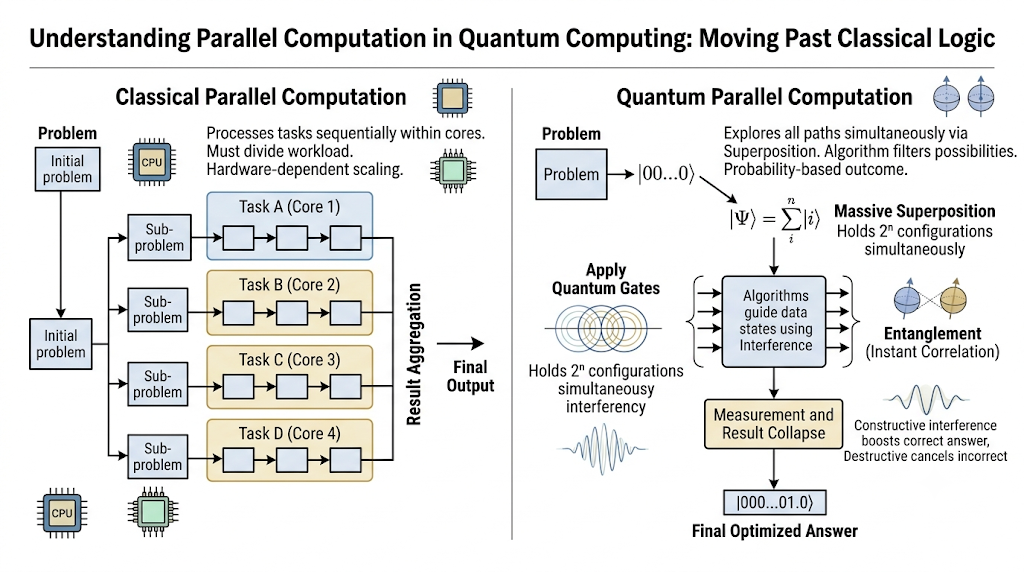
In traditional computer science, parallel computation means executing multiple tasks at the exact same time by splitting the workload across separate physical hardware units, such as multi-core CPUs or graphics processing units (GPUs). If you have a massive dataset to process, a classical parallel system splits the data into distinct packets and hands each packet to a different processor core.
Quantum parallel computation is fundamentally different. Instead of dividing an assignment across multiple pieces of physical hardware, a quantum computer processes an entire universe of potential solutions simultaneously within the exact same set of quantum bits.
Classical Parallelism: [Core 1 -> Task A]  [Core 2 -> Task B]  [Core 3 -> Task C]
Quantum Parallelism:   [Single Quantum Processor Engine -> Processing All Possibilities Simultaneously]
This phenomenon is crucial because it alters the mathematical relationship between the size of a problem and the time required to solve it. While a classical machine must work through a massive, unstructured database by looking at each entry one by one (or core by core), a quantum computer leverages subatomic physics to evaluate those entries collectively, providing an architectural shortcut to the correct answer.
Fundamental Concepts
To fully grasp how quantum computers perform parallel computation, we must first contrast their core architecture with the classical technology we use every day.
Classical Bits
A classical bit is the foundational building block of traditional computing. It operates as a simple, binary macro-switch. At any given moment, a classical bit can exist in one of two distinct, mutually exclusive states: 0 (off) or 1 (on). Every email you send, video you stream, and application you run is ultimately compiled down into millions of these binary states.
Qubits
A quantum bit, or qubit, is the fundamental unit of quantum information. Unlike a classical bit made of silicon circuitry, a qubit is typically constructed using a controlled microscopic system, such as an isolated electron, a single photon, or a superconducting circuit. Because it operates at the quantum scale, a qubit can represent a 0, a 1, or any mathematical combination of both states simultaneously.
Superposition
Superposition is the physical capability of a qubit to exist in multiple states at once. Think of a classical bit like a coin resting flat on a table; it can show either heads (1) or tails (0). A qubit in superposition is like a coin spinning rapidly on its edge. While it is spinning, it is not strictly heads or strictly tails. Instead, it exists in a fluid, mathematical blend of both possibilities until it stops spinning.
Quantum Entanglement
Entanglement is a unique connection that can link two or more qubits together, regardless of the distance separating them. When qubits become entangled, the physical state of one qubit becomes instantly correlated with the state of its partners. If you modify one entangled qubit, you inherently alter the entire interconnected system, allowing a quantum processor to share and synchronize complex computations exponentially faster than classical wiring allows.
Quantum Interference
Because qubits in superposition behave more like overlapping waves than rigid, solid switches, they can influence one another using the principles of wave interference. Just as waves in an ocean can crash together to create a massive peak (constructive interference) or flatten each other out into completely calm water (destructive interference), quantum systems use interference to manipulate probabilities.
Quantum Measurement
Quantum measurement is the act of reading the final data from a quantum processor. This step introduces a strict physical constraint: the moment you measure a qubit in superposition, its fluid quantum state immediately collapses into a definite, classical binary value (either a 0 or a 1). Managing this collapse is the central challenge of creating functional quantum software.
How Quantum Computers Perform Parallel Computation
Understanding the step-by-step workflow of a quantum processor reveals exactly how quantum parallelism operates in practice without getting bogged down in dense linear algebra.
+------------------------------------+
| 1. Encoding Information into Qubits|
+------------------------------------+
                 |
                 v
+------------------------------------+
|  2. Activating Superposition Gates |
+------------------------------------+
                 |
                 v
+------------------------------------+
| 3. Simultaneous State Processing   |
+------------------------------------+
                 |
                 v
+------------------------------------+
|  4. Applying Quantum Interference  |
+------------------------------------+
                 |
                 v
+------------------------------------+
| 5. Collapsing System via Measure   |
+------------------------------------+
Encoding Information into Qubits
The process begins by preparing the hardware. Qubits are initialized into a standard, baseline ground state, which typically represents a clean binary sequence of 0s. This is the equivalent of clearing a classical calculator’s memory before starting a brand-new calculation.
Creating Superposition
Next, the quantum computer fires precise external control signals—such as finely tuned microwave pulses or laser beams—at the qubits. These pulses act as specific quantum logic gates. Passing a qubit through a specialized gate (known as a Hadamard gate) coaxes the particle out of its rigid binary state and forces it into a fluid state of superposition. If you put 30 separate qubits into superposition simultaneously, they instantly hold $2^{30}$ mathematical combinations at the exact same time.
Processing Multiple Quantum States Simultaneously
Once the system is in collective superposition, the quantum computer runs its calculation. Because the qubits contain every possible data combination simultaneously, any mathematical operation applied to the system manipulates every single one of those possibilities at once.
The Maze Analogy: Imagine navigating a complex physical maze. A classical computer handles this by acting like a single explorer who walks down one path, hits a dead end, backtracks, and tries the next path sequentially. Even a multi-core classical computer simply sends a few distinct explorers down different paths at the same time.
A quantum computer performs parallel computation by acting like a flood of water poured into the maze entrance. The quantum system explores every single path, dead end, and corridor simultaneously because its qubits physically embody all possible routes at once.
Using Quantum Interference
If a quantum computer holds all possible answers simultaneously, how do we extract the single correct solution? If you simply measure the system randomly, you will get a completely random data string, which is useless. This is where quantum interference serves as the primary engine of the computation.
Quantum algorithms are systematically designed to act as a filtering system of waves. As the calculation progresses, the algorithm uses destructive interference to cancel out the unhelpful mathematical pathways (the incorrect answers), forcing their probability amplitudes down toward zero. Simultaneously, it uses constructive interference to amplify the probability of the correct answer.
Measuring the Final Result
In the final step, the computer measures the system. Because the algorithm carefully sculpted the wave probabilities using interference, the fluid, spinning system collapses with an incredibly high probability of landing directly on the correct, optimized answer. The computer reads this output as a standard classical binary string of 0s and 1s.
Why Parallel Computation Does Not Mean Reading Every State at Once
A major point of confusion for beginners is assuming that quantum computers let you read out millions of answers simultaneously at the end of a run. This is physically impossible due to the laws of quantum measurement. You only ever get one classical result per measurement. The true power of quantum parallel computation lies entirely within the hidden, mid-calculation phase, where the machine weeds out bad choices internally before delivering the final result.
QuantumUting.com Guide to Parallel Quantum Computation
Building a strong, foundational understanding of quantum information science requires a structured, step-by-step approach to learning. This specialized educational blueprint helps students navigate the learning curve cleanly.
Understanding Qubit Behavior
Before diving into complex, multi-qubit systems, beginners must spend time studying the physics of a single isolated qubit. Focus on learning how physical hardware control systems use laser pulses or radio frequencies to manipulate subatomic attributes, such as an electron’s spin direction or a photon’s polarization angle.
Learning Superposition Step by Step
Superposition should not be treated as a magical concept. Utilize foundational educational platforms like QuantumUting to study basic vector spaces and probability distributions. Visualize a single qubit’s state space using tools like the Bloch Sphere—a geometric representation of a qubit’s state as a point on the surface of a physical sphere.
Exploring Quantum Algorithms
Once you understand how qubits hold information, transition to studying how software developers utilize these properties. Avoid diving straight into highly advanced math. Instead, start with foundational, historical protocols like the Deutsch-Jozsa algorithm, which clearly demonstrates how quantum parallelism solves problems in fewer steps than classical computation.
Building Strong Quantum Foundations
Do not rush into writing complex code. Prioritize learning the core mechanics of quantum logic gates, such as:
- X Gates: The quantum equivalent of a classical NOT gate.
- Hadamard (H) Gates: The essential tool used to create superposition.
- CNOT Gates: Controlled gates used to create quantum entanglement between separate qubits.
Preparing for Advanced Quantum Computing Topics
Once your foundations are secure, you can confidently move toward intermediate topics. This includes studying quantum error correction protocols, exploring how physical noise corrupts data, and learning to deploy code directly onto live cloud-accessible quantum processors.
Real-World Applications
Quantum parallel computation is not just an abstract academic exercise; it is poised to transform major industrial sectors by solving problems that would take a classical supercomputer thousands of years to unravel.
- Scientific Research: Researchers can accurately model quantum mechanical behaviors inside complex atomic structures without relying on rough mathematical approximations.
- Drug Discovery: Quantum systems can simulate the exact molecular behavior of brand-new chemical compounds, cutting down the time required to develop life-saving medications from decades to months.
- Optimization Problems: Industries can instantly calculate the absolute most efficient routes, schedules, and asset distributions out of billions of conflicting variables.
- Financial Modeling: Quantitative analysts can leverage quantum processing to evaluate massive risk portfolios and simulate complex economic fluctuations in real-time.
- Artificial Intelligence: Processing massive datasets through quantum-state vectors speeds up the training phases of advanced machine learning models and pattern recognition software.
- Cryptography: Quantum computers can run specialized math (like Shor’s algorithm) to quickly break traditional prime-factorization encryption, while simultaneously paving the way for unbreakable, quantum-secure communication keys.
- Logistics Optimization: Global shipping networks can continuously analyze live weather patterns, port delays, and fuel usage to optimize supply chains instantly.
Benefits of Quantum Parallel Computation
The core advantages of deploying quantum parallel systems include:
- Faster Problem Exploration: They reduce computational time for specific, highly complex tasks from an exponential curve down to a manageable, linear timeframe.
- Efficient Complex Calculations: They analyze massive, multi-dimensional data sets inside a single processing matrix without requiring giant data centers packed with thousands of hot, power-hungry server racks.
- Better Optimization: Instead of guessing a “good enough” approximation to a problem, quantum systems use interference to systematically pinpoint the absolute best mathematical solution.
- Improved Scientific Simulations: They model nature using nature’s own native language—quantum mechanics—allowing for unprecedented precision in chemistry and physics research.
- Foundation for Future Quantum Technologies: Perfecting parallel processing architecture provides the critical engineering groundwork needed to eventually build a global, secure quantum internet network.
Classical Parallel Computing vs Quantum Parallel Computation
| Feature | Classical Parallel Computing | Quantum Parallel Computation |
| Processing Method | Multiple physical processors, threads, or cores working concurrently. | Inherent superposition of qubits within a unified processor framework. |
| Data Representation | Classical binary bits representing rigid, absolute states (0 or 1). | Qubits representing continuous fluid states of 0, 1, or both at once. |
| Simultaneous State Processing | Strictly hardware-dependent; scaling up requires adding more physical chips. | Quantum-state dependent; adding a qubit doubles the internal capacity exponentially. |
| Interference | Not applicable; classical states do not have wave phase values. | Essential; uses wave patterns to amplify correct answers and cancel out bad ones. |
| Typical Applications | General-purpose web hosting, video rendering, and traditional databases. | Highly specialized quantum algorithms, molecular modeling, and deep cryptography. |
Common Challenges
While the theoretical potential of quantum computers is massive, building the actual physical hardware remains one of the greatest engineering hurdles of our time.
Quantum Decoherence
Qubits in superposition are incredibly fragile. If an environment’s ambient temperature shifts slightly, or if stray electromagnetic waves pass near the processor, the qubits will prematurely interact with the outside world. This interaction causes them to lose their quantum properties and snap back into standard classical bits, ruining the parallel calculation.
Noise in Quantum Systems
Modern quantum processors are highly susceptible to “noise”—slight operational imperfections caused by control lasers, microwave signals, or material impurities in the chip itself. This noise introduces minor calculations errors that quickly compound over long processing sequences.
Error Correction
Because you cannot inspect a qubit mid-calculation without accidentally collapsing its superposition state, engineers must design highly elaborate, indirect monitoring frameworks. These Quantum Error Correction (QEC) protocols combine thousands of fragile “physical qubits” together to form a single, highly stable, error-free “logical qubit.”
Hardware Limitations
To keep qubits stable and minimize environmental interactions, modern quantum computers must be housed inside specialized refrigeration units known as dilution refrigerators. These units cool the processor down to a fraction of a degree above absolute zero—making the interior of a quantum computer colder than deep interstellar space.
Scalability
Connecting a few dozen qubits together is relatively straightforward. However, building an enterprise-grade machine capable of running highly complex parallel applications will require scaling systems up to millions of stable physical qubits. Designing the micro-wiring and control systems needed to handle that density is an ongoing area of global research.
Best Practices for Beginners
If you are eager to venture into the world of quantum computing, following these practical, foundational guidelines will keep you from getting overwhelmed:
- Learn classical computing fundamentals first: You cannot fully appreciate why quantum parallelism is special until you understand how classical computer registers, logic gates, and computational complexities work.
- Understand qubits before studying algorithms: Spend ample time studying single and dual qubit interactions before trying to unravel massive computational frameworks like Shor’s or Grover’s algorithms.
- Practice with quantum simulators: Do not worry if you do not have millions of dollars to buy a quantum computer. Use open-source software toolkits to write, test, and debug real quantum code directly on your local classical laptop simulator.
- Focus on concepts before mathematics: Prioritize building a solid, intuitive understanding of physical analogies and visual workflows before drowning your progress in advanced multivariable calculus and matrix transformations.
- Study superposition and interference together: Never view superposition as a standalone feature. Always remember that superposition is simply the tool used to set up the computational space, while interference is the actual active workhorse that solves the problem.
Career Opportunities
The global quantum ecosystem is expanding rapidly, creating a wide array of career paths for students, engineers, and researchers alike:
- Quantum Software Developer: Designing, coding, and debugging specialized quantum applications and algorithms using frameworks like Qiskit or Cirq.
- Quantum Computing Engineer: Developing the physical microchips, supercooled components, and advanced control systems that house the quantum core.
- Quantum Algorithm Researcher: Discovering new mathematical pathways and shortcuts that utilize quantum parallelism to solve novel industrial problems.
- Quantum Information Scientist: Studying the fundamental physics governing entanglement, information storage, and thermodynamic boundaries at the subatomic scale.
- Quantum Systems Engineer: Managing the integration points where high-performance classical supercomputers link up with quantum acceleration hardware.
- Research Scientist: Leading academic and industrial laboratory experiments to discover brand-new, ultra-stable materials for next-generation qubit creation.
Future of Quantum Parallel Computation
As the industry moves forward, the development timeline is focused on several key infrastructural milestones:
Fault-Tolerant Quantum Computers
The ultimate goal of the industry is to move past the current era of noisy, error-prone processors and build fully fault-tolerant machines. These advanced systems will run continuous, real-time error correction, allowing algorithms to execute indefinitely without data corruption.
Scalable Quantum Hardware
Researchers are actively exploring modular chip designs, where multiple smaller quantum processors are linked together using optical fiber networks. This approach allows systems to scale up their total qubit counts smoothly without requiring a single, impossibly massive refrigerator unit.
Quantum Cloud Computing
In the future, everyday users will not own physical quantum computers. Instead, heavy-duty machines will remain housed in specialized data centers managed by enterprise providers. Software developers and businesses will simply access these processors remotely, renting quantum parallel processing time via standard internet cloud protocols.
Enterprise Quantum Applications
Within the coming years, top-tier global logistics firms, pharmaceutical conglomerates, and financial institutions will integrate quantum parallel processing directly into their daily corporate workflows, gaining a decisive operational advantage over competitors who rely solely on classical computing hardware.
Hybrid Quantum-Classical Computing
The future of computing is not a total replacement of old technology. Quantum computers will work alongside traditional supercomputers, acting as highly specialized accelerators. A classical computer will handle general data storage, file management, and input/output workflows, offloading only the most dense, mathematically complex parallel calculations to the connected quantum engine.
Common Misconceptions
As quantum computing gains mainstream media attention, several prominent myths have emerged that confuse beginners.
Quantum Computers Try Every Answer Simultaneously
This is the most widespread myth in popular science writing. Quantum computers do not simply run millions of separate classical software programs at the same time and look at the answers. Instead, they use wave-like states to adjust internal mathematical probabilities, filtering out bad results collectively so that only the single correct answer remains visible upon final measurement.
Quantum Computers Replace Classical Computers
Quantum computers are not a faster version of your home laptop or smartphone. They are highly specialized mathematical engines. For standard tasks like browsing the internet, typing a document, or streaming high-definition video, a quantum computer offers absolutely zero speed advantage and would actually perform worse than a standard smartphone chip.
More Qubits Always Mean Better Performance
A high qubit count is meaningless if those qubits are noisy, unentangled, or prone to quick decoherence. A machine with 50 highly stable, error-corrected, fully entangled qubits is vastly more powerful and useful than a machine with 1,000 noisy, fragile qubits that lose their data states within microseconds.
Quantum Parallelism Eliminates the Need for Algorithms
You cannot simply type a standard classical programming script into a quantum machine and expect it to magically run faster. Quantum parallel computing only works if the code is written from scratch to leverage specific quantum mechanics. Without a meticulously designed quantum algorithm to guide the wave interference, the machine will return nothing but random, scrambled data.
FAQ Section
1. Does quantum parallel computation mean a quantum computer can run multiple applications at the same time?
No. Quantum parallel computation is entirely different from classical multitasking or running background programs. It means a single specialized algorithm can evaluate a massive space of potential solutions to a specific problem simultaneously within an interconnected matrix of qubits.
2. Can I use quantum parallel processing to make my video games or regular software run faster?
No. Regular software applications and video games are built on linear, step-by-step classical logic. Quantum processors offer no speedup for these everyday tasks. They are strictly designed for complex mathematical computations, such as prime factorization, molecular simulation, and dense multi-variable optimization.
3. What is the main physical difference between a classical processor core and a quantum processor?
A classical processor core uses microscopic transistors to route electrical currents, storing data as absolute binary 1s and 0s. A quantum processor manipulates isolated subatomic particles—like electrons or photons—and uses their wave-like quantum properties to hold states of superposition and entanglement.
4. Why doesn’t a quantum computer immediately collapse its qubits when performing parallel calculations?
Quantum computers are carefully engineered to completely isolate their internal processors from the outside world. By sealing the chip inside a supercooled vacuum refrigerator, the system blocks out stray light, heat, and electromagnetic radiation, allowing the qubits to complete their calculations before environmental noise forces a collapse.
5. Do you need a background in advanced physics to understand quantum parallel computation?
While advanced physics is required to build the actual hardware, you do not need a physics degree to understand how the system processes information. Focusing on core concepts like states, logic gates, and wave probabilities provides a solid foundation for any software developer or student.
6. How does adding more qubits affect the parallel processing power of a quantum computer?
The processing capacity grows exponentially. Because of the rules of superposition, every single functional qubit you add to an entangled system doubles the number of computational states that can be held simultaneously. A system with $N$ qubits can process $2^N$ states at once.
7. What role does QuantumUting.com play in learning about quantum systems?
QuantumUting.com acts as an accessible, beginner-friendly learning resource that translates complex quantum physics into clear, practical computer science lessons, helping students build strong structural foundations before tackling advanced industrial programming.
8. Is quantum parallel computing currently being used by major corporations?
Yes, but primarily in an experimental and exploratory capacity. Leading technology enterprises, research universities, and global pharmaceutical corporations are currently using cloud-accessible quantum processors to develop prototype algorithms and prepare for the fault-tolerant era.
9. What happens to a qubit’s data state during a quantum measurement?
The moment a measurement signal interacts with a qubit, its fluid state of superposition instantly ends. The wave function collapses, forcing the qubit to drop its simultaneous possibilities and land directly on a standard, predictable classical binary value of either 0 or 1.
10. Why is quantum interference considered the engine of quantum parallelism?
Superposition allows the computer to hold many options at once, but interference is what actually isolates the correct answer. Without constructive and destructive interference to amplify the right solution and zero out the incorrect paths, there would be no way to extract a useful result from the calculation.
Final Summary
Quantum computers achieve their parallel processing power not by copy-pasting classical hardware methods, but by shifting how data is stored and manipulated. By trading out rigid, binary classical bits for fluid, subatomic qubits, these machines utilize the physical phenomena of superposition and entanglement to explore vast, multidimensional problem spaces all at once. However, achieving a true quantum advantage is a delicate, calculated dance. It relies entirely on smart algorithm design—using quantum interference to systematically flatten out wrong paths and amplify the correct solution before the fragile system undergoes measurement collapse. Rushing into advanced programming without mastering these basic physical concepts is a recipe for confusion.
