Introduction
Quantum computers promise to solve problems that normal computers cannot. But how do we know if they work? We have to measure them. Measuring a qubit sounds simple. In reality, it is one of the trickiest parts of quantum computing. Get it wrong, and your whole result is wrong. This guide explains how qubits are measured. We use plain words and simple examples. No heavy math here.
What is a qubit?
A classical bit is either 0 or 1. That is all it can be. A qubit is different. It can be 0, 1, or a mix of both at the same time. This mix is called superposition.
What does “measuring a qubit” mean?
Measuring a qubit means checking its state. You send in a signal or a pulse. Then you read the result. The result tells you if the qubit shows 0 or 1.
Why is quantum measurement different?
In everyday life, looking at something does not change it. You can check your phone’s battery level many times. The battery stays the same each time.
Qubits do not work this way. The act of measuring a qubit changes it. This is a core rule of quantum physics, not a flaw in our tools.
A quick word on superposition
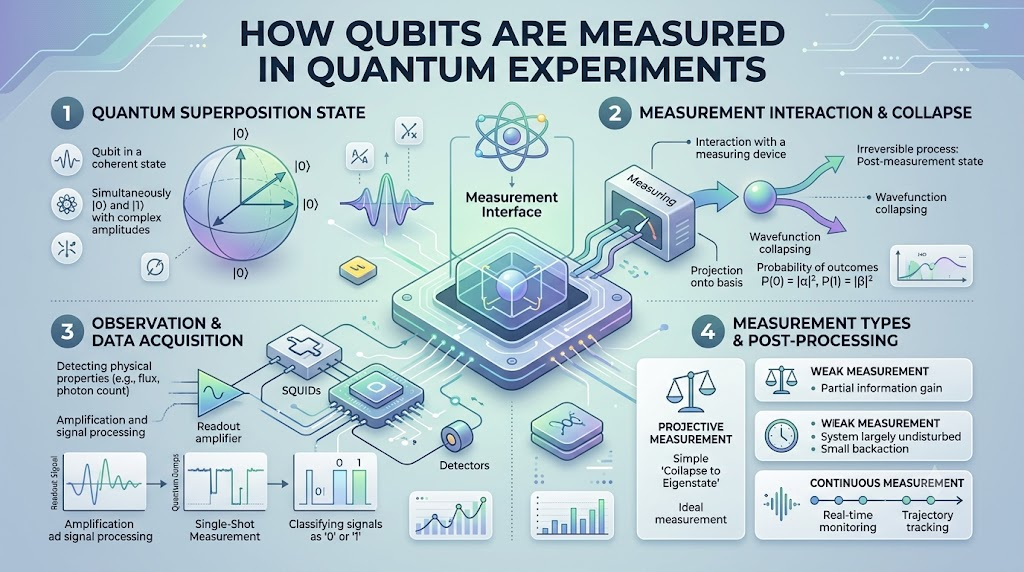
Before you measure a qubit, it can be in superposition. Think of it like a coin spinning in the air. It is not heads or tails yet. It is both, in a sense, until it lands.
Measurement is like the coin landing. It forces the qubit to “pick” a final state. That state is either 0 or 1.
Why Qubit Measurement Is Tricky
The qubit is in superposition first
Before you check a qubit, it may hold many possible values at once. This is normal for qubits. It is not true for classical bits.
Measurement forces a single answer
When you measure a qubit, superposition ends. The qubit “collapses” into one clear state. You get either a 0 or a 1, never both.
You cannot peek without changing things
You cannot secretly check a qubit’s state and leave it untouched. The act of measuring always disturbs it. This makes qubits very different from normal objects.
Noise causes errors
Real quantum hardware is not perfect. Heat, stray signals, and tiny vibrations can all disturb a qubit. These issues are called noise. Noise can lead to wrong measurement results.
Common Ways Qubits Are Measured
Different types of qubits need different measurement tools. Here are the main methods used today.
Readout using microwave signals
This method works for superconducting qubits. These qubits are tiny circuits kept extremely cold. A microwave pulse is sent toward the qubit. The signal that bounces back tells you the qubit’s state.
Fluorescence detection
This method works for trapped-ion qubits. These qubits are single charged atoms held in place by electric fields. A laser shines on the ion. If the ion glows, that means one state. If it stays dark, that means the other state.
Spin-based readout
This method works for spin qubits. These qubits often use the spin of a single electron. Spin is a quantum property, a bit like a tiny magnet pointing up or down. Special circuits detect which way the spin points.
Photon detection
This method works for photonic qubits. These qubits use particles of light called photons. Sensors called photon detectors catch the photon and record where it appears. That location tells you the result.
Different qubits, different tools
Each qubit type needs its own readout method. This is because each type stores information in a different physical way.
| Qubit Type | Measurement Method |
|---|---|
| Superconducting | Microwave signal readout |
| Trapped-ion | Fluorescence detection |
| Spin | Spin-based electronic readout |
| Photonic | Photon detection |
Key Concepts in Qubit Measurement
Measurement basis
A measurement basis is the “question” you ask the qubit. The most common basis asks: is it 0 or 1? Other bases ask different questions, like checking a mix of states. The basis you pick affects what answer you get.
Single-shot vs repeated measurement
A single-shot measurement checks a qubit just once. It gives one result, 0 or 1. Repeated measurement means running the same setup many times. This builds a fuller picture of the qubit’s behavior.
Measurement fidelity
Fidelity means accuracy. Measurement fidelity tells you how often a measurement gives the true, correct result. High fidelity means fewer mistakes.
Decoherence
Decoherence happens when a qubit loses its quantum behavior. This can happen due to noise, heat, or time itself. Once decoherence sets in, useful quantum information is lost.
Quantum non-demolition measurement
Some special methods try to reduce how much a measurement disturbs a qubit. These are called quantum non-demolition measurements. They still collapse the qubit but aim to limit extra damage.
How It Works, Step by Step
Here is the basic flow for measuring a qubit:
Prepare the qubit → run the quantum operation → apply a measurement pulse or signal → detect the result → record 0 or 1
First, scientists prepare the qubit in a starting state. Then they run the quantum program they want to test. Next, they send a measurement pulse or signal. A detector picks up the response. Finally, the result gets recorded as a 0 or a 1.
Example: In a superconducting qubit, a microwave pulse goes in. The qubit reflects this pulse back in a specific way. That reflected signal tells researchers if the qubit was in state 0 or state 1.
Why Repeated Measurements Matter
One measurement is not enough
A single measurement gives only one bit of data: a 0 or a 1. It cannot show you the full superposition that existed before collapse.
Repeating builds a probability picture
Researchers run the same experiment many times. Say a qubit was 70% likely to collapse into state 1. Out of 100 tries, you would expect close to 70 results of “1.”
This reveals the original quantum state
By repeating the experiment, scientists can estimate what the qubit’s superposition looked like before it collapsed. This turns single random results into useful, meaningful data.
Real-World Use Cases
- Verifying quantum algorithms. Measurement checks if a quantum program gave the expected answer.
- Quantum error correction. This process finds and fixes errors in qubits, and it relies on careful measurement.
- Benchmarking quantum computers. Measurement results help compare different quantum machines.
- Quantum sensing and metrology. Some sensors use qubits to measure things like tiny magnetic fields, and this needs precise readout.
- Research into new qubit designs. Scientists measure new qubit types to test if they work well.
Benefits and Challenges
Benefits
- Confirms that quantum computations actually work
- Helps engineers improve quantum hardware
- Supports error correction, which is key for reliable computing
Challenges
- Measurement errors can give wrong results
- Decoherence can destroy quantum information before it is read
- Measurement speed is often limited
- Equipment for measurement is specialized and costly
- Environmental noise adds extra errors
Best Practices Used in Labs
- Carefully calibrate all measurement equipment before running experiments.
- Reduce environmental noise using cooling systems and shielding.
- Use error correction and error mitigation methods to handle mistakes.
- Run many repeated measurements to get reliable statistics.
- Keep working to improve measurement fidelity over time.
Common Misconceptions to Avoid
- “Measuring a qubit is just like reading a normal computer bit.” This is false. Measurement changes a qubit’s state, unlike reading a classical bit.
- “A qubit can be both 0 and 1 after measurement.” This is false. After measurement, the qubit shows only one clear result.
- “All qubits are measured the same way.” This is false. Different qubit types use different physical readout methods.
- “More measurements always fix errors.” This helps with statistics, but it does not remove hardware noise or fix a broken qubit.
Tools and Platforms Used in This Field
This list is for awareness only. It is not a ranking or recommendation.
| Platform | Known For |
|---|---|
| IBM Quantum | Cloud access to superconducting quantum computers |
| Google Quantum AI | Research on superconducting qubits and quantum algorithms |
| IonQ | Trapped-ion quantum computing systems |
| Rigetti | Superconducting quantum computing hardware |
| Qiskit | Open-source software for building quantum programs |
| Amazon Braket | Cloud platform for testing quantum algorithms on different hardware |
Future Trends
- Faster, more accurate readout. Researchers keep working on quicker and cleaner measurement methods.
- Better error correction. Improved measurement helps catch and fix errors sooner.
- Scaling to thousands of qubits. Future quantum computers will need reliable measurement across many more qubits at once.
Frequently Asked Questions
What is a qubit?
A qubit is the basic unit of quantum information. Unlike a classical bit, which is only 0 or 1, a qubit can hold a mix of both states at once. This mix is called superposition.
Why does measuring a qubit change its state?
Quantum physics says that observing a system affects it. When you measure a qubit, you force it out of superposition. It then settles into one definite state, either 0 or 1.
What does “collapse” mean in quantum measurement?
Collapse is the moment a qubit moves from superposition into a single, fixed value. Before collapse, the qubit holds a mix of states. After collapse, it holds only one.
How accurate are qubit measurements?
Accuracy depends on the hardware and method used. Scientists describe this accuracy using measurement fidelity, and researchers work hard to push fidelity as high as possible.
What is the difference between measuring a qubit and a classical bit?
Reading a classical bit never changes its value. Measuring a qubit, however, always disturbs it and forces it into one final state.
Why do researchers repeat the same measurement many times?
A single measurement only gives one result, 0 or 1. Repeating the experiment many times lets researchers build a probability picture of the qubit’s original state.
What is measurement fidelity?
Measurement fidelity is a way to describe accuracy. High fidelity means the measurement usually gives the true, correct result, with few mistakes.
Can a qubit be measured without disturbing it at all?
No, not completely. Special methods called quantum non-demolition measurements try to reduce disturbance, but some effect on the qubit is unavoidable.
Which qubit type is easiest to measure?
There is no single “easiest” type. Each qubit type, like superconducting, trapped-ion, or photonic, has its own strengths and challenges for measurement.
What tools or platforms can I use to try quantum measurement myself?
Platforms like IBM Quantum and Amazon Braket let you run real quantum programs in the cloud. Software like Qiskit helps you write and test these programs yourself.
Conclusion
Measuring a qubit is not as simple as checking a light switch. Superposition, collapse, and noise all make the job harder. Yet measurement is the only way we can trust that a quantum computer worked.
Different qubit types use different readout tools, from microwaves to lasers to light detectors. Scientists repeat measurements to build a full picture of quantum behavior. As measurement tools improve, so will the power of quantum computing itself.
