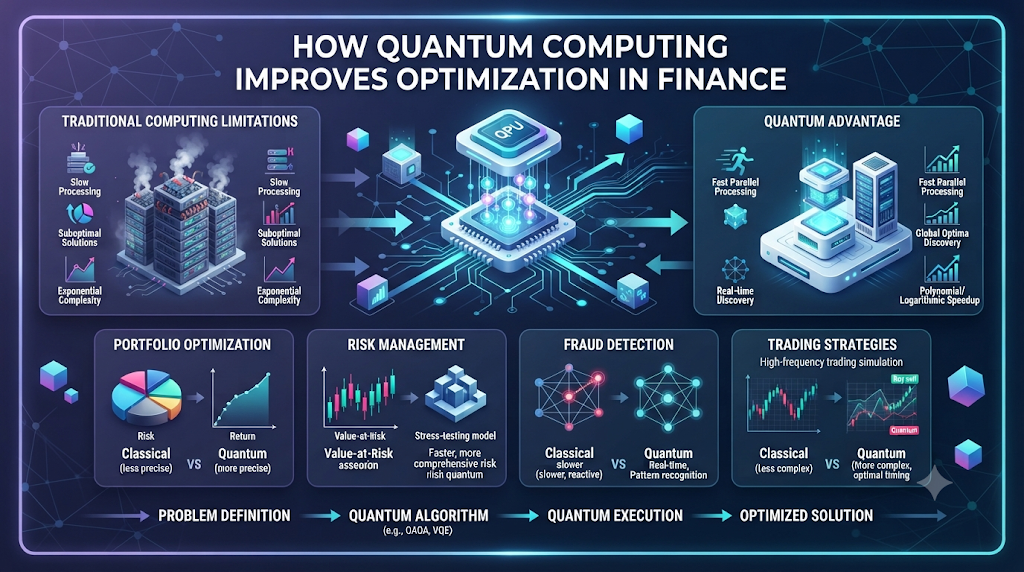
Finance runs on optimization. Banks, funds, and insurers hunt for the best mix of assets every day. These problems grow fast as you add more choices. Classical computers slow down. Many firms then settle for “good enough” answers.
Quantum computing offers a new path. It does not replace your servers. It attacks one class of problem: hard optimization. This guide explains how quantum computing improves optimization in finance. You will learn where it works today, where it fails, and how to start.
Why Optimization Is Hard in Finance
Many finance problems are combinatorial. That word means you must pick the best option from a huge set of options. The count grows very fast as the problem grows.
Take portfolio optimization. You want the best return at a set level of risk. Say you can pick from 100 assets. The number of possible mixes has 31 digits. No computer can check every mix one by one.
Classical solvers use clever shortcuts. Linear programming and mixed-integer methods work well here. So do heuristics like simulated annealing. But some problems still resist them. Integer rules, non-linear payoffs, and trading costs make the math messy.
Then there is time. Markets move in seconds. A solver that takes an hour gives you a stale answer. Speed matters as much as accuracy.
How Quantum Computing Helps: The Short Version
A classical bit is 0 or 1. A qubit can hold both states at once. This is called superposition. So one machine can hold many answers at once.
Qubits can also link together. This is called entanglement. Linked qubits act as one system, not as single units. This gives the machine a rare kind of power.
Here is the honest part. A quantum computer does not just check every answer at once. When you read it, the system picks one answer. The trick is in the design of the algorithm. Good quantum algorithms shape the search itself. They raise the odds of landing on a strong answer.
The Main Quantum Approaches
Quantum annealing
This method maps your problem to an energy landscape. Low energy means a good answer. The machine settles into a low-energy state, much like water finding its level. It can also tunnel through energy walls instead of climbing over them. Quantum annealing machines exist today and handle small, rugged problems well.
QAOA
QAOA stands for Quantum Approximate Optimization Algorithm. It runs on gate-based quantum computers. A quantum unit proposes answers. A classical loop tunes the settings. The two work as a team over many rounds. Research teams use QAOA a lot for portfolio selection tests.
VQE
VQE stands for Variational Quantum Eigensolver. It also splits work between quantum and classical parts. It finds the best value of a cost function. Finance teams test it for risk and return models. Note that both QAOA and VQE are hybrid methods. Your classical machines stay in the loop.
Where It Helps Most in Finance
Portfolio optimization
This is the flagship use case. You pick assets, balance risk and return, and respect limits such as sector caps. The problem fits the quantum format well. IBM and Vanguard have shared research on portfolio building with quantum tools. Other large banks run similar pilots. Results are early but useful.
Risk analysis
Risk teams use Monte Carlo tests. These need huge piles of random samples. Quantum amplitude estimation may cut the sample count for the same accuracy. The math supports this. Real machines have not yet delivered it at scale. Watch this space.
Currency arbitrage detection
Finding the best path across currency pairs is a graph problem. You hunt for a chain of trades that ends with more than you started with. Quantum search methods may speed up this hunt. Some banks test this on small case studies today.
Fraud and settlement problems
Fraud detection often comes down to grouping and matching tasks. Settlement batching is a scheduling problem. Both can be framed as optimization. These areas are still early stage for quantum, but the fit is real.
The State of Play Today
Where do big firms stand? Most large banks now have small quantum teams. JPMorgan, HSBC, and Goldman Sachs all run research programs. IBM and Vanguard have shared joint work on portfolio building. This is a real trend, not just talk.
But note the shape of it. Almost all of this work is research or pilot level. No bank runs its core books on a quantum machine today. The smart teams use quantum to learn, not to launch.
There is also a middle path. Some vendors sell quantum-inspired solvers. These are classical chips built with quantum ideas. They run today, with no cryogenics and no queues. Toshiba and Fujitsu offer such tools. For many finance problems, they beat both ends.
How to Start: A Practical Path
Follow these six steps. They save money and time.
- Pick one small, real problem. Do not pick your core trading engine. Pick a niche task with clear value.
- Write the problem as a QUBO. This is a math format that maps your choices to energy values. Vendors provide tools for this step.
- Build a classical baseline first. Use the best classical solver you can afford. This step is not optional.
- Test on a quantum simulator. Simulators are free or cheap. They show if your model behaves.
- Run on real hardware through a cloud service. Major cloud platforms offer quantum access. Expect noise and small problem sizes.
- Compare results with the same time budget on both systems. Report the gap honestly, even if classical wins.
When You Should NOT Use It
Skip quantum if your problem fits a classical solver. If mixed-integer programming solves your task in seconds, stay classical. Tune your solver first. Many “hard” problems are just badly coded ones.
Skip it if you need exact, certified answers. Quantum methods return answers with odds, not proof. You get a strong candidate, not a proof. Regulators may not accept that yet.
Skip it for microsecond trading. Cloud access adds latency. Data rules may also block cloud use.
What are the alternatives? Better heuristics, GPU clusters, and solver upgrades often deliver more value today. Quantum-inspired chips offer a middle path. Try those first. My honest view: treat quantum as research, not production, for now.
What Can Go Wrong
Noise is the big one. Today’s qubits are fragile. Errors build up as the circuit grows. Error fix methods are improving but not ready for real use.
Qubit counts are small. Real machines handle modest problem sizes. Your QUBO may not fit.
The advantage is often absent. In many public benchmarks, tuned classical solvers still win. Some quantum claims fade under fair testing.
Encoding is hard too. Finance constraints can blow up the size of your QUBO. A small problem can become a huge one.
How to prevent all this? Keep scope small. Build a strong baseline. Set clear success metrics before you test.
Cost, Security, and Maintenance
Cloud access is the cheap way in. You pay by the hour or by the task. A pilot costs far less than a hardware purchase.
Security needs care. Your problem data may leave your firm when you use cloud hardware. Check your data rules first. Also note a bigger issue: future quantum machines could break today’s encryption. Start planning a move to post-quantum encryption now.
Upkeep is real work. Vendors change their hardware and tools fast. Hybrid pipelines need people who know both finance and quantum. Budget for that skill mix.
How to Verify It Worked
Set your metrics before you start. Then test with the same clock for both systems.
Compare solution quality. Give the quantum run and the classical run the same time budget. Then compare the best answers each found.
Measure time to target. How long does each system take to reach a set score?
Check robustness. Run each system many times. Quantum results vary shot to shot. Look at the spread, not just the best run.
Track cost per solution. Include cloud fees, talent time, and setup work.
| Method | Best for | State today | Main limit |
|---|---|---|---|
| Classical solvers | Most current workloads | Mature and fast | Struggles on huge, rugged spaces |
| Quantum-inspired chips | Large rugged problems now | Usable today | Not a true quantum machine |
| Quantum annealing | Small rugged problems | Pilots run now | Few qubits, noisy results |
| QAOA and VQE | Research and pilots | Early research | Needs better hardware |
Common Mistakes to Avoid
- Using a weak classical baseline. A slow baseline makes quantum look good for no reason.
- Believing every advantage claim. Ask for fair, timed benchmarks.
- Skipping the size check. Your problem must fit the hardware.
- Sending raw client data to cloud hardware. Clean it or mask it first.
- Having no exit plan. Decide in advance when to stop the pilot.
Quick checklist before your first pilot:
- One small problem with clear value
- A strong, tuned classical baseline
- A QUBO that fits the hardware
- Data rules checked and cleared
- Success metrics agreed in writing
- A stop date for the pilot
Frequently Asked Questions
Q1. What is quantum computing in finance?
It means using quantum machines on finance problems. The main focus today is optimization, risk, and search tasks. Banks and funds test it in small pilots.
Q2. Can quantum computers beat classical computers in finance today?
Not yet in production. Fair tests often favor tuned classical solvers. The gap is closing as hardware improves.
Q3. What is portfolio optimization in quantum terms?
It becomes an energy problem. Each asset mix gets an energy score. The quantum machine searches for the lowest score, which means the best mix.
Q4. Do I need to buy a quantum computer?
No. Cloud services sell access by the hour. Most teams start this way and never buy hardware.
Q5. Is quantum annealing the same as QAOA?
No. Annealing uses a special machine that settles into low energy. QAOA runs on gate-based machines with a classical helper loop. Both aim at the same problem types.
Q6. How much does a quantum pilot cost?
It varies a lot. Cloud hours are often the smallest line item. Talent and setup time cost more than compute.
Q7. Will quantum break my bank’s security?
Not today. But future machines could crack current encryption. Regulators advise planning a move to post-quantum encryption.
Q8. What skills does my team need?
You need one person fluent in optimization math. Add one person comfortable with quantum tools. Domain finance knowledge ties it together.
Q9. When will quantum be production-ready for finance?
There is no fixed date. Guesses range from a few years to ten years for broad use. Small, narrow wins will come first.
Q10. What should I do next?
Pick one small problem and run a two-month pilot. Keep the classical baseline strong. Publish the honest result inside your firm.
Conclusion
Quantum computing improves optimization in finance by shaping the search itself, not by brute force. Portfolio work leads the field today, with risk and arbitrage close behind. Treat it as research with a strict budget, a strong classical baseline, and honest metrics. Your next step: pick one small problem and run a timed pilot. That test will teach you more than any vendor demo.
10 SEO-Friendly Titles
Awareness titles:
- What Is Quantum Computing in Finance?
- Why Quantum Computing Matters for Finance
- Quantum Optimization in Finance, Explained
- How Quantum Computers Solve Hard Money Problems
- Quantum Finance: What to Know Before You Start
Google-ranking titles:
- How Quantum Computing Improves Optimization in Finance
- Quantum Portfolio Optimization: A Step-by-Step Guide
- Quantum Annealing vs QAOA for Financial Problems
- How to Start Quantum Computing in Finance: 6 Steps
- Quantum Optimization in Finance: Benefits and Limits
Top 6 Hashtags
#QuantumComputing, #FinTech, #PortfolioOptimization, #QuantumFinance, #RiskManagement, #Investing
