Introduction
Quantum computing is no longer a distant dream confined to sci-fi movies. It is actively reshaping how we think about information, technology, and problem-solving. At the absolute core of this technological leap lies a phenomenon so strange yet so powerful that it defies our everyday experiences: quantum interference. Understanding quantum interference is the ultimate key to unlocking how quantum algorithms outpace classical supercomputers. By mastering this concept, you will gain a clear picture of how quantum physics transforms from an abstract theory into a computational powerhouse. Let’s dive into how this subatomic magic works, using simple language and everyday examples. For a broader look at the foundational principles driving this field, you can explore our comprehensive introductory resources available at QuantumUting.com.
What Is Quantum Interference?
At its most basic level, quantum interference is a principle of quantum mechanics where the subatomic states of a system can combine to either amplify or cancel each other out.
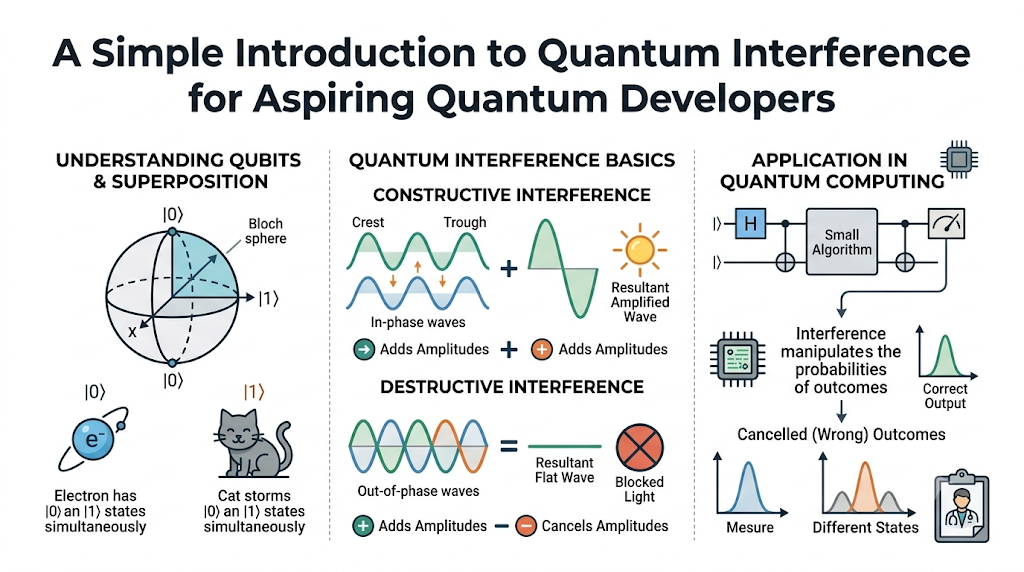
To understand this, think of waves in an ocean. When two waves meet, they don’t just crash and disappear blindly. If the crest of one wave meets the crest of another, they merge into a much larger wave. Conversely, if a crest meets a trough (the lowest point of a wave), they flatten each other out. Quantum particles, such as electrons or photons, behave like these waves.
In quantum physics, particles do not exist in just one definite place until they are measured. Instead, they travel as waves of probability. When these waves cross paths, they interfere with one another.
Unlike classical physics, where an object is either present or it isn’t, quantum mechanics operates in a realm of probabilities. Quantum interference is the mechanism that manipulates these probabilities, making it the foundational engine behind how a quantum computer processes information.
Understanding the Basics Before Quantum Interference
Before we look deeper into how interference operates, we need to establish a few building blocks. If you don’t know what is reacting behind the scenes, the concept won’t make much sense.
What is a Qubit?
A classical computer relies on bits, which act like basic light switches that can only be off (0) or on (1). A qubit (quantum bit) is the fundamental unit of information in quantum computing. Unlike a standard bit, a qubit can exist in a state of 0, 1, or both simultaneously.
Superposition
This ability to exist in multiple states at once is called superposition. Think of a spinning coin. While it is flat on a table, it is clearly either heads or tails. But while it is actively spinning, it is a blur of both possibilities at the exact same time. It only settles into a definitive state when you slap your hand down to stop it.
Wave Functions and Probability Amplitudes
To track this blurry, spinning state, physicists use a mathematical tool called a wave function. The wave function describes everything we can know about the quantum state of a particle. Inside this wave function are probability amplitudes.
Analogy Check: Think of a probability amplitude as the “weight” or “chance” of a specific outcome happening. Crucially, these amplitudes can be positive numbers, negative numbers, or even complex numbers. This ability to hold negative values is exactly what allows them to cancel each other out later.
Quantum States
A quantum state is simply the current condition of a quantum system. When a qubit is in superposition, its overall quantum state is a delicate blend of all its possible outcomes, each waiting for interference to guide its final destination.
How Quantum Interference Works
Now that the building blocks are in place, let’s explore the step-by-step mechanics of how interference alters reality.
[Qubits initialized in Superposition]
                 │
                 ▼
     [Apply Quantum Operations]
      (Creates Wave Functions)
                 │
        ┌────────┴────────┐
        ▼                 ▼
  [Constructive]    [Destructive]
   Amplitudes        Amplitudes
   Add Together     Cancel Out
        │                 │
        └────────┬────────┘
                 ▼
    [High Probability Target]
                 │
                 ▼
      [Measurement Taken]
    (Correct Answer Revealed)
Step 1: Establishing Wave Behavior
When a quantum algorithm starts, qubits are placed into a state of superposition. At this moment, they stop acting like rigid little marbles and start acting like ripples on a pond. Each possible answer to a computational problem is assigned a specific wave path.
Step 2: Combining Probability Amplitudes
As the quantum computer runs its program, it directs these waves toward each other. The probability amplitudes (the math behind the waves) begin to interact. If two paths leading to an incorrect answer meet, the computer designs the algorithm so that a positive amplitude meets a negative amplitude.
Step 3: Constructive Interference
When two waves line up perfectly crest-to-crest, they undergo constructive interference. Their amplitudes add together, making the wave much taller. In computational terms, this drastically boosts the probability that this specific state will be observed.
Step 4: Destructive Interference
When a crest meets a trough, they undergo destructive interference. They cancel one another out completely, dropping the wave height to zero. This means the probability of this incorrect path occurring drops to nothing.
Step 5: Measurement Outcomes
Finally, the system is measured. The act of measurement forces the delicate quantum waves to collapse back into hard classical reality (0s and 1s). Because the algorithm used constructive interference to amplify the correct answer and destructive interference to erase the wrong ones, the computer drops the correct answer right into the lap of the developer with incredibly high probability.
Why Quantum Interference Is Important
Without quantum interference, quantum computers would lose their computational edge over classical systems. Here is why this phenomenon is a complete game-changer:
- Faster Quantum Computation: Instead of checking every single folder in a digital filing cabinet one by one, a quantum computer can look at all of them simultaneously and use interference to instantly highlight the correct folder.
- Efficient Problem Solving: It allows systems to sort through trillions of variables. Problems that would take a classical supercomputer thousands of years to calculate can potentially be solved in mere minutes.
- Improved Algorithm Performance: By systematically dampening wrong answers, it ensures that the system doesn’t waste processing energy on dead ends.
- High Probability of Correct Answers: Quantum mechanics is naturally probabilistic, meaning there is always a tiny element of chance. Interference acts as a directional funnel, making sure the final answer is highly accurate.
- Foundation for Quantum Algorithms: Iconic frameworks like Grover’s Search Algorithm and Shor’s Algorithm rely entirely on manipulating interference patterns to function.
Types of Quantum Interference
Quantum interference manifests in several distinct ways depending on the complexity of the system involved.
Constructive Interference
This occurs when the phases of two or more quantum waves match perfectly.
- Example: Imagine two synchronized swings moving forward at the exact same moment. If you push them together, their combined energy creates a much higher arc. In a quantum system, this results in a high probability spike for that specific computational state.
Destructive Interference
This occurs when the phases of two waves are completely out of sync by 180 degrees.
- Example: Noise-canceling headphones use this exact concept. They listen to the background noise around you and instantly create an opposite sound wave to flatten out the ambient noise. In quantum computing, this erases unwanted computational paths.
Single-Particle Interference
Amazingly, a single quantum particle can interfere with itself. When a single photon is fired through a barrier with two paths, its wave function splits and travels through both paths simultaneously, interfering with itself along the way before landing on a detector.
Multi-Particle Interference
This happens when multiple distinct qubits interact. As more particles are introduced, their wave functions become deeply intertwined. Managing multi-particle interference allows quantum computers to scale their processing power exponentially to handle massive global data sets.
Real-World Examples
To see how this works outside of a abstract textbook, let’s examine a few physical and technological examples.
The Double-Slit Experiment
This is the classic experiment that shocked the scientific community. When scientists fired individual electrons at a screen containing two parallel slits, they expected to see two neat lines appear on the back wall. Instead, they saw a zebra-stripe pattern of multiple lines. This proved that even individual particles act like waves, passing through both slits at once and creating an interference pattern on the other side.
Quantum Computing Architecture
Inside a physical quantum computer (like the ones built by IBM or Google), engineers use microwave pulses to deliberately manipulate the interference patterns of superconducting qubits. They actively orchestrate the waves to drift toward constructive or destructive points to process math equations.
Quantum Communication and Cryptography
In quantum networks, interference is used to verify if a hacker is trying to steal data. If an eavesdropper tries to intercept a secure quantum message, their observation alters the wave function, disrupting the delicate interference pattern and instantly alerting the network administrators of a security breach.
Applications of Quantum Interference
The practical everyday applications of this technology span across nearly every major global industry.
Quantum Algorithms
As mentioned earlier, code bases like Grover’s Algorithm use interference to scour unsorted databases at blinding speeds, changing how we handle big data indexing.
Quantum Cryptography
By utilizing interference patterns, scientists are developing unhackable communication lines using Quantum Key Distribution (QKD), keeping global banking and government secrets safe.
Quantum Sensing
Because quantum waves are intensely sensitive to their surrounding environments, device developers use interference to create ultra-precise sensors. These tools can map out underground mineral deposits or detect incredibly faint changes in human brain activity without invasive surgery.
Drug Discovery and Simulation
Simulating how a new molecule behaves requires tracking a massive web of electron interactions. Classical computers crumble under this math. Quantum computers use interference to map out molecular structures smoothly, accelerating the creation of life-saving medications.
Optimization Problems
Whether it is finding the most fuel-efficient routes for global shipping fleets or managing volatile financial portfolios, interference sifts through billions of combinations to find the absolute most cost-effective path forward.
Common Challenges
While the theory sounds perfect, building hardware that reliably controls quantum interference is one of the toughest engineering challenges of our century.
- Decoherence: Quantum states are incredibly fragile. The slightest warmth, vibration, or stray electromagnetic signal from the outside world can cause a qubit to lose its quantum properties. When this happens, the waves vanish, and the calculation crashes.
- Environmental Noise: Keeping a quantum processor stable requires burying it inside a massive refrigeration unit cooled to temperatures colder than deep space to block out environmental noise.
- Measurement Errors: Reading the final result of a quantum calculation can accidentally disrupt the system too early, introducing bugs into the final output data.
- Hardware Limitations: Manufacturing thousands of identical, flawless qubits that can maintain clean interference patterns over long periods remains an ongoing hardware bottleneck.
Best Practices for Learning Quantum Interference
If you are a student or developer looking to master this field, avoid getting bogged down in dense academic textbooks right away. Use this practical roadmap instead:
- Visualize First: Use online wave simulators to see how physical water waves interact. Mastering the behavior of physical waves makes understanding quantum waves infinitely easier.
- Use Open-Source Toolkits: Don’t just read about it; code it. Use free development platforms like IBM’s Qiskit or Google’s Cirq. These tools allow you to build simple quantum circuits and watch interference happen visually on your screen.
- Focus on the Logic, Not the Math: Focus heavily on the concepts of superposition and phase shifts before you try to tackle the complex linear algebra behind wave equations.
- Engage with Communities: Join active learning hubs like Discord servers, subreddits, and open forums dedicated to quantum learning to share ideas with fellow peers.
Future Trends
The horizon of quantum information science is moving rapidly. Over the next decade, we can expect significant evolutionary steps:
- Fault-Tolerant Quantum Computing: Scientists are developing logical qubits that use built-in error correction codes to shield delicate interference patterns from external noise.
- Scalable Quantum Hardware: New manufacturing techniques are allowing chips to hold thousands of interconnected qubits without losing stability.
- The Quantum Internet: We are moving closer to a secure network of quantum computers connected via fiber-optic cables, sharing entangled particles and interference metrics globally.
- Next-Generation Quantum Algorithms: Researchers are actively writing new software frameworks tailored specifically for machine learning and artificial intelligence applications.
Comparison Tables
Constructive vs Destructive Quantum Interference
| Feature | Constructive Interference | Destructive Interference |
| Wave Alignment | Crest meets crest, trough meets trough | Crest meets trough |
| Amplitude Effect | Amplitudes add together (amplified) | Amplitudes cancel each other out |
| Probability Impact | Maximizes the probability of an outcome | Minimizes the probability to zero |
| Real-World Example | Two synchronized ocean waves forming a larger peak | Noise-canceling headphones erasing background hums |
Classical Wave Interference vs Quantum Interference
| Feature | Classical Wave Interference | Quantum Interference | Key Difference |
| Physical Medium | Requires a physical substance (water, air, sound strings) | Operates on abstract mathematical probability waves | Classical moves physical matter; quantum shifts the likelihood of physical realities. |
| Particle Behavior | Involves millions of interacting macro molecules | Can occur with a single isolated particle interacting with itself | Quantum systems do not require multiple physical elements to create a pattern. |
| Measurement Effect | Observing the wave does not alter its physical shape | Observing the wave immediately forces it to collapse into a single point | Quantum measurement fundamentally forces a choice, ending the interference state. |
FAQs
Q1: Can quantum interference happen with everyday classical objects like cars or tennis balls?
No, large everyday objects do not display quantum interference because they interact constantly with their surroundings, which instantly destroys their quantum properties before waves can form.
Q2: Is quantum interference the same thing as quantum entanglement?
No. Superposition is a single particle holding multiple states, interference is those states interacting with each other, and entanglement is a deep, unbreakable connection linking two or more distant particles.
Q3: How do quantum algorithms actively control interference?
Programmers use quantum gates (like microwave pulses or lasers) to shift the phases of qubits, purposefully steering them into constructive or destructive patterns.
Q4: Does measuring a qubit stop the process of quantum interference?
Yes. The exact second you measure a qubit, its wave function collapses into a solid classical state of either 0 or 1, ending all active interference.
Q5: What is a phase shift in quantum mechanics?
A phase shift is a tiny adjustment made to the timing or alignment of a wave, determining whether it will line up nicely to build up or clash to cancel out.
Q6: Why do we care about negative probabilities in quantum amplitudes?
Physical probabilities can never be negative, but the underlying amplitudes can be. This negative value is what allows a wave to subtract from a positive wave, resulting in zero chance.
Q7: Do you need an advanced math degree to start learning about quantum interference?
Not at all. While the underlying physics uses deep math, the core concepts can easily be understood through visual wave logic and computer programming tools.
Q8: What industry will notice the biggest impact from quantum interference first?
The pharmaceutical sector (drug discovery) and logistics sectors (supply chain optimization) are poised to see the fastest breakthroughs.
Q9: What exactly causes decoherence in a quantum computer?
Anything from a tiny fluctuation in temperature, minor magnetic fields, or even a stray Wi-Fi signal can cause a system to drop its quantum properties.
Q10: Are there any free software tools available to practice using quantum interference?
Yes, open-source libraries like IBM’s Qiskit and Google’s Cirq are completely free and offer excellent visual tools for complete beginners.
Conclusion
Quantum interference stands out as one of the most remarkable and foundational principles driving the revolution of quantum technologies. It is the vital tool that transforms the wild, unpredictable world of quantum mechanics into an organized computational engine. By guiding how probability waves interact, it gives us the rare power to discard millions of incorrect options instantly while shining a spotlight on the precise answers we need. For anyone entering the fields of computer science, engineering, or physics, building a solid conceptual foundation in how interference works is incredibly rewarding. As hardware developers continue to stabilize these delicate systems, our ability to harness the power of quantum waves will pave the way for completely new eras of computing discovery.
