Introduction
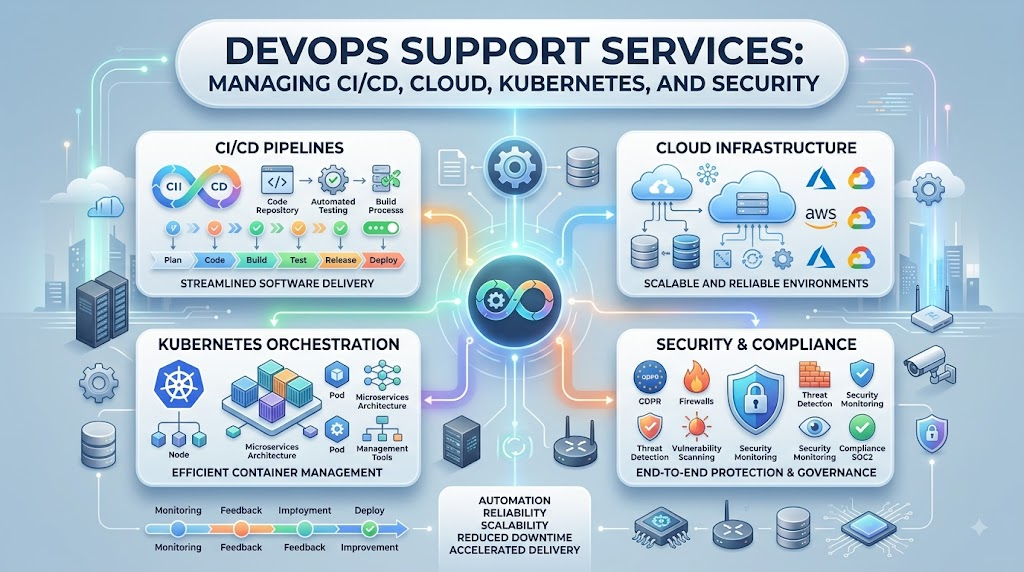
Building a modern application is only one part of running a technology business. Once software reaches production, teams must continuously manage deployments, infrastructure, monitoring, security, cloud resources, backups, scaling, and unexpected incidents. As applications grow, these responsibilities can become difficult to handle alongside normal development work. A failed pipeline may delay a release. A cloud configuration problem may affect an application. A Kubernetes issue can require specialized troubleshooting, while insufficient monitoring can make an incident harder to understand. At the same time, security requirements and operational workloads continue to increase. This is why DevOps Support Services can be valuable for organizations that need continuing assistance rather than one-time implementation work. Support can provide additional operational capacity for infrastructure management, CI/CD, cloud environments, automation, monitoring, troubleshooting, and production activities.
What Are DevOps Support Services?
DevOps support refers to the continuing technical work required to keep development, infrastructure, and production environments functioning effectively.
A DevOps support team may assist with infrastructure administration, deployment pipelines, cloud operations, monitoring, troubleshooting, automation, Infrastructure as Code, release activities, and production incidents.
There is an important difference between implementing DevOps and supporting DevOps.
During implementation, a team might create a CI/CD pipeline, configure cloud infrastructure, introduce containers, or establish monitoring. Once those systems are operational, they still need maintenance. Pipeline configurations change, dependencies are updated, infrastructure requirements evolve, certificates or credentials require attention, and applications need to scale.
Ongoing support addresses these operational realities.
It can also help identify repeated problems. If engineers repeatedly fix the same deployment issue manually, for example, the better long-term approach may be to improve the pipeline or automate the underlying process.
Why Ongoing DevOps Support Matters
Modern infrastructure changes continuously. Cloud resources are added or removed, applications receive frequent releases, security controls evolve, and workloads can change unexpectedly.
Internal engineering teams often have to balance these operational responsibilities with product development. When the same engineers are responsible for building features and responding to infrastructure incidents, operational work can interrupt development priorities.
Ongoing support can provide additional expertise without necessarily replacing internal teams.
A company might retain architectural and product ownership internally while using external engineers for defined activities such as cloud administration, monitoring, CI/CD maintenance, Kubernetes troubleshooting, or incident support.
This can be especially useful for organizations that have grown quickly but have not yet built a large platform or operations team.
Effective support should also focus on prevention. Monitoring recurring incidents, documenting known problems, improving automation, and identifying configuration weaknesses can make the environment easier to operate over time.
24/7 DevOps Support Services
Applications serving customers across multiple regions may operate beyond normal office hours. For these environments, 24/7 DevOps Support Services can provide a structured approach to handling operational events outside a standard working schedule.
Depending on the support agreement, activities can include continuous monitoring, alert handling, incident investigation, deployment assistance, infrastructure troubleshooting, escalation, and emergency production response.
However, 24/7 coverage should not simply mean having someone available. A useful support model requires defined procedures.
For example, an alert should have a clear severity level, an identified owner, a troubleshooting process, and an escalation path. Engineers should know which incidents require immediate action and which can be handled during normal maintenance windows.
Documentation is equally important. Without access to architecture diagrams, runbooks, system information, and escalation contacts, even an experienced engineer may spend unnecessary time understanding an unfamiliar environment.
Organizations should therefore define which systems require round-the-clock attention and which can operate under business-hours support.
Understanding Managed DevOps Services
Managed DevOps Services generally involve assigning recurring operational responsibilities to an external technical team.
Traditional consulting often focuses on advice, architecture, implementation, or a specific technical project. Managed support is more operational: the external team continues to perform agreed responsibilities over time.
These responsibilities can include:
- CI/CD pipeline management
- Infrastructure automation
- Cloud administration
- Configuration management
- Monitoring
- Release management
- Backup-related operations
- Security activities
- Infrastructure maintenance
- Production troubleshooting
Managed DevOps can be useful when a company wants additional operational capacity without immediately building a larger internal team.
It is not necessarily the best option for every organization. Larger businesses with mature platform engineering functions may prefer to keep most responsibilities internally and bring in external specialists only for particular areas.
Before choosing a managed model, companies should define ownership clearly. Access permissions, change approval, escalation, documentation, reporting, and knowledge transfer should all be understood by both sides.
Kubernetes Support Services
Kubernetes can simplify application deployment and scaling, but operating Kubernetes at production scale requires knowledge of many interconnected components.
Kubernetes Support Services can cover cluster administration, workload management, scaling, networking, security, monitoring, upgrades, resource allocation, troubleshooting, and production optimization.
Kubernetes environments may run on platforms such as Amazon EKS, Azure AKS, or Google GKE. While these managed services reduce some infrastructure responsibilities, application and cluster operations still require attention.
Typical operational issues include workloads entering crash loops, resource limits being configured incorrectly, failed deployments, networking problems, unexpected scaling behavior, or insufficient monitoring.
Support should therefore go beyond fixing individual incidents. Teams should also consider upgrade planning, resource policies, access controls, observability, workload configuration, and automation.
A well-maintained Kubernetes environment is easier to troubleshoot because engineers have reliable monitoring, documented procedures, and consistent deployment practices.
AWS DevOps Support Services
AWS environments can include a wide range of services and architectures. Depending on the application, teams may work with EC2, EKS, ECS, Lambda, networking services, storage, identity systems, and monitoring tools.
AWS DevOps Support Services can help organizations manage these environments through infrastructure automation, deployment support, monitoring, configuration management, and day-to-day cloud operations.
Infrastructure as Code can be used to make infrastructure changes more repeatable. Terraform and CloudFormation are examples of technologies commonly used for this purpose.
CI/CD pipelines can also reduce manual release steps. Monitoring provides operational visibility into applications and infrastructure, helping teams investigate unusual behavior and performance issues.
There is no universal AWS architecture that fits every workload. A serverless application may require a different operational approach from a Kubernetes platform or a traditional virtual-machine-based application.
AWS support should therefore be based on workload characteristics, security requirements, operational needs, and the skills available within the organization.
Azure DevOps Support Services
Organizations using Microsoft Azure also have recurring operational responsibilities across infrastructure, application delivery, monitoring, and production environments.
Azure DevOps Support Services may involve Azure Pipelines, AKS, Azure infrastructure, release management, deployment automation, monitoring, and CI/CD operations.
For example, a support team might help investigate a failed pipeline, troubleshoot a production deployment, manage infrastructure changes, or review recurring operational alerts.
Azure environments can also contain multiple subscriptions, applications, environments, and deployment workflows. Consistency becomes increasingly important as the environment expands.
External support can complement internal engineering teams by taking responsibility for defined operational activities while internal teams maintain control over application design and business priorities.
DevSecOps Support Services
Security becomes more effective when it is integrated into everyday engineering processes rather than added only immediately before release.
DevSecOps Support Services can help incorporate security practices into development, CI/CD, infrastructure, and production workflows.
Relevant activities may include:
- Static Application Security Testing (SAST)
- Dynamic Application Security Testing (DAST)
- Dependency scanning
- Container image security
- Secrets management
- Vulnerability management
- Secure CI/CD
- Security automation
- Compliance-related practices
For example, automated dependency scanning can identify potentially vulnerable libraries before they reach production. Container scanning can identify security issues within images, while proper secrets management reduces the need to store sensitive credentials directly in source repositories.
The objective is to make security part of the delivery lifecycle. Controls should be appropriate to the organization’s risk level and should work alongside developer and operations workflows rather than creating unnecessary friction.
SRE Support Services
Site Reliability Engineering brings an engineering-focused approach to production reliability.
SRE Support Services can involve observability, incident management, reliability automation, capacity planning, performance engineering, SLI and SLO design, and root-cause analysis.
SLIs provide measurements of system behavior, while SLOs establish reliability targets. SLAs are typically agreements defining service expectations, while error budgets can help teams balance reliability objectives with the pace of software changes.
Observability is another important part of SRE. Metrics, logs, and traces can provide information needed to understand what is happening inside an application or infrastructure environment.
SRE support should not focus entirely on reacting to outages. Automation and analysis can help reduce repetitive operational tasks and identify patterns behind recurring incidents.
This approach can help engineering teams make reliability an ongoing engineering responsibility rather than a separate activity performed only after something fails.
MLOps Support Services
Machine-learning applications have operational requirements that extend beyond model development.
Once a model is ready for production, teams may need infrastructure, deployment pipelines, monitoring, version management, resource management, and automation.
MLOps Support Services can support these areas by helping operate ML pipelines, deployment environments, model monitoring systems, and related infrastructure.
Version management is particularly important because production environments may involve multiple model versions, application versions, and data or configuration dependencies.
MLOps connects machine-learning development with operational engineering practices. It provides a structured approach to moving ML workloads into production and maintaining their surrounding infrastructure.
The exact support model depends on the organization’s ML architecture, workload requirements, deployment process, and operational maturity.
DevOps Support Technology Areas
| Area | Common Technologies / Practices | Primary Purpose |
|---|---|---|
| CI/CD | Jenkins, GitHub Actions, GitLab CI/CD, Azure Pipelines | Automated software delivery |
| Cloud | AWS, Azure, Google Cloud | Infrastructure and cloud operations |
| Containers | Docker, Kubernetes | Consistent application environments |
| Infrastructure as Code | Terraform, CloudFormation | Repeatable infrastructure management |
| Monitoring | Metrics, logs, traces | Visibility into systems |
| Security | SAST, DAST, secrets management | Secure development and delivery |
| SRE | SLI, SLO, error budgets | Reliability management |
| MLOps | ML pipelines, model monitoring | Production ML operations |
These technologies represent common approaches rather than a mandatory toolset. Technology choices should reflect the organization’s architecture, existing skills, integration requirements, and operational goals.
Practical Benefits of Continuous DevOps Support
The value of continuous support often comes from improving everyday operational processes rather than from one dramatic change.
Faster troubleshooting can result from established runbooks, monitoring, and experienced engineers who understand the environment.
Less repetitive work can be achieved by identifying manual activities that can be automated through scripts, pipelines, or Infrastructure as Code.
Improved visibility comes from properly configured metrics, logs, traces, and alerts.
Consistent deployments can result from standardized CI/CD workflows and controlled configuration changes.
Better incident handling becomes possible when ownership and escalation procedures are clearly established.
Stronger security practices can emerge when security checks are incorporated into development and deployment processes.
Improved reliability can result from combining observability, automation, capacity planning, incident analysis, and preventive maintenance.
These benefits depend on how the support model is implemented. Simply adding an external team does not automatically solve operational problems.
Common Challenges When Managing DevOps Support
1. Poor Documentation
Missing architecture information, runbooks, system details, and operational procedures can slow down troubleshooting.
2. Unclear Ownership
If responsibilities are not defined, teams may spend time determining who should investigate or approve a change.
3. Weak Escalation
Critical incidents require clear escalation rules so that serious problems reach the appropriate engineers quickly.
4. Limited Observability
Insufficient logs, metrics, and traces make it difficult to understand application and infrastructure behavior.
5. Too Much Manual Work
Manual deployments and infrastructure changes can introduce inconsistency and increase the possibility of human error.
6. Configuration Differences
Differences between development, staging, and production environments can create unexpected deployment problems.
7. Communication Gaps
External and internal teams need agreed communication channels, responsibilities, and reporting practices.
8. Limited Knowledge Transfer
Support should not create a situation where the internal team cannot understand or operate its own systems.
9. External Dependency
Organizations should retain sufficient internal knowledge to make architecture, security, and operational decisions.
10. Weak Security Processes
Poor credential management, excessive access, and missing security checks can increase operational risk.
How to Evaluate a DevOps Support Company
Choosing a provider should involve technical and operational evaluation rather than simply comparing service lists.
Consider these areas:
- Technical capability: Does the team understand your actual infrastructure and deployment environment?
- Cloud knowledge: Can it work effectively with your primary cloud platform?
- Kubernetes experience: Is there practical knowledge of cluster operations if containers are involved?
- Security: Are access management, secrets, vulnerabilities, and security controls handled appropriately?
- SRE capability: Can the team work with observability, incidents, SLOs, capacity, and reliability?
- MLOps knowledge: Is there relevant understanding of production machine-learning environments?
- Monitoring: How are alerts, metrics, logs, and incidents managed?
- Escalation: What happens when a routine problem becomes a critical incident?
- Documentation: How are runbooks, changes, and operational knowledge maintained?
- Communication: How will internal teams and support engineers coordinate?
- Coverage: Does the support schedule match actual operational needs?
- SLA structure: Are service expectations clearly documented?
- Knowledge transfer: Will internal engineers receive useful operational knowledge?
- Security practices: Are access and credentials handled according to organizational requirements?
- Team compatibility: Can the external engineers work effectively alongside existing technical teams?
The best provider is not necessarily the one offering the largest list of services. The more important question is whether its operating model matches the organization’s real technical and business requirements.
DevOps Support Area and Business Need
| Support Area | Typical Business Need |
| DevOps Support | Ongoing infrastructure and delivery assistance |
| 24/7 DevOps Support | Continuous monitoring and incident response |
| Managed DevOps | Reduce recurring operational responsibilities |
| Kubernetes Support | Operate containerized production environments |
| AWS DevOps Support | Manage AWS infrastructure and deployments |
| Azure DevOps Support | Support Azure-based delivery and operations |
| DevSecOps Support | Integrate security into engineering workflows |
| SRE Support | Strengthen reliability and operational practices |
| MLOps Support | Operate ML workloads in production |
Frequently Asked Questions
What are DevOps Support Services?
They are ongoing technical and operational services that can cover infrastructure, CI/CD, cloud operations, monitoring, automation, troubleshooting, deployments, and production environments.
Why do companies need ongoing DevOps support?
Infrastructure changes continuously, while engineering teams have competing priorities. Ongoing support can provide additional expertise and capacity for recurring operational responsibilities.
What can 24/7 DevOps Support Services cover?
Depending on the agreed scope, 24/7 support may include monitoring, alert handling, incident investigation, troubleshooting, escalation, deployment assistance, and production response.
How are managed DevOps and regular support different?
Regular support may focus on selected operational needs or technical issues. Managed DevOps generally involves assigning an external team responsibility for a defined set of recurring operations.
When should a company consider Kubernetes support?
Kubernetes support can be useful when an organization operates production clusters and needs assistance with upgrades, scaling, monitoring, networking, workload management, security, or troubleshooting.
What does AWS DevOps support include?
It can involve AWS infrastructure operations, EC2, EKS, ECS, Lambda, Terraform, CloudFormation, CI/CD, monitoring, automation, and deployment management.
How can DevSecOps support help engineering teams?
It can integrate security practices such as code analysis, dependency scanning, container security, secrets management, and vulnerability management into normal delivery processes.
What do SRE and MLOps support address?
SRE focuses on reliability, observability, incident management, automation, capacity, and performance. MLOps focuses on operating ML infrastructure, pipelines, model deployment, monitoring, and production workflows.
Conclusion
Modern applications depend on more than application code. Cloud infrastructure, deployment pipelines, container platforms, monitoring systems, security controls, and production environments all require continuous management. As these systems become more complex, organizations may need additional operational expertise to maintain them effectively. A suitable DevOps support model can bring together cloud operations, CI/CD, automation, Kubernetes management, security, observability, SRE practices, and MLOps. The emphasis should be on creating repeatable processes, improving visibility, addressing recurring problems, and reducing unnecessary manual effort. Organizations should not select a support model based only on the number of technologies a provider mentions. Technical maturity, infrastructure complexity, security requirements, internal capabilities, workload characteristics, coverage needs, documentation, communication, and long-term objectives are all important considerations.
