Introduction
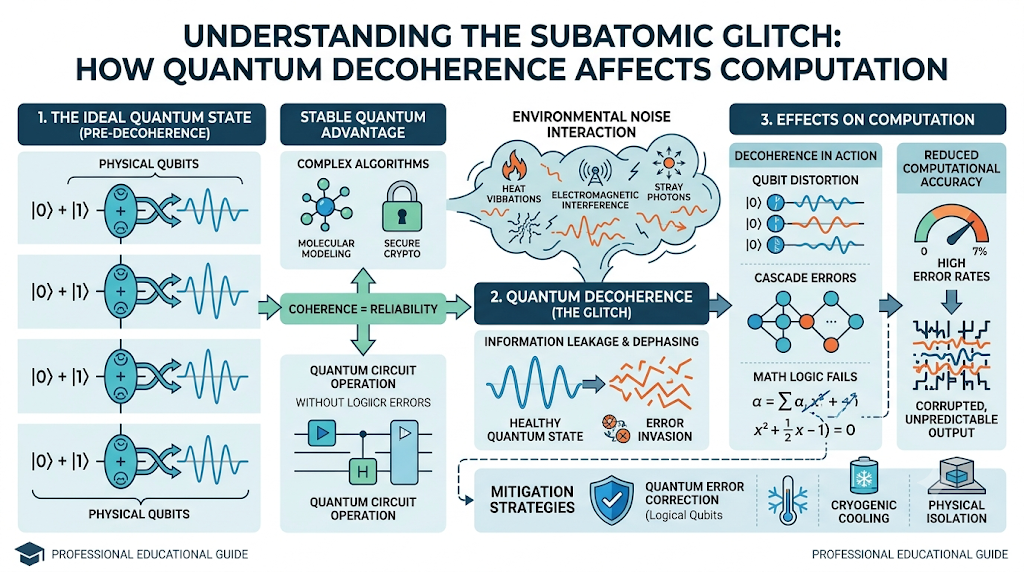
This vulnerability introduces one of the greatest obstacles in modern physics and computer science: quantum decoherence. It is the primary reason why building reliable, large-scale quantum computers is incredibly difficult. When quantum systems interact with their surroundings, they lose their unique quantum properties, causing errors that disrupt computational logic. Understanding this phenomenon is essential for anyone entering the field. At QuantumUting.com, we aim to break down these complex quantum concepts into clear, digestible insights for students and tech enthusiasts alike. In this comprehensive guide, you will learn exactly what quantum decoherence is, how it introduces quantum noise into hardware, and how researchers use quantum error correction to protect fragile qubits from environmental interference.
What Is Quantum Decoherence?
Featured Snippet Definition: Quantum decoherence is the process by which a quantum system loses its quantum properties—such as superposition and entanglement—due to interactions with its surrounding environment. This interaction turns delicate quantum data into classical, standard data, effectively destroying the quantum computational advantage.
To understand how quantum decoherence affects computation, think of a spinning coin. While the coin is spinning on a table, it exists in a state that is a mix of both heads and tails. This is similar to how a quantum system holds multiple possibilities at once.
Core Concepts
Before exploring how decoherence degrades calculations, it helps to understand the foundational pieces of a quantum system.
Qubits
A classical computer uses bits as its basic unit of information, which can only exist as a 0 or a 1. A quantum computer uses qubits (quantum bits). Qubits can represent a 0, a 1, or any fractional combination of both simultaneously, allowing them to process vast amounts of data at once.
Superposition
Superposition is the ability of a qubit to exist in multiple states at the same time. Think of it like a musical chord where multiple notes are played simultaneously, creating a richer sound than a single note could achieve on its own.
Entanglement
Entanglement occurs when two or more qubits become deeply linked. The state of one qubit instantly influences the state of another, no matter how far apart they are. This allows quantum computers to share information across different parts of a system instantly.
Quantum Noise
Quantum noise refers to any unwanted disturbance that alters the state of a qubit. Just like static hiss on an old radio station makes it hard to hear the music, quantum noise scrambles the delicate information inside a quantum computer.
Environmental Interactions
Quantum hardware is incredibly sensitive. Minor environmental factors like microscopic temperature changes, magnetic fields, stray light, or wifi signals can interact with qubits. These unintentional interactions are the primary trigger for decoherence.
Measurement
In quantum physics, looking at a system changes it. When a quantum computer finishes a calculation, researchers measure the qubits to read the final answer. This intentional measurement deliberately forces the qubits out of superposition. Decoherence is essentially an unintentional measurement caused by the environment looking in before the computation is complete.
How Quantum Decoherence Affects Computation
When decoherence strikes a quantum computer, it creates a domino effect that impacts everything from individual qubits to complex software algorithms.
Plaintext
+-----------------------+      +-----------------------+      +-----------------------+
|  Environmental Noise  | ---> |  Quantum Decoherence  | ---> | Loss of Superposition |
| (Heat, Magnetism, etc)|      | (Information Leakage) |      | (Reverts to standard) |
+-----------------------+      +-----------------------+      +-----------------------+
                                                                          |
                                                                          v
+-----------------------+      +-----------------------+      +-----------------------+
| Faulty Computational  | <--- | High Cascading Error  | <--- | Scrambled Algorithms  |
|        Output         |      |         Rates         |      | (Math Logic Fails)    |
+-----------------------+      +-----------------------+      +-----------------------+
Loss of Quantum Information
When a qubit decoheres, it leaks its quantum properties into the surrounding environment. The unique blend of 0 and 1 vanishes, leaving behind a simple, classical 0 or 1. This means any specialized data stored in that qubit is permanently lost.
Reduced Computational Accuracy
Because decoherence alters the states of qubits mid-calculation, the mathematical accuracy of the system plummets. Instead of arriving at a precise solution, the quantum computer begins guessing randomly, making the final output unreliable.
Increased Error Rates
Decoherence introduces a high volume of errors into quantum hardware. In a standard computer, a bit flipping from 0 to 1 is rare. In a quantum computer, qubits constantly drift away from their intended states, leading to high error rates that must be continuously managed.
Impact on Quantum Algorithms
Quantum algorithms are carefully written to exploit superposition and entanglement to solve problems. If decoherence disrupts these states midway through running an algorithm, the mathematical logic fails, and the program crashes or yields incorrect data.
Effects on Multi-Qubit Systems
The problem worsens as you add more qubits. Because entangled qubits are interconnected, if a single qubit suffers from decoherence, the disruption can quickly cascade through the entire network, ruining the global quantum state.
Challenges in Building Large Quantum Computers
This compounding error rate creates a massive barrier to scalability. The more qubits you add to a system to make it more powerful, the more surfaces there are for environmental noise to strike, making large quantum computers highly unstable.
QuantumUting.com Guide to Understanding Quantum Decoherence
To help you navigate this complex landscape, our educational philosophy at QuantumUting.com focuses on breaking down hardware and software principles into distinct, manageable steps.
Learning Quantum Fundamentals
Before diving into complex engineering challenges, you should comfortably understand how a qubit operates. Grasping how superposition builds computational pathways makes it much easier to see exactly why decoherence is so destructive.
Understanding Quantum Hardware Challenges
Different types of quantum hardware handle decoherence in different ways. For example, superconducting qubits process information very quickly but are highly sensitive to temperature fluctuations. On the other hand, trapped-ion qubits hold their quantum states longer but process operations at a slower pace.
Exploring Error Correction
Because we cannot perfectly isolate a quantum system, we must design systems to tolerate errors. Learning how scientists group multiple fragile qubits together to form a single, sturdy “logical qubit” is an essential milestone for any computer science student.
Studying Fault-Tolerant Quantum Computing
Fault tolerance is the ultimate goal of modern quantum engineering. It refers to a system’s ability to continue running algorithms accurately even when individual hardware pieces experience decoherence.
Building Strong Quantum Computing Knowledge
True mastery comes from balancing theory with real-world limitations. By studying decoherence, you shift from viewing quantum computers as ideal mathematical engines to understanding them as real, physical machines fighting against environmental noise.
Methods Used to Reduce Decoherence
Scientists use several ingenious engineering techniques to shield qubits from the environment and minimize the effects of decoherence.
Quantum Error Correction
Since physical qubits will inevitably experience some decoherence, researchers use quantum error correction algorithms. By spreading a single piece of quantum data across an array of physical qubits, the system can detect and fix errors automatically without ruining the ongoing computation.
Physical Isolation
Quantum processors are housed inside heavily shielded containers. These chambers block out external electromagnetic radiation, radio waves, and magnetic fields, acting like deep-underground bunkers for delicate quantum information.
Cryogenic Cooling
Heat is a major source of atomic movement and quantum noise. To eliminate thermal vibrations, quantum computers are placed inside specialized refrigerators called dilution refrigerators. These devices cool the quantum hardware down to near absolute zero—colder than deep outer space.
Improved Qubit Design
Engineers are constantly researching better physical materials to build qubits. By manufacturing cleaner synthetic diamonds or using highly precise laser-trapped ions, they can create qubits that are naturally more resilient to environmental noise.
Fault-Tolerant Architectures
Designing a system with fault-tolerant architecture means organizing the connections between qubits very carefully. This design ensures that if decoherence occurs in one isolated pocket of the machine, the error cannot spread to neighboring components.
Benefits of Managing Decoherence
Overcoming decoherence unlocks the true potential of advanced computing technologies.
- More Reliable Computation: Minimizing decoherence allows quantum systems to run longer, more complex programs without experiencing random internal corruption.
- Better Algorithm Performance: Quantum algorithms can fully utilize deep entanglement networks, accurately solving complex chemistry and cryptography calculations.
- Improved Scalability: Controlling noise makes it possible to safely connect thousands of qubits together without a compounding cascade of errors.
- Higher Computational Accuracy: Eliminating background interference ensures that the final calculated output matches the mathematical prediction every time.
- Advancement of Quantum Technologies: Successfully managing decoherence moves the industry out of experimental research labs and into real-world commercial use.
Stable Quantum States vs Decoherent Quantum States
The table below outlines the core differences between a well-maintained quantum system and one that has surrendered to environmental noise.
| Feature | Stable Quantum States | Decoherent Quantum States |
| Information Retention | High; preserves rich multi-state properties. | Reduced; reverts to simple classical binary data. |
| Error Rate | Lower; operations proceed predictably. | Higher; errors accumulate rapidly. |
| Algorithm Performance | Reliable; runs complex formulas to completion. | Less Reliable; math logic breaks down mid-way. |
| Qubit Stability | Strong; maintains superposition and entanglement. | Weak; loses quantum properties quickly. |
| Computation Quality | Improved; provides clear, accurate answers. | Degraded; yields corrupted, noisy output. |
Common Challenges
Developing reliable quantum computing platforms involves navigating several distinct engineering roadblocks.
- Environmental Noise: Tiny changes in room temperature or nearby electrical currents can easily ruin a calculation.
- Hardware Limitations: Manufacturing thousands of completely identical, flawless physical qubits remains incredibly difficult.
- Maintaining Coherence: Extending the lifetime of a qubit’s quantum state long enough to execute millions of operational gates is an ongoing struggle.
- Scaling Quantum Systems: As more qubits are added, wiring them together without introducing extra heat and noise becomes highly complex.
- Error Management: Running error correction software requires a massive amount of extra data, often demanding hundreds of physical qubits just to protect a single operational qubit.
Educational Recommendation: If you are learning these concepts for the first time, look at cloud-based quantum programming platforms. Running simple algorithms on real prototype hardware allows you to observe these noise errors firsthand in a practical setting.
Best Practices for Beginners
If you want to build a deep understanding of quantum computing without getting overwhelmed, follow these practical steps:
- Learn quantum fundamentals first: Master the concepts of vectors, probability, and basic classical logic gates before tackling quantum models.
- Understand qubit behavior before advanced topics: Spend time studying how a single qubit changes state before trying to understand large networks of entangled qubits.
- Explore quantum error correction concepts: Read up on how classical error correction works with parity bits, then step up to see how quantum systems adapt those rules.
- Use simulators to study quantum circuits: Run your initial code on ideal software simulators where decoherence does not exist, then run it on real hardware to see the difference.
- Build knowledge step by step: Do not rush into advanced hardware physics; give yourself time to learn the vocabulary and design principles gradually.
Career Opportunities
The global push to solve the decoherence problem has created a strong demand for skilled professionals across several specialized career paths.
- Quantum Hardware Engineer: Focuses on designing cleaner physical chips, better cryogenic setups, and advanced shielding methods.
- Quantum Software Developer: Builds applications that run efficiently within the short time windows available before decoherence occurs.
- Quantum Research Scientist: Conducts laboratory experiments to uncover new materials and physical states that are immune to noise.
- Quantum Systems Engineer: Specializes in connecting individual components like lasers, microwaves, and cooling systems into a working computer.
- Quantum Information Scientist: Analyzes the theoretical limits of how data moves through quantum channels and designs advanced correction codes.
- Quantum Algorithm Developer: Designs unique mathematical shortcuts tailored to get accurate results out of noisy, intermediate-scale quantum machines.
Future of Quantum Computing
As research progresses, the industry is moving away from experimental prototypes and toward reliable commercial systems.
Fault-Tolerant Quantum Computers
The ultimate goal is building machines where error correction happens faster than decoherence can cause damage, opening the door to reliable, continuous quantum processing.
Improved Qubit Technologies
New approaches, such as topological qubits, are designed to protect information using structural geometry, making them naturally immune to minor environmental bumps.
AI-Assisted Quantum Research
Scientists are now using artificial intelligence to monitor quantum noise patterns in real-time, allowing automated control systems to adjust hardware settings instantly to stop decoherence before it starts.
Scalable Quantum Systems
Future designs will likely connect multiple small, perfectly isolated quantum chips together using specialized fiber-optic networks, avoiding the noise issues that come with building single giant processors.
Commercial Quantum Applications
Overcoming decoherence will allow industries to use quantum computing for massive breakthroughs, such as modeling complex molecules for life-saving medicine and optimizing global logistics networks.
Common Misconceptions
Decoherence Means Quantum Computers Cannot Work
Some beginners believe decoherence makes quantum computing impossible. In reality, it is simply a difficult engineering challenge that researchers are systematically solving using error correction and better isolation materials.
Quantum Error Correction Eliminates Every Error
Error correction does not stop decoherence from happening; instead, it identifies and fixes the errors after they occur, keeping the broader calculation on track.
More Qubits Automatically Solve Decoherence
Adding more raw qubits to a system actually increases its exposure to environmental noise. A quantum computer only becomes more powerful if those extra qubits are accompanied by strong error management systems.
Decoherence Is the Same as Measurement
While both processes break down a superposition state into a standard classical state, measurement is a deliberate action taken to read a final answer, whereas decoherence is an accidental disruption caused by environmental noise.
FAQ Section
- What is the difference between quantum coherence and quantum decoherence?Quantum coherence is the healthy state where a qubit successfully maintains its quantum properties like superposition. Decoherence is the breakdown of that state caused by outside interference.
- Can quantum decoherence be stopped completely?No, it cannot be stopped entirely because no object can be perfectly isolated from the rest of the universe. Instead, scientists focus on minimizing it and using error correction to fix the issues it causes.
- How long does a qubit usually stay coherent?Coherence times vary wildly depending on the hardware. Some systems lose coherence in a fraction of a millisecond, while others can hold their state for several seconds under ideal laboratory conditions.
- Why is heat such a big problem for quantum systems?Heat causes atoms to vibrate wildly. These rapid microscopic movements create electromagnetic noise that collides with qubits, instantly disrupting their delicate quantum states.
- What is a logical qubit vs a physical qubit?A physical qubit is a single, fragile quantum component on a chip. A logical qubit is a reliable, cooperative collection of many physical qubits working together to protect a single unit of data from decoherence.
- Does decoherence happen in standard classical computers?No. Classical computers use massive groups of electrons to store data as 0s and 1s, making them sturdy and immune to the tiny subatomic disturbances that disrupt individual quantum particles.
- How does quantum error correction fix a qubit without looking at it?It uses clever mathematical tricks that measure the relationship between an array of auxiliary qubits without inspecting the specific secret data stored inside the main computing qubit.
- Which qubit type has the best resistance to decoherence?Trapped-ion and neutral-atom systems generally have longer natural coherence times, whereas superconducting qubits have shorter coherence times but perform operations much faster.
- What role does programming play in managing decoherence?Software developers write highly efficient algorithms that complete their tasks using the fewest possible steps, aiming to finish the calculation before decoherence can scramble the qubits.
- Where can I go to start practicing quantum computing as a beginner?You can start by studying structured tutorials on specialized platforms like QuantumUting.com, and use free cloud-based quantum simulators to build and test your own virtual quantum circuits safely.
Final Summary
Quantum decoherence remains one of the defining challenges of modern technological innovation. As we have explored, the very features that give quantum computing its incredible power—superposition and entanglement—also make it deeply sensitive to the outside world. When environmental noise leaks into a processor, it strips qubits of their quantum capabilities, leading to high error rates and corrupted data. However, understanding this vulnerability is precisely what allows us to overcome it. Through a combination of cryogenic cooling, advanced materials engineering, and brilliant quantum error correction protocols, scientists are successfully extending coherence times and building sturdier computational frameworks. For any student or technology enthusiast, learning how decoherence affects computation is the key to moving past the hype and understanding how quantum hardware operates in the real world.
