Introduction
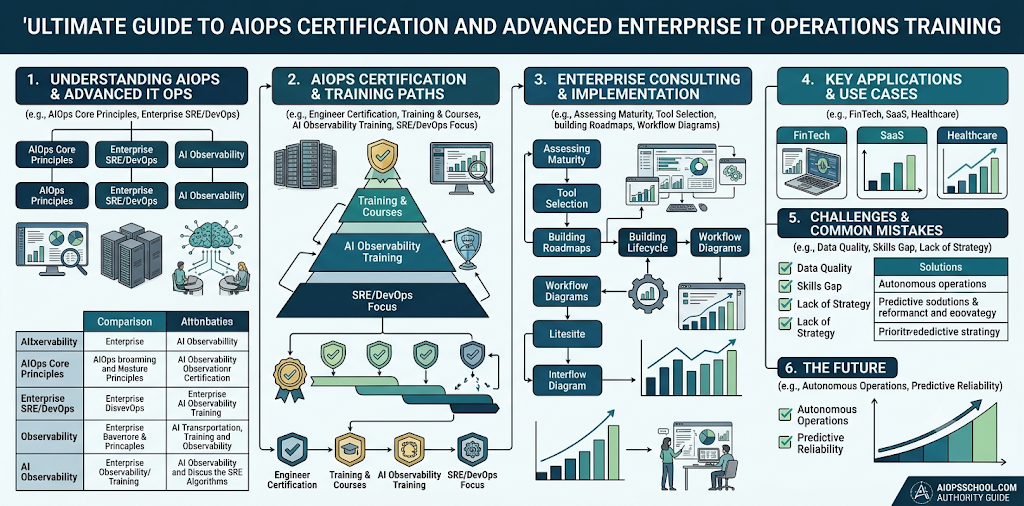
Modern enterprise IT environments have evolved beyond human scale. The rapid transition toward cloud-native ecosystems, microservices architectures, and complex Kubernetes orchestrations generates billions of telemetry data points every single day. For traditional IT operations teams, this overwhelming volume of logs, metrics, traces, and events creates an operational nightmare. To overcome this operational friction, forward-thinking organizations and technology professionals are turning to Artificial Intelligence for IT Operations (AIOps). By embedding machine learning, statistical correlation, and automated analysis into the observability pipeline, AIOps transforms chaotic data streams into clear, actionable operational intelligence. Navigating this shift requires specialized training, industry-recognized validation, and experienced strategic guidance. Educational resources like AIOpsSchool provide the essential foundation, structured certification pathways, and expert implementation frameworks necessary to build an automated, self-healing enterprise infrastructure.
Featured Snippet
What Is AIOps?
AIOps (Artificial Intelligence for IT Operations) is the application of machine learning, data science, and natural language processing to automate, streamline, and optimize IT operations. By aggregating multi-source telemetry data, AIOps platforms reduce alert noise, isolate root causes, predict system anomalies, and orchestrate automated incident responses in complex, distributed cloud environments.
Understanding AIOps
What Is Artificial Intelligence for IT Operations?
At its core, AIOps shifts IT operations from a reactive posture to a proactive and predictive state. It functions by ingesting massive volumes of historical and real-time data from across your entire technology stack—including infrastructure, network, applications, and security systems.
Advanced machine learning algorithms process this data to establish an operational baseline, filter out background noise, group related symptoms together, and surface the precise trigger behind an incident before users experience service degradation.
Why Traditional IT Operations Are No Longer Enough
Traditional IT operations rely heavily on static, threshold-based monitoring. For example, an alert triggers if CPU utilization exceeds 85% for more than five minutes.
While this methodology worked for centralized, monolithic environments on bare-metal servers, it fails in dynamic, elastic cloud settings where containers spin up and down within seconds. Static thresholds create a binary worldview that results in a continuous stream of false positives, masking genuine systemic failures under a mountain of noise.
How AI and Machine Learning Improve Operations
Machine learning algorithms excel at pattern matching and anomaly detection across high-cardinality datasets. Instead of human operators manually correlating a database slowdown with a simultaneous network configuration change, an AIOps platform automatically evaluates dependencies and groups these related events into a single, cohesive incident context. This drastically minimizes Mean Time to Detection (MTTD) and Mean Time to Resolution (MTTR).
Evolution from Monitoring to Intelligent Operations
| Traditional Operations | AIOps-Driven Operations |
| Reactive Monitoring: Responds only after a pre-defined threshold is crossed or an outage occurs. | Predictive Intelligence: Detects subtle statistical deviations and anomalies before failures happen. |
| Siloed Dashboards: Separate views for networks, infrastructure, databases, and application tiers. | Unified Telemetry: Ingests and correlates logs, metrics, traces, and events across the entire stack. |
| Manual Triaging: Human operators sort through thousands of alerts to find the root cause. | Automated RCA: AI engines isolate root causes and surface exact trigger components instantly. |
| Scripted Remediation: Requires manual intervention or brittle, rigid automation scripts. | Intelligent Orchestration: Triggers dynamic, context-aware self-healing workflows and patterns. |
In Simple Terms
Imagine driving a car where the dashboard only lights up after your engine completely breaks down on the highway. That is traditional monitoring. AIOps acts like an intelligent, built-in copilot that listens to the subtle changes in engine vibrations, checks the oil quality in real time, predicts a failure fifty miles before it happens, and automatically adjusts the vehicle’s settings to keep you driving safely.
Real-World Example
A global retail platform experiences a sudden bottleneck during a flash sale. Instead of generating 400 individual alerts from 400 microservices instances—which would panic the on-call team—the AIOps engine aggregates these signals. It recognizes that a minor memory leak in the checkout service triggered a cascading slowdown, combines all 400 alerts into a single incident card, and assigns it to the exact engineer responsible for that service code.
Why It Matters
For modern businesses, system downtime directly equates to lost revenue and brand damage. AIOps moves companies away from chaotic “war rooms” toward controlled, data-driven automated resolutions, protecting both customer experience and engineering sanity.
Key Takeaways
- Traditional monitoring cannot scale alongside dynamic microservices and cloud architectures.
- AIOps uses machine learning to ingest, filter, and correlate disparate telemetry data streams.
- The transition moves operations from reactive manual firefighting to proactive automated resolution.
Why AIOps Skills Are Becoming Essential
Growth of Cloud-Native Infrastructure
The transition to containerized deployments managed by Kubernetes means that infrastructure layers change constantly. Applications scale out dynamically based on real-time traffic spikes, creating a landscape that human operators cannot trace manually. Professionals who understand how to configure and manage AI-driven observability layers are vital to keeping these ephemeral systems stable.
Rise of Distributed Systems
Microservices architectures isolate business functions into hundreds of decoupled components. When a user transaction fails, finding the broken link in a chain of distributed services requires tracking complex distributed trace graphs. AIOps skills empower engineers to deploy machine learning models that read trace paths instantly, highlighting execution bottlenecks across complex cloud networks.
Demand for Reliability Engineering
Organizations are shifting from classic sysadmin models to Site Reliability Engineering (SRE) paradigms. Modern reliability engineering focuses heavily on data, service-level objectives (SLOs), and error budgets. AIOps platforms provide SREs with the predictive analytics required to manage these metrics accurately, forecasting when an error budget is on track to be breached days in advance.
Automation of Incident Management
Automating incident response requires clean, contextual inputs. An automated script cannot execute correctly if it is fed inaccurate or noisy alert signals. Professionals trained in AIOps possess the knowledge to refine data streams, ensuring that automated playbooks hook into reliable incident data for seamless self-healing remediation.
Future of Autonomous Operations
We are steadily moving toward a world of “NoOps” or fully autonomous IT operations. In this future landscape, infrastructures optimize their own configurations, re-allocate resources based on demand forecasts, and repair their own software bugs. Developing expertise in AIOps today places engineers at the forefront of designing and managing these self-driving enterprise systems.
AIOps Certification Explained
What Is an AIOps Certification?
An AIOps Certification is a formal, industry-recognized validation that proves an engineer’s proficiency in blending data science concepts with IT operations. It certifies that an individual knows how to design data ingestion pipelines, configure machine learning engines for anomaly detection, build automated correlation matrices, and optimize modern observability architectures.
Benefits of Professional Certification
Achieving a professional certification establishes instant credibility within the enterprise landscape. For individuals, it opens up high-paying career tracks, accelerates promotions, and differentiates them in a competitive job market. For organizations, employing certified professionals guarantees that complex internal systems are maintained using standardized, proven industry frameworks.
Skills Validated Through Certification
- Telemetry Data Architecture: Structuring and normalizing unstructured log data, metrics, and distributed traces.
- Algorithmic Analysis: Fine-tuning anomaly detection algorithms and noise-reduction parameters.
- Incident Lifecycle Automation: Mapping correlation patterns to automated webhook remediations.
- Platform Integration: Connecting AIOps engines seamlessly with ITSM systems, cloud platforms, and CI/CD tools.
Who Should Pursue AIOps Certification?
- DevOps Engineers: Seeking to integrate intelligent, automated feedback loops into the software delivery pipeline.
- SRE Engineers: Focused on reducing MTTR, eliminating alert fatigue, and protecting enterprise error budgets.
- Cloud & Platform Engineers: Tasked with maintaining reliable, highly scalable cloud architectures.
- Monitoring Specialists: Looking to upgrade their legacy monitoring skills to advanced AI observability models.
- IT Managers & Leaders: Aiming to drive modern operational transformations within their engineering business units.
In Simple Terms
Think of an AIOps certification like an advanced pilot’s license specifically for automated, supersonic aircraft. It tells companies that you don’t just know how to drive a basic vehicle; you possess the verified skills to navigate incredibly complex, automated, high-speed machines safely.
Real-World Example
An enterprise infrastructure team is looking to transition from reactive monitoring to an automated NoOps model. Out of five internal candidates, the engineer holding a verified AIOps Certification is selected to lead the architecture project because they possess proven, theoretical and practical knowledge on how to map machine learning models to the company’s existing OpenTelemetry framework.
Why It Matters
As enterprise technology stacks grow increasingly complex, degrees and generalized certifications become insufficient. Targeted validation ensures engineers can deliver immediate, structured value to complex systems without expensive trial-and-error periods.
Key Takeaways
- Certifications validate an engineer’s intersectional mastery over data science and systems engineering.
- It bridges the operational knowledge gap between legacy monitoring and AI-driven automation.
- Certified professionals are highly valued for enterprise-wide digital and cloud transformations.
AIOps Training and Courses
What Learners Typically Study
Machine Learning for IT Operations
Learners explore the fundamental data models that drive operations, focusing on unsupervised learning models for anomaly detection, time-series forecasting to predict resource exhaustion, and supervised classification algorithms for grouping historical incident types.
Event Correlation
This involves mastering how to group hundreds of disparate, concurrent operational events into single, contextual incidents based on temporal proximity, topological relationships, and historical incident patterns.
Intelligent Alerting
Moving away from rigid thresholds, students learn how to design dynamic, rolling baselines that automatically adjust based on historical usage patterns, time of day, and seasonal business cycles.
[Raw Telemetry Ingestion]
          │
          ▼
[Dynamic Baselines & Outlier Detection] ──► (Filters background noise)
          │
          ▼
[Topological Event Correlation]          ──► (Groups related symptoms)
          │
          ▼
[Intelligent Alert Notification]         ──► (Delivers a single, actionable ticket)
Root Cause Analysis
Courses cover how to configure dependency graphs across infrastructure layers, allowing the AI engine to trace downstream failures directly to their original upstream infrastructure or application trigger.
Predictive Analytics
Engineers learn how to build models that forecast disk capacity exhaustion, network saturation, and potential hardware failures well before they impact end-user experience.
Incident Automation
This covers connecting the outputs of AIOps platforms to downstream orchestration tools, triggering self-healing scripts, auto-scaling commands, and automated incident ticketing workflows.
Observability
Students learn how to build deep system visibility by instrumenting software architectures to emit high-quality operational telemetry, shifting from simple outward symptom tracking to internal system state comprehension.
OpenTelemetry
As an open standard, training dives deep into configuring OpenTelemetry collectors, APIs, and SDKs to seamlessly gather and export vendor-agnostic metrics, logs, and distributed trace data.
Monitoring Automation
This involves designing systems where infrastructure deployments automatically register, configure, and apply their own intelligent monitoring policies the moment they are provisioned via Infrastructure as Code (IaC).
AIOps Engineer Certification Path
Building deep expertise requires a structured learning path that graduates from fundamental operations to advanced automation architecture.
| Level | Skills | Outcome |
| Beginner Level | Core Linux, basic cloud architecture, monitoring fundamentals, log aggregation, and understanding metric collection. | Capable of managing legacy monitoring tools and interpreting basic system alert streams. |
| Intermediate Level | OpenTelemetry configuration, distributed tracing, statistical anomaly detection, advanced event correlation, and scripting. | Capable of designing full-stack observability layers and minimizing alert noise across microservices. |
| Advanced Level | Custom ML model fine-tuning, automated self-healing orchestration, enterprise architecture design, and predictive system modeling. | Capable of architecting autonomous enterprise operations and leading global NoOps transformations. |
AIOps Engineer Career Roadmap
Required Technical Skills
To successfully navigate the evolution into an AIOps expert, you must systematically build a foundation across several core engineering domains:
- Linux: Deep comfort with system internals, performance profiling, log paths, and kernel metrics.
- Networking: Comprehensive knowledge of DNS, TCP/IP, load balancing, service meshes, and distributed network traffic routing.
- Cloud Platforms: Hands-on operational experience with major hyperscalers (AWS, Azure, GCP) and their native telemetry pipelines.
- Kubernetes: Mastery over container orchestration, cluster networking, service architectures, and ephemeral event streams.
- Monitoring Tools: Hands-on proficiency with traditional and modern stacks like Prometheus, Grafana, Datadog, and ELK.
- Automation: Practical experience using Infrastructure as Code tools like Terraform alongside configuration tools like Ansible.
- Python: Strong scripting and programming skills to manipulate data structures, interface with APIs, and manage data science libraries.
- Observability: Holistic grasp of instrumenting codebases and configuring vendor-agnostic data pipelines.
Learning Sequence
- Master Systems and Infrastructure: Spend time understanding how Linux, containers, and cloud networks function under real-world production stress.
- Deep-Dive into Observability Data: Learn how to instrument applications to emit clean logs, metrics, and traces using OpenTelemetry.
- Learn Practical Automation: Focus on automating routine infrastructure deployment and configuration tasks using code.
- Acquire Data Science Fundamentals: Learn how time-series forecasting, clustering algorithms, and regression models apply specifically to infrastructure data.
- Integrate AIOps Engines: Practice routing operational data streams through ML frameworks to automate noise reduction and cross-stack correlation.
AI Observability Training
What Is AI Observability?
AI Observability is the evolution of traditional monitoring. While monitoring tells you when a system is failing, observability enables you to understand why it is failing by analyzing its internal outputs. AI Observability infuses machine learning directly into this telemetry layer, automatically parsing through high-cardinality data to spotlight unexpected system behaviors and hidden failure patterns that humans wouldn’t think to look for.
Why Observability Matters
Modern distributed systems fail in completely unpredictable and novel ways. Static monitoring setups only look for “known-unknowns” (pre-configured failure thresholds). AI Observability allows engineers to diagnose “unknown-unknowns”—complex, systemic failures that have never occurred before—by tracing data connections comprehensively across the entire application stack.
Logs, Metrics, Traces, and Events
These four pillars form the bedrock of comprehensive data ingestion:
- Logs: Textual records of specific application events, providing rich context during post-incident investigations.
- Metrics: Numeric values measured over intervals (e.g., CPU load, memory use), ideal for statistical anomaly tracking.
- Traces: End-to-end journey maps of user requests as they hop across various distributed microservices networks.
- Events: Key structural changes within the system environment, such as code deployments, auto-scaling steps, or config modifications.
OpenTelemetry Fundamentals
OpenTelemetry (OTel) provides the industry-standard framework for gathering system data. Training focuses on deploying OTel collectors to ingest telemetry uniformly, transforming diverse vendor-specific data formats into clean, standardized open-source data streams.
Intelligent Monitoring Systems
Intelligent systems utilize the unified data provided by OpenTelemetry to build context graphs. These graphs understand the intricate topological relationships between a container, the virtual machine it resides on, the network switch it routes through, and the microservice code it executes, allowing for precise system visualization.
       [Application Code Instrumented with OTel]
                           │
                           ▼
                  [OTel Collector Node]
                           │
                           ▼
             [AI Observability Engine (ML Model)]
             ├── Anomaly Detection
             ├── High-Cardinality Analysis
             └── Dependency Topology Mapping
                           │
                           ▼
          [Unified Insights & Contextual Alerts]
Monitoring vs. Observability
| Feature | Monitoring | Observability |
| Primary Question | “Is my system working?” (Symptom-focused) | “Why is my system behaving this way?” (Cause-focused) |
| Data Nature | Aggregated, low-cardinality, predictable metrics. | Disaggregated, high-cardinality, complex traces and logs. |
| System View | External validation of components in isolation. | Deep, internal visibility across distributed system pathways. |
| Analysis Method | Static thresholds and human alert curation. | Algorithmic correlation and automated pattern analysis. |
In Simple Terms
Monitoring is like a doctor checking your temperature and telling you that you have a fever. AI Observability is like a state-of-the-art MRI scan coupled with an automated diagnostic assistant that maps your entire blood flow, instantly pointing out the exact underlying infection causing the fever.
Real-World Example
An e-commerce payment gateway slows down intermittently for just 2% of global transactions. Traditional monitoring shows average latency stays within normal boundaries. An AI Observability platform analyzes individual, high-cardinality distributed traces and detects that the 2% latency spike occurs only when a specific localized database cluster experiences a subtle micro-queuing issue.
Why It Matters
Without AI Observability, small, complex engineering issues remain hidden for months, slowly eroding customer trust and application performance until they eventually trigger a catastrophic system outage.
Key Takeaways
- Monitoring checks for known failure states; observability explains entirely new, complex system patterns.
- OpenTelemetry serves as the vital standard for collecting vendor-neutral telemetry data.
- Integrating AI with observability enables the rapid diagnosis of complex, distributed system errors.
AIOps for SRE and DevOps Engineers
How AIOps Supports SRE Practices
Site Reliability Engineers are tasked with maximizing system availability while accelerating software feature delivery. AIOps platforms act as an operational lever for SREs, automatically calculating dynamic error budgets and pinpointing structural reliability weaknesses before they impact users.
Reducing Alert Fatigue
Alert fatigue is one of the leading causes of engineering burnout. When on-call engineers are bombarded with non-actionable notifications, their responsiveness naturally drops. AIOps alleviates this by filtering out up to 90% of raw operational noise, ensuring engineers are only interrupted for verified, high-context operational anomalies.
Improving Incident Response
When an incident strikes, AIOps accelerates every stage of the response lifecycle. It automatically generates incident tickets, populates them with associated log traces, identifies the exact code deployment that introduced the issue, and tags the specific engineering squad needed to implement the fix.
Enhancing Reliability Engineering
By analyzing long-term operational trends, machine learning models can spot chronic system degradation patterns that human operators miss over weeks of standard operation. This allows engineering teams to allocate sprint time to fix the underlying technical debt permanently.
Supporting Continuous Delivery
Modern DevOps teams push code to production multiple times a day. AIOps tools track these deployment windows closely. If an application release introduces a subtle performance regression, the engine identifies the code push as the likely root cause and can trigger an automated rollback loop to protect production integrity.
Enterprise AIOps Consulting
Why Organizations Need AIOps Consulting
Implementing an AIOps framework across an entire enterprise involves more than just purchasing software licenses. It requires restructuring data ingestion pathways, rewriting operational protocols, and shifting cultural mindsets. Specialized consulting ensures organizations avoid costly dead-ends, accelerating their time-to-value.
Assessing Operational Maturity
Consulting engagements begin by auditing an organization’s current operational maturity level. Consultants assess the quality of existing telemetry data, the integration level of current toolsets, and the capability of the engineering staff to adopt advanced automated workflows.
Tool Selection Strategies
The AIOps tool landscape is vast, featuring a mix of open-source utilities and major enterprise suites. Consultants provide an objective evaluation of these tools, matching an organization’s specific technical ecosystem, compliance rules, and budgetary constraints with the ideal platforms.
Building AIOps Roadmaps
A successful enterprise deployment occurs in carefully planned phases. Consultants design custom implementation roadmaps that deliver early, high-impact victories—such as alert noise reduction—before rolling out advanced capabilities like automated infrastructure self-healing.
Change Management Considerations
Moving toward autonomous operations can spark internal resistance from teams worried about job security or automated errors. Strategic consulting addresses these cultural dynamics head-on through structured upskilling, open documentation, and clear alignment on how automation frees engineers from mundane tasks to focus on innovation.
AIOps Implementation Services
Implementation Lifecycle
[Assessment Phase] ──► [Design & Architecture] ──► [Tool Selection & Integration]
                                                            │
                                                            ▼
[Continuous Improvement] ◄── [Optimization] ◄── [Automation Orchestration]
Assessment
A thorough analysis of the enterprise’s current IT landscape, mapping out all data sources, existing monitoring tools, and historical incident patterns.
Design
Creating a scalable architecture for the data streaming pipeline, ensuring it can ingest high-velocity data securely without adding latency to production systems.
Tool Selection
Selecting and configuring appropriate AIOps software suites, data collectors, and correlation engines aligned with enterprise goals.
Integration
Connecting the chosen AIOps platform deeply with underlying cloud resources, Kubernetes environments, on-premise infrastructure, and central ITSM platforms like ServiceNow or Jira.
Automation
Building and testing automated workflows, starting with rich incident enrichment and progressing toward closed-loop automated remediations.
Optimization
Continuous model tuning over several weeks to minimize false alerts, adjust machine learning baselines, and sharpen root cause analysis accuracy.
Continuous Improvement
Regular reviews of operational telemetry to introduce new data inputs, refine automated playbooks, and keep pace with evolving software features.
Real-World Enterprise Use Cases
Banking and Financial Services
- Operational Challenge: A global banking app suffered regular transaction slowdowns during core processing windows, causing compliance tracking failures and customer frustration.
- AIOps Solution: Implemented an enterprise AIOps platform to ingest core banking database logs and cross-correlate them with real-time network traffic metrics.
- Business Outcome: The engine isolated an unindexed database query triggered during heavy loads, dropping MTTR from 4 hours to under 3 minutes and avoiding costly regulatory fines.
Healthcare Platforms
- Operational Challenge: A major healthcare telemedicine provider faced severe alert fatigue, with engineers receiving over 10,000 infrastructure alerts per day, masking real app glitches.
- AIOps Solution: Deployed intelligent event correlation to group symptoms by service topology and suppress repetitive, non-actionable background alerts.
- Business Outcome: Alert noise fell by 88%, allowing on-call teams to spot and resolve critical patient portal errors before users noticed a slowdown.
SaaS Companies
- Operational Challenge: A fast-growing B2B software vendor struggled with application regressions slipping through continuous integration (CI/CD) pipelines into production.
- AIOps Solution: Linked the AIOps observability platform directly into deployment logs, monitoring system health behaviors during release windows.
- Business Outcome: The engine caught memory anomalies immediately after code rollouts, initiating automated microservice rollbacks that reduced user-facing bugs by 75%.
Telecommunications
- Operational Challenge: A telecom operator experienced random cellular tower throughput degradation across widespread regional networks, taxing field engineering teams.
- AIOps Solution: Deployed predictive analytics models to trace time-series radio network data alongside local environmental and weather inputs.
- Business Outcome: The platform predicted component degradation 48 hours prior to actual system failure, shifting maintenance from reactive emergency fixing to lower-cost planned schedules.
E-Commerce Platforms
- Operational Challenge: An online retailer lost millions during peak holiday sales due to cascading cart abandonment issues that standard infrastructure metrics failed to explain.
- AIOps Solution: Implemented full-stack AI Observability, mapping real-time checkout tracing directly alongside business conversion metrics.
- Business Outcome: The platform flagged a microservice API error causing regional payment processing issues, allowing instantaneous remediation and protecting holiday revenue.
Benefits of AIOps Adoption
- Reduced Downtime: Predictive anomaly tracking fixes infrastructure vulnerabilities before they escalate into user-facing outages.
- Faster Root Cause Analysis: Machine learning traces cross-stack dependencies instantly, reducing manual log parsing from hours to seconds.
- Better User Experience: Ensuring software layers operate reliably creates a smoother, highly performant end-user application journey.
- Reduced Operational Costs: Minimizing major incidents and avoiding false alerts optimizes engineering utilization and resource spending.
- Improved Reliability: Continuous, algorithmic analysis enables systems to handle unpredictable traffic spikes without systemic degradation.
- Smarter Decision-Making: Shifting from guesswork to clear, data-driven historical modeling guides smarter capital and architectural planning.
Common Challenges in AIOps Adoption
- Data Quality Issues: Machine learning models depend on high-quality data. Siloed, incomplete, or corrupted log formats will degrade an AIOps engine’s accuracy.
- Solution: Standardize data formatting enterprise-wide using open, structured logging practices like OpenTelemetry.
- Tool Integration Challenges: Legacy enterprises often use fragmented, siloed monitoring applications that do not naturally communicate with each other.
- Solution: Leverage specialized implementation services to construct unified API ingestion layers and central data brokers.
- Skills Gap: Traditional operations engineering teams may lack foundational data literacy or automated scripting skills.
- Solution: Partner with structured learning platforms like AIOpsSchool to systematically upskill teams using hands-on training tracks.
- Organizational Resistance: Siloed teams may resist sharing data logs or fear that system automation threatens their roles.
- Solution: Emphasize that automation removes repetitive, stressful work, allowing engineering teams to focus on meaningful architecture work.
- Lack of Observability Maturity: Attempting advanced automated remediation when your system lacks basic log and metric tracking will lead to inaccurate automation responses.
- Solution: Follow a structured maturity road map, mastering data collection and noise reduction before rolling out complex self-healing automations.
Common Mistakes Professionals Make
- [ ] Focusing Only on Tools: Assuming that purchasing an expensive AIOps tool will magically fix systemic operational problems without updating processes.
- [ ] Ignoring Observability Fundamentals: Attempting to build predictive AI models on top of low-quality, missing, or siloed infrastructure logs.
- [ ] Poor Data Collection: Ingesting endless unfiltered system data into the AI platform, creating noise and inflating data storage costs.
- [ ] Skipping Automation Strategy: Setting up alert correlation engines without creating clear, actionable processes or code playbooks to resolve incidents.
- [ ] Lack of Continuous Learning: Relying on static legacy infrastructure skill sets while ignoring modern cloud-native standards like OpenTelemetry and Kubernetes.
Future of AIOps
Autonomous Operations
We are moving rapidly toward systems capable of completely autonomous operation. In this paradigm, software architectures will dynamically adjust their own footprints, provision their own computing clusters, and patch security vulnerabilities without human intervention.
AI-Driven Incident Management
The future incident lifecycle will be largely automated. AI agents will detect anomalies, open tracking tickets, isolate root causes, execute self-healing steps, and post comprehensive incident post-mortems straight to internal wikis before a human engineer opens their dashboard.
                  [System Anomaly Detected]
                              │
                              ▼
        [AI Agent Initiates Self-Healing Protocol]
        ├── Triage & Root Cause Confirmed
        ├── Automated Rollback/Patch Triggered
        └── Complete Incident Post-Mortem Written
                              │
                              ▼
                [System Restored to Baseline]
           (Human notified via completed report summary)
Predictive Reliability Engineering
Instead of reviewing historical availability trends, reliability engineering will become forward-looking. Engineers will use simulations and predictive models to evaluate how new code changes will affect global system stability before deploying to production.
Intelligent Capacity Planning
AIOps engines will analyze year-over-year usage trends, regional economic patterns, and promotional calendars to predict exact infrastructure capacity needs, avoiding both waste and performance issues.
Self-Healing Infrastructure
When software components or hardware configurations degrade, infrastructure elements will leverage code blocks to rebuild themselves, swap out faulty nodes, and run automated health checks to self-heal.
AI-Powered Observability
Observability platforms will feature natural language interfaces, allowing engineers to query complex distributed telemetry stacks simply by asking, “What infrastructure change caused the localized checkout slowdown this afternoon?”
Why Learn with AIOpsSchool
Industry-Focused Curriculum
The learning materials are designed and updated continuously by real-world enterprise architects and platform engineering leaders, ensuring you study skills directly aligned with modern workplace demands.
Hands-On Learning
We move past passive video watching. Students build practical skills by instrumenting real applications, configuring machine learning engines, and writing automated response playbooks within live sandbox lab environments.
Certification Programs
Our structured certifications provide a validated, industry-recognized benchmark of excellence, helping you stand out to recruiters and advance your career.
Enterprise Consulting Expertise
Our training programs are shaped by real consulting engagements with global enterprises, exposing you to authentic architectural patterns and real-world system challenges.
Career-Oriented Skill Development
We focus on the complete engineering skillset—bridging systems engineering, cloud-native architecture, data analytics, and automation—to prepare you for high-impact roles in modern enterprise operations.
FAQ SECTION
What is AIOps Certification?
An AIOps Certification is an industry-recognized professional credential that validates an engineer’s competency in applying machine learning, data science, and modern observability principles to automate and optimize enterprise IT operations. It proves your practical ability to design data pipelines, reduce alert noise, and implement automated self-healing infrastructures.
Who should learn AIOps?
AIOps training is highly beneficial for DevOps engineers, Site Reliability Engineers (SREs), cloud engineers, systems architects, monitoring specialists, and IT operations managers who want to scale their skill sets alongside modern cloud-native infrastructures.
What skills are required for AIOps Engineers?
AIOps engineers need a blend of systems engineering and data literacy, including proficiency with Linux systems, Kubernetes container orchestration, networking protocols, programming with Python, cloud platforms, and vendor-agnostic telemetry collection using OpenTelemetry.
How does AIOps help DevOps teams?
AIOps supports DevOps workflows by providing continuous, automated feedback loops throughout the CI/CD deployment lifecycle. It instantly correlates code releases with downstream performance impacts, enabling automated rollbacks and reducing the time spent on manual post-deployment debugging.
What is AI Observability?
AI Observability is an advanced operations practice that infuses machine learning into the telemetry collection pipeline. It analyzes deep system logs, metrics, and traces to help engineers understand and resolve unpredictable system bugs and complex, distributed infrastructure problems.
What is OpenTelemetry?
OpenTelemetry (OTel) is an open-source, vendor-neutral framework under the Cloud Native Computing Foundation (CNCF). It provides a standardized set of APIs, SDKs, and tools to collect, generate, and export telemetry data across diverse enterprise software architectures.
How long does it take to learn AIOps?
For engineers with an established background in basic cloud computing, Linux administration, and monitoring systems, achieving professional proficiency through a structured AIOps training track typically takes three to six months of focused study and hands-on laboratory practice.
What are AIOps Implementation Services?
AIOps Implementation Services are specialized consulting structures through which enterprise architects audit an organization’s existing telemetry stack, select appropriate AI tools, build secure ingestion pipelines, and configure machine learning models to automate incident resolution safely.
Is AIOps a good career choice?
Yes, AIOps is an excellent, high-growth career track. As modern enterprise infrastructures grow too complex for manual human monitoring alone, companies are offering competitive compensation for certified engineers who can design and manage intelligent, automated IT operations.
What is the future of AIOps?
The future of AIOps centers on fully autonomous operations (NoOps). Over the coming years, architectures will evolve to feature self-healing systems, automated incident resolution loops, predictive capacity adjustments, and natural language interfaces for real-time troubleshooting.
Final Summary
The scale and velocity of modern cloud-native systems have permanently outpaced human monitoring capabilities. Relying on legacy, threshold-based toolsets leaves organizations vulnerable to alert fatigue, lengthy system outages, and burned-out engineering teams. Transitioning to AIOps is no longer an optional optimization; it is a fundamental business necessity for maintaining stable, modern software delivery. Mastering AIOps requires a structured focus on high-quality telemetry, open data collection standards like OpenTelemetry, and an automation-first engineering culture. For individual professionals, developing these technical skills opens up advanced career opportunities in SRE, DevOps, and platform engineering.
