Introduction
Classical computers power our world using tiny silicon transistors that flip between two fixed options: off or on, represented as a 0 or a 1. This binary architecture has scaled incredibly well, but it hits a wall when facing highly complex mathematical problems, like predicting molecular configurations or processing massive optimization datasets. Learning How Qubits Are Represented Physically demystifies the actual machines being built in laboratories today. Understanding how we manipulate subatomic particles allows engineers and technology learners to separate science fiction from real engineering progress. To help you navigate this complex computing landscape, QuantumUting.com provides approachable educational frameworks, technical guides, and career resources. This article explores the physical building blocks of quantum bits, compares the leading hardware approaches, and details how researchers control the fragile states of quantum information.
Understanding Qubits
What is a Qubit?
A qubit, short for quantum bit, is the fundamental unit of quantum information. While a classical bit can only exist in one of two distinct positions ($0$ or $1$), a qubit can store a combination of both states simultaneously.
Difference Between Bits and Qubits
Think of a classical bit like a standard light switch that is either flipped completely down ($0$) or completely up ($1$). A qubit is like a spinning coin. While it spins, it is not merely a heads or a tails; it contains a fluid combination of both possibilities until you stop it and measure the result.
Superposition Explained Simply
Superposition is the ability of a quantum system to exist in multiple states at the same time. Mathematically, a qubit’s state is written as a combination of its base states:
$$\psi = \alpha|0\rangle + \beta|1\rangle$$
Here, $\alpha$ and $\beta$ represent probability amplitudes. Until the system is measured, it holds a fluid balance of both options, allowing a quantum computer to process vast combinations of possibilities simultaneously.
Entanglement Overview
Entanglement is a unique quantum phenomenon where two or more physical qubits become deeply interconnected. When qubits are entangled, the physical state of one instantly dictates the state of the other, no matter how far apart they are. This shared connection allows quantum processors to solve complex, multi-variable problems much faster than classical systems.
The Foundation of Quantum Computing
Because qubits utilize superposition and entanglement, the processing power of a quantum computer grows exponentially with every physical qubit added. A system with just 50 high-quality qubits can process more simultaneous states than any classical supercomputer ever built.
Why Physical Representation of Qubits Matters
Moving from theoretical math equations to functioning hardware requires finding real physical systems that exhibit quantum behaviors. Scientists must find objects in nature that can be isolated, controlled, and measured with extreme precision.
The major engineering obstacle is protecting the fragile nature of quantum information. Physical qubits are highly sensitive to their surroundings. A tiny shift in room temperature, minimal electromagnetic noise, or passing Wi-Fi signals can cause a qubit to fall out of its quantum state, ruining an ongoing calculation.
Building stable physical hardware requires maintaining a perfect balance: the qubits must be isolated from outside interference while remaining accessible enough for lasers, microwaves, or magnetic fields to execute computing commands.
Core Requirements of a Physical Qubit
To build a functional quantum computer, a physical system must satisfy five fundamental criteria established by physicist David DiVincenzo.
- State Initialization: The capability to reliably set all physical qubits to a known baseline starting position (such as the $|0\rangle$ state) before beginning a calculation.
- Quantum State Control: The ability to manipulate qubits precisely using external controls to execute quantum gates and operations.
- Measurement Capability: A reliable mechanism to read out the final state of the qubits, collapsing the spinning quantum coin into a clear $0$ or $1$ result.
- Long Coherence Time: The duration a physical qubit can hold its quantum state before environmental noise destroys the information.
- Error Management and Scalability: The structural capability to link thousands of physical qubits together while actively correcting processing errors.
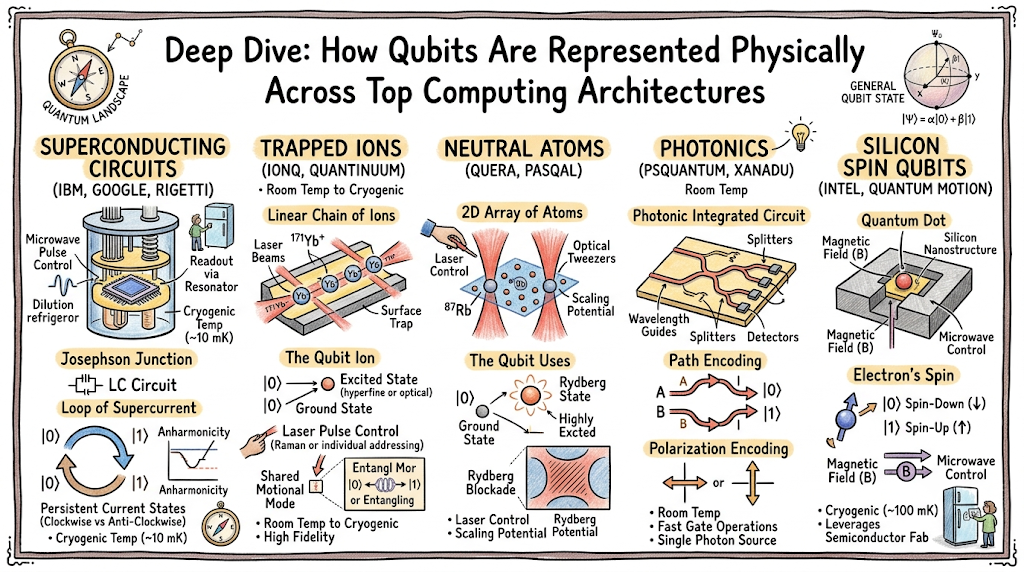
Major Physical Representations of Qubits
Scientists and technology companies are exploring several distinct hardware approaches to build reliable quantum computers.
                  ┌────────────── Physical Qubits ──────────────┐
                  │                                             │
         ┌────────┴────────┐                           ┌────────┴────────┐
         │  Macro-Systems  │                           │ Atomic-Systems  │
         └────────┬────────┘                           └────────┬────────┘
                  │                                             │
    ┌─────────────┼─────────────┐                 ┌─────────────┼─────────────┐
    │             │             │                 │             │             │
Superconducting Spin       Topological       Trapped Ions  Neutral Atoms  Photonic
  (Circuits)   (Silicon)   (Majorana)          (Lasers)     (Optical)    (Light)
1. Superconducting Qubits
Superconducting qubits are built using macroscopic, engineered electronic circuits manufactured on silicon chips. These circuits are cooled down to temperatures colder than deep space, allowing electricity to flow through them with zero resistance.
The core component of a superconducting qubit is a Josephson junction, which consists of a microscopic insulating barrier sandwiched between two superconducting metals. This junction allows engineers to isolate two distinct energy levels to represent the $|0\rangle$ and $|1\rangle$ states.
- Advantages: Built using existing silicon manufacturing methods; fast gate execution speeds.
- Limitations: Requires massive dilution refrigerators; short coherence times compared to atomic systems.
- Real-World Usage: This approach is favored by major technology companies like IBM and Google.
2. Trapped Ion Qubits
Trapped ion systems use individual, naturally identical atoms (such as Ytterbium) that have been stripped of an electron to give them an electric charge. These charged ions are held suspended in mid-air inside a vacuum chamber using precise electromagnetic fields.
Information is stored within the internal electronic energy levels of each individual atom. Highly precise lasers are aimed at the suspended ions to alter their energy states and execute logic gates.
- Advantages: Exceptionally long coherence times; naturally identical qubits provided by physics.
- Limitations: Slower gate operation speeds; managing complex laser arrays becomes difficult as systems scale.
3. Photonic Qubits
Photonic systems use individual particles of light—photons—as physical qubits. Information is encoded using distinct physical properties of the light wave, such as its horizontal or vertical polarization.
These systems use optical pathways, mirrors, and beam splitters routed across specialized glass microchips to direct the photons and perform calculations.
- Advantages: Photons can operate at room temperature and travel long distances through standard fiber-optic cables without losing coherence.
- Limitations: Photons do not naturally interact with each other, making it difficult to build two-qubit logic gates.
4. Spin Qubits
Silicon spin qubits utilize the intrinsic magnetic orientation (spin-up or spin-down) of a single electron trapped inside a microscopic semiconductor structure called a quantum dot.
- Advantages: Exceptionally small physical footprint; can leverage existing commercial semiconductor factories.
- Limitations: Highly sensitive to structural defects in the surrounding silicon chip.
5. Neutral Atom Qubits
Similar to trapped ions, this approach uses neutral atoms suspended inside a vacuum. However, instead of using electric fields, it uses highly focused intersecting laser beams called optical tweezers to trap and organize the atoms into dense multi-dimensional grids.
- Advantages: High scalability potential; can easily pack thousands of atoms into a very small physical area.
- Limitations: The neutral atoms can easily escape their optical traps if disturbed by minimal thermal energy.
6. Topological Qubits
Topological quantum computing is an advanced approach that splits electron paths to create theoretical particles called Majorana fermions. Information is stored by braiding these particle paths around one another in space and time.
- Advantages: Exceptional built-in protection against environmental noise and decoherence.
- Limitations: Extremely difficult to create and verify in laboratory settings; still in the early stages of basic hardware research.
Comparison of Different Qubit Technologies
| Qubit Type | Physical Medium | Key Advantages | Primary Challenges | Scalability Potential |
| Superconducting | Microscopic currents in frozen circuits | Fast gate speeds; utilizes proven silicon manufacturing | Extremely short coherence times; needs massive cooling | Moderate (limited by wiring and cooling constraints) |
| Trapped Ion | Suspended charged atoms | Long coherence times; naturally identical qubits | Slower gate speeds; requires intricate laser targeting | Moderate (limited by optical switching complexity) |
| Photonic | Individual particles of light (photons) | Operates at room temp; ideal for quantum networks | Photons do not interact easily; high loss rates | High (can leverage advanced optical microchips) |
| Spin Qubits | Electron spin inside silicon chips | Tiny physical footprint; compatible with chip fabs | Prone to material impurities and background noise | High (fits smoothly into existing silicon pipelines) |
| Neutral Atom | Atoms held by optical tweezers | Dense multi-dimensional grids; easy scaling | Fragile trapping arrays; sensitive to thermal leaks | Very High (can arrange thousands of atoms easily) |
How Quantum States Are Represented Physically
To make a quantum computer functional, engineers must map the abstract mathematical concepts of $|0\rangle$ and $|1\rangle$ onto real, measurable properties of matter.
- Energy Levels: In atomic systems, the low-energy “ground” state represents $|0\rangle$, while a higher-energy “excited” state represents $|1\rangle$.
- Magnetic Spin Properties: An electron spinning clockwise (spin-up) represents $|0\rangle$, while spinning counter-clockwise (spin-down) represents $|1\rangle$.
- Light Polarization: A photon vibrating along a horizontal plane represents $|0\rangle$, while vertical vibration represents $|1\rangle$.
To manipulate these physical states, engineers expose the qubits to carefully timed pulses of energy. For instance, hitting a trapped ion with a laser pulse for a specific number of microseconds can push it halfway between its ground and excited states, placing the atom into a physical state of superposition.
Challenges in Building Physical Qubits
- Decoherence: The process where a physical qubit loses its quantum properties due to environmental interactions, turning back into a plain classical bit.
- Environmental Noise: Tiny temperature fluctuations, stray magnetic fields, and materials impurities can disrupt calculation accuracy.
- High Raw Error Rates: Today’s physical qubits experience significantly higher error rates than standard silicon transistors.
- Scaling Difficulties: Adding more physical qubits increases the complexity of control wiring and refrigeration, making system management a major engineering challenge.
Quantum Error Correction and Stability
Because physical qubits are fragile, real-world quantum computers cannot rely on them directly for long calculations. Instead, platforms must implement quantum error correction algorithms.
These systems group multiple fragile physical qubits together using quantum entanglement to create a single, highly stable logical qubit.
[Physical Qubit 1] + [Physical Qubit 2] + [Physical Qubit 3] ---> [1 Stable Logical Qubit]
(Fragile, prone to noise)                                         (Protected by Error Correction)
To run complex commercial software, a quantum computer will need thousands of logical qubits. Since it takes hundreds of physical qubits to build a single error-corrected logical qubit, hardware manufacturers must find ways to scale up their systems to handle millions of stable physical qubits.
Real-World Quantum Computing Platforms
The global race to build functional quantum computers has led to diverse corporate and academic research paths:
- Superconducting Hubs: Led by companies like IBM and Google, focused on scaling up large, multi-qubit processor architectures.
- Atomic Trapping Systems: Pioneered by companies like IonQ and Quantinuum, focusing on high-precision trapped ion setups.
- Silicon Spin Pioneers: Research groups working within existing commercial fabrication foundries to build quantum dots on standard silicon chips.
Rather than buying these machines directly, most businesses and researchers interact with quantum hardware through cloud platforms, running code on real systems located in remote server laboratories.
Future of Physical Qubit Technologies
- Hybrid Hardware Architectures: Future quantum computers may connect different qubit types together, using trapped ions to store data and photonic channels to transmit information.
- Integrated Control Chips: Moving control electronics directly inside cryogenic refrigerators to eliminate the massive bundles of wiring that limit current scalability.
- Global Quantum Networking: Building dedicated optical networks to link independent quantum computers together, creating an interconnected quantum internet.
Career Opportunities in Quantum Computing
The rapid growth of the quantum hardware sector has created a strong job market for multi-disciplinary technical professionals.
In-Demand Roles
- Quantum Hardware Specialist: Focuses on fabrication, microchip design, and optimizing physical qubit substrates.
- Quantum Engineer: Specializes in building the microwave, laser, and cryogenic systems required to run quantum processors.
- Quantum Software Developer: Writes the low-level compilation tools and error-correcting algorithms that interface with physical chips.
Educational Skill Path
To enter this specialized field, focus on building strong core foundations in linear algebra, programming languages like Python (specifically packages like Qiskit), and fundamental concepts in quantum mechanics and electronics.
Common Misconceptions About Qubits
- Myth: Qubits can store infinitely more data than classical bits.Reality: While a qubit holds fluid probabilities during a calculation, it collapses into a single classical $0$ or $1$ the moment it is measured. Its value lies in the simultaneous pathways it explores during processing, not its final storage capacity.
- Myth: Quantum computers will completely replace standard laptops.Reality: Quantum hardware is designed specifically as an accelerator for highly targeted mathematical problems. Your everyday applications, streaming services, and text documents will always run more efficiently on classical silicon chips.
- Myth: We have reached full fault-tolerant quantum computing.Reality: Modern quantum processors are still in the development phase, meaning they contain noisy physical qubits that are prone to errors. Building fully fault-tolerant systems remains an active engineering goal.
Frequently Asked Questions
- What is a physical qubit?
A physical qubit is a real, tangible object in a laboratory—such as an atom, a photon, or a superconducting circuit—that can be manipulated to store and process quantum information.
- Why do some physical qubits require extreme cooling?
Superconducting and silicon spin qubits must be cooled to near absolute zero to eliminate thermal energy and electrical resistance, which would otherwise disrupt and destroy the fragile quantum state.
- Can a physical qubit be made out of light?
Yes. Photonic quantum computing uses individual particles of light (photons) as qubits, encoding binary data using physical attributes like wave polarization.
- What is the difference between a physical qubit and a logical qubit?
A physical qubit is a single, error-prone quantum component. A logical qubit combines multiple physical qubits using error-correcting code to create a stable, reliable unit for running software.
- How do scientists change the value of a physical qubit?
Engineers alter qubit states by delivering precise pulses of energy—such as microwave frequencies for superconducting circuits or focused laser beams for trapped ions.
- What happens when a qubit experiences decoherence?
When a qubit undergoes decoherence, it loses its quantum properties due to outside interference, turning back into a standard classical bit and halting the quantum calculation.
- Which physical qubit technology is currently the best?
No single approach has won the race. Superconducting systems excel in fast processing speeds, trapped ions lead in coherence times, and neutral atoms offer exceptional density and scaling potential.
- Are physical qubits manufactured like standard computer chips?
Superconducting and spin qubits are built using traditional silicon lithography methods, while trapped ion and neutral atom systems are constructed using specialized vacuum chambers and laser setups.
- How do you measure a physical qubit without ruining the calculation early?
Measurement always collapses a qubit’s quantum state. Therefore, engineers only measure qubits at the very end of a workflow, converting the final quantum positions into standard classical data.
- Can I code on a real physical qubit platform today?
Yes. Many hardware manufacturers provide public cloud access to their systems, allowing developers to write quantum code in Python and run it on real laboratory hardware remotely.
Final Summary
Understanding how qubits are represented physically clarifies the real-world mechanics behind quantum computing. Whether utilizing the frozen currents of superconducting circuits, the laser-controlled states of trapped ions, or the polarization of individual photons, turning abstract math into stable physical hardware is central to advancing this computing frontier. As teams continue to drive down error rates and optimize scaling methods, we move closer to unlocking the true potential of quantum processing.
