Introduction
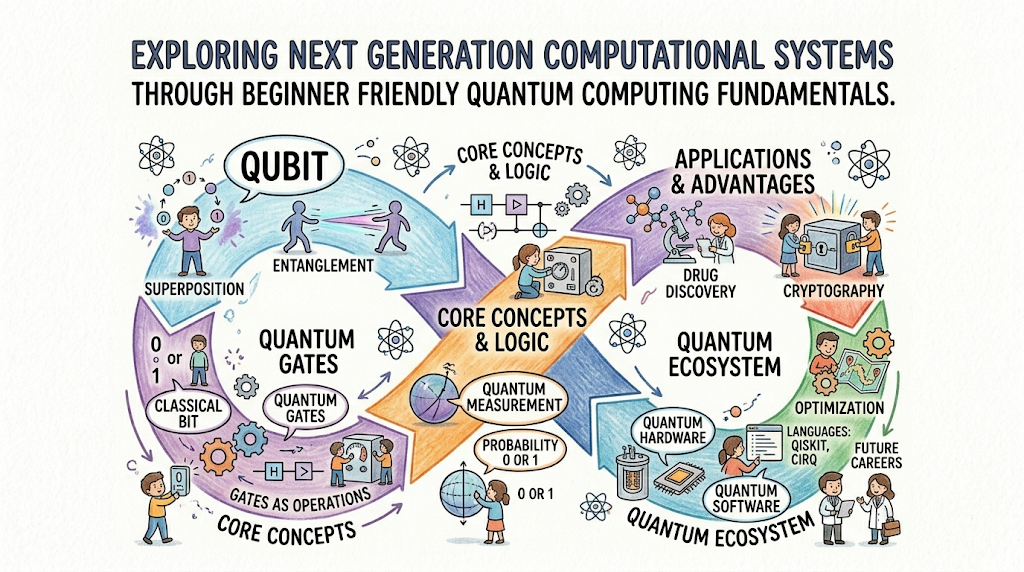
Every day, our world generates massive amounts of complex data. Traditional computers process this information using millions of tiny switches called transistors. While these machines are incredibly fast, they struggle with certain highly complex problems. When a problem involves analyzing billions of possibilities at the same time, standard processing methods quickly hit a wall.This processing bottleneck is where next-generation technology changes the game. At its core, quantum computing is a revolutionary approach to processing information by using the fundamental laws of nature. Instead of relying on traditional binary limits, it utilizes the unique properties of physics to perform calculations that would otherwise take standard systems thousands of years to complete.Understanding this technology matters because it will soon redefine fields like medicine, cybersecurity, and artificial intelligence. By altering how we process complex calculations, these advanced systems open doors to innovations that once belonged strictly to science fiction.In this comprehensive guide, you will learn the essential core principles behind this technology. We will break down how these systems function, compare them to standard computing models, and explore real-world use cases. You will also discover the conceptual tools and career paths shaping this rapidly growing ecosystem.If you are eager to master these concepts, the educational platform QuantumUting provides excellent structural guides and beginner-friendly tutorials to help you confidently start your technical learning journey.
Evolution of Computing Systems
Classical Computing Limitations
Traditional computers rely on silicon microchips containing billions of transistors that act as simple on-off switches. These switches represent data as binary digits, commonly known as bits. A bit can only exist in one of two distinct positions at any given time: a 0 or a 1.
While this binary setup powers our modern digital world, it faces significant physical limitations. As transistors become smaller, they approach the atomic scale, where standard electrical rules begin to break down. Furthermore, when a traditional system tackles a massive optimization problem, it must analyze every single possible solution one after the other, creating massive delays.
Emergence of Quantum Computing Ideas
To overcome these physical limitations, scientists looked toward the field of physics that studies how matter acts at the atomic scale. In the late twentieth century, visionary physicists suggested a completely new way to handle information. They realized that systems built on atomic principles could process data in ways that standard silicon chips could never match.
Instead of fighting against atomic scale anomalies, these researchers proposed building machines that embrace them. This marked the birth of a new computational era, shifting the focus from standard electrical currents to controlled atomic properties.
Shift Toward Quantum Technologies
This conceptual shift completely transformed our approach to building advanced machinery. Engineers began designing specialized environments capable of controlling individual atoms, photons, or electrons.
This evolution moved computational science away from simple linear processing. By harnessing atomic properties, modern researchers started developing systems that handle complex data relationships simultaneously, paving the way for true computational acceleration.
Core Concepts of Quantum Computing
Qubits and Quantum States
The fundamental building block of this next-generation technology is the quantum bit, or qubit. Unlike a standard binary bit that is limited to being either a 0 or a 1, a qubit operates under more flexible rules.
A qubit represents a physical system, such as the spin of an electron or the polarization of a photon. Because it follows atomic laws, a qubit can exist in a fluid state where it holds a combination of both 0 and 1 simultaneously. This unique characteristic allows the system to hold vastly more information than a traditional binary digit.
Superposition and Entanglement (Conceptual)
To truly understand how a qubit functions, we must explore two essential principles from quantum mechanics basics. The first principle is superposition, which allows a qubit to exist in multiple states at the exact same time. Think of a spinning coin: while it spins, it is not just heads or tails, but a fluid combination of both possibilities until it stops.
The second principle is entanglement, a unique connection that can link pairs of qubits. When two qubits become entangled, the state of one instantly influences the state of the other, no matter how far apart they are. This connection allows qubits to share information instantly, creating a deeply unified processing network.
Quantum Gates and Circuits
In standard electronics, information is processed using logical gates that manipulate bits through operations like AND, OR, and NOT. Similarly, advanced processing systems use specialized quantum gates to alter the states of qubits.These gates do not just flip switches between 0 and 1. Instead, they rotate the mathematical possibilities of a qubit, shifting its superposition or linking it with other qubits. When engineers string these gates together, they create advanced circuits designed to solve specific mathematical problems.
Quantum Measurement
A critical moment in this processing cycle occurs during quantum measurement. While a qubit is processing inside a circuit, it remains in a fluid superposition of possibilities. However, the moment it is measured, its fluid state collapses into a definite classical value of either 0 or 1.
This means that during a calculation, the machine works with vast clouds of possibilities. The final measurement act simply distills that complex cloud down into a clear, readable binary answer that humans can easily interpret.
Quantum Algorithms Overview
To run an advanced circuit effectively, developers use specialized quantum algorithms. These are structured step-by-step instructions designed specifically to run on qubit-based systems.
Unlike standard software programs, these algorithms manipulate superpositions and entanglements directly. They guide the qubits through complex pathways, canceling out incorrect answers while amplifying the correct ones to deliver highly efficient solutions.
Key Principles of Quantum Computing
Parallelism in Quantum Systems
Because qubits can exist in a state of superposition, a quantum system possesses massive inherent parallelism. A standard computer must check every path in a maze one by one to find the exit.
In contrast, a system utilizing qubits can explore every single path through the maze simultaneously. As you add more qubits to the system, its processing capacity scales exponentially, allowing it to evaluate millions of possibilities at the exact same moment.
Probabilistic Nature of Quantum Results
One of the most surprising aspects of this technology is that it is inherently probabilistic. Traditional computers are deterministic, meaning that entering the exact same input will always yield the exact same output.
Quantum systems operate differently by dealing with the mathematical likelihood of various outcomes. The system does not give a single rigid answer immediately; instead, it provides a distribution of probabilities, showing which final state is the most mathematically sound.
Quantum Interference
To ensure the correct answer stands out from these probabilities, the system relies on quantum interference. This principle works just like overlapping waves in an ocean. Waves can experience constructive interference, where they combine to create a taller wave, or destructive interference, where they crash into each other and cancel out.
Plaintext
Advanced algorithms use this principle to systematically cancel out the mathematical paths leading to wrong answers. At the exact same time, they amplify the paths leading to the correct solution, making the right answer highly visible during final measurement.
Error Sensitivity and Stability
Maintaining these fluid atomic states requires extreme environmental precision. Qubits are highly sensitive to their surroundings, and even minor temperature changes or electromagnetic shifts can disrupt their delicate balance.
This disruption is known as decoherence, and it introduces calculation errors into the system. To keep quantum hardware stable, components must be heavily shielded and cooled to temperatures colder than deep outer space.
Quantum Advantage Concept
The ultimate goal of this technological field is to achieve quantum advantage. This term describes the specific milestone where an advanced quantum system solves a real-world problem significantly faster than the most powerful classical supercomputer on Earth.
Achieving this milestone does not mean these new machines will take over every daily task. Instead, it proves that for specific, ultra-complex mathematical challenges, qubit-based processing is fundamentally superior.
Quantum Computing vs Classical Computing
Core Differences Explained
To clearly understand this technology, it helps to compare it directly with the systems we use every day. The fundamental differences lie in how they store data, process instructions, and scale their power.
| Feature | Classical Computing | Quantum Computing |
| Basic Data Unit | Binary Bit (0 or 1) | Qubit (0, 1, or both simultaneously) |
| Operational Rules | Boolean Logic | Superposition and Entanglement |
| Processing Style | Sequential (One after another) | Parallel (Simultaneous evaluation) |
| Environmental Needs | Standard room temperature | Extreme isolation and near-absolute zero |
Processing Power Comparison
The processing power of a standard computer scales linearly as you add more transistors. If you double the number of bits, you double the system’s capacity to hold distinct pieces of data.
Quantum systems scale exponentially. Because of superposition, a system with $n$ qubits can hold $2^n$ states simultaneously. This means a system with just 300 perfectly synchronized qubits can hold more data states than there are atoms in the observable universe.
Use Case Differences
Traditional computers remain perfect for daily operational tasks. They excel at streaming high-definition video, managing massive databases, running word processors, and rendering web pages.
Qubits excel at uncovering deep patterns within massive, chaotic datasets. They are built specifically to handle complex molecular simulations, solve massive logistical puzzles, and process intricate statistical models that would leave a standard supercomputer stuck in an endless loop.
Strengths and Limitations
Standard computing is incredibly reliable, affordable, and requires no specialized environmental conditions to operate. However, its primary limitation is its inability to solve highly complex, multi-variable optimization problems efficiently.
The primary strength of a quantum system is its unmatched processing speed for specific, highly complex calculations. Its limitations include high operational costs, extreme sensitivity to environmental noise, and the requirement for complex error-correction systems.
Real-World Applications of Quantum Computing
Cryptography and Security
One of the most talked-about quantum applications is its potential impact on digital security. Most modern data encryption relies on the fact that standard computers cannot easily factor massive prime numbers.
Because advanced quantum algorithms can factor these numbers with ease, they could theoretically bypass traditional security systems. This has sparked a major global effort to develop new, quantum-resistant encryption methods to keep data safe.
Drug Discovery and Chemistry Simulation
Simulating how molecules interact at an atomic level requires immense computing power. Standard computers must use rough approximations because they cannot track every subatomic variable.
Quantum hardware can simulate these molecular structures perfectly because it operates on the exact same physical laws. This capability allows medical researchers to accurately predict chemical reactions, drastically accelerating drug discovery and the creation of life-saving medicines.
Financial Modeling
The financial world relies heavily on risk management and complex probability mapping. Investment firms regularly run simulations to predict market movements, optimize portfolios, and balance risks.
By applying quantum algorithms to these financial models, analysts can process thousands of economic variables simultaneously. This leads to much more accurate risk assessments, wiser investment strategies, and more stable financial portfolios.
AI and Machine Learning (Conceptual)
Machine learning models require parsing through mountains of training data to identify complex patterns. As datasets grow larger, training these artificial intelligence systems requires significant time and energy.
Integrating quantum systems into machine learning pipelines could vastly accelerate pattern recognition. Qubits can scan multi-dimensional data structures quickly, helping AI systems discover subtle connections and learn complex tasks much more efficiently.
Optimization Problems
From global supply chains to national power grids, finding the most efficient way to distribute resources is a massive mathematical challenge. Even minor adjustments can alter the entire system.
Quantum systems are uniquely built to solve these sprawling optimization puzzles. They can analyze global shipping routes, traffic patterns, or manufacturing schedules all at once, helping organizations minimize waste, cut costs, and maximize productivity.
Common Misunderstandings About Quantum Computing
It is not faster for everything
A widespread myth is that a quantum computer will make every single software application run at lightning speed. In reality, for basic tasks like browsing the web, sending emails, or playing video games, these advanced systems offer no noticeable speed advantage over a standard laptop.
It is not a replacement for classical computers
These next-generation machines are not designed to replace your personal computer or smartphone. Instead, they will operate as specialized co-processors, handling highly complex mathematical workloads while working alongside standard computing infrastructure.
It is still in early development
While media headlines often make it sound like these machines are ready for widespread use, the technology is still in its developmental stages. Researchers are working hard to scale up qubit counts and build reliable error-correction systems.
It requires specialized understanding
You cannot write code for a qubit system using standard programming logic. Developing software for these advanced machines requires a solid grasp of linear algebra, probability, and quantum mechanics basics.
It is highly sensitive to errors
Qubits are not perfectly stable switches. Because they are vulnerable to the slightest environmental disturbance, a major part of modern research focuses on error correction rather than simply adding more qubits to a system.
Essential Tools & Platforms (Conceptual Overview)
You do not need an expensive physics laboratory to interact with this advanced technology. Today, several major technology companies provide public access to cloud quantum platforms, allowing users to run code on real quantum hardware over the internet.
For instance, IBM Quantum and Google Quantum AI offer robust development ecosystems. Developers can use open-source frameworks like Qiskit or Cirq to write programs in familiar languages like Python, testing their logic on cloud-based quantum simulators before deploying it to actual hardware.
Career Path in Quantum Computing
Skills Required
- Mathematics Basics: A solid understanding of vector spaces and matrix transformations.
- Linear Algebra: The foundational mathematical language used to describe qubit states and gate rotations.
- Physics Fundamentals: Conceptual knowledge of wave mechanics and atomic principles.
- Programming Basics (Python): Mastery of Python, as it serves as the primary language for modern development frameworks.
- Logical Reasoning: The ability to think outside of traditional binary limits and embrace probabilistic outcomes.
Learning Roadmap
Your learning journey should start by mastering linear algebra and basic probability theory. Once you have a strong mathematical foundation, learn the core syntax of Python and explore open-source toolkits like Qiskit.
After mastering the basics, practice building simple circuits and simulating them on your local computer. From there, you can move on to studying classic algorithms and experimenting with live cloud-hosted hardware.
Certifications & Learning Resources
Aspiring developers can find excellent foundational courses on major online learning platforms. Many top-tier universities and technology companies offer specialized certificates in quantum programming and information science to help build your professional credentials.
Career Opportunities
The job market in this field is expanding rapidly. Organizations are actively hiring quantum software engineers, research scientists, hardware optimization technicians, and specialized business consultants to bridge the gap between abstract physics and real-world industrial needs.
Learning Resources from QuantumUting
To accelerate your professional growth, explore the curated training materials provided by QuantumUting. Their step-by-step guides, structured tutorials, and beginner-focused modules are specifically designed to help you transform complex concepts into practical development skills.
Future of Quantum Computing
Quantum Hardware Advancements
The next major milestone in this field centers on developing fault-tolerant hardware. Engineers are actively designing new types of qubits that feature built-in protection against environmental noise, drastically reducing calculation errors.
Quantum Cloud Computing
In the coming years, access to these advanced systems will become incredibly streamlined through cloud infrastructure. Businesses of all sizes will be able to rent qubit processing power on demand, integrating advanced calculations directly into their existing daily operations.
AI + Quantum Integration
The convergence of artificial intelligence and advanced computing systems will likely trigger a massive wave of technological innovation. Qubit-accelerated machine learning will enable AI models to process complex data structures, solve deep scientific challenges, and generate highly accurate predictions.
Scalable Quantum Systems
To solve the world’s largest challenges, modern systems must scale up to house thousands of stable, interconnected qubits. Researchers are developing modular architectures that allow separate microchips to link together seamlessly through entangled light pathways.
Future Skills Required
As these machines move from research laboratories into commercial data centers, the demand for skilled developers will skyrocket. The workforce of tomorrow will need professionals who can translate complex business problems into optimized quantum algorithms.
FAQs
- What is quantum computing in simple terms?It is an advanced approach to computing that uses the laws of atomic physics to process complex data in ways that traditional computers cannot match.
- What is a qubit and how does it work?A qubit is the basic unit of quantum information, capable of representing a 0, a 1, or both states simultaneously thanks to a principle called superposition.
- Will a quantum computer replace my everyday laptop?No, these machines are specialized systems built for complex scientific and mathematical calculations, while standard computers will remain perfect for daily tasks.
- What is the difference between superposition and entanglement?Superposition allows a single qubit to hold multiple states at once, while entanglement links multiple qubits together so their states depend directly on one another.
- Why do quantum systems require extreme cooling?Qubits are incredibly sensitive to environmental heat and interference, so they must be cooled near absolute zero to maintain stability and prevent errors.
- Can I learn quantum programming if I do not have a PhD in physics?Yes, anyone with a solid grasp of basic linear algebra, python programming, and logical reasoning can learn to build applications using modern cloud platforms.
- What programming languages are used in this field?Python is the most popular language because it integrates seamlessly with major open-source development frameworks like Qiskit and Cirq.
- What is quantum advantage?It is the milestone where a quantum system solves a highly complex mathematical problem significantly faster than the world’s most powerful traditional supercomputer.
- How will this technology impact cybersecurity?It has the potential to break traditional encryption models, which is driving the global development of new, quantum-resistant security standards.
- Where can a beginner go to start learning these concepts online?You can get started easily by exploring the free open-source documentation provided by major cloud platforms or by reviewing the foundational guides on QuantumUting.
Final Summary
Quantum computing represents a massive shift in how humanity processes complex information. By breaking away from the strict limitations of binary bits and embracing the fluid laws of nature, this technology offers elegant solutions to some of our deepest computational puzzles.
As these next-generation systems continue to mature, they will unlock incredible breakthroughs across science, medicine, finance, and artificial intelligence. Embracing these foundational concepts today will prepare you to participate in the incredible technological landscape of tomorrow.
