Introduction
In the modern cloud-native era, the Certified FinOps Engineer program offered by Finopsschool serves as a critical bridge between technical execution and financial accountability. As organizations scale their cloud footprints, the ability to manage costs effectively becomes as important as maintaining system uptime. This guide is designed to help engineers, architects, and managers understand how this certification can transform a career path within the DevOps and platform engineering ecosystem. By mastering these principles, professionals can move beyond simple infrastructure management and become strategic partners who drive real business value through optimized cloud spending. This roadmap provides the clarity needed to make informed decisions about your professional development in a competitive global market.
What is the Certified FinOps Engineer?
The Certified FinOps Engineer is a professional designation that validates an individual’s ability to apply financial management principles to cloud infrastructure. It exists because the traditional “set it and forget it” approach to cloud procurement leads to massive waste and unpredictable budgets in enterprise environments. This certification focuses on practical, production-ready skills that allow engineers to implement automated governance and real-time visibility into cloud spend. It aligns perfectly with modern engineering workflows where developers and SREs are increasingly responsible for the economic impact of their architectural choices. By focusing on action over theory, this program ensures that practitioners can deliver immediate ROI to their organizations.
Who Should Pursue Certified FinOps Engineer?
This certification is ideal for DevOps engineers, Site Reliability Engineers (SREs), and Cloud Architects who find themselves managing complex, high-cost environments. It is also highly relevant for platform engineers who are building the internal tools that other developers use to deploy resources. Engineering managers and technical leaders who need to justify cloud budgets to executives will find the strategic framework invaluable for long-term planning. Whether you are a beginner looking to specialize or a veteran engineer in the Indian or global market, this skill set is becoming a mandatory requirement for senior-level roles. Even data professionals and security engineers benefit, as they often oversee the most resource-intensive workloads in the cloud.
Why Certified FinOps Engineer is Valuable Today and Beyond
The value of this certification lies in its longevity and the increasing demand for cloud financial discipline across all industries. As enterprises move away from experimental cloud usage toward mature, governed operations, the need for professionals who can “speak finance” is skyrocketing. It helps engineers stay relevant because, while specific cloud tools may change, the core principles of unit economics and resource optimization remain constant. Professionals who hold this certification are seen as strategic assets who can prevent budget overruns before they happen. This expertise ensures that cloud migration and scaling efforts remain sustainable and profitable for the business over the long term.
Certified FinOps Engineer Certification Overview
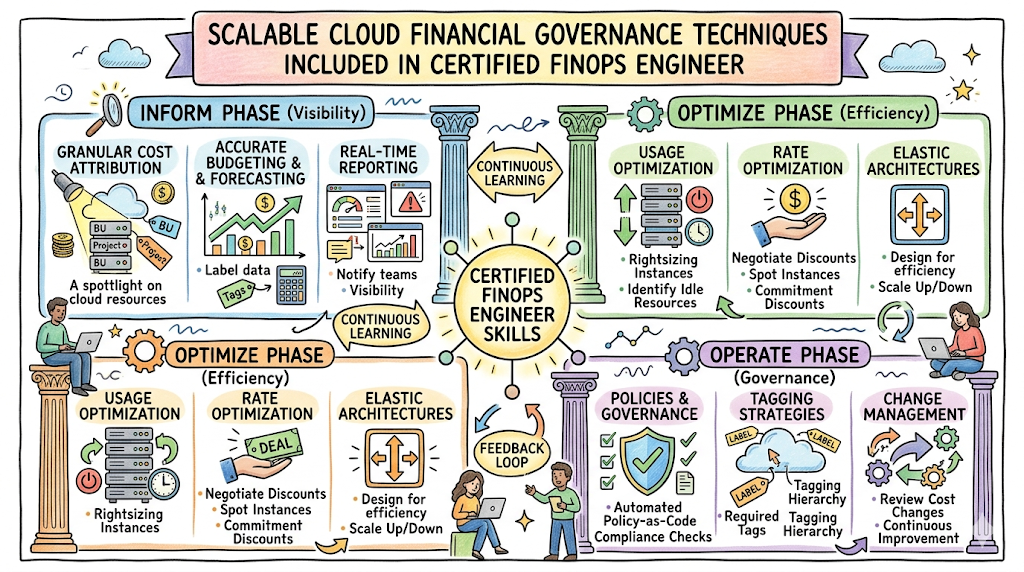
The program is delivered via the official training portal and hosted on the specialized website. It utilizes a multi-tiered assessment approach that tests both theoretical knowledge and practical application of the FinOps lifecycle: Inform, Optimize, and Operate. Candidates are expected to demonstrate ownership of the cloud financial footprint, from initial tagging strategies to automated rightsizing. The structure is designed to be accessible yet rigorous, ensuring that those who pass are truly ready to handle enterprise-level challenges. By focusing on collaboration across finance, engineering, and business units, the program breaks down traditional silos and promotes a culture of shared accountability.
Certified FinOps Engineer Certification Tracks & Levels
The certification journey is divided into levels that cater to different stages of professional growth: Foundation, Professional, and Advanced. The Foundation level is perfect for establishing a common language and understanding the basic pillars of cloud economics. The Professional level dives deep into the technical automation and integration tasks that allow for real-time cost control. The Advanced level is geared toward those who wish to design enterprise-wide FinOps strategies or lead a dedicated FinOps Center of Excellence. These tracks allow professionals to align their learning with their specific career goals, whether they want to remain highly technical or move into a strategic leadership capacity.
Complete Certified FinOps Engineer Certification Table
| Track | Level | Who it’s for | Prerequisites | Skills Covered | Recommended Order |
| Cloud Economics | Foundation | Junior Engineers, Analysts | Basic Cloud Literacy | Core Principles, Lifecycle | First |
| Engineering Ops | Professional | DevOps, SRE, Platform | 2+ Years Experience | Automation, APIs, Scripting | Second |
| Strategic Lead | Advanced | Solutions Architects | Professional Cert | Multi-cloud Governance | Third |
| Enterprise Management | Expert | Directors, Eng Managers | 5+ Years Industry | Culture & Policy Design | Optional |
Detailed Guide for Each Certified FinOps Engineer Certification
Certified FinOps Engineer – Associate Level
What it is
This certification validates a foundational understanding of the cloud financial management lifecycle and the ability to explain cost drivers to non-technical stakeholders.
Who should take it
It is designed for early-career engineers, cloud administrators, and business analysts who need to understand the fundamental mechanics of cloud billing.
Skills you’ll gain
- Understanding CapEx vs. OpEx in a cloud context.
- Mapping resources to business units using tagging.
- Identifying obvious areas of cloud waste.
- Navigating native billing and cost management dashboards.
Real-world projects you should be able to do
- Create a monthly cost report for a development team.
- Implement a basic resource tagging policy.
- Identify underutilized instances in a sandbox environment.
Preparation plan
- 7–14 days: Review the core glossary and the six principles of FinOps.
- 30 days: Practice navigating AWS, Azure, or GCP billing centers.
- 60 days: Not typically required for this introductory level.
Common mistakes
- Ignoring the cultural aspect of FinOps.
- Focusing only on one cloud provider’s terminology.
Best next certification after this
- Same-track option: Certified FinOps Engineer – Professional
- Cross-track option: Certified Kubernetes Administrator
- Leadership option: FinOps Certified Practitioner
Certified FinOps Engineer – Professional Level
What it is
This level focuses on the technical execution of FinOps, specifically how to automate the optimization of resources and build cost-aware infrastructure.
Who should take it
It is intended for experienced DevOps engineers and SREs who are responsible for maintaining large-scale production environments.
Skills you’ll gain
- Scripting automated rightsizing and scheduling tasks.
- Building custom cost visibility dashboards via APIs.
- Managing commitment-based discounts (Savings Plans, RIs).
- Implementing cost guardrails in CI/CD pipelines.
Real-world projects you should be able to do
- Build a script that identifies and deletes unattached storage volumes.
- Integrate cost-estimation tools into GitHub or GitLab workflows.
- Design a dashboard that correlates performance metrics with cost.
Preparation plan
- 7–14 days: Study the documentation for cloud billing APIs.
- 30 days: Build three automation scripts in a lab environment.
- 60 days: Review complex multi-account billing architectures.
Common mistakes
- Automating shutdowns without proper stakeholder notification.
- Failing to account for data egress costs in architectural plans.
Best next certification after this
- Same-track option: Certified FinOps Engineer – Advanced
- Cross-track option: AWS Certified Solutions Architect – Professional
- Leadership option: Engineering Management Certification
Choose Your Learning Path
DevOps Path
The DevOps path focuses on making cost a primary metric within the software development lifecycle. Engineers learn to “shift left” by providing developers with visibility into the financial impact of their code and infrastructure choices before deployment. This path emphasizes the use of tools that scan Terraform or CloudFormation templates for expensive configurations. By integrating these checks into the pipeline, teams can prevent waste from reaching production. It is an essential track for organizations that want to maintain a high velocity while keeping their cloud spend under strict control.
DevSecOps Path
In this path, the focus is on the intersection of security compliance and financial governance. Professionals learn how unauthorized or insecure resources often lead to both security vulnerabilities and massive billing spikes. By implementing policy-as-code, engineers can ensure that every deployed resource meets both security standards and budget constraints. This track is particularly important for regulated industries where every dollar spent must be audited and every resource secured. It creates a robust framework where financial safety and data security are managed through a single, unified workflow.
SRE Path
The SRE path is built around the concept of the “cost of reliability.” Engineers learn to balance service level objectives (SLOs) with the expenses required to maintain high availability. This involves deep dives into observability and monitoring tools to ensure that redundancy is provided efficiently without over-provisioning. SREs learn to treat cost as a technical constraint, much like latency or error rates. By optimizing for both performance and price, they ensure that the infrastructure is not only resilient but also economically viable for the business.
AIOps Path
The AIOps path teaches engineers how to use machine learning and artificial intelligence to manage cloud complexity. In environments with thousands of moving parts, manual cost management is impossible, so AIOps practitioners build systems that can detect anomalies automatically. This path covers the implementation of predictive analytics to forecast future spend based on historical trends. Engineers learn to deploy self-healing systems that can adjust resource allocation in real-time based on intelligent insights. It is a forward-thinking track for those managing massive, dynamic workloads that require algorithmic oversight.
MLOps Path
This path is specifically tailored to the unique financial challenges of machine learning operations. MLOps engineers focus on the high costs of GPU utilization, large-scale data processing, and model training environments. They learn how to optimize training jobs to reduce waste and how to right-size inference clusters for cost-effective deployment. Given that AI initiatives can quickly become a company’s largest cloud expense, this specialization is incredibly valuable. It ensures that data science teams can continue to innovate without being slowed down by unexpected and unmanaged infrastructure costs.
DataOps Path
The DataOps path focuses on the financial management of data storage, movement, and analysis. Data engineers learn to optimize data lakes, warehouses, and ETL pipelines to minimize expensive data egress and processing fees. This track covers the selection of appropriate storage tiers (hot, cool, or archive) based on access patterns to ensure data remains accessible but affordable. As data volumes continue to grow exponentially, the ability to architect cost-effective data pipelines is a critical skill for any modern organization. It ensures that the business can derive value from its data without the infrastructure costs outweighing the benefits.
FinOps Path
The pure FinOps path is for those who wish to specialize entirely in the cultural and operational shift of cloud financial management. This track covers the entire framework, from establishing executive buy-in to driving individual engineer accountability. Professionals learn how to build a FinOps Center of Excellence and how to facilitate communication between the finance department and the engineering teams. It is a strategic path that focuses on organizational change, reporting, and lifecycle management. This leads to specialized roles where the primary goal is the overall economic health of the company’s cloud ecosystem.
Role → Recommended Certified FinOps Engineer Certifications
| Role | Recommended Certifications |
| DevOps Engineer | Associate, Professional |
| SRE | Professional, Advanced |
| Platform Engineer | Professional, Advanced |
| Cloud Engineer | Associate, Professional |
| Security Engineer | Associate (Compliance focus) |
| Data Engineer | Associate (Storage focus) |
| FinOps Practitioner | All Levels (Foundation to Expert) |
| Engineering Manager | Foundation, Leadership |
Next Certifications to Take After Certified FinOps Engineer
Same Track Progression
For those who want to reach the pinnacle of this discipline, moving toward the Expert level is the natural next step. This involves mastering the art of enterprise-wide orchestration and multi-cloud governance. You will focus on building sophisticated reporting systems and defining the financial policies that govern thousands of cloud accounts. This deep specialization makes you a rare and highly sought-after professional who can lead large-scale digital transformations. It is about moving from “doing” the work to “designing” the systems that govern the work.
Cross-Track Expansion
Broadening your skills into specific cloud provider certifications (like AWS Professional or Google Professional Cloud Architect) is highly recommended. Understanding the deep technical nuances of specific services allows you to offer more granular optimization advice. For instance, a FinOps engineer with a CKA (Certified Kubernetes Administrator) can provide expert-level advice on container orchestration costs. This combination of financial oversight and deep technical knowledge makes you a powerhouse in the job market. It allows you to solve technical bottlenecks while simultaneously reducing the company’s cloud bill.
Leadership & Management Track
If your goal is to move into executive leadership, focusing on management training or an MBA-style program is a wise choice. FinOps is essentially a bridge between the technical world and the boardroom, so strong communication and leadership skills are vital. You will learn how to present complex financial data to non-technical executives and how to negotiate budgets at the highest levels. This track prepares you for roles such as VP of Infrastructure or Chief Technology Officer. It ensures you have the “soft skills” to match your technical FinOps mastery.
Training & Certification Support Providers for Certified FinOps Engineer
DevOpsSchool
DevOpsSchool provides an immersive learning environment for professionals who want to master the full spectrum of modern IT practices. Their curriculum is deeply rooted in hands-on labs and real-world scenarios, ensuring that students don’t just learn the theory of FinOps but actually know how to implement it. With a focus on automation and CI/CD integration, DevOpsSchool prepares engineers to handle the technical complexities of modern cloud environments. Their instructors are industry veterans who bring years of practical experience into the classroom, offering insights that are often missing from standard training manuals. It is a top choice for those looking for a comprehensive, project-based approach to their professional development.
Cotocus
Cotocus is a specialized training organization that excels in delivering high-level technical training for enterprise teams. They offer a unique blend of consulting and education, which means their training is always aligned with the latest industry challenges and solutions. Their FinOps programs are particularly strong in the areas of multi-cloud governance and automated cost control. Cotocus focuses on empowering engineers with the exact tools and techniques they need to drive immediate improvements in their infrastructure. For organizations looking to upskill their entire engineering department, Cotocus provides customized programs that address specific architectural needs and financial goals with precision and authority.
Scmgalaxy
Scmgalaxy has built a massive community of DevOps and SCM professionals, making it a rich resource for anyone looking to specialize in cloud financial management. Their training programs are known for being thorough, community-oriented, and highly practical. They offer a wide range of resources, from free tutorials to intensive certification bootcamps, catering to learners at all stages of their careers. By emphasizing the “Software Configuration” aspect of cloud management, Scmgalaxy helps students understand how even small changes in code can have large-scale financial impacts. It is an ideal platform for engineers who value continuous learning and a supportive peer network.
BestDevOps
BestDevOps focuses on providing efficient, career-focused training that gets professionals ready for the job market as quickly as possible. Their FinOps content is streamlined to cover the most important concepts and tools without any unnecessary fluff. They provide excellent study materials, including mock exams and quick-reference guides, that are perfect for busy professionals. For those in the Indian market and beyond who need to gain new skills while working full-time, BestDevOps offers a structured and manageable path to certification. Their focus is on practical results and helping students achieve a high return on their educational investment in the shortest time possible.
Devsecopsschool.com
Devsecopsschool.com is the leader in teaching the integration of security and financial governance into the DevOps lifecycle. They recognize that a secure cloud is often a more cost-effective cloud, and their training reflects this dual priority. Students learn how to use automated policy-as-code tools to maintain both compliance and budget control. This makes their graduates particularly valuable to organizations in highly regulated sectors like finance and healthcare. By focusing on the “Security and Governance” pillar of FinOps, this school ensures that its students can build robust, trustworthy, and economically sustainable cloud platforms for the long term.
Sreschool.com
Sreschool.com is dedicated to the discipline of Site Reliability Engineering, with a strong emphasis on the economic efficiency of reliable systems. Their training teaches engineers how to manage the “reliability budget” and how to make data-driven decisions about infrastructure scaling. Students gain a deep understanding of observability tools and how to use them to identify cost anomalies in real-time. This school is perfect for technical professionals who want to ensure their systems are not only high-performing but also cost-optimized. By learning the SRE approach to FinOps, students become experts at maintaining the perfect balance between service availability and operational expense.
Aiopsschool.com
Aiopsschool.com is at the cutting edge of IT education, focusing on the use of artificial intelligence to manage and optimize complex cloud environments. Their FinOps modules teach students how to build and deploy machine learning models that can predict spending and automate cost-saving measures. As cloud footprints become larger and more dynamic, the skills taught here are becoming essential for maintaining any level of control. The school provides a forward-looking curriculum that prepares engineers for a future where AI handles the heavy lifting of infrastructure management. It is the go-to provider for those who want to be at the forefront of the automated cloud revolution.
Dataopsschool.com
Dataopsschool.com specializes in the unique operational and financial challenges of data-intensive organizations. They provide deep-dive training on how to optimize data warehouses, manage data lifecycle costs, and reduce the expense of big data analytics. Their curriculum is highly technical, focusing on the specific APIs and configurations required to run cost-effective data pipelines. For data engineers and architects, this school offers the specialized knowledge needed to ensure that data initiatives remain profitable. By mastering the economics of data operations, students can lead their organizations toward more sustainable and valuable data-driven decision-making processes without the fear of uncontrolled costs.
Finopsschool.com
Finopsschool.com is the primary authority for the Certified FinOps Engineer program, offering a direct and comprehensive path to mastery. Their courses are designed specifically to meet the global standards of the FinOps framework, ensuring that every student receives a world-class education. They offer the most up-to-date resources, expert-led sessions, and a clear roadmap from Foundation to Expert levels. By focusing exclusively on cloud financial management, they provide a level of depth and specialization that is unmatched by more general IT training providers. It is the definitive choice for anyone who wants to make FinOps their primary professional focus and earn a globally recognized credential.
Frequently Asked Questions
- How long does it take to prepare for the Certified FinOps Engineer exam?
For the Associate level, 30 days is usually sufficient. For the Professional level, we recommend 60 days of hands-on practice.
- Is there a prerequisite for the Professional level certification?
While not always mandatory, having the Associate-level certificate and at least two years of cloud experience is strongly advised.
- Does the exam focus on one specific cloud provider like AWS?
No, the certification is cloud-agnostic. It focuses on universal FinOps principles that apply to AWS, Azure, GCP, and private clouds.
- Will this certification help me get a higher salary?
Yes, cloud cost management is a high-demand skill. Professionals with this certification often command premium salaries due to their direct impact on the bottom line.
- Is the exam taken online or in person?
The exam is proctored and can be taken online from your home or office for your convenience.
- What is the passing score for the certification?
The passing score varies slightly by level but generally ranges between 70% and 75%.
- How often do I need to renew the certification?
The certification is typically valid for two to three years, after which you must renew to stay current with new cloud models.
- Do I need to be a programmer to pass the Professional level?
You don’t need to be a full-stack developer, but you should be comfortable with basic scripting and using APIs to automate tasks.
- What is the cost of the exam?
Pricing can vary by region and level, so it is best to check the official website for the most current fee structure.
- Is there a community I can join for study support?
Yes, there is a global FinOps community with Slack channels and local meetups where you can find study buddies and mentors.
- Are there any hands-on labs included in the training?
Most reputable providers, including the ones mentioned in this guide, offer extensive hands-on labs to build practical skills.
- Can an engineering manager benefit from this technical certification?
Absolutely. Even if you don’t do the coding, understanding the technical hurdles of FinOps helps you lead your team more effectively.
FAQs on Certified FinOps Engineer
- What are the key technical tools an engineer should master for this certification?
Engineers should become proficient in native cloud cost management tools such as AWS Cost Explorer and Azure Cost Management. Additionally, mastery of infrastructure-as-code tools like Terraform and Pulumi is essential for implementing financial guardrails. Knowledge of container cost management tools like Kubecost is also highly beneficial for the Professional and Advanced tracks.
- How does this certification address multi-cloud financial management?
The program provides a unified framework that can be applied across different providers. It teaches you how to normalize billing data from various sources into a single, cohesive reporting structure for the entire organization.
- Is the focus more on cost-cutting or on value realization?
The focus is heavily on value realization. While cost-cutting is a part of it, the ultimate goal is to ensure that every dollar spent on the cloud is driving maximum business growth and innovation.
- What is the role of automation in the Professional track?
Automation is the backbone of the Professional track. You will learn to build “self-healing” infrastructure that can automatically right-size itself or shut down unnecessary resources based on predefined policies.
- How does the FinOps lifecycle impact daily engineering tasks?
It integrates financial awareness into the daily workflow. Engineers start checking the cost impact of a change just as they would check for performance bugs or security vulnerabilities before a release.
- What is the importance of “unit economics” in this program?
Unit economics allows the business to see the cloud cost per customer or per transaction. This certification teaches you how to architect systems so that these metrics can be accurately measured and reported.
- How does this certification handle Kubernetes cost management?
It covers specific strategies for allocating shared cluster costs to different teams or projects, which is one of the most significant challenges in modern containerized environments.
- What are the common pitfalls organizations face when starting FinOps?
The most common mistake is treating FinOps as a one-time project rather than a continuous cultural shift. This program teaches you how to build a sustainable practice that lives within the engineering culture.
Final Thoughts: Is Certified FinOps Engineer Worth It?
From my perspective as a mentor who has seen the evolution of the cloud from its infancy, I can say that FinOps is not just a trend—it is the maturity phase of cloud computing. We are no longer in a period where throwing money at the cloud to solve problems is acceptable. The future belongs to the engineers who can build elegant, high-performing systems that are also fiscally responsible.
The Certified FinOps Engineer program is a rigorous but rewarding path that gives you the tools to lead this change. It provides a unique blend of technical mastery and business acumen that is rare in the industry today. If you want to elevate your career and become a leader who understands both the “how” and the “how much” of cloud technology, then this certification is absolutely worth the investment of your time and effort. It is the final piece of the puzzle for any professional looking to master the modern cloud ecosystem.
