Introduction
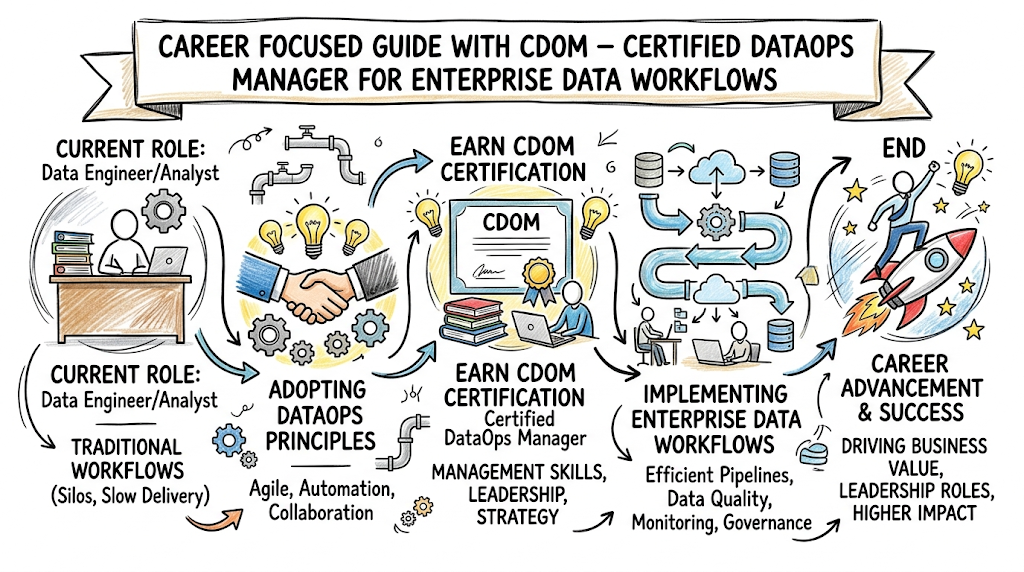
In the current landscape of digital transformation, the management of data has shifted from a backend utility to a core business driver. The CDOM – Certified DataOps Manager certification provides a comprehensive framework for professionals to transition from traditional data administration to modern, automated data lifecycle management. This guide is designed to help engineers and managers understand how to implement agile practices within data teams to ensure speed, quality, and reliability across all pipelines. By aligning with the standards set by Dataopsschool, professionals can validate their expertise in creating a culture of continuous improvement and cross-functional collaboration. This roadmap clarifies the impact of the certification on career growth and its role in modernizing enterprise data strategies.
What is the CDOM – Certified DataOps Manager?
The CDOM – Certified DataOps Manager represents a fundamental shift in how organizations perceive and manage their data assets. It exists to bridge the gap between data engineering and operational excellence, ensuring that data is delivered with the same speed and reliability as software code. This certification prioritizes production-ready skills, moving beyond theoretical data modeling to focus on automated testing, deployment, and monitoring. By adopting this framework, organizations can reduce the lead time for data-driven insights while maintaining high standards of data integrity.
This program aligns perfectly with modern engineering workflows by integrating DevOps principles like CI/CD, version control, and observability into the data ecosystem. It emphasizes the creation of resilient, scalable data platforms that can handle the increasing complexity of cloud-native environments. For enterprises, this means moving away from manual, error-prone processes toward a “Data as Code” approach that ensures every change is validated and every pipeline is monitored in real time.
Who Should Pursue CDOM – Certified DataOps Manager?
This certification is specifically designed for technical professionals who are moving into leadership or management roles within the data domain. Senior data engineers, lead developers, and site reliability engineers will find the curriculum directly applicable to their daily challenges of scaling infrastructure and managing team output. It is also an essential credential for existing engineering managers and directors who need to oversee complex data projects and align them with broader business objectives.
The relevance of this certification extends across both the Indian and global markets, as companies everywhere seek leaders who can navigate the complexities of modern data stacks. Beginners with a strong technical foundation can use this path to accelerate their career toward management, while experienced veterans can use it to formalize their expertise in agile data operations. Ultimately, it is for anyone responsible for the health, delivery, and strategic value of data within an organization.
Why CDOM – Certified DataOps Manager is Valuable and Beyond
The value of the CDOM – Certified DataOps Manager lies in its ability to future-proof a professional’s career in an era of rapid technological change. As toolsets evolve and cloud providers introduce new services, the core principles of DataOps remain constant, providing a stable foundation for long-term career growth. This certification demonstrates a commitment to operational excellence that is highly sought after by enterprises looking to maximize their return on data investments.
Furthermore, the demand for specialized data management leadership continues to grow as data volumes explode and compliance requirements become more stringent. Investing time in this certification ensures that professionals stay relevant by mastering the intersection of data engineering, security, and operations. It provides a distinct competitive advantage, positioning the holder as a specialist capable of leading high-performance teams and delivering measurable business value through optimized data delivery.
CDOM – Certified DataOps Manager Certification Overview
The certification program is delivered through a structured digital learning environment and is hosted on the official provider platform. It adopts a practical, assessment-heavy approach that requires candidates to demonstrate their competency in real-world scenarios rather than just passing multiple-choice tests. This ownership of the curriculum by industry experts ensures that the content remains aligned with the latest enterprise practices and architectural trends.
The structure of the program is designed to be cumulative, starting with foundational concepts and progressing to advanced strategic management. It covers the entire lifecycle of data operations, including pipeline orchestration, quality management, and cost optimization. Professionals can expect a rigorous evaluation process that validates their ability to design, implement, and manage enterprise-grade DataOps frameworks that support a wide variety of business use cases.
CDOM – Certified DataOps Manager Certification Tracks & Levels
The certification is organized into three distinct levels—Foundation, Professional, and Advanced—to mirror the natural progression of a technical career. The Foundation level introduces the core vocabulary and concepts of DataOps, focusing on the cultural shift and basic automation requirements. The Professional level dives into the technical details of managing pipelines, teams, and service level objectives. Finally, the Advanced level is designed for strategic leaders who are responsible for enterprise-wide data governance and organizational transformation.
These tracks also allow for specialization in areas such as SRE for data, FinOps for data infrastructure, or security-focused data operations. By providing a clear hierarchy of skills, the program allows professionals to map their learning journey to their specific career goals. Whether an individual wants to remain a deep technical specialist or transition into a senior leadership role, there is a clear track available to validate their expertise at every stage.
Complete CDOM – Certified DataOps Manager Certification Table
| Track | Level | Who it’s for | Prerequisites | Skills Covered | Recommended Order |
| Core DataOps | Foundation | Aspiring Managers, Junior Engineers | Data Fundamentals | CD/CD, Pipeline Basics, Culture | 1 |
| Management | Professional | Team Leads, Data Architects | 3+ Years Experience | SLOs, Team Leadership, Quality | 2 |
| Strategy | Advanced | Directors, CDOs, VP of Data | 7+ Years Experience | Governance, ROI, Roadmap Design | 3 |
| Reliability | SRE Track | SREs, Platform Engineers | DevOps Knowledge | Observability, Incident Management | Optional |
| Security | DevSecOps Track | Security Engineers, Data Architects | Security Basics | Encryption, Access Control, Audits | Optional |
| Cost | FinOps Track | Finance Leads, Lead Engineers | Cloud Knowledge | Budgeting, Cloud Cost Management | Optional |
Detailed Guide for Each CDOM – Certified DataOps Manager Certification
CDOM – Foundation
What it is
The Foundation certification validates a basic understanding of the DataOps manifesto and the fundamental principles of automating the data lifecycle. It ensures that candidates can communicate effectively using industry-standard terminology and understand the goals of a DataOps transformation.
Who should take it
This level is ideal for junior data engineers, software developers, and project managers who are new to the operational side of data and want to build a strong conceptual base.
Skills you’ll gain
- Understanding the core components of the DataOps lifecycle.
- Mastery of version control concepts for data pipelines.
- Knowledge of basic automated testing frameworks for data.
- Familiarity with the cultural requirements for successful DataOps adoption.
Real-world projects you should be able to do
- Setting up a basic version-controlled repository for SQL and ETL scripts.
- Building a simple CI/CD pipeline for a data transformation task.
- Identifying common bottlenecks in a manual data delivery process.
Preparation plan
- 7-14 Days: Review the DataOps Manifesto and core terminology.
- 30 Days: Practice setting up basic automation tools and exploring case studies.
- 60 Days: Participate in community forums and take foundational practice exams.
Common mistakes
- Focusing too much on specific tools rather than the underlying principles.
- Underestimating the importance of team collaboration and culture.
Best next certification after this
- Same-track option: CDOM Professional
- Cross-track option: Cloud Practitioner
- Leadership option: Agile Team Lead
CDOM – Professional
What it is
The Professional level validates the ability to manage complex data environments and lead technical teams in the implementation of automated workflows. It focuses on the intersection of technical architecture and operational management.
Who should take it
This is suitable for mid-level engineers, team leads, and architects who are responsible for the performance and reliability of data platforms in a production environment.
Skills you’ll gain
- Designing and implementing scalable data orchestration systems.
- Managing Service Level Agreements (SLAs) and Service Level Objectives (SLOs).
- Implementing advanced monitoring and observability for data quality.
- Optimizing resource allocation and managing technical debt in pipelines.
Real-world projects you should be able to do
- Designing an end-to-end DataOps strategy for a specific business unit.
- Implementing a real-time data quality monitoring and alerting system.
- Conducting a comprehensive root-cause analysis for a data pipeline outage.
Preparation plan
- 7-14 Days: Deep dive into advanced orchestration and containerization tools.
- 30 Days: Work on scenario-based problems involving team dynamics and SLAs.
- 60 Days: Complete a practical project that demonstrates end-to-end pipeline management.
Common mistakes
- Over-engineering solutions without considering long-term maintenance costs.
- Failing to align technical goals with the broader business strategy.
Best next certification after this
- Same-track option: CDOM Advanced
- Cross-track option: SRE Professional
- Leadership option: Engineering Management Professional
CDOM – Advanced
What it is
The Advanced certification is the highest level of validation for strategic leaders who define the vision and governance for data operations across an entire organization. It focuses on large-scale transformation and leadership.
Who should take it
This level is reserved for Directors of Data Engineering, Chief Data Officers, and Principal Architects who influence technical strategy and manage large budgets.
Skills you’ll gain
- Developing and executing a multi-year enterprise DataOps roadmap.
- Establishing global data governance, privacy, and compliance standards.
- Leading organizational change and fostering a high-performance data culture.
- Calculating and presenting the ROI of DataOps initiatives to executive stakeholders.
Real-world projects you should be able to do
- Authoring an enterprise-wide data governance and security policy.
- Leading a migration from legacy data systems to a modern DataOps-driven architecture.
- Developing a financial model for cost avoidance and optimization in data infrastructure.
Preparation plan
- 7-14 Days: Study executive-level strategy frameworks and case studies.
- 30 Days: Participate in peer review sessions and strategy simulations.
- 60 Days: Finalize an enterprise strategy proposal and defend it in a review.
Common mistakes
- Neglecting the legal and compliance aspects of data management at scale.
- Focusing exclusively on technical milestones while ignoring organizational health.
Best next certification after this
- Same-track option: Data Strategy Master
- Cross-track option: Executive FinOps
- Leadership option: Executive Leadership Program
Choose Your Learning Path
DevOps Path
The DevOps path focuses on the rigorous application of software engineering standards to data pipelines. You will learn to treat data infrastructure as code, utilizing tools like Jenkins, GitLab CI, and Terraform to automate every aspect of delivery. This path ensures that data changes are versioned, tested, and deployed with the same level of confidence as a standard software release, reducing the risk of production errors.
DevSecOps Path
The security path is critical for professionals working with sensitive data in regulated industries. You will master the integration of automated security checks, encryption, and access controls within the data pipeline. This path ensures that security is not a separate gate but a continuous part of the data lifecycle, allowing for both speed and compliance in high-stakes environments.
SRE Path
The Site Reliability Engineering path for data focuses on the health and uptime of the data platform. You will learn how to set meaningful error budgets and monitor the performance of data streams to ensure they meet the business’s availability requirements. This path is essential for organizations where data delivery is time-sensitive and downtime has a direct impact on revenue.
AIOps Path
This path leverages machine learning to improve the efficiency and reliability of the data platform itself. You will learn how to use AI-driven tools for predictive maintenance, anomaly detection, and automated capacity planning. It is a forward-looking track that prepares you to manage the next generation of intelligent, self-healing data infrastructures.
MLOps Path
The MLOps path bridges the gap between data science and production, focusing on the automated deployment and monitoring of machine learning models. You will learn how to create reproducible model pipelines and track model performance in real time. This ensures that machine learning initiatives provide consistent value and can be scaled across the organization.
DataOps Path
The core DataOps path is dedicated to the orchestration and quality of the data delivery value chain. You will master the coordination of diverse teams and the management of complex data workflows from source to consumption. This path defines the fundamental role of the modern data manager, focusing on agility, collaboration, and the elimination of data silos.
FinOps Path
The financial operations path focuses on the cost-efficiency of data management in the cloud. You will learn how to track storage and processing costs, identify wasteful practices, and implement strategies for cost avoidance. This path is vital for ensuring that the technical performance of a data platform is balanced with its financial sustainability.
Role → Recommended CDOM – Certified DataOps Manager Certifications
| Role | Recommended Certifications |
| DevOps Engineer | CDOM Foundation, SRE Track |
| SRE | CDOM Professional, SRE Track |
| Platform Engineer | CDOM Professional, FinOps Track |
| Cloud Engineer | CDOM Foundation, Professional |
| Security Engineer | CDOM Foundation, DevSecOps Track |
| Data Engineer | CDOM Foundation, Professional |
| FinOps Practitioner | CDOM Foundation, FinOps Track |
| Engineering Manager | CDOM Professional, Advanced |
| Data Architect | CDOM Professional, Advanced |
| Chief Data Officer | CDOM Advanced |
Next Certifications to Take After CDOM – Certified DataOps Manager
Same Track Progression
After completing the core CDOM levels, professionals should consider deep-diving into specific data architecture certifications. Mastering tools like Snowflake, Databricks, or advanced Airflow orchestration can complement your management skills with elite technical depth. This progression ensures you remain a hands-on leader who understands the technical nuances of the platforms your team manages.
Cross-Track Expansion
Expanding your expertise into adjacent fields like MLOps or FinOps can significantly increase your value to an organization. Understanding how models are deployed or how cloud budgets are managed allows you to oversee a broader range of engineering initiatives. This cross-track expansion is often the key to moving from a departmental manager to a cross-functional technical leader.
Leadership & Management Track
For those aiming for executive positions, combining CDOM with a formal management credential like the PMP or an MBA is highly effective. These programs help you transition from managing technical output to managing organizational strategy, budgets, and long-term business growth. This combination creates a powerful profile for roles such as Vice President of Engineering or Chief Technology Officer.
Training & Certification Support Providers for CDOM – Certified DataOps Manager
DevOpsSchool is a premier institution recognized for its deep technical expertise and comprehensive training programs in the DevOps and DataOps domains. They provide a structured learning environment that emphasizes hands-on experience and real-world application of automated delivery principles. Their curriculum is continuously updated to reflect the latest industry trends, ensuring that students are always learning the most relevant skills. With a focus on end-to-end lifecycle management, they prepare professionals to handle complex enterprise challenges with confidence. Their instructors are seasoned experts who bring years of production-level experience to the classroom, making them a top choice for aspiring managers and senior engineers alike.
Cotocus provides high-impact training and consulting services that focus on accelerating digital transformation through modern engineering practices. They are known for their agile approach to education, offering intensive courses that help professionals upskill quickly in areas like cloud-native architecture and platform engineering. Their programs are designed to be project-centric, allowing participants to build a portfolio of work that demonstrates their technical competence. By focusing on the intersection of technology and business value, they ensure that their graduates are not just tool experts but strategic thinkers. Their commitment to quality and practical learning makes them a valuable partner for any professional looking to advance their career.
Scmgalaxy is a long-standing community-driven platform that has played a vital role in educating the global engineering community on configuration management and automation. They offer an extensive library of resources, including deep-dive tutorials, industry articles, and specialized training programs. Their approach is rooted in real-world problem-solving, making their courses highly practical for engineers working in production environments. They foster a supportive learning atmosphere where professionals can exchange ideas and best practices. As a trusted source of unbiased information, they help individuals and organizations navigate the complexities of software supply chains and automated operations with clarity and expertise.
BestDevOps specializes in delivering elite training for professionals who want to reach the highest levels of technical excellence in site reliability and platform engineering. Their courses are designed to be rigorous, pushing students to master complex orchestration and observability frameworks. They emphasize the importance of building resilient systems that can scale effortlessly in the cloud. By providing access to high-end lab environments and expert mentorship, they ensure that every student gains a deep understanding of production-grade operations. Their reputation for producing top-tier talent makes them a preferred training partner for leading technology companies worldwide seeking advanced operational expertise.
Devsecopsschool is dedicated to the critical task of integrating security into the heart of the modern delivery pipeline. Their training programs empower engineers to move beyond traditional security silos and adopt a continuous, automated approach to protection and compliance. They cover essential topics such as infrastructure as code security, automated vulnerability scanning, and secure data handling. In an environment where data breaches are an ever-present threat, their curriculum provides the essential skills needed to build and manage secure data platforms. Their focus on practical, actionable security measures makes them a unique and indispensable provider for any professional involved in data management.
Sreschool provides targeted education for those responsible for the reliability and performance of enterprise-scale systems. Their curriculum is built on the core principles of site reliability engineering, adapted for a variety of technical and organizational contexts. They teach students how to use data-driven methods to manage risk, reduce toil, and ensure consistent system uptime. Key areas of focus include incident response, error budgeting, and the creation of robust observability dashboards. Their training emphasizes the cultural shifts required to implement SRE successfully, making them an excellent choice for managers looking to improve their team’s operational health and delivery speed.
Aiopsschool is a pioneer in providing education on the application of artificial intelligence and machine learning to IT operations. They offer specialized courses that help professionals understand how to implement intelligent automation and predictive analytics within their infrastructure. Their training is essential for anyone looking to manage large-scale, complex environments where manual monitoring is no longer sufficient. By mastering AIOps, engineers can significantly improve their incident response times and optimize system performance through data-driven insights. They are the leading source for staying ahead of the curve in the rapidly evolving field of intelligent operations and automated management.
Dataopsschool is the primary institution focused on the specialized discipline of data operations and the host of the CDOM certification. They provide a comprehensive roadmap for data engineers and architects to transition into high-level management roles. Their curriculum is uniquely designed to address the specific challenges of data delivery, such as schema management, data quality, and governance. They emphasize a production-first mindset, ensuring that every student is capable of building and leading high-performance DataOps teams. Their dedication to this specific niche makes them the definitive choice for anyone seeking to master the operational side of the modern data stack.
Finopsschool addresses the growing demand for financial accountability and cost optimization in cloud environments. Their training programs help engineers and managers understand the financial impact of their infrastructure decisions and implement strategies to maximize cloud value. They teach practical skills for tracking spend, identifying waste, and fostering collaboration between technical and financial departments. This is particularly relevant for data-intensive organizations where infrastructure costs can grow exponentially. By providing a clear framework for cloud financial management, they help professionals ensure that their technical successes are balanced with financial sustainability and high return on investment.
Frequently Asked Questions (General)
- How long does it typically take to prepare for the CDOM Foundation exam?
Most candidates spend approximately 15 to 30 days preparing, depending on their existing familiarity with DevOps and data engineering concepts.
- Is there a practical component to the certification exams?
Yes, the Professional and Advanced levels include scenario-based assessments that require you to solve real-world operational challenges in a simulated environment.
- Does the certification focus on specific tools like Airflow or dbt?
The certification is tool-agnostic and focuses on the underlying principles, though popular tools are often used as examples in the learning modules.
- Are there any prerequisites for taking the Professional level exam?
While not strictly enforced, it is highly recommended to have at least three years of experience in data or operations and to have completed the Foundation level.
- Is the CDOM – Certified DataOps Manager recognized by global enterprises?
Yes, the certification is designed to meet international standards and is highly valued by organizations in North America, Europe, India, and Asia.
- How does this certification help with career progression for a senior engineer?
It provides the necessary management framework and strategic vocabulary needed to transition from a hands-on contributor to a team lead or engineering manager.
- What is the passing score for the certification exams?
The passing score is typically set at 70%, ensuring that all certified professionals have a high level of competency in the subject matter.
- Can the training be completed while working a full-time job?
The programs are designed to be flexible, with many self-paced options that allow professionals to balance their studies with their existing work commitments.
- Is there a community for certified DataOps Managers?
Yes, graduates gain access to an exclusive network of professionals for peer support, networking, and sharing best practices in the field of DataOps.
- How often is the curriculum updated?
The content is reviewed annually by a committee of industry experts to ensure it reflects the latest shifts in technology and enterprise management.
- Are there bulk certification options for enterprise teams?
Yes, many training providers offer corporate programs designed to upskill entire teams and align them with a unified DataOps strategy.
- Does this certification cover cloud-specific data services like AWS Redshift or BigQuery?
It covers the operational management of these services, focusing on how they fit into a larger automated pipeline rather than just their specific configurations.
FAQs on CDOM – Certified DataOps Manager
- What is the primary difference between a Data Engineer and a DataOps Manager?
A Data Engineer focuses on building the data infrastructure and pipelines, while a DataOps Manager focuses on the speed, quality, and operational reliability of those pipelines.
- How does CDOM address the issue of data quality in automated pipelines?
The certification teaches frameworks for integrating automated data validation and quality checks directly into the CI/CD process to catch errors early.
- Is the CDOM – Certified DataOps Manager suitable for non-technical managers?
While it is a management certification, it requires a solid technical foundation to understand the complexities of automated data lifecycles and infrastructure.
- Does the program cover data privacy regulations like GDPR?
Yes, the Professional and Advanced levels include modules on data governance and how to automate compliance checks within the delivery lifecycle.
- What is the role of a DataOps Manager during a production outage?
The manager is responsible for leading the incident response, coordinating between teams, and ensuring a thorough post-mortem is conducted to prevent recurrence.
- Can DataOps principles be applied to legacy on-premise data systems?
Yes, the certification provides strategies for modernizing legacy operations and creating hybrid environments that bridge on-premise and cloud systems.
- How does the certification handle the “cultural shift” aspect of DataOps?
The curriculum includes specific sections on change management and techniques for breaking down the traditional silos between data and operations teams.
- What is the ROI for a company that invests in CDOM certification for its staff?
Companies typically see a reduction in data errors, faster time-to-market for insights, and improved team efficiency through the elimination of manual work.
Final Thoughts: Is CDOM – Certified DataOps Manager Worth It?
Choosing to pursue the CDOM – Certified DataOps Manager is a strategic decision for any professional looking to lead in the modern data economy. It moves beyond the hype of individual tools and focuses on the sustainable management of complex systems. As someone who has watched the industry evolve, I can confidently say that the ability to manage data with agility and precision is one of the most valuable skill sets an engineering leader can possess.
The certification provides a clear, documented path for growth, turning anecdotal experience into a formal, recognized expertise. My advice is to approach the program not just as a test to pass, but as a framework to implement within your own organization. The true value lies in the operational improvements you will be able to drive and the high-performance culture you will be equipped to build.
