Introduction
The transition from traditional software development to Artificial Intelligence (AI) and Machine Learning (ML) has been one of the most significant shifts I have witnessed in my career. Over the years, I have seen brilliant data science projects fail simply because there was no bridge between the experimental model and the production environment. This is exactly why MLOps (Machine Learning Operations) has emerged as the backbone of modern AI success. If you are an engineer or a manager looking to lead in the era of intelligence, the MLOps Certified Professional (MLOCP) is your blueprint for success. This guide will walk you through the certification, the career paths available, and how to master the operational side of AI.
The Core Philosophy of MLOps
In my experience, the hardest part of AI isn’t building the model—it’s keeping it alive, reliable, and scalable. Unlike standard code, an ML model can “break” even if you don’t change a single line of logic. This happens because the data in the real world changes, a phenomenon known as “drift.”
MLOps brings the rigor of DevOps—automation, testing, and monitoring—to the world of Machine Learning. It ensures that your models aren’t just one-time experiments but are instead robust services that provide continuous value to your business.
Global Certification Landscape Overview
Before we dive deep into the MLOCP, it is important to see where it sits within the larger operational ecosystem. Modern engineering is no longer just about “writing code”; it is about specialized operations.
Professional Certification Comparison Table
| Track | Level | Who it’s for | Prerequisites | Skills Covered | Recommended Order |
| MLOps | Professional | ML Engineers, SREs, Software Devs | Python, Basic ML | CI/CD/CT, MLflow, Kubernetes, Drift Detection | Foundation → MLOCP |
| DevOps | Professional | Developers, SysAdmins | Linux, Git, CI/CD | Jenkins, Docker, Ansible, Infrastructure as Code | DCP → CDA |
| DevSecOps | Professional | Security Experts, Engineers | DevOps Basics | SAST/DAST, Container Security, Compliance | DSOCP |
| SRE | Professional | Platform Engineers, SREs | Admin experience | Error Budgets, SLIs/SLOs, Observability | SRECP |
| DataOps | Professional | Data Engineers, Architects | SQL, ETL Tools | Data Quality, Pipeline Automation, Governance | DOCP |
| FinOps | Professional | Managers, Architects | Cloud Basics | Cloud Cost Optimization, Unit Economics | FOCP |
Deep Dive: MLOps Certified Professional (MLOCP)
The MLOCP is designed to transform you from a developer into an architect who can manage the entire lifecycle of a machine learning product. It focuses on the “Continuous” nature of ML: Continuous Integration, Continuous Delivery, and Continuous Training.
What it is
The MLOps Certified Professional (MLOCP) is an industry-recognized credential that validates your ability to automate and scale machine learning workflows. It combines data engineering, ML engineering, and DevOps practices into a single, cohesive framework.
Who should take it
- Software Engineers wanting to move into the high-growth AI/ML field.
- DevOps Engineers who need to support data science teams.
- Data Scientists who want to learn how to deploy their own models.
- Engineering Managers who need to oversee AI-driven digital transformation.
Skills you’ll gain
- Pipeline Automation: Building CI/CD/CT workflows for machine learning.
- Model Management: Using registries like MLflow for versioning and metadata tracking.
- Containerization: Mastering Docker and Kubernetes specifically for model serving.
- Observability: Implementing monitoring for data drift and model performance decay.
- Infrastructure: Provisioning scalable ML environments using Infrastructure as Code (IaC).
Real-world projects you should be able to do
- Automated Retraining System: A pipeline that automatically triggers a model retrain when accuracy drops.
- Scalable Model API: Deploying a model as a high-performance REST API using Kubernetes.
- Drift Detection Dashboard: A system that alerts the team when the “real-world” data changes significantly from the “training” data.
- Feature Store Deployment: Setting up a centralized repository for reusable machine learning features.
Preparation Plan
Phase 1: The Foundational Pillars (Day 1–15)
The first two weeks are about mastering the environment where MLOps lives. In the professional world, everything runs on Linux and is versioned with Git. If these aren’t second nature, the advanced tools will feel like a struggle.
Week 1: Linux and Automation
Spend the first week living in the terminal. You need to be comfortable managing files, checking system logs, and writing Bash scripts to automate repetitive tasks.
- Focus: File permissions, process management, and networking basics.
- Lab Task: Write a script that automatically backs up a local dataset and logs the operation with a timestamp.
Week 2: Python and Git Excellence
MLOps is built on Python. You don’t need to be a research scientist, but you must understand modular programming.
- Focus: Python environments (venv/Conda), building APIs with FastAPI, and advanced Git workflows (branching and merging).
- Lab Task: Build a simple Python application that takes a CSV file, cleans the data, and outputs a summary, all managed through a Git repository.
Phase 2: The MLOps Lifecycle & Data (Day 16–30)
Now that you have the environment ready, we move into the “ML” part of MLOps. This phase is about reproducibility—ensuring that if you run a training job today, you can get the exact same results six months from now.
Week 3: Experiment Tracking with MLflow
Tracking your experiments is the heartbeat of MLOps. You must learn how to log every parameter, metric, and model version.
- Focus: MLflow Tracking, Model Registry, and the MLflow UI.
- Lab Task: Train a scikit-learn model and log at least 10 different runs with different hyperparameters using MLflow.
Week 4: Data Versioning and Governance
Data changes faster than code. Tools like DVC (Data Version Control) allow you to version massive datasets without bloating your Git repository.
- Focus: DVC integration, Feature Stores (Feast), and data lineage.
- Lab Task: Set up a DVC pipeline that tracks a 500MB dataset and allows you to “time travel” between different versions of that data.
Phase 3: Infrastructure and Scaling (Day 31–45)
This is where you move from a local machine to the cloud. You will learn how to “package” your intelligence so it can run anywhere.
Week 5: Containerization with Docker
Docker is the standard for MLOps. You need to know how to create “slim” images that contain only what your model needs to run.
- Focus: Writing efficient Dockerfiles, managing images, and multi-stage builds.
- Lab Task: Package your FastAPI model from Week 2 into a Docker container and ensure it starts up in under 5 seconds.
Week 6: Orchestration with Kubernetes and Helm
One container is easy; managing 100 containers is hard. Kubernetes is the brain that manages your scaling and self-healing.
- Focus: Pods, Deployments, Services, and Helm charts for package management.
- Lab Task: Deploy your Dockerized model to a local Kubernetes cluster (like Minikube or Kind) and set up a Service to access it.
Phase 4: CI/CD/CT and Mastery (Day 46–60)
The final phase is about the “Continuous” part of MLOps. We bring everything together into a fully automated pipeline that requires zero human intervention to deploy or retrain.
Week 7: Building the CI/CD/CT Pipeline
Learn to use GitHub Actions or Jenkins to automate your tests. The “CT” (Continuous Training) is what makes MLOps unique.
- Focus: Automated testing with Pytest, automated image builds, and triggering retraining based on data changes.
- Lab Task: Create a GitHub Action that runs every time you push code, tests your model accuracy, and builds a new Docker image only if the tests pass.
Week 8: Monitoring, Security, and LLMOps
In the final week, we focus on keeping the system healthy and secure. We also look at the emerging field of LLMOps for managing Large Language Models.
- Focus: Prometheus/Grafana for monitoring, drift detection with Evidently AI, and model security.
- Lab Task: Set up a Grafana dashboard that shows the “Drift” of your model’s predictions in real-time.
Common Mistakes
- Neglecting Data Versioning: Focusing only on the code and forgetting to track the data used for training.
- Manual Deployment: Using “copy-paste” methods to move models to production instead of automated pipelines.
- Lack of Monitoring: Assuming a model will stay accurate forever once it is deployed.
- Ignoring Costs: Running massive ML clusters without optimizing for resource usage and cost.
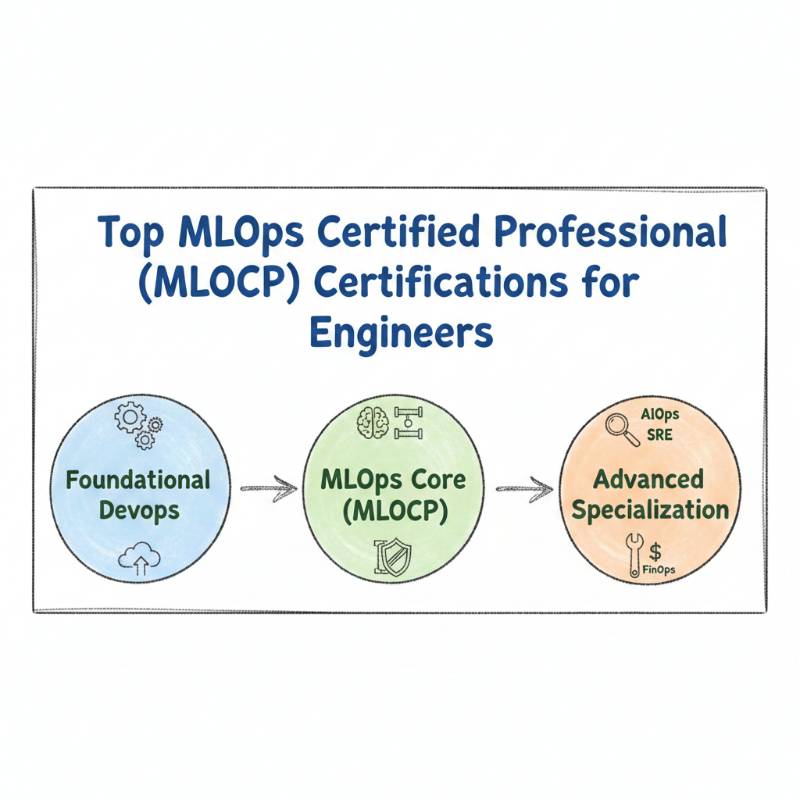
Best next certification after this
Option 1: Same Track (Vertical Growth)
Recommended: Certified AIOps Professional (AIOCP)
If you want to stay in the world of Artificial Intelligence but expand your scope, AIOps is the natural evolution. While MLOps focuses on the lifecycle of a specific model, AIOps focuses on using AI to manage the health of the entire IT infrastructure.
- Focus: Using Machine Learning for predictive maintenance, automated root-cause analysis, and self-healing systems.
- Why take it: It allows you to apply the ML skills you gained in MLOCP to solve larger operational problems across the entire company, making you a “Master of AI Infrastructure.”
Option 2: Cross-Track (Horizontal Growth)
Recommended: SRE Certified Professional (SRECP)
The biggest challenge for any MLOps engineer is reliability. If your model is brilliant but your system is down, it provides zero value. Site Reliability Engineering (SRE) is the perfect partner for MLOps.
- Focus: Error budgets, SLIs/SLOs, incident management, and high-availability architecture.
- Why take it: Mastering SRE principles ensures that the models you deploy are not just “working” but are truly “highly available” and “production-hardened.” It makes you a “full-stack” operations expert.
Option 3: Leadership (Career Growth)
Recommended: Certified DevOps Manager
If you have been an individual contributor for a while and want to move into a role where you lead squads, manage budgets, and define the culture of your organization, this is the path for you.
- Focus: Strategic planning, ROI of automation, team building, and driving cultural change across departments.
- Why take it: It bridges the gap between “technical expert” and “business leader.” You will learn how to justify AI/ML investments to stakeholders and manage the human side of digital transformation.
Choose Your Path: 6 Specialized Learning Roads
Career growth in the modern era is about specialization. Here are the six core paths you can choose from, depending on your professional interests:
- DevOps Path: Focuses on the general automation of software delivery and cultural transformation.
- DevSecOps Path: Prioritizes “Security as Code,” ensuring that every automated step is protected and compliant.
- SRE Path: Dedicated to the reliability and performance of large-scale systems using observability and error budgets.
- AIOps/MLOps Path: The “future-proof” track for those who want to build and manage AI-driven applications.
- DataOps Path: Focuses on the integrity, speed, and reliability of data flows across an organization.
- FinOps Path: For those interested in the economics of the cloud—ensuring every dollar spent on tech drives profit.
Role → Recommended Certifications Mapping
Align your learning journey with your current job or the role you want to achieve next:
| Current/Target Role | Foundational Certification | Advanced Specialization | Expert/Leadership Level |
| DevOps Engineer | Certified DevOps Professional (CDP) | Kubernetes Certified Expert | MLOps Certified Professional (MLOCP) |
| SRE (Site Reliability Engineer) | SRE Certified Professional (SRECP) | Observability & Monitoring Expert | MLOCP (for AI Reliability) |
| Platform Engineer | Infrastructure as Code (Terraform/Ansible) | Kubernetes Administration (CKA) | MLOCP |
| Cloud Engineer | AWS/Azure/GCP Solutions Architect | Certified FinOps Professional | MLOCP |
| Security Engineer | DevSecOps Certified Professional (DSOCP) | Cloud Security Professional | DevSecOps Expert (Advanced) |
| Data Engineer | Certified DataOps Professional (DOCP) | Big Data Architect | MLOCP |
| FinOps Practitioner | FinOps Certified Practitioner (FOCP) | Cloud Financial Manager | Certified DevOps Manager |
| Engineering Manager | Certified DevOps Manager | MLOCP (for AI Strategy) | FinOps Certified Professional |
Next Certifications to Take
After completing the MLOCP, consider these three directions for continued growth:
- Same Track (Deep Expertise): AIOps Certified Professional. This allows you to apply your ML knowledge to automate the health and performance of the entire IT stack.
- Cross-Track (Hybrid Skills): SRE Certified Professional (SRECP). Since MLOps relies heavily on production stability, SRE principles are the perfect complement to your skill set.
- Leadership (Career Growth): Certified DevOps Manager. This is the path for those looking to move from a technical lead role into a Director or VP level position, managing multiple specialized teams.
Training & Certification Support Institutions
Choosing the right training partner is essential for mastering the complex labs required for MLOps. These institutions are the leaders in the field:
DevOpsSchool As the primary global provider for the MLOCP certification, DevOpsSchool offers a deep-dive, instructor-led curriculum. They are known for their massive library of hands-on labs, lifetime access to learning materials, and trainers who are active practitioners in the MLOps and SRE domains.
Cotocus Cotocus is a boutique technical institution that specializes in high-intensity corporate bootcamps. Their MLOps training is designed to help working engineers transition quickly into production-level roles by focusing on “Zero-to-One” project implementations and advanced Kubernetes orchestration.
Scmgalaxy A community-driven powerhouse, Scmgalaxy provides extensive technical documentation, community forums, and specialized workshops for MLOps aspirants. It is an excellent resource for professionals looking for long-term community support and deep-dive technical blogs on tool integrations.
BestDevOps BestDevOps focuses on providing structured career roadmaps and mentoring for engineers. Their training methodology makes complex MLOps toolchains easy to understand, helping professionals map their current skills to high-paying senior architect roles.
devsecopsschool While the name suggests a focus on security, this institution provides the critical “Security-Left” perspective for MLOps. They help engineers learn how to secure the software supply chain and implement robust access controls within ML pipelines.
sreschool Since MLOps relies heavily on production stability, sreschool is the go-to place for learning the reliability side of AI. They focus on teaching how to apply SRE principles—like SLOs and error budgets—to machine learning models to ensure 24/7 uptime.
aiopsschool This institution focuses on the cutting edge where AI is used to manage IT operations. Their training complements the MLOCP by showing how the models you build can be used to predict system failures and automate self-healing infrastructure.
dataopsschool Essential for the “Data” part of MLOps, this school focuses on the integrity, speed, and reliability of the data flow. They provide deep-dive training into data versioning, feature stores, and automated data quality checks that are vital for ML success.
finopsschool Managing the cost of AI is a massive challenge, and finopsschool provides the financial governance layer. They teach engineers how to monitor and optimize the cloud spend associated with large-scale ML training and inference clusters.
Frequently Asked Questions (General)
- Is MLOps just “DevOps for AI”?
Essentially, yes, but it is more complex because it manages three moving parts: Code, Data, and the Model itself. - How long does it take to get certified?
Most professionals complete the preparation in 30 to 45 days. - Is Python mandatory for the MLOCP?
Yes, a basic understanding of Python is necessary as it is the primary language for ML pipelines. - Do I need a background in math or statistics?
While it helps, the MLOCP focuses on the operational side (deployment and scaling) rather than building complex mathematical algorithms. - Is Kubernetes required for MLOps?
Yes, Kubernetes is the industry standard for orchestrating and scaling model containers. - Will this certification help me get a salary hike?
Yes, MLOps is one of the highest-paying niche skills in the current tech market due to high demand and low supply of experts. - Is the exam online or offline?
The exam is typically delivered online through a proctored environment. - Can I take this if I am a Project Manager?
Yes, it is highly recommended for managers who need to understand the realistic timelines and risks of AI projects. - What is the value of this certification in India?
With the rise of Global Capability Centers (GCCs) in India, MLOps expertise is in extremely high demand across Bangalore, Pune, Hyderabad, and Delhi. - Do these certifications expire?
Most are valid for 2-3 years, ensuring that professionals stay updated with the latest tools and trends. - Are there any prerequisites for the MLOCP?
A basic understanding of Git, Linux, and the general machine learning lifecycle is recommended. - What if I fail the exam?
Most providers offer a retake option after a certain period of additional study.
FAQs on MLOps Certified Professional (MLOCP)
- What is the core focus of the MLOCP exam?
The exam focuses on Continuous Integration (CI), Continuous Delivery (CD), and Continuous Training (CT) for machine learning models. - Does MLOCP cover open-source tools?
Yes, it focuses heavily on open-source standards like MLflow, Docker, Kubernetes, and DVC to ensure you are not locked into one vendor. - What is “Continuous Training” (CT) in the context of MLOCP?
CT is the automated process of retraining a model with new data without manual intervention—a key pillar of the MLOCP curriculum. - How does MLOCP address “Model Monitoring”?
It teaches you how to set up alerts for data drift (changes in input data) and concept drift (changes in the relationship between input and output). - Is the certification recognized globally?
Yes, the MLOCP is a standard used by organizations worldwide to identify qualified MLOps engineers. - Can I transition from a traditional DevOps role to MLOps?
Absolutely. In fact, traditional DevOps engineers usually find the transition very smooth because they already understand the core principles of automation. - What is the “Model Registry” skill?
It is the ability to manage multiple versions of models, tracking which one is in staging, production, or retired. - Where can I find the official curriculum?
You can find the most updated list of topics and lab requirements at the Official MLOCP Page.
Conclusion: The New Standard for High-Stakes Engineering
We are entering a phase where “good enough” AI is no longer acceptable. The industry has reached a tipping point where companies prioritize stability and scalability over experimental novelty. This shift creates a massive gap for professionals who understand how to treat a machine learning model as a high-performance, versioned piece of software. The MLOps Certified Professional (MLOCP) program is the bridge across that gap. It isn’t just about learning tools; it’s about mastering a repeatable, secure, and cost-effective lifecycle for intelligence. Whether you are aiming for a senior role in a global tech hub like Bangalore or leading a remote team across the globe, this certification provides the technical depth and credibility needed to thrive. My final recommendation: don’t just study the model—master the machine that delivers it.