Introduction
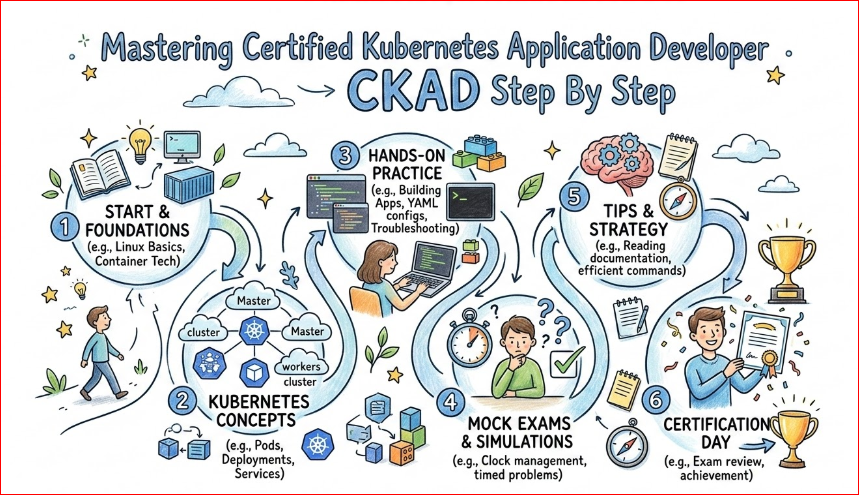
Kubernetes has rapidly become the universal control plane for modern infrastructure. Whether you are building microservices, managing massive data pipelines, or leading an engineering team, understanding how applications run inside Kubernetes is no longer optional—it is a mandatory skill. In my experience mentoring software engineers and engineering managers globally, one certification stands out for developers who want to prove they can actually build and deploy on this platform: the Certified Kubernetes Application Developer (CKAD). Unlike multiple-choice exams, the CKAD is a fully practical, performance-based test. You are dropped into a live terminal and asked to solve real-world deployment problems. Passing this exam proves to employers that your skills are production-ready. This master guide will break down exactly what the CKAD is, how to prepare for it, and how it fits into your broader career roadmap—whether you are aiming for DevOps, Site Reliability Engineering (SRE), or beyond.
The Kubernetes Certification Landscape
To understand where the CKAD fits in, you must first understand the broader Kubernetes certification ecosystem. Below is a complete table outlining the major certifications, their tracks, and the recommended order of progression.
| Track | Level | Who it’s for | Prerequisites | Skills covered | Recommended order |
|---|---|---|---|---|---|
| Cloud Native Basics | Beginner | Managers, Freshers, Product Owners | None | Kubernetes architecture basics, cloud-native concepts | 1 |
| Application Development | Intermediate | Software Engineers, Developers, App Architects | Linux basics, Docker knowledge | Pod design, Configuration, Observability, Services | 2 |
| Administration | Intermediate | DevOps Engineers, SREs, SysAdmins | Linux basics, Networking basics | Cluster architecture, Installation, Troubleshooting | 3 |
| Security | Advanced | Security Engineers, DevSecOps Practitioners | CKA Certification | Cluster setup security, System hardening, Microservice vulnerabilities | 4 |
Deep Dive: Certified Kubernetes Application Developer (CKAD)
What it is
The Certified Kubernetes Application Developer (CKAD) is a performance-based certification that validates your ability to design, build, configure, and expose cloud-native applications for Kubernetes. It tests your practical ability to use standard Kubernetes primitives via the command line in a live environment.
Who should take it
This certification is highly recommended for Software Engineers, Backend Developers, and Application Architects. It is also incredibly valuable for Engineering Managers who want a hands-on understanding of how their teams deploy and manage code in modern cloud environments.
Skills you’ll gain
By preparing for and passing the CKAD, you will master the following critical skills:
- Application Design and Build: Creating containerized applications and defining how they run inside Kubernetes using Deployments and Jobs.
- Application Environment, Configuration, and Security: Managing ConfigMaps, Secrets, and SecurityContexts to securely inject data into your applications.
- Services and Networking: Understanding NetworkPolicies and exposing your applications using Services and Ingress.
- Application Observability and Maintenance: Implementing Liveness and Readiness probes, and accessing container logs to debug failing applications.
- State Persistence: Using PersistentVolumeClaims to ensure your application data survives container restarts.
Real-world projects you should be able to do after it
- Deploy a Microservices Architecture: You will be able to take a multi-tier application (e.g., frontend, backend API, and database cache) and deploy it seamlessly onto a Kubernetes cluster.
- Configure Zero-Downtime Deployments: You can implement Rolling Updates and Rollbacks, ensuring users experience no downtime when new code is pushed.
- Build an Auto-Scaling Pipeline: You will know how to configure Horizontal Pod Autoscalers (HPA) so your application scales up automatically during high traffic.
- Troubleshoot Production Outages: You will be capable of rapidly diagnosing why a Pod is crashing by reading logs and inspecting events in the terminal.
Preparation plan
The time you need to prepare depends entirely on your prior experience with containers. Here are three realistic paths:
The 7–14 Days Plan (For Experienced Users):
If you already use Kubernetes daily but want the official credential.
- Days 1-3: Review the official CKAD syllabus. Focus heavily on areas you don’t use often (like advanced NetworkPolicies or CronJobs).
- Days 4-8: Master imperative commands (
kubectl run,kubectl expose,kubectl create). Speed is everything in this exam. - Days 9-14: Take mock exams and practice in live terminal environments. Focus on time management.
The 30 Days Plan (Steady Pace for Developers):
If you know Docker but are relatively new to Kubernetes.
- Week 1: Learn Kubernetes architecture, Pods, ReplicaSets, and Deployments. Set up a local cluster (like Minikube or kind).
- Week 2: Dive into Configuration (ConfigMaps, Secrets) and State Persistence (Volumes, PVCs).
- Week 3: Master Networking (Services, Ingress) and Observability (Probes, Logging).
- Week 4: Spend the entire week doing hands-on labs and timed mock exams.
The 60 Days Plan (For Beginners):
If you are starting fresh with containers.
- Days 1-15: Learn Linux basics, YAML syntax, and Docker containerization. You must understand containers before orchestrating them.
- Days 16-30: Cover fundamental Kubernetes concepts (Pods, Deployments, Services).
- Days 31-45: Cover advanced topics (StatefulSets, NetworkPolicies, SecurityContexts).
- Days 46-60: Intensive hands-on practice, focusing on speed, imperative commands, and navigating official documentation quickly.
Common mistakes
- Relying on writing YAML from scratch: Writing YAML by hand takes too long. Always use imperative commands with
--dry-run=client -o yamlto generate your base files. - Poor time management: Getting stuck on a 2% question for 20 minutes is a guaranteed way to fail. Flag difficult questions and move on.
- Ignoring context switching: The exam environment has multiple clusters. Forgetting to switch your
kubectlcontext before answering a question will result in zero points for that task. - Memorizing instead of practicing: This is not a multiple-choice exam. If your muscle memory isn’t trained in the terminal, you will run out of time.
Best next certification after this
Once you have conquered the CKAD, you should strategically choose your next step.
- Same track (Administration): The Certified Kubernetes Administrator (CKA) is the logical next step. It shifts the focus from the application layer to cluster administration and troubleshooting.
- Cross-track (Cloud Provider): AWS Certified DevOps Engineer Professional or Azure DevOps Engineer Expert, to apply your Kubernetes skills within a specific cloud ecosystem.
- Leadership (Management): ITIL or Agile certifications, for managers who want to blend technical Kubernetes capabilities with process and team leadership.
Choose Your Path
Kubernetes is a foundational skill, but it is not the end of the road. Depending on your career goals, the CKAD serves as a launchpad into several high-demand engineering disciplines. Here are six distinct paths you can choose:
1. DevOps
DevOps bridges the gap between software development and IT operations. In this path, your CKAD skills will be used to build CI/CD pipelines that automatically test, build, and deploy containerized code into Kubernetes clusters.
- Focus: Jenkins, GitLab CI, Terraform, Ansible.
2. DevSecOps
Security must be integrated from the beginning of the software lifecycle. In DevSecOps, you take your Kubernetes application knowledge and apply strict security boundaries.
- Focus: Container image scanning, RBAC, Network Policies, secrets management, and tools like HashiCorp Vault.
3. SRE (Site Reliability Engineering)
SRE applies software engineering principles to operations to ensure highly reliable and scalable systems. Your CKAD troubleshooting skills are crucial here.
- Focus: Observability (Prometheus, Grafana), incident response, error budgets, and chaos engineering.
4. AIOps / MLOps
Machine Learning models need a place to run, and Kubernetes is the industry standard for MLOps. You will use your CKAD knowledge to deploy complex model-training jobs and serve AI models via APIs at scale.
- Focus: Kubeflow, model registry, automated model retraining pipelines, and GPU node management.
5. DataOps
DataOps brings agile and DevOps practices to data analytics. You will manage large-scale data processing engines that run on top of Kubernetes.
- Focus: Apache Spark on Kubernetes, Apache Kafka, Airflow, and database orchestration.
6. FinOps
Cloud computing can get expensive fast. FinOps practitioners ensure that engineering teams are getting maximum business value for their cloud spend. Your understanding of Pod resource requests and limits will be vital here.
- Focus: Cost allocation, right-sizing workloads, spot instances, and tools like Kubecost.
Role → Recommended Certifications Mapping
| Role | Recommended certifications (in order) |
|---|---|
| DevOps Engineer | CKAD → CKA → AWS DevOps Engineer – Professional |
| SRE | CKA → CKAD → Observability / Monitoring certifications |
| Platform Engineer | CKA → CKS → HashiCorp Terraform Associate |
| Cloud Engineer | Cloud Architect Associate (AWS/Azure/GCP) → CKAD → CKA |
| Security Engineer | Security+ (or equivalent) → CKA → CKS |
| Data Engineer | CKAD → Cloud Data Engineer / Data Analytics certification |
| FinOps Practitioner | FinOps Certified Practitioner → Cloud Practitioner → CKAD |
| Engineering Manager | Agile/Scrum certification → CKAD → Cloud Architect Associate |
Top Institutions for CKAD Training & Certification
Achieving the CKAD requires structured learning and dedicated lab environments. The following institutions are industry leaders in providing Training cum Certifications for the CKAD and related engineering fields. These platforms offer excellent bootcamp experiences, mentor support, and realistic exam simulators.
- DevOpsSchool
A highly reputed global training platform that offers comprehensive DevOps and Kubernetes programs. They provide hands-on lab access, expert-led live sessions, and a curriculum heavily focused on real-world production scenarios. - Cotocus
Known for highly specialized IT consulting and technical training. They offer deep-dive Kubernetes workshops that prepare engineers not just for exams, but for deploying enterprise-grade infrastructure. - Scmgalaxy
A fantastic community-driven learning platform. Scmgalaxy offers rich tutorials, forum support, and structured courses that help developers grasp cloud-native application development from the ground up. - BestDevOps
Focused entirely on modern operational practices. Their courses integrate Kubernetes training with standard DevOps toolchains like Jenkins and Terraform, giving you a holistic view of the ecosystem. - devsecopsschool.com
If your ultimate goal is security, this institution bridges the gap between application development and container security. They offer great foundational training before you move into advanced DevSecOps tracks. - sreschool.com
Tailored specifically for aspiring Site Reliability Engineers. Their Kubernetes training focuses heavily on observability, high availability, and incident management within cloud-native environments. - aiopsschool.com
Focuses on the intersection of Artificial Intelligence and IT Operations. They teach engineers how to deploy and manage AI-driven operational tools, relying heavily on Kubernetes as the underlying fabric. - dataopsschool.com
The premier destination for learning how to manage data pipelines on modern infrastructure. Their curriculum teaches you how to orchestrate big data tools seamlessly within Kubernetes clusters. - finopsschool.com
Dedicated to cloud financial management. They provide excellent training on how to optimize Kubernetes workloads and manage cloud expenditures without sacrificing application performance.
Frequently Asked Questions (FAQs)
1. Is the CKAD exam multiple-choice?
No. The CKAD is 100% hands-on and performance-based. You are given a set of tasks to complete in a live command-line environment within a strict time limit.
2. How difficult is the CKAD?
It is challenging but highly fair. The difficulty does not come from trick questions; it comes from the time pressure. You must know your imperative commands and YAML structures well enough to work very quickly.
3. What are the prerequisites for taking the CKAD?
There are no official certification prerequisites. However, you absolutely must have a solid understanding of Linux command-line operations, basic networking, and Docker/container fundamentals before attempting it.
4. How much time do I need to prepare?
Depending on your background, preparation can take anywhere from 14 days (for daily Kubernetes users) to 60 days (for complete beginners). Consistent, daily hands-on practice is the key.
5. Should I take CKA or CKAD first?
If you are a developer, software engineer, or application architect, take the CKAD first. It focuses on the application layer. If you are a SysAdmin or traditional operations engineer, you might prefer starting with the CKA, which focuses on cluster administration.
6. Does the CKAD hold value for Engineering Managers?
Yes. Even if you do not write code daily, passing the CKAD gives you profound respect from your engineering teams. It allows you to understand architectural constraints, accurately estimate deployment timelines, and lead technical discussions effectively.
7. Can I use the official Kubernetes documentation during the exam?
Yes! You are allowed to have one tab open to the official Kubernetes documentation (kubernetes.io). However, you will not have time to read long articles. You must know exactly what to search for and where to copy YAML snippets.
8. What happens if I fail the exam on my first try?
The Linux Foundation generously provides one free retake for the exam. If you fail, review your score report, identify your weak domains, practice heavily for a week, and try again.
9. How long is the CKAD certification valid?
The certification is valid for 24 months (2 years) from the date you pass the exam. You will need to renew it to stay current with the rapidly evolving Kubernetes ecosystem.
10. What programming languages do I need to know for the CKAD?
You do not need to be an expert in any specific programming language (like Python or Java) for the exam itself. You only need to understand YAML, JSON, and standard Linux shell commands.
11. Does CKAD cover setting up a Kubernetes cluster from scratch?
No. Cluster installation, bootstrapping, and upgrading are covered in the CKA exam, not the CKAD. In the CKAD, you are provided with a fully functional cluster and asked to deploy applications onto it.
12. Will CKAD help me get a job?
Absolutely. Because it is a performance-based exam, hiring managers highly respect it. It definitively proves that you can jump into a company’s cloud-native environment and start contributing immediately without needing basic syntax training.
FAQs (Certified Kubernetes Application Developer – CKAD)
1. Has the CKAD curriculum changed recently? Yes. As of early , the exam is based on Kubernetes v1.35. While the core primitives remain the same, there is now a much heavier emphasis on modern tools like Helm, Kustomize, and the Gateway API (the successor to Ingress). You should be prepared to not just create resources, but to migrate or modify them using these tools.
2. What is the current passing score and duration? The passing score remains 66%, and the exam duration is strictly 2 hours (120 minutes). You will typically face 15 to 20 performance-based tasks. In the current environment, the proctoring check-in is very rigorous, so I recommend joining the session at least 30 minutes early to clear your desk and perform the required security checks.
3. Is the exam still “open book”? Yes, but with limits. You are allowed one additional tab open to access the official Kubernetes Documentation. However, you cannot use external blogs, GitHub, or AI tools. In 2026, speed is the real test; if you spend too much time searching the docs, you will likely run out of time to finish the tasks.
4. Can I use a dual-monitor setup? No. The Linux Foundation and PSI rules currently require a single monitor for the exam. If you have an external monitor connected to a laptop, the laptop lid must be closed. I highly suggest practicing on a single screen to get used to the split-screen terminal and documentation layout.
5. How much weight is given to Security in the 2026 CKAD? The “Application Environment, Configuration, and Security” domain now accounts for 25% of the total score—the largest single section. This includes mastering NetworkPolicies, SecurityContexts, and ServiceAccounts. Security is no longer an “extra” topic; it is core to the application developer’s role.
6. Do I need to learn the Gateway API for CKAD? Absolutely. While standard Ingress is still covered, the Gateway API (Gateway and HTTPRoute) is becoming a standard question type. You should know how to route traffic and manage basic load-balancing using these newer resources.
7. Is the certification validity still the same? The CKAD certification is valid for 3 years. This is a great window for career growth, but given how fast Kubernetes evolves (moving from v1.30 to v1.35 in just a year), I always suggest my mentees keep practicing even after they are certified.
8. What is the best strategy if I get a “Laggy” terminal? The 2026 exam environment runs in a remote browser window which can sometimes feel slow. To counter this, avoid typing long YAML files. Use kubectl imperative commands with --dry-run=client -o yaml > file.yaml to generate your templates. This minimizes the amount of typing needed and reduces the impact of any network lag.
Testimonials
“Before the CKAD, I only knew how to write code, but I had no idea how it actually ran in the cloud. Preparing for this certification completely changed my perspective. Now, I design my microservices with deployments, health checks, and scaling in mind from day one.”
— Senior Software Engineer, Fintech
“As an Engineering Manager, I was tired of just nodding along when my SRE team talked about Pod crashes and ingress controllers. Taking the CKAD bootcamp at DevOpsSchool gave me the hands-on confidence to actively participate in architectural design reviews. Best career investment I’ve made this year.”
— VP of Engineering, E-commerce
“The time pressure of the exam is intense, but it accurately reflects production outages. Passing the CKAD didn’t just give me a certificate; it gave me the muscle memory to troubleshoot our live clusters without panicking.”
— DevOps Practitioner, Global SaaS Provider
Conclusion
The Certified Kubernetes Application Developer (CKAD) is more than just a badge on your resume. It is a rigorous, practical gauntlet that transforms you from someone who writes code into someone who owns the entire application lifecycle in the cloud. By mastering these skills, you future-proof your career against the shifting landscapes of IT. Whether you ultimately choose the path of an SRE, a DevSecOps expert, or an Engineering Manager, the foundational knowledge gained from the CKAD will serve you every single day in production.