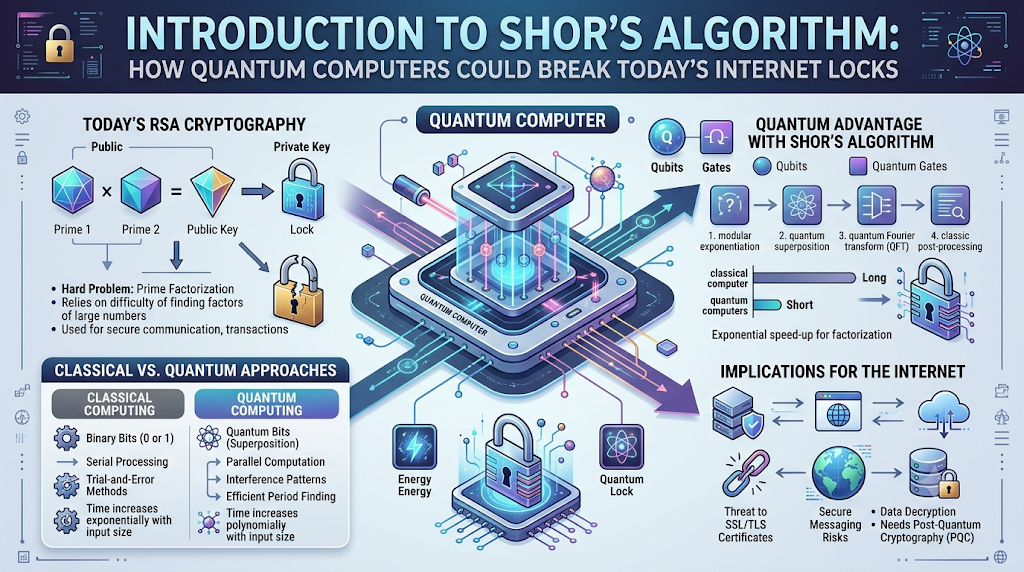
Introduction
Every time you log in to your bank, send a private message, or buy something online, a quiet piece of math is working in the background. You cannot see it, but it is the reason strangers cannot read your data as it travels across the internet. This math depends on one simple fact: some problems are very easy to do in one direction and almost impossible to undo.
For decades, this idea has worked well. But a new kind of machine, the quantum computer, plays by different rules. In 1994, a mathematician named Peter Shor showed that such a machine could solve the exact problem that protects much of the internet, and do it far faster than any normal computer. His method is now called Shor’s Algorithm, and it is the main reason security experts around the world are paying close attention to quantum computing.
If you want to keep learning about quantum ideas in plain language, you can visit Quantumuting.com. In this article, I will explain how today’s locks work, how Shor’s Algorithm picks them, why it matters for cybersecurity, and what scientists are doing about it. I will keep it simple enough for a high school student. No hard math, just clear ideas and everyday examples.
The Secret Lock Keeping the Internet Safe
Let us start with how the internet keeps secrets. When your phone talks to your bank, the two need to agree on a secret code without anyone else learning it. But they are talking over a public network, where anyone could be listening. That sounds impossible, and yet it works, thanks to something called public-key encryption. One of the most famous types is called RSA.
Here is the idea in plain words. Imagine you have a padlock that anyone can snap shut, but only you have the key to open. You hand out copies of the open padlock to the whole world. Anyone can lock a message for you with it, but only you can unlock it. In RSA, the “padlock” is a very big number that you share publicly. The “key” is the two secret numbers that were multiplied together to make it.
Now think about why this works. Multiplying two numbers is easy. If I ask you to multiply 7 and 13, you get 91 in a few seconds. But if I hand you 91 and ask which two prime numbers were multiplied to make it, you have to search. Prime numbers are numbers like 2, 3, 5, 7, and 11 that can only be divided by 1 and themselves. For a small number like 91, the search is quick. But RSA uses numbers with more than 600 digits. For a normal computer, finding the two secret primes behind such a number is not just slow. It would take many billions of years, even with the fastest supercomputers we have.
That gap between “easy to multiply” and “nearly impossible to split back apart” is the entire lock. The security of your emails, online shopping, and many digital signatures rests on it. Other locks, such as the ones built on elliptic curves, also depend on hard puzzles of a similar kind. Shor’s Algorithm goes after both.
What Is Shor’s Algorithm?
Shor’s Algorithm is a set of steps, invented by Peter Shor in 1994, that lets a quantum computer find the secret prime numbers hidden inside a big number. In other words, it undoes the multiplication that RSA relies on. It does not do this by trying every guess one by one. It uses a clever shortcut.
Here is a simple way to think about it. Imagine you are in a giant library with a million books, and you need to find the one page that has a secret note. A normal computer walks through the shelves and checks page after page. Even if it is very fast, the library is so big that it never finishes. Shor’s trick is different. Instead of checking every page, it finds a hidden pattern in how the books are arranged, and that pattern points straight to the answer.
That hidden pattern is a repeating cycle. When you take a number and keep multiplying it by itself, then look at the leftovers after dividing by the big number, the leftovers start to repeat after a certain number of steps. Finding the length of that repeating cycle is very hard for a normal computer when the numbers are huge. But once you know the cycle length, a few easy steps turn it into the two secret prime numbers.
This is where quantum computers shine. They are very good at spotting repeating patterns, a bit like how noise-cancelling headphones find and cancel out a repeating sound wave. A quantum computer can look at many possibilities at once, let the wrong answers cancel each other out, and leave the right pattern standing. Shor found a way to use this special strength to crack the cycle-finding step, and that opens the whole lock.
It is worth knowing that this is not only a theory. In 2001, a team at IBM used a tiny quantum computer to run Shor’s Algorithm on the number 15, which it split into 3 and 5. That is a very small number, but it proved that the idea works in real hardware. The hard part now is building machines big and stable enough to handle numbers with hundreds of digits.
Classical Computers vs. Quantum Computers
Let us compare the two kinds of machines side by side.
| Area | Classical Computer | Quantum Computer Running Shor’s Algorithm |
|---|---|---|
| How it attacks the lock | Tries to split the big number by testing possible factors, using smart but still slow methods | Finds the hidden repeating pattern, which leads straight to the secret prime numbers |
| Time to crack a 2048-bit RSA code | Many billions of years or more with today’s methods | Estimated at hours to days, once a large and stable enough machine exists |
| Basic unit of data | Bit: either 0 or 1 | Qubit: can hold a mix of 0 and 1 at the same time |
| How it handles many options | Checks them mostly one after another | Works with many possibilities together and lets wrong ones cancel out |
| Where it stands today | Powerful and everywhere | Still small, noisy, and not yet able to break real RSA keys |
A quick note on the table. Shor’s Algorithm does not guess passwords the way a hacker might try “password123.” Instead, it attacks the math that protects the connection itself. If that lock is broken, an attacker may be able to read the private data that the lock was guarding.
The word “qubit” sounds strange, so here is a simple picture. A normal bit is like a light switch that is either on or off. A qubit is more like a spinning coin. While it spins, it is not just heads or tails but a mix of both. When you finally look at it, it lands on one side. Quantum computers cleverly use this spinning state to explore many paths together.
Also, do not panic about the last row of the table. Today’s quantum computers have far too few reliable qubits to break real encryption. Qubits are delicate, and tiny bits of heat or noise can ruin the work. Researchers estimate that breaking a 2048-bit RSA key would take a machine with about a million good-enough qubits, and that number keeps getting lower as scientists find smarter methods. So the danger is not here today, but it is not something to ignore either.
The Threat to Global Cybersecurity
Imagine that a powerful quantum computer suddenly appeared in the hands of a hacker group or a hostile government. What could go wrong? The biggest problem is that the locks protecting most of the internet’s private traffic would stop working. Secure websites, virtual private networks, digital signatures, and many messaging tools all lean on public-key math that Shor’s Algorithm can break.
For banks, this is a serious matter. Online banking relies on encrypted connections to keep your account details private. Digital signatures prove that a payment order really came from you and was not changed on the way. If those signatures could be faked, someone could send false payment orders that look completely real. Banks would need to prove that every transaction is honest, and that gets very hard when the lock itself is broken.
Governments face an even bigger risk. Many states protect secrets for decades, like military plans, spy reports, and private talks between countries. Here comes a worry that experts call “harvest now, decrypt later.” An attacker can record encrypted data today, even though they cannot read it, and simply store it. Years later, when a strong quantum computer arrives, they can unlock the whole pile. So data that must stay secret for a long time is already at risk, even before the quantum machine exists.
For regular people, the risk touches private messages, medical records, saved photos, and work files. Some people call the day when quantum computers can break today’s locks the “quantum apocalypse,” though experts also use calmer names like “Q-Day.” The name sounds dramatic, but the idea is simple: a day when our old locks stop working. The good news is that this is not a surprise attack. We can see it coming, which gives us time to prepare.
Preparing for the Future: Post-Quantum Security
Scientists and security experts are not sitting around waiting. They are building a new set of locks, called post-quantum cryptography, that are designed to stay safe even against quantum computers. The key is to switch to math puzzles that Shor’s Algorithm cannot solve. Shor’s trick works because factoring has a hidden repeating pattern. So the new puzzles are built on problems that do not have that kind of pattern.
One of the most promising types is based on something called lattices. Picture a huge grid of dots stretching in hundreds of directions. Someone hides a secret point inside this grid and gives you a nearby spot. Finding the exact hidden point from the nearby spot is extremely hard, even for a quantum computer, as far as anyone knows. Other new locks use different hard puzzles, such as ones based on special hash functions and on error-correcting codes.
This work is not just in the lab. After years of open testing by researchers around the world, the US National Institute of Standards and Technology (NIST) published its first official post-quantum standards in August 2024. These include a method for safely sharing secret keys and methods for digital signatures. Big tech companies and browser makers have already started adding these new locks to their products, often alongside the old ones for extra safety.
What can a company or a regular person do now? Companies should make a list of where they use encryption, so they know what needs to change. They should watch for updates from their software providers and plan a move to the new standards, especially for data that must stay secret for many years. Regular users can help by keeping their phones, apps, and browsers up to date, since the new protections will usually arrive through normal updates.
FAQs
1. What is Shor’s Algorithm in simple words?
Shor’s Algorithm is a method that lets a quantum computer find the two secret prime numbers hidden inside a very big number. This is the same puzzle that protects much of today’s internet security.
2. Who invented Shor’s Algorithm?
Peter Shor, a mathematician, came up with it in 1994. That is why it carries his name.
3. Can Shor’s Algorithm break my passwords today?
No. Today’s quantum computers are far too small and unreliable to run it on real encryption. Also, it does not guess passwords directly. It attacks the math behind public-key locks like RSA.
4. Why is factoring big numbers hard for normal computers?
Multiplying two primes is easy, but working backward to find them gets slower and slower as the number grows. For numbers with hundreds of digits, even the fastest supercomputers would need billions of years.
5. What is a qubit?
A qubit is the basic unit of information in a quantum computer. Unlike a normal bit, which is only 0 or 1, a qubit can hold a mix of both at once until it is measured.
6. When will a quantum computer be able to break RSA?
Nobody knows the exact date. Experts think it needs a machine with roughly a million reliable qubits, which does not exist yet. Estimates vary, but many security teams plan as if it could happen within the next ten to twenty years.
7. What does “harvest now, decrypt later” mean?
It means attackers save encrypted data today, even though they cannot read it, and wait until a strong quantum computer can unlock it. This is why data that must stay secret for many years is at risk already.
8. What is post-quantum cryptography?
It is a new type of encryption built on math puzzles that even quantum computers are not known to solve quickly. Its goal is to keep data safe in a world with powerful quantum machines.
9. Does quantum computing also threaten other types of encryption?
Shor’s Algorithm threatens public-key methods like RSA and elliptic curve locks. Common methods for scrambling data, like AES, are much less affected, and using longer keys keeps them strong.
10. What can I do now to get ready?
Keep your devices and apps updated, since new protections usually arrive through updates. If you run a business, list where you use encryption and plan a move to the new post-quantum standards, starting with your most sensitive data.
Conclusion
Shor’s Algorithm is one of the most important ideas in the story of quantum computing. It shows that a quantum computer can crack a puzzle that would take a normal computer longer than the age of the universe. That puzzle, splitting a huge number into two secret primes, is the lock behind much of today’s internet security.
But this is not a story of doom. Today’s quantum computers are still far too small and fragile to break real encryption. Meanwhile, researchers have built new locks that are designed to resist quantum attacks, and the first official standards are already here. The world is moving, step by step, toward a safer setup.
The best approach is calm and steady action. Understand the risk, protect long-lived secrets first, keep your software updated, and follow the move toward post-quantum security. The lock of the future is already being built, and the sooner we start using it, the safer our data will be when quantum computers finally grow up.
