Introduction
Imagine rolling a standard six-sided die. While it spins through the air, it is a blur of possibilities. It could land on a two, a four, or a six. In the everyday world, we know the die is always showing one specific face at any given millisecond; we just cannot see it clearly until it stops. This is the strange, exciting reality of quantum computing. In this cutting-edge field, measuring information is one of the most important steps in the entire computational process. Unlike traditional computers that give straightforward, rigid answers, quantum computers rely heavily on quantum measurement probabilities to determine the final results of complex calculations. By learning how we read these systems, you will gain a clear view of how the next generation of technology processes reality. For more insights into these foundational concepts, you can check out the educational guides available at QuantumUting.com.
2. What Is Quantum Measurement?
At its core, quantum measurement is the act of observing a quantum system to look at its final state. In our day-to-day lives, looking at something does not change it. If you look at a blue car parked on the street, your glance does not suddenly paint the car red.
In quantum mechanics, however, the act of looking changes everything.
The Purpose of Measurement
The primary purpose of measurement is to extract readable, usable data from a quantum processor. Before you measure a quantum system, it operates in a delicate, fluid state capable of holding vast amounts of data simultaneously. However, human beings and traditional computers cannot read fluid data. We need definitive answers—like a “yes” or a “no.” Measurement bridges this gap by forcing the quantum system to settle down and deliver a clear data point.
Why Measurement is Necessary
Without measurement, a quantum program would run forever inside a machine without ever sharing its results with the outside world. We must measure the system to see the answer to the problem we asked the computer to solve.
Classical Bits vs. Qubits
To understand the profound shift in how this works, we must compare classical bits with qubits (quantum bits):
- Classical Bits: Traditional computers use transistors to store information as classical bits. A bit is rigid. It is either a 0 (off) or a 1 (on). Measuring a classical bit is simple: you check if electricity is flowing. If it is, the bit is a 1. Checking it does not change it.
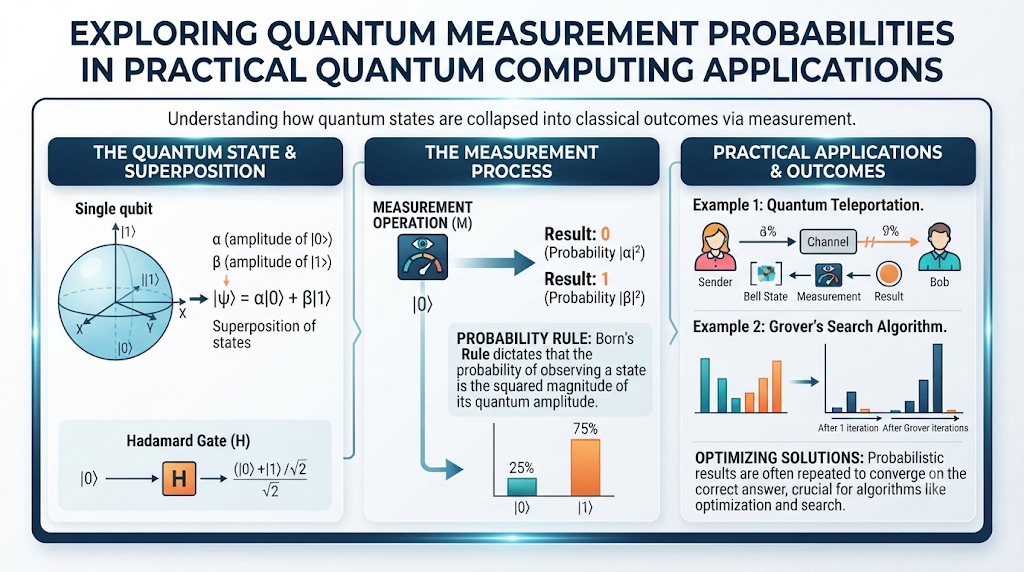
- Qubits: A qubit is the fundamental unit of quantum computing. Before it is measured, a qubit does not have to choose between being a 0 or a 1. It can exist in a blended state of both. Yet, the moment you measure it, the qubit instantly drops its complex identity and snaps into a rigid classical state: either a strict 0 or a strict 1.
3. Understanding the Basics
To master quantum measurement probabilities, we need to unpack a few core building blocks using simple, real-world analogies.
Classical Bits and Qubits: The Light Switch Analogy
Think of a traditional computer bit as a standard household light switch. It can either be flipped down (0) or flipped up (1). There is no in-between state.
A qubit, on the other hand, acts like a modern dimmer switch. You can slide it all the way down, all the way up, or leave it hovering anywhere in between. The intermediate zone represents a unique blend of light and dark.
Quantum States and Superposition: The Spinning Coin Analogy
When a qubit is hovering in that intermediate zone, it is occupying what scientists call quantum states. The most famous of these states is superposition.
Let us use a spinning coin analogy. If you place a coin flat on a desk, it displays either heads (1) or tails (0). This represents a classical bit. But if you spin that coin on the table, is it heads or tails? It is a blur of both at the exact same time. The spinning coin is in a superposition of heads and tails.
Probability and Measurement Outcomes
What happens when you slam your hand down on the spinning coin to stop it? The spin stops instantly, and you are forced to look at a single, unchanging result: it is either heads or tails.
The act of slamming your hand down is the quantum measurement. The chance of it landing on heads versus tails is the measurement outcome, governed entirely by probability. If the coin was spun perfectly, you have a 50% chance of seeing heads and a 50% chance of seeing tails.
4. What Are Quantum Measurement Probabilities?
When we work with a quantum computer, we manipulate qubits using quantum gates to build quantum circuits. These components arrange the qubits so that they point toward the correct answer. However, because qubits live in superposition, the final answer is inherently tied to chance.
The Probabilities of |0⟩ and |1⟩
In quantum physics text, you will often see the states written with special brackets as $\vert{}0\rangle$ (pronounced “ket zero”) and $\vert{}1\rangle$ (pronounced “ket one”). These are simply the quantum versions of our classic 0 and 1.
When a qubit is in superposition, it has a specific probability of collapsing into $\vert{}0\rangle$ and a specific probability of collapsing into $\vert{}1\rangle$. For example, a qubit might be set up so it has an 80% chance of being read as a $\vert{}0\rangle$ and a 20% chance of being read as a $\vert{}1\rangle$.
Probability Amplitudes (The Hidden Math Fabric)
How does the qubit know what the chances are? Behind the scenes, quantum states use something called probability amplitudes.
Think of these amplitudes as hidden, internal wave-like paths. Unlike regular percentages (which are always positive numbers like 40% or 60%), probability amplitudes can be positive, negative, or even complex numbers. When these waves interact inside quantum algorithms, they can cancel each other out or reinforce one another—much like ripples of water in a pool.
When we finally measure the qubit, the machine square-multiplies these amplitudes, transforming those hidden wave paths into positive, real-world percentages that always add up to exactly 100%.
Why Repeated Measurements Yield Different Results
Because the final stage of a quantum calculation relies on probability, running a quantum circuit just once is rarely enough. If a qubit has an 80% chance of yielding a 0 and a 20% chance of yielding a 1, a single test might give you a 1. If you stop there, you might assume the answer is always 1, which is incorrect.
To find the true trend, developers run the exact same quantum circuit hundreds or thousands of times. This process is called taking “shots.” If you run the circuit 1,000 times, you will notice that roughly 800 times it returns a 0, and roughly 200 times it returns a 1. The dominant answer reveals the solution to your problem.
Randomness vs. Uncertainty
It is vital to distinguish between everyday uncertainty and quantum randomness:
- Uncertainty (Classical): You don’t know the weather tomorrow because you lack perfect data about every wind current and cloud. The data exists; you just don’t have it.
- Randomness (Quantum): A qubit in superposition does not hide a secret, pre-determined choice. The final identity of the qubit literally does not exist until the measurement occurs. It is nature behaving with true, fundamental randomness.
5. Why Measurement Probabilities Matter
You might wonder: if quantum computers are so random, how can they be useful? Why would we want a computer that deals in chances instead of certainties?
The answer lies in how we control those probabilities to achieve reliable quantum computation.
- Running Quantum Algorithms: Smart quantum programs are designed to alter the hidden probability amplitudes. They act like a magnet, pulling the highest probabilities toward the correct answers while lowering the probabilities of the wrong answers. By the time the program finishes, the correct answer stands out like a tall peak in a mountain range.
- Scientific Experiments and Simulations: Nature operates on quantum principles. Chemical reactions, molecular structures, and material properties are all driven by underlying quantum mechanics. By using measurement probabilities, quantum computers can accurately simulate nature in ways a rigid classical computer never could.
- Result Verification and Decision-Making: By reviewing the spread of percentages generated from repeated measurements, researchers can verify the strength of their conclusions. If an algorithm gives a specific answer 99% of the time, confidence is incredibly high. If the spread is split 50/50, it tells the researcher that more refinement is needed.
6. Factors That Affect Measurement Results
In a perfect world, quantum measurements would match our mathematical predictions perfectly. However, building real-world quantum hardware is one of the toughest engineering challenges of the modern era. Several factors can disrupt the delicate balance of probabilities.
Superposition Vulnerability
Because qubits in superposition are incredibly sensitive, keeping them steady requires absolute isolation. Any minor disturbance can upset the intended probabilities before we are ready to measure them.
Quantum Noise and Decoherence
Qubits are highly sensitive to their environments. Stray heat, electromagnetic waves, and even minor physical vibrations cause quantum noise. This noise leads to a phenomenon called decoherence, where the qubit prematurely loses its quantum properties and drops out of superposition entirely. It is equivalent to someone bumping the table while your coin is spinning, forcing it to stop before you want it to.
Hardware Quality and Measurement Errors
The physical tools used to read qubits are not perfect. Sometimes, a qubit successfully collapses into a $\vert{}0\rangle$, but the hardware sensor misreads it as a $\vert{}1\rangle$. These are known as measurement errors, and they can skew the final data percentages.
Circuit Depth
The longer a quantum program runs (known as circuit depth), the more quantum gates the qubits must pass through. Each additional gate introduces a small chance of error. If a circuit is too deep, the final measurement probabilities may degrade into pure, useless randomness.
Error Correction to the Rescue
To battle these challenges, scientists are developing advanced quantum error correction techniques. By grouping multiple fragile physical qubits together to act as a single, ultra-stable “logical qubit,” systems can detect and fix errors silently in the background, ensuring the final measurement probabilities remain accurate.
7. Real-World Applications
Understanding and mastering these measurement probabilities allows us to tackle complex problems across various global industries.
[ Quantum Computation ] ➔ [ Probability Manipulation ] ➔ [ Real-World Breakthroughs ]
Cryptography
Modern security relies on math problems that are incredibly slow for classical computers to solve. Quantum computers can use precise measurement probabilities to map out mathematical factors swiftly, completely redefining how we secure private digital communications.
Drug Discovery
Designing life-saving medication requires analyzing how complex molecules interact. Because molecules follow quantum rules, scientists can map out the measurement probabilities of molecular bonds using quantum simulations, accelerating the discovery of new therapies.
Financial Modeling
The financial markets are driven by massive webs of uncertainty. Quantum computers can process vast arrays of chaotic market variables simultaneously, using probability spreads to help institutions optimize investments and balance risk profiles accurately.
Artificial Intelligence
Machine learning requires sorting through mountainous piles of data to discover hidden patterns. Quantum-enhanced AI algorithms use superposition and controlled probabilities to scan data configurations faster, speeding up training times for complex AI systems.
Optimization and Materials Science
Whether it is finding the most fuel-efficient routes for global shipping fleets or discovering ultra-durable, lightweight metals for aerospace engineering, managing quantum probabilities allows us to evaluate millions of structural options instantly to identify the optimal configuration.
8. Common Misconceptions
Because quantum physics sounds like science fiction, several common myths confuse beginners. Let us set the record straight.
Misconception 1: Quantum computers just spit out random, useless answers.
Reality: While the final step relies on probability, the process is highly controlled. Quantum algorithms deliberately tilt the scales so that the right answer has the highest probability of appearing. It is calculated, purposeful probability, not blind guesswork.
Misconception 2: Probability means the computer is inaccurate.
Reality: A probabilistic answer is highly accurate if you understand how to read it. In quantum computing, getting an exact percentage spread over multiple trials provides a precise, multi-layered view of a complex problem that a simple 1 or 0 cannot capture.
Misconception 3: Measuring a state keeps it the same.
Reality: In the classical world, checking a gauge changes nothing. In the quantum world, measurement actively forces a fluid superposition to collapse permanently into a single, rigid state. You cannot measure a qubit and expect it to stay in its original blended state.
Misconception 4: Doing more measurements fixes bad hardware.
Reality: If your quantum computer has high internal noise or faulty sensors, running the experiment more times will simply repeat the same systematic errors. More measurements improve your statistical confidence, but they cannot fix poor hardware quality.
9. Best Practices for Learning Quantum Measurement
If you are eager to master quantum computing and work with these concepts firsthand, use this structured roadmap to guide your learning journey efficiently.
- Start with Single-Qubit Examples: Do not try to understand massive quantum networks right away. Begin by studying how a single qubit moves from a basic state into superposition and back again.
- Learn Superposition Before Algorithms: Make sure you thoroughly understand how a qubit holds multiple possibilities simultaneously before you attempt to learn complex processes like Shor’s or Grover’s algorithms.
- Practice with Quantum Simulators: You do not need a multi-million-dollar quantum computer to practice. Use free, web-based quantum simulators. These programs let you build visual quantum circuits, apply virtual gates, and instantly view the resulting measurement probability charts on your screen.
- Compare Classical and Quantum Probability: Constantly contrast the two ideas. Remember that classical probability stems from a lack of information (like a hidden card), while quantum probability stems from a true absence of a fixed state (like a spinning coin).
- Understand Repeated Experiments: Get comfortable with the concept of “shots.” Train yourself to look at quantum output not as a single answer, but as a distribution pattern gathered over thousands of runs.
10. Future Trends
As we look toward the horizon, the way we interact with quantum systems is evolving rapidly.
- Better Quantum Hardware and High Fidelity: Engineers are successfully designing cleaner systems with reduced noise. This drastically improves measurement fidelity, meaning the results we read match our theoretical calculations with near-perfect accuracy.
- Fault-Tolerant Quantum Computing: The industry is moving closer to building fault-tolerant systems. These machines will use advanced error correction to safeguard qubits throughout deep circuits, preserving pure probabilities over long, complex runs.
- AI-Assisted Quantum Experimentation: Researchers are now combining artificial intelligence with quantum engineering. AI algorithms are being used to monitor quantum noise in real time, automatically tuning the system to protect the qubits’ delicate states.
- Scalable Quantum Processors: The next generation of processors will link thousands of high-quality qubits together, opening the door to solving massive problems across science and industry.
Comparison Tables
Table 1: Classical Probability vs. Quantum Measurement Probability
| Feature | Classical Probability | Quantum Measurement Probability | Key Difference |
| Core State | Object is always in one definitive state behind the scenes. | Object exists in a fluid superposition of states simultaneously. | Real vs. Blended existence. |
| Cause of Chance | Arises due to a lack of data or observation tools. | Arises from true, fundamental quantum mechanics. | Lack of knowledge vs. Nature’s true design. |
| Interference | Probabilities simply add up linearly. | Underlying wave paths can reinforce or cancel out. | Quantum waves can cancel bad answers. |
| Effect of Viewing | Observing the object does not change its physical condition. | Observing the object forces it to collapse into a fixed state. | Measurement alters a quantum system. |
Table 2: Factors Affecting Quantum Measurement Accuracy
| Factor | Description | Impact on Results | Possible Improvement (High-Level) |
| Decoherence | Qubits interact with surrounding heat or vibrations. | Causes qubits to drop out of superposition too early. | Use extreme isolation and sub-zero cooling. |
| Quantum Noise | Stray electromagnetic interference in the hardware. | Distorts the intended probability distribution. | Build advanced structural hardware shielding. |
| Sensor Readout Error | Physical instruments misread the final qubit state. | Causes a 0 to be recorded as a 1, or vice versa. | Improve calibration and laser precision tools. |
| Circuit Depth | The total number of consecutive gates in a program. | Accumulates small errors until the output is pure noise. | Optimize algorithms to use fewer gates overall. |
FAQs
Q: Can a quantum measurement result in something other than a 0 or a 1?
A: No. Even though a qubit can exist in a rich superposition beforehand, the act of measurement forces it to collapse into a standard, classical state—either a strict 0 or a strict 1.
Q: What causes a qubit to choose between 0 and 1 when measured?
A: According to quantum mechanics, the choice is fundamentally random. The specific probability of that choice is determined by the qubit’s wave-like probability amplitudes before the measurement happens.
Q: How do we know if a quantum computer’s random answer is actually correct?
A: We run the program thousands of times. If the algorithm is well-designed, the correct answer will appear far more frequently than the incorrect ones, standing out clearly in the final data.
Q: Does measuring one qubit affect other qubits in the system?
A: Yes, if the qubits are linked through a phenomenon called quantum entanglement. In an entangled system, measuring one qubit instantly influences the measurement probabilities of the other.
Q: Can we reverse a quantum measurement?
A: No. Once a measurement is made and the qubit collapses into a 0 or a 1, its original, fluid superposition state is erased. The process is completely irreversible.
Q: Why does environmental heat disrupt quantum measurements?
A: Heat introduces physical energy and vibration. This external energy acts like an unwanted measurement, causing the fragile qubit to drop out of its superposition prematurely.
Q: What is the difference between a physical qubit and a logical qubit?
A: A physical qubit is a single, fragile quantum component prone to errors. A logical qubit groups many physical qubits together using error correction to create a highly stable system.
Q: Are quantum simulators perfectly accurate compared to real quantum computers?
A: Simulators are perfectly accurate mathematically because they don’t suffer from real-world quantum noise. However, standard computers can only simulate small numbers of qubits before running out of memory.
Q: What does “measurement fidelity” mean?
A: Measurement fidelity is a metric that indicates how accurately the reading hardware records the actual state of the qubit, with 100% fidelity representing an error-free readout.
Q: Do I need a strong background in advanced calculus to understand quantum programming?
A: Not to get started. Many modern development tools allow you to build circuits and explore quantum measurement probabilities using basic logic, visual interfaces, and simple percentages.
Conclusion
In summary, quantum measurement probabilities are not an obstacle to be avoided—they are a fundamental asset that defines how information is processed and retrieved in the quantum realm. By moving past the rigid certainties of classical computing, quantum systems use the laws of probability to analyze vast arrays of data simultaneously.
Learning how these probabilities are shaped by superposition, manipulated by quantum gates, and read through repeated measurements gives you the essential foundation needed to explore advanced fields like quantum programming and algorithm design. As hardware components improve and error correction techniques mature, our ability to direct these probabilities will open the door to solving some of the world’s most complex scientific challenges.
