Introduction
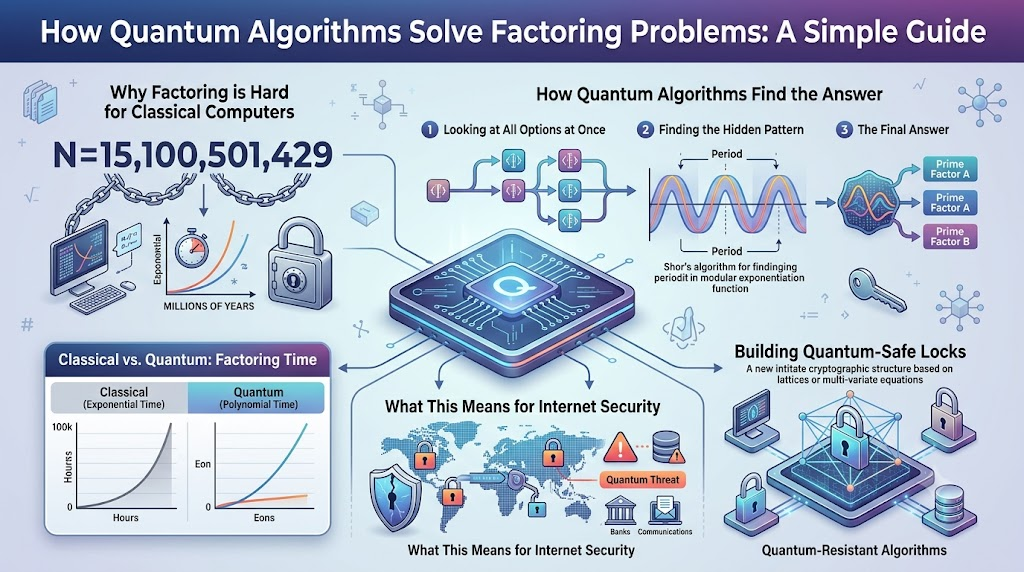
Imagine a giant, heavy vault holding all of your deepest secrets. The lock on this vault is a math puzzle so incredibly hard that a normal computer would need millions of years to guess the combination. Right now, this invisible math lock protects everything we do on the internet. It guards our private emails, our online bank accounts, our social media passwords, and even secret government files.
But what if someone built a master key that could open this unbreakable vault in just a few minutes? That is exactly what a quantum computer is. To understand how these super-powered machines work, you can explore more at Quantumuting.com. These machines do not just guess passwords faster than our home computers. Instead, they use completely different rules of physics to solve the math puzzle from the inside out.
Why Factoring is the Ultimate Math Puzzle
To understand the immense power of quantum computers, we first need to talk about factoring. Factoring is just a simple way of finding out which smaller numbers multiply together to make a bigger number. For example, if you take the number 15, its secret factors are 3 and 5, because 3 multiplied by 5 equals 15. That is very easy for a human brain to figure out in just a few seconds.
But imagine doing this for a massive number that has over two hundred digits. Suddenly, the puzzle becomes almost impossible. If you give a regular computer a giant number and ask it to find the two secret prime numbers that multiply to make it, the computer has to guess almost blindly. It tries one number, then the next, and then the next, checking every single combination one by one.
Because the number is so huge, even the fastest standard computers on Earth would take thousands, or even millions, of years to check every single option. This extreme difficulty is exactly why we use factoring as the main lock for internet security. When you buy something online, your credit card details are locked inside one of these giant numbers. The system relies on the fact that no computer has the time to solve the puzzle.
For decades, this system has worked perfectly. We felt completely safe knowing that no computer could ever count fast enough to break the lock. But quantum computers do not count like regular computers do. They cheat the system by turning the math puzzle into a pattern-finding game, bypassing the need to check every single guess.
How Quantum Algorithms Find the Answer
A special set of instructions called Shor’s Algorithm gives quantum computers the magic power to solve these giant factoring puzzles. Here is how it works without any confusing math or difficult equations.
Looking at All Options at Once
Regular computers read information like a person reading a book—one word at a time, page by page. If a normal computer needs to find a way out of a maze, it walks down one path, hits a dead end, turns around, and tries another path. This trial and error takes a very long time. Quantum computers, however, act like a bird flying over the maze. Thanks to the strange rules of quantum physics, they can look at all the possible paths at the exact same time. They do not have to check one guess and then move to the next; they hold all the possible guesses at once.
Finding the Hidden Pattern
Shor’s Algorithm takes the giant number we want to break apart and turns it into a repeating wave or a pattern. You can think of it like the repeating tick-tock of a clock. To find the secret factors, the quantum computer just needs to figure out how long it takes for the pattern to repeat itself. While a regular computer would get hopelessly lost trying to measure this massive wave, a quantum computer uses a clever trick called “interference.”
The Final Answer
Think of interference like ripples in a pond. If two waves crash into each other, they can cancel each other out and make the water flat. But if they line up perfectly, they join together to make a much bigger wave. The quantum algorithm forces all the wrong answers to crash and cancel each other out. At the same time, it makes the right answer join together and grow into a massive, clear wave. When the computer finally spits out a result, the only thing left standing is the correct answer—the exact hidden pattern that reveals the secret numbers.
Comparing Classical Computers vs. Quantum Algorithms
| Feature | Standard Computer | Quantum Computer (Shor’s Algorithm) |
| Method Used | Checks guesses one by one in a straight line. | Looks at many possibilities at once using waves. |
| Time to Solve a Massive Number | Millions of years. | A few hours or minutes. |
| Effect on Passwords | Safe, secure, and reliable. | Can easily unlock current security codes. |
As you can clearly see in the table above, the difference between these two machines is night and day. A standard computer is limited by how fast it can check one option after another. Even if we build faster regular computers, the math puzzles can just be made slightly larger to keep them secure. It is a slow, straight-line process that will always struggle with massive numbers.
Quantum computers change the rules entirely. They do not rely on raw speed; they rely on a much smarter method. By finding repeating waves instead of doing blind math, they cut the time down from a million years to a quick coffee break. This massive jump in power is exactly why technology experts are both incredibly excited and very worried.
The comparison table clearly shows that our current way of protecting passwords will not survive a quantum attack. What is currently considered perfectly safe will soon be completely open. This major shift forces us to rethink how we protect sensitive data across the entire globe.
What This Means for Internet Security
So, what happens when a machine can easily crack the ultimate math puzzle? The short answer is that every digital lock we currently use becomes useless. Every time you log into your bank, send a private text message, or update your health records, your device uses this factoring puzzle to scramble the data. This keeps bad actors and hackers from reading your private business.
Once a powerful quantum computer is turned on, this protective scramble will no longer work. The machine could unlock secure websites, read encrypted government emails, and even take control of global financial systems. This is often called the “Quantum Threat.” It is a scary thought because the internet was simply not built to defend against this new kind of power.
Even worse, some hackers are already stealing locked data today. They cannot read it right now, but they are storing it away on huge hard drives. They are waiting for the day they can buy or rent a quantum computer to finally unlock the files they stole years ago. This means the threat is not just a future problem; it affects the private data we are sending right now.
Building Quantum-Safe Locks for the Future
Luckily, the smartest minds in computer science are not just sitting around waiting for the internet to break. They are already working hard on a solution. If quantum computers can solve the factoring puzzle easily, the answer is simple: we need to create brand-new puzzles that even quantum computers cannot solve.
This new field of study is called post-quantum cryptography. Scientists are designing digital locks based on entirely different areas of math. Instead of relying on multiplying numbers, these new locks use complex grids, shapes, and random errors that deeply confuse quantum algorithms. Because these new puzzles do not have repeating wave patterns, algorithms like Shor’s cannot be used to break them.
The goal is to update the entire internet with these new locks before the first giant quantum computer is completely built. It will take a massive amount of work to upgrade every phone, computer, and web server in the world. However, by preparing for this future today, we can make sure that our private information stays completely safe, no matter how powerful computers become in the future.
FAQs
1. What is a factoring problem?
A factoring problem is a math puzzle where you have to find the smaller numbers that multiply together to make a much larger number.
2. Why do we use factoring for internet security?
We use it because it is easy to multiply two big numbers together to create a lock, but it takes regular computers millions of years to work backward and guess those starting numbers.
3. What is a quantum computer?
A quantum computer is a super-powered machine that uses the strange rules of quantum physics to solve complex problems in minutes instead of millions of years.
4. What is Shor’s Algorithm?
Shor’s Algorithm is a special set of instructions that allows a quantum computer to find the hidden factors of massive numbers incredibly fast.
5. How do regular computers solve mazes compared to quantum computers?
A regular computer tries one path at a time until it finds the exit, while a quantum computer looks at all the possible paths at the exact same time.
6. What does interference mean in quantum computing?
Interference is a trick where a quantum computer makes all the wrong answers cancel each other out, leaving only the correct answer behind.
7. Will quantum computers break into my bank account tomorrow?
No, fully powerful quantum computers do not exist yet. Scientists are still building them, so your bank account is safe for now.
8. What is the Quantum Threat?
The Quantum Threat is the fear that once powerful quantum computers are built, they will be able to easily break the passwords and security systems we use today.
9. Why are hackers saving stolen data they cannot read?
Hackers are saving scrambled data today in the hope that they can use a quantum computer in the future to unlock and read it.
10. What are scientists doing to protect our digital future?
Scientists are building “quantum-safe” locks, which are brand-new math puzzles designed to confuse quantum computers and keep our data completely secure.
Conclusion
The jump from regular computing to quantum computing is one of the most amazing leaps in human history. We are moving from machines that count slowly on their fingers to devices that use the strange rules of physics to solve impossible puzzles. The factoring problem, once thought to be an unbreakable shield for our internet, is proving to be no match for the power of quantum algorithms.
While this brings a very real threat to our digital safety, it also pushes us to invent better, stronger security systems. The race is currently on between the machines that can break the locks and the scientists building new, unbreakable doors. By understanding how these amazing quantum tools work, we can better appreciate the massive changes coming to our digital world in the near future.
