Introduction
Every single day, we create an incredible amount of digital information. From the billions of emails sent every morning to the millions of photos uploaded every hour, our global data pile is growing faster than ever before. With all this information stored across massive servers, finding one specific detail is becoming a massive challenge. Traditional computers, the ones we use right now at home and in massive data centers, are starting to hit a wall when asked to search through these oceans of information.
As the world generates more data, finding that one specific piece of information gets much harder. Until recently, we just accepted that searching through massive amounts of raw data would take a very long time. But a completely new approach to processing information is stepping in to rewrite the rules. This new technology promises to turn searches that would normally take thousands of years into tasks that take mere seconds. If you are curious to read more about this emerging field, you can find excellent resources over at Quantumuting.
This is the promise of quantum computing. It is an entirely different way of building a machine, using the strange rules of physics to process information in ways a normal computer simply cannot. By changing how we store, read, and search for data, this technology will finally solve the problem of dealing with our ever-expanding digital universe.
The “Needle in a Haystack” Data Problem
To understand why traditional computers struggle, we first need to look at what scientists call an “unsorted database.” Imagine you have a massive, thick phone book for a huge city. If you know a person’s name, finding their phone number is easy because the book is sorted alphabetically. But what if you only have a phone number and need to find the name it belongs to? Because the numbers are completely random and not sorted, your only option is to start on page one and read every single line until you find a match.
This is exactly how a normal computer handles an unsorted database. If a database is not organized in a specific way, the computer is forced to check every single item one by one. In computer science, this is known as a linear search. If there are ten items, it might take ten steps. If there are a billion items, it could take a billion steps.
When you are trying to find a literal needle in a haystack, checking every single piece of hay one by one is far too slow. Today, we are dealing with databases that hold trillions of files. Whether it is matching a single fingerprint against billions of criminal records or searching through decades of weather data, classical computers just cannot keep up.
Because classical computers rely on binary code—switches that are either on or off, representing ones and zeros—they can only do one thing at a time. They read the first file, say “no,” move to the second file, say “no,” and repeat this process endlessly. For the truly massive problems we face today, this one-by-one method is simply too slow to be useful.
Enter Grover’s Algorithm: The Quantum Shortcut
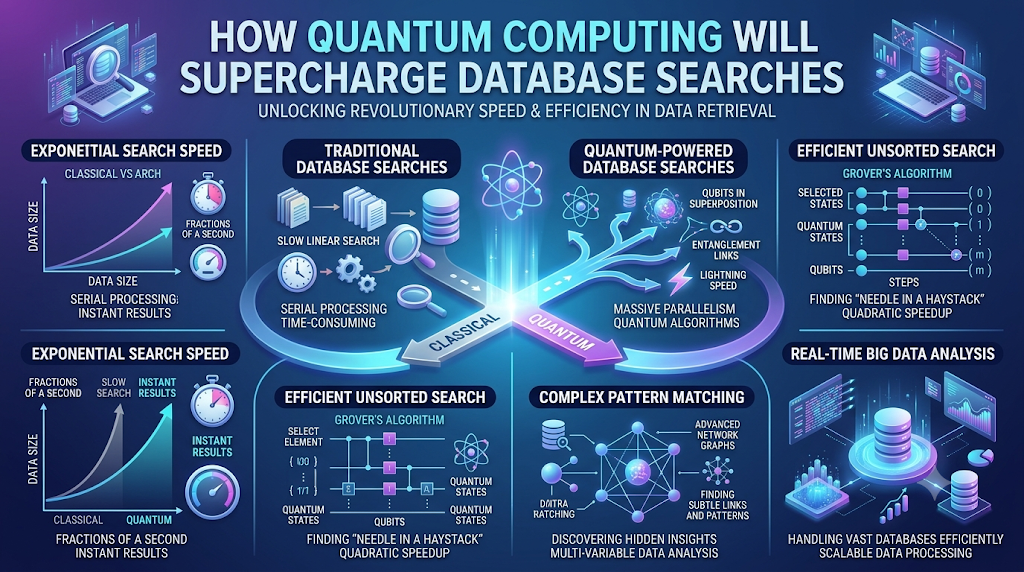
To solve this massive speed problem, a scientist named Lov Grover created a special mathematical recipe called Grover’s Algorithm. Instead of checking items one by one, this method allows a quantum computer to search an entire unsorted database in a fraction of the time.
Looking at Everything at Once
Traditional computers use bits, which are either a 0 or a 1. Quantum computers use “qubits.” Because of the strange rules of quantum physics, a qubit can exist as a 0, a 1, or both at the exact same time. This concept is called superposition. Because qubits can be in multiple states at once, a quantum computer does not have to look at files one by one. It can essentially look at all the different possibilities in the database at the exact same time.
Turning Up the Volume on the Right Answer
Looking at everything at once is great, but you still need to pull the correct answer out of the pile. This is where Grover’s Algorithm does something amazing called probability amplification. Imagine you are listening to a radio, but there is a lot of static and you cannot hear the song clearly. Grover’s Algorithm acts like a volume knob for the data. It slowly turns down the volume on all the wrong answers (the static) and turns up the volume on the one correct answer (the song). By the end of the process, the right answer is so loud that it instantly stands out from the rest of the database.
Why It Is So Fast
Because the computer is checking all items simultaneously and amplifying the right answer, the speed difference is incredible. If you have a normal database with one million items, a regular computer might have to check all one million items to find what it needs. A quantum computer using Grover’s Algorithm only needs to run about one thousand checks to find the same item. It turns a massive, impossible search into a fast, manageable task.
Comparing Classical Searches vs. Quantum Searches
| Feature | Classical Computer Search | Quantum Computer Search |
|---|---|---|
| Search Method | One-by-one (Linear) | Simultaneous (All at once) |
| Time Taken for 1 Million Records | Up to 1,000,000 steps | Only about 1,000 steps |
| Best Use Case | Small, organized, sorted lists | Massive, complex, unsorted databases |
As you can see in the table above, the difference in how these two systems operate is massive. A classical computer is fundamentally limited by its need to process information in a straight line. If you double the amount of data, you double the amount of time it takes to search it. This linear relationship is exactly why our current technology struggles with modern, big data problems.
On the other hand, the quantum approach bypasses the line completely. Instead of waiting for its turn to check file number 500,000, it evaluates the entire landscape of data simultaneously. The time it takes to search does not double just because the data doubles.
This means that as databases get larger and more complex over the coming decades, quantum computers will become increasingly valuable. A task that might take a classical computer hundreds of years to finish could theoretically be solved by a quantum computer while you are drinking a single cup of coffee.
Real-World Impact: What Will We Search Faster?
The ability to search massive databases this quickly will completely change how many industries operate. One of the biggest impacts will be in the medical field. When scientists want to discover a new drug to cure a disease, they have to test billions of different chemical combinations to see which one works. Right now, this takes years of computer simulations. With quantum searching, computers could find the perfect chemical match almost instantly, bringing life-saving medicines to the public much faster.
Cybersecurity will also see a massive shift. Hackers often hide malicious code deep inside millions of lines of normal software. Finding these hidden threats is like finding a needle in a haystack, and current security programs often find them too late. A quantum system could scan massive networks and identify strange, hidden patterns in real-time, shutting down cyber attacks before they can even start doing damage.
Finally, consider the world of global logistics and supply chains. Thousands of massive cargo ships, millions of delivery trucks, and billions of packages are moving around the world every single day. Trying to find the absolute best, most efficient route for all these moving parts is an enormous mathematical headache for traditional computers. A quantum database could instantly search all possible routes, weather conditions, and traffic delays to find the perfect shipping path, saving billions of dollars and reducing pollution.
When Will Quantum Databases Become a Reality?
While the idea of super-fast searches sounds amazing, you will not be buying a quantum computer for your home office anytime soon. Right now, these machines are massive, complex, and highly experimental. We are still in the early days of this technology, much like the giant, room-sized computers of the 1950s. Most experts agree that widespread use of quantum databases is still quite a few years away from becoming an everyday reality.
One of the biggest hurdles scientists face today is hardware stability. Qubits are incredibly fragile. If they get even slightly too warm, or if there is a tiny magnetic interference in the room, they lose their information and the calculation fails. To keep them stable, these processors have to be kept inside massive refrigerators that cool them down to temperatures colder than deep space.
Scientists are currently working hard to create better error-correction methods. They are trying to build machines that can fix their own mistakes on the fly without losing the data. Once we can build stable, reliable quantum processors that do not require such extreme conditions, the era of quantum database searching will officially begin, transforming how we interact with the digital world forever.
Conclusion
The way we handle information is on the brink of a massive shift. We have spent the last few decades building faster classical computers, but even our best machines are struggling to search through the mountains of unsorted data we create daily. Checking items one by one is simply no longer a workable solution for the future.
By looking at all the data at once and using probability to make the right answer stand out, this new technology skips the line entirely. It turns impossible searches into minor tasks. From discovering new medicines to securing our digital lives and optimizing global travel, the benefits of this immense speed will touch almost every part of our lives.
Though we still have hardware challenges to overcome, the science behind it is proven and real. As researchers continue to build more stable and reliable machines, the day when we can search billions of records in the blink of an eye is drawing closer. We are moving toward a future where no piece of data is ever truly lost or too hard to find.
FAQs
1. What exactly is a quantum computer?
A quantum computer is a powerful new type of machine that uses the principles of quantum physics to process information. Instead of using standard binary bits like a normal computer, it uses qubits, allowing it to solve incredibly complex problems much faster.
2. How is a qubit different from a regular bit?
A regular bit can only be a 0 or a 1, like a light switch that is either off or on. A qubit can be a 0, a 1, or both at the exact same time, allowing the computer to handle multiple possibilities simultaneously.
3. What does “unsorted database” mean?
An unsorted database is a collection of information that has no specific order or organization. Because it is not alphabetized or grouped logically, finding a specific item usually requires checking every single entry one by one.
4. What is Grover’s Algorithm?
Grover’s Algorithm is a special mathematical instruction for quantum computers. It allows the computer to search through an unsorted database incredibly fast by checking all items at once instead of one at a time.
5. Why do normal computers struggle with large databases?
Normal computers can only process one piece of information at a time. If a database has a billion files, the computer has to look at them one by one, which simply takes too much time.
6. Will a quantum computer replace my home laptop?
No, they are not meant to replace home computers. They are designed for massive, complex calculations that normal computers cannot handle, while your laptop will still be best for everyday tasks like browsing the internet or typing documents.
7. What is probability amplification?
It is the method Grover’s Algorithm uses to find the right answer. It slowly decreases the likelihood of picking the wrong answers and increases the likelihood of picking the right one, making the correct answer stand out clearly.
8. How will this technology help the medical field?
It will allow scientists to instantly search through billions of chemical combinations to find the exact molecules needed to create new, life-saving drugs, turning a process that takes years into one that takes seconds.
9. Are quantum computers being used to search databases right now?
Not on a large commercial scale. The hardware is currently in the experimental phase and is mainly used by researchers and large tech companies in specialized laboratories.
10. Why is the hardware so difficult to build?
The qubits inside the processor are extremely delicate. Any slight change in temperature or minor outside interference can destroy the data, so the machines must be kept incredibly isolated and colder than deep space.
